


Beyond Visual Line of Sight (BVLOS) Drone Market Definition and Overview
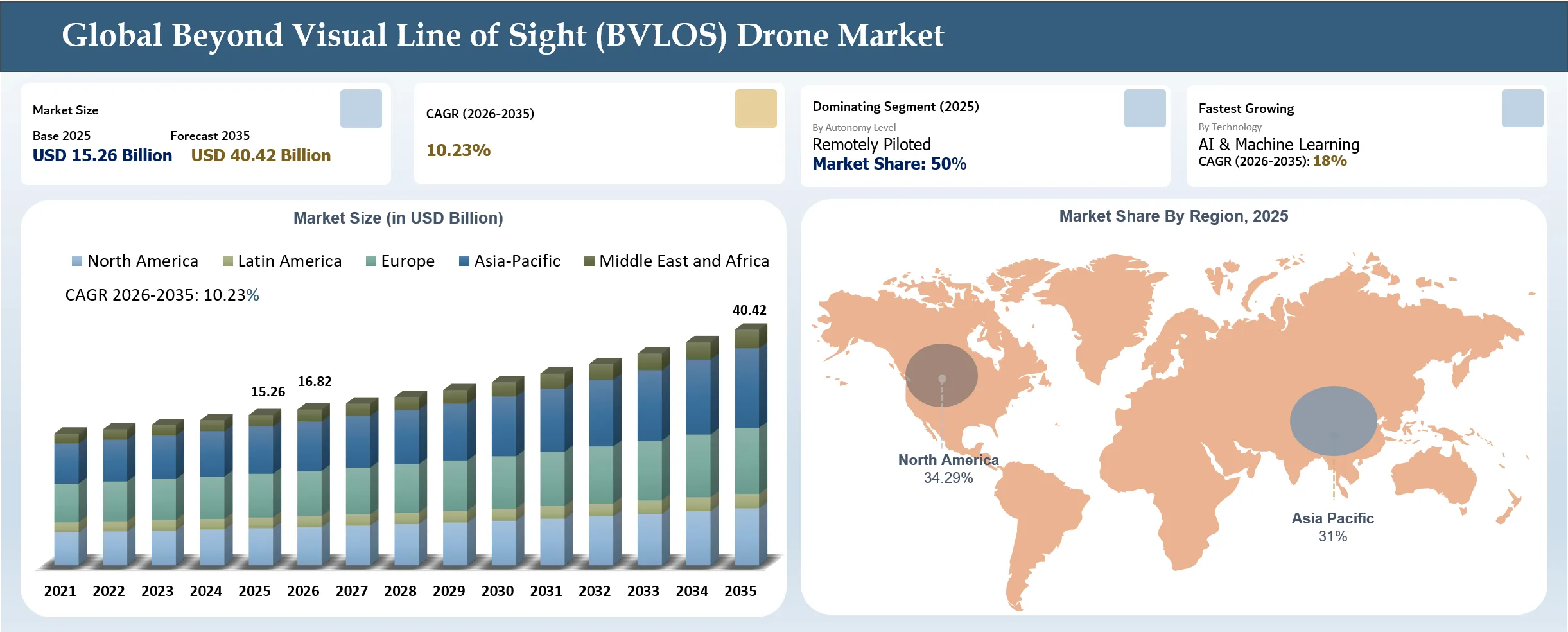
The global beyond visual line of sight (BVLOS) drone market reached USD 15.26 billion in 2025 and is expected to reach USD 40.42 billion by 2035, growing with a CAGR of 10.23% during the forecast period 2026-2035. The market development is being supported by the transition toward routine and scalable BVLOS operations. In May 2025, the FAA's Drone Integration Concept of Operations highlights several scalable BVLOS operations such as package delivery, agriculture, aerial surveying, civic operations, and other commercial ventures; also, the FAA recorded more than 860,000 drone registrations as of August 2024, which reflects the expansion of the UAS operations base. The advancement in the commercial use of drones has been marked by Zipline achieving a milestone of 2 million commercial drone deliveries by March 2026, but also by their autonomous aircraft flying at least 300 feet in altitude and taking 90 seconds to deliver the goods. In the area of healthcare logistics, the USDOT MHA Nation Drone Project completed BVLOS medication delivery between two remote communities, built the framework for a scalable drone network, conducted stakeholder surveys and six listening sessions, and offered drone education to more than 200 youth via their Drones in the Schools program. These events suggest growing commercialization of BVLOS drones for deliveries, healthcare services, agriculture, surveying, infrastructure, and public service applications through the development of autonomous flight, airspace integration, and supporting infrastructure systems.
The growing regulatory backing for BVLOS drone flights is boosting the demand for connectivity solutions required for commercial and public safety drone missions. In May 2026, as per Small Caps, Elsight secured a USD 2 million follow-on order from its U.S. public safety client, which is more than 4× the original order booked in January 2026. The booking has been driven by further advancements in US regulation related to the Beyond Visual Line of Sight (BVLOS) operation, and a final rule by the FAA is anticipated in 2026. Elsight had recorded 2025 revenue of USD 22.8 million (1,024% YoY growth), net profit of USD 7.48 million, and backlog of USD 22 million, highlighting growing demand for its Halo connectivity platform for commercial drone and BVLOS applications.
White-Space Opportunities for BVLOS Drone Regulatory, Connectivity and Airspace Management Solutions
In May 2026, the UK government announced USD 63.0 million (£46.5 million) to accelerate the development and deployment of drones and advanced air mobility, creating opportunities across BVLOS-enabling regulation, digital flight approvals, drone identification, airspace management, safety, and long-range commercial drone operations. The largest investment area is USD 35.88 million (£26.5 million) for smarter drone regulation and reducing red tape, including faster approvals for emergency response, medical logistics, and infrastructure inspection and a streamlined digital application process for drone operators. A further nearly USD 27.75 million (£20.5 million) is being invested in a bespoke Hybrid Remote ID system that transmits a drone’s identification and location during flight and enables authorized users to access flight information remotely. These investments create opportunities for BVLOS regulatory-compliance platforms, automated approval systems, remote identification, drone tracking, connectivity, airspace-management technologies, and safety systems, particularly as the UK aims to enable more routine drone deliveries, long-range inspections, and hospital logistics. The government also highlighted USD 3.11 billion (£2.3 billion) for green aircraft development and USD 85.29 million (£63 million) for sustainable aviation fuel, creating additional opportunities across advanced aviation and eVTOL technologies.
The funding is expected to create commercial opportunities for companies involved in BVLOS operations, drone regulation, autonomous aviation, identification, and advanced air mobility. Windracers is positioned to benefit from regulatory development supporting autonomous and long-range drone operations, particularly in medical logistics, critical infrastructure, and remote cargo delivery, while Altitude Angel can benefit through its U-space, airspace management, and digital flight-authorisation platforms that support safe integration of BVLOS drones into controlled airspace. Elsight can benefit in BVLOS connectivity and communications, with its Halo platform providing reliable multi-network connectivity for long-range drone operations, while Dronecloud can benefit in drone fleet management, operational compliance, and digital flight planning. In advanced air mobility, Vertical Aerospace can benefit from the development of the UK’s electric flying-taxi ecosystem, while Skyports is positioned across drone delivery, vertiport infrastructure, and advanced air mobility operations. NATS can benefit through airspace management, UAS traffic integration, and safe coordination of increasingly complex drone operations, while Thales can benefit from airspace surveillance, identification, communications, and drone traffic-management technologies. These companies collectively highlight white-space opportunities across BVLOS connectivity, digital flight approvals, UAS traffic management, Remote ID, autonomous operations, safety systems, drone logistics, and advanced air-mobility infrastructure.
Beyond Visual Line of Sight (BVLOS) Drone Market Strategic Takeaways
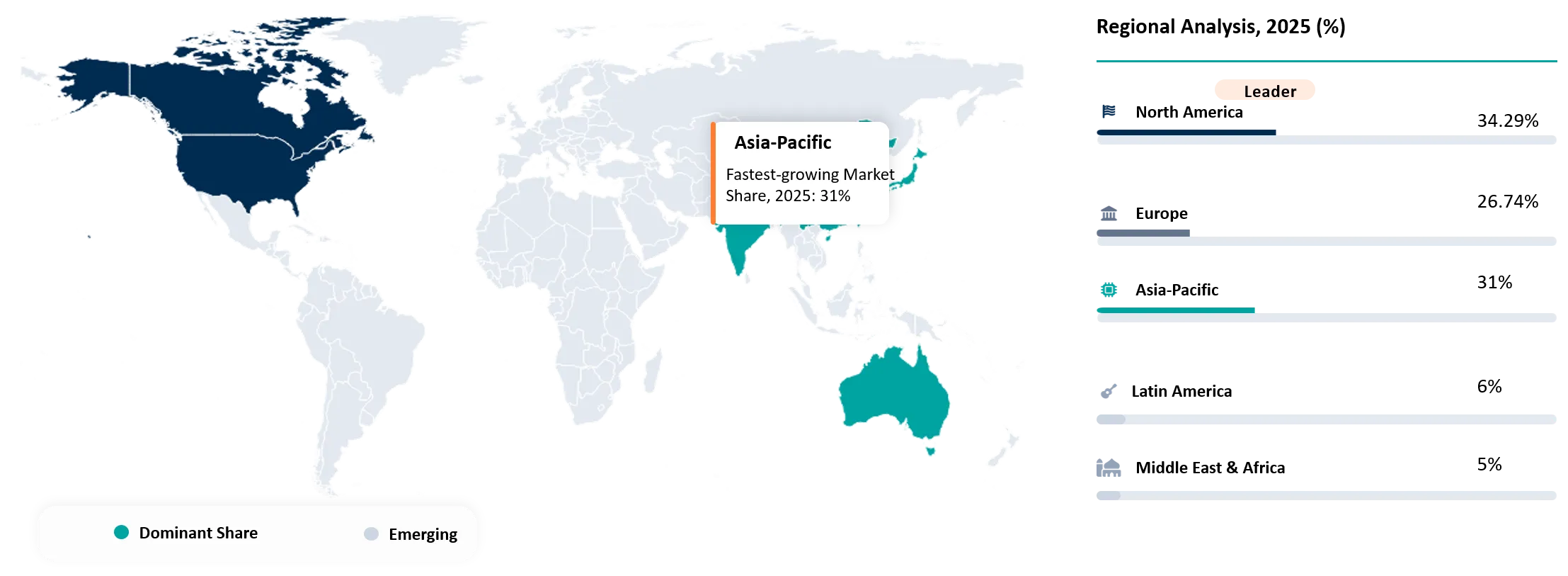
- North America dominated the global market landscape with a 34.29% market share in 2025. The Asia-Pacific region followed as a key growth engine, securing a 31% global market share in 2025.
- Remotely piloted drones led the market by autonomy level, capturing a 50% market share in 2025. Demand in this segment is supported by regulatory frameworks, with the FAA recording 481,760 certified remote pilots in 2026.
- Zipline surpassed 2 million commercial drone deliveries by March 2026, executing deliveries in 90-second operational windows. The company raised over USD 600 million in funding to expand operations, reaching a valuation of USD 7.6 billion.
- The UK government announced USD 63.0 million (£46.5 million) in funding to accelerate drone and advanced air mobility deployment. The investment includes USD 35.88 million for regulatory streamlining and USD 27.75 million for a Hybrid Remote ID system.
Beyond Visual Line of Sight (BVLOS) Drone Market Industry Trends and Strategic Insight
- Transition from experimental BVLOS flights to repeatable commercial operations is reshaping the industry, with operators increasingly moving toward standardized, risk-based operating models rather than isolated demonstrations and individual exemptions.
- Regulatory frameworks are becoming a core competitive differentiator, making regulatory readiness, operational safety cases, certification capability, and authorization expertise increasingly important alongside drone hardware.
- Autonomous flight is moving toward operational autonomy rather than simple waypoint navigation, combining onboard sensing, navigation, decision-making, and mission management to reduce continuous dependence on remote pilots.
- Manufacturers should compete on complete BVLOS capability rather than airframe performance alone, integrating autonomy, DAA, C2, navigation resilience, UTM connectivity, and fleet-management capabilities into a unified platform.
- Technology providers should focus investment on DAA, autonomous decision-making, resilient C2, sensor fusion, and UTM interoperability, as these technologies address the primary barriers to routine BVLOS scaling.
Beyond Visual Line of Sight (BVLOS) Drone Market Scope
| Metrics | Details | |
| 2025 Market Size | USD 15.26 Billion | |
| 2035 Projected Market Size | USD 40.42 Billion | |
| CAGR (2026-2035) | 10.23% | |
| Largest Market | North America | |
| Fastest Growing Market | Asia-Pacific | |
| By Platform Type | Fixed-Wing UAVs, Multirotor / Rotary-Wing UAVs, Hybrid VTOL UAVs, Others | |
| By Autonomy Level | Remotely Piloted, Semi-Autonomous, Fully Autonomous | |
| By Maximum Take-Off Weight (MTOW) | Less than 25 kg, 25–150 kg, above 150 kg | |
| By Technology | Autonomous Navigation, Detect-and-Avoid (DAA), Artificial Intelligence (AI) & Machine Learning (ML), Command-and-Control (C2), Communication & Connectivity Technology, GPS/GNSS & Alternative Positioning Technology, Computer Vision & Sensor Fusion, Obstacle Detection & Avoidance, Unmanned Traffic Management (UTM), Others | |
| By Application | Infrastructure Inspection & Utilities, Mapping & Surveying, Precision Agriculture, Cargo Transportation, Parcel & Medical Delivery, Defense & ISR, Public Safety & Emergency Response, Environmental Monitoring, Others | |
| By End User | Commercial Enterprises, Civil Government & Public Safety Agencies, Defense & Military Users | |
| By Region | North America | U.S., Canada, Mexico |
| Europe | Germany, UK, France, Spain, Italy, Poland | |
| Asia-Pacific | China, India, Japan, Australia, South Korea, Indonesia, Malaysia | |
| Latin America | Brazil, Argentina | |
| Middle East and Africa | UAE, Saudi Arabia, South Africa, Israel, Türkiye | |
| Report Insights Covered | Competitive Landscape Analysis, Company Profile Analysis, Market Size, Share, Growth | |
Beyond Visual Line of Sight (BVLOS) Drone Market Disruption Analysis
Shift Toward Standardized BVLOS Authorization Reshaping Commercial Drone Operations
The disruption in the beyond visual line of sight (BVLOS) drone market is primarily associated with the shift from case-by-case waivers toward standardized authorization frameworks, which is changing how commercial BVLOS operations are approved and scaled. In August 2025, the Federal Aviation Administration (FAA) published its BVLOS rule proposal that included the operational requirements, aircraft manufacture, separation from other aircraft, operational authorization, security, reporting, and record keeping. In the concept of operations document released by the FAA in May 2025, routine scalable BVLOS operations were stated as one of the key regulatory goals.
Regulatory evolution has also affected the commercial operating paradigm through increased emphasis on airworthiness, operational requirements, automation of data services, C2 communications, UTM, and safety management functions for scalable BVLOS operations. According to the FAA, before the development of 2025 CONOPS, all BVLOS flights were approved on a case-by-case basis, while 2025 CONOPS will provide a framework for scalable operations. On a commercial scale, Zipline indicated that by March 2026, over 2 million commercial drone deliveries will have been made, reflecting the trend towards network operations of drones instead of isolated flights. It should be noted that the delivery process at Zipline takes 90 seconds, and a recent software update has decreased the noise level of the aircraft by 30%, illustrating how operational and aircraft-level technologies are being refined alongside BVLOS commercialization.
Beyond Visual Line of Sight (BVLOS) Drone Market BCG Matrix: Company Evaluation

Stars include Wing Aviation, Zipline, AeroVironment, and General Atomics Aeronautical Systems because they have strong positions in high-growth BVLOS applications spanning autonomous delivery, long-endurance UAVs, defense ISR, and scalable commercial drone operations. Wing Aviation and Zipline have established strong positions in autonomous BVLOS delivery, while AeroVironment and General Atomics benefit from established defense UAV portfolios and growing demand for persistent, long-range unmanned operations. Question Marks include Baykar, Airbus, Leonardo, Lockheed Martin, Quantum Systems, and Matternet, as these companies possess significant technological, defense, aerospace, or specialized delivery capabilities but face varying levels of competition and regulatory complexity in expanding their BVLOS-specific commercial positions.
Potential includes Delair and Skydio, which have established capabilities in autonomous UAVs, inspection, surveying, mapping, and defense-related applications but have comparatively narrower positions in large-scale BVLOS operations. Delair benefits from long-endurance fixed-wing UAV expertise suited to extended-range missions, while Skydio has a strong position in autonomous navigation and AI-powered drone operations. Tailenders comprise Amazon Prime Air, primarily because its BVLOS delivery ambitions have faced regulatory, operational, and commercialization challenges relative to established autonomous delivery operators.
Beyond Visual Line of Sight (BVLOS) Drone Market Dynamics
Driver Impact Analysis
| Driver | Market Growth Impact (%) | Demand Concentration | Impacted Use Case | Strategic Impact |
Regulatory normalization of BVLOS operations is enabling routine and scalable drone deployments by creating clearer pathways for commercial flights beyond visual range. | 20% | North America, Europe, Asia-Pacific
| Commercial delivery, agriculture, aerial surveying, public safety
| Accelerates commercialization by reducing dependence on case-by-case approvals and increases demand for regulation-ready aircraft, DAA, C2, UTM, and operational-management systems. |
Growing demand for long-range infrastructure inspection is driving BVLOS adoption for monitoring power lines, pipelines, railways, telecom assets, and other geographically dispersed infrastructure. | 18% | North America, Europe, Asia-Pacific | Power-grid inspection, pipeline monitoring, railway inspection, telecom infrastructure | Shifts inspection programs from manually piloted, localized flights toward persistent wide-area monitoring, increasing demand for long-endurance platforms, autonomous navigation, high-resolution payloads, and remote fleet management. |
Expansion of drone-based delivery and logistics is increasing demand for BVLOS drones. | 22% | North America, Europe, Asia-Pacific
| Parcel delivery, medical delivery, retail logistics, last-mile delivery | Creates the strongest requirement for repeatable BVLOS networks because delivery economics depend on autonomous operation over routes that cannot be continuously monitored visually; this increases demand for DAA, reliable C2, autonomous navigation, UTM, and automated fleet operations. |
Rising need for wide-area surveillance and public safety is accelerating BVLOS deployment. | 15% | North America, Europe, Middle East & Asia-Pacific
| Border surveillance, disaster response, firefighting, emergency response, search and rescue | Expands demand for long-endurance UAVs capable of persistent monitoring across large or difficult-to-access areas, strengthening requirements for secure communications, autonomous flight, thermal/EO sensors, and real-time situational awareness. |
Advancements in detect-and-avoid (DAA) systems are improving the ability of drones to safely operate beyond the pilot’s visual range and supporting wider commercial deployment. | 17% | North America, Europe, Asia-Pacific | Autonomous delivery, infrastructure inspection, surveillance, one-to-many operations | Makes BVLOS operations technically and economically more scalable by reducing reliance on visual observers and enabling safer integration with other airspace users; continued DAA development is therefore critical for expanding autonomous and one-to-many operations. |
Expansion of drone-based delivery and logistics is increasing demand for BVLOS drones
Autonomous delivery and logistics by drones have seen a surge in adoption; this has driven the demand for BVLOS drones as retailers, healthcare organizations, and logistics firms shift their focus from small-scale pilots to large-scale delivery networks. For healthcare logistics, the MHA Nation Drone Project by the U.S. Department of Transportation is exploring various routes for sustainable BVLOS delivery projects, which could either be through certification in 14 CFR Parts 91 and 135 or collaboration with commercial companies.
The increasing use of commercial drone deliveries is bringing practical BVLOS operational data into the real world, helping to develop regulatory systems and advance the use of long-distance autonomous drones. In June 2026, according to DroneWatch, the UK civil aviation authority (CAA) had amassed over 1,600 BVLOS flights and over 350 hours of flight operations in March 2026, which can be used in developing future BVLOS regulations. This database includes flight operations conducted by companies such as Amazon Prime Air, Wing, and Matternet, among others, with the increasing number of drone delivery operations contributing significantly to the accumulation of real-world data to shape regulatory frameworks and enable broader commercial BVLOS deployment.
Restraint Impact Analysis
| Restraint | Drag on Market Growth (%) | Primary Impact Area | Impacted Use Case | Strategic Impact |
Stringent and fragmented BVLOS regulations increase approval complexity and can delay commercial deployment across different countries. | 12% | Regulatory approvals & market access | Drone delivery, inspection, surveying, public safety | Slows international expansion and increases compliance costs; operators must develop country-specific certification and operational frameworks. |
Limited detect-and-avoid technology scalability restricts reliable BVLOS operations in complex and shared airspace environments. | 15% | Flight safety & onboard technology | Drone delivery, logistics, infrastructure inspection, aerial mobility | Restricts high-density BVLOS deployment and increases the need for advanced DAA, sensor fusion and validation, raising system cost and delaying large-scale commercialization. |
Command-and-control (C2) link reliability limitations can constrain BVLOS flight range and operational reliability when communication connectivity is disrupted. | 11% | Connectivity & operational continuity | Long-range delivery, pipeline/power-line inspection, remote-area surveillance | Limits mission range and operational availability, encouraging investment in redundant communications, satellite connectivity and fail-safe flight systems. |
Insufficient UTM and airspace-integration infrastructure limits the ability to safely coordinate multiple BVLOS drones with other airspace users. | 10% | Airspace management & traffic coordination | Multi-drone delivery networks, logistics corridors, emergency response | Restricts simultaneous high-volume drone operations and increases dependence on dedicated corridors or segregated airspace. |
Limited detect-and-avoid technology scalability restricts reliable BVLOS operations in complex and shared airspace environments
One of the major limitations that restricts the implementation of BVLOS drones is the lack of scalability of effective detect-and-avoid (DAA) systems when using drones in shared airspace. BVLOS drones need to detect both cooperative and non-cooperative aircraft and be able to avoid a potential collision without visual control of a remote pilot. While the number of BVLOS operations grows, the technology has not been proven fully capable of consistently detecting targets under different weather conditions, at different heights, and among different types of aerial objects.
The rapid expansion of the U.S. fleet of drones will create more challenges for the current airspace system and raise the need for incorporating safe BVLOS flights. In April 2026, according to Western Michigan University's FAA statistics cited in the study show that the U.S. had more than 1.87 million recreational drones and more than 957,000 commercial drones. These figures demonstrate the growing UAV fleet that needs to be integrated into the national airspace safely. The thesis focuses on the proposed FAA Part 108 framework for BVLOS operations and the problem of integration of the growing UAV fleet with manned aviation, as well as scaling of existing technology and creation of new systems.
Beyond Visual Line of Sight (BVLOS) Drone Market Segmentation Analysis
The global beyond visual line of sight (BVLOS) drone market is segmented based on platform type, autonomy level, maximum take-off weight (MTOW), technology, application, end user, and region.
Remotely Piloted Drones Driving Dominance in BVLOS Operations
The remotely piloted segment is dominating the autonomy levels of the beyond visual line of sight (BVLOS) drone market, with 50% market share in 2025. The reason behind such domination of this segment is the need for human involvement and decision-making in all the operations conducted by BVLOS drones, especially in sectors like infrastructure inspection, agriculture, energy, surveying, public safety, and drone delivery. Another contributing factor behind the dominance of the remotely piloted segment is the sheer number of remotely piloted systems; the Federal Aviation Administration (FAA) stated that in 2026 there were 481,760 certified remote pilots and 837,513 registered drones in the US, demonstrating the substantial operational base available for remotely controlled UAS deployment.
The increasing regulatory acceptance of BVLOS operations is also strengthening demand for remotely piloted vehicles. In August 2025, the FAA released a BVLOS rule, which was intended to create standardized requirements for regular BVLOS flights, such as authorization for operations, aircraft requirements, separation from other aircraft, security, and accountability clauses. In 2026, the Federal Aviation Administration (FAA) kept promoting the commercial use of drones on the basis of Part 107, which requires remote pilots to obtain Remote Pilot Certificates, while the 2026 aerospace forecast by the FAA included over 493,000 remote-pilot certifications. Thus, the growing popularity of BVLOS flights, along with the existing human-in-the-loop flight system and growing regulatory framework for BVLOS flights, makes remotely piloted drones the most prominent autonomy category in the BVLOS market.
Beyond Visual Line of Sight (BVLOS) Drone Market Geographical Penetration
Accelerating BVLOS Commercialization and Regulatory Development Driving North American Market Leadership
North America dominates the beyond visual line of sight (BVLOS) drone market, with a 34.29% market share in 2025, due to the presence of a well-developed drone industry in the region, high commercial adoption rate, and the development of regulatory frameworks for operations that span farther ranges. The U.S. has been identified as the key driver for regional growth due to its adoption of BVLOS drone usage for applications in infrastructure inspection, agriculture, logistics, public safety, and energy sectors. In June 2025, the U.S. government passed an executive order instructing the FAA to speed up the operations of BVLOS drones for commercial and public safety uses as well as extend the UAS test ranges for BVLOS and autonomous drones.
The rapid scaling of autonomous drone delivery is strengthening the commercial case for BVLOS operations across North America. In January 2026, according to Zipline, a U.S.-based robotics and autonomous logistics company, the company surpassed 2 million commercial deliveries and raised more than USD 600 million in January 2026 to accelerate its next phase of growth. The funding round valued Zipline at USD 7.6 billion, while the company announced expansion of its autonomous drone-delivery operations into Houston and Phoenix, followed by additional U.S. metropolitan markets. The expansion demonstrates growing commercial adoption of autonomous drone logistics and strengthens demand for BVLOS operations, drone fleet management, airspace integration, connectivity, and delivery infrastructure across North America.
U.S. Beyond Visual Line of Sight (BVLOS) Drone Market Trends
The U.S. holds a dominant position in the North America beyond visual line of sight (BVLOS) drone market, due to the existence of its established commercial drone ecosystem, high number of licensed remote pilots, and regulatory developments for enabling BVLOS flights. The U.S. has seen favorable acceptance of drones for infrastructure inspections, agricultural use, energy management, public safety, surveying, and deliveries, while the FAA continues to develop the necessary infrastructure for widespread BVLOS flights.
The development of regional drone operations hubs is strengthening the infrastructure required to scale safe and coordinated BVLOS operations in the U.S. In October 2025, ANRA Technologies, a U.S.-based airspace and mission-management technology company, launched a public-private partnership in Michigan’s Eastern Upper Peninsula to establish a regional drone Operations Center in Chippewa County. The project integrates ANRA’s FAA-authorized airspace-management platform with Censys Technologies, a U.S.-based aerospace company specializing in long-range fixed-wing VTOL drones for BVLOS operations, while Michigan Tech Research Institute (MTRI), a U.S.-based aviation and research organization, leads data analytics and performance evaluation. The initiative began with alignment, tabletop exercises, and simulations in July 2025, with live flights and real-world missions scheduled for 2026 and final results expected by Q3 2026.
Canada Beyond Visual Line of Sight (BVLOS) Drone Market Outlook
Canada is emerging as a major country in the North America beyond visual line of sight (BVLOS) drone market, due to its progressive regulatory system that is progressive, as well as the development of the commercial drone market in the country with a focus on facilitating lower-risk BVLOS flights. In March 2025, the Government of Canada adopted new BVLOS regulations, which would allow replacing the existing case-by-case Special Flight Operations Certificate requirements with the facilitation of innovative lower-risk BVLOS operations that would help drive the development of the drone sector in the country. These BVLOS regulations were put in force on November 4, 2025.
Growing adoption of Drone-as-a-Service models across infrastructure-intensive industries is expanding the commercial use of drones for surveying, inspection, and monitoring. In June 2026, ZenaTech Inc., a Canada-based AI drone, Drone-as-a-Service (DaaS), enterprise SaaS, and quantum-computing technology company, signed an offer to acquire an established Western Canadian geospatial and land-surveying company to expand its DaaS business across utilities, infrastructure, forestry, mining, agriculture, and government. The acquisition forms part of ZenaTech’s North American expansion strategy and follows its 20th DaaS acquisition completed in January 2026. ZenaTech’s DaaS segment accounted for 82% of Q3 2025 revenue, generating USD 3.57 million of the company’s USD 4.35 million quarterly revenue, highlighting the growing contribution of drone-based services.
Rapid Regulatory Development and Commercial Drone Deployment Driving Asia-Pacific Growth
Asia-Pacific Region emerges as a key player in the beyond visual line of sight (BVLOS) drone market, with a 31% share of the market in 2025, due to the rising usage of commercial drones, modernization of airspace through government initiatives, and increasing use of BVLOS technology in various sectors like logistics, infrastructure inspection, farming, mining, and public safety. Nations such as China, Japan, India, Australia, and Singapore have started developing regulatory and testing platforms for BVLOS operations.
The expansion of BVLOS drone applications in maritime logistics is creating new opportunities for faster, safer, and more efficient ship-to-shore deliveries. In July 2025, Skyports Drone Services, a UK-based drone delivery and aerial logistics company, and TFG Marine, a Singapore-based marine fuel supply and bunkering company, completed Singapore’s first drone operations involving bunker tanker vessels, transporting bunker fuel samples between vessels and shore facilities beyond visual line of sight (BVLOS). The operation demonstrates the use of BVLOS drones for maritime logistics and ship-to-shore delivery, providing a practical application for time-sensitive transport in Singapore’s port environment.
Japan Beyond Visual Line of Sight (BVLOS) Drone Market Trends
Japan is a leading country in the Asia-Pacific beyond visual line of sight (BVLOS) drone market, since it has already established regulations for Level 4 flights, increasing usage of drones for logistics and infrastructure purposes, and attempts made by the government to make unmanned aircraft a part of the community. Japan’s regulation of Level 4 allows BVLOS flights in populated areas without any ground access control measures, if all the conditions for obtaining Class 1 UAS certification, Class 1 remote pilot license, and flight approval are fulfilled.
The expansion of long-range drone logistics in Japan is accelerating the adoption of BVLOS operations for remote and hard-to-reach locations. In March 2025, Aerodyne Japan, the Japanese subsidiary of Malaysia-based Aerodyne Group, a global drone services and AI-driven data technology company, partnered with Phoenix-Wings GmbH, a Germany-headquartered VTOL logistics-drone manufacturer, to conduct a 48-km inter-island Level 3 BVLOS logistics demonstration in Sasebo, Nagasaki. The PW.ORCA used in the demonstration has a maximum payload of 15 kg and a flight range of 100 km, while Aerodyne imported its first PW.ORCA into Japan in January 2025 and obtained the required flight permits. The companies are targeting applications including last-mile delivery to remote islands and mountainous areas, disaster-response transport, and rapid delivery of high-value goods, supported by Aerodyne’s route optimization, real-time data analytics, predictive maintenance, drone operation management, and aerial LTE communication capabilities.
Beyond Visual Line of Sight (BVLOS) Drone Market Competitive Landscape
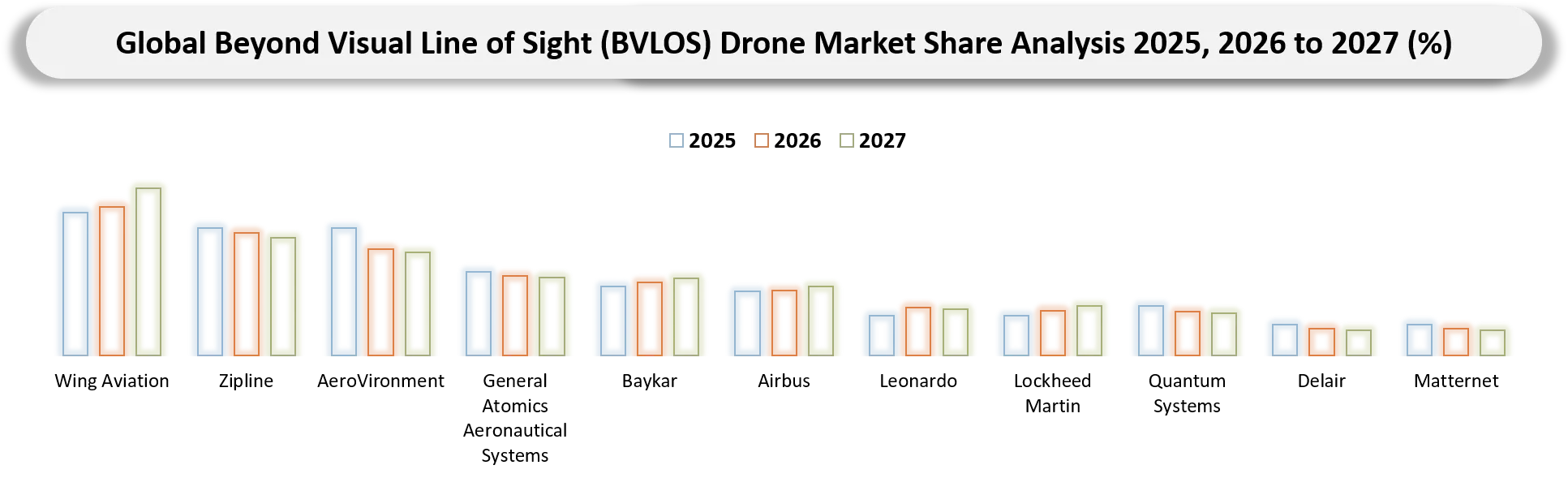
- The market is characterized by three key participant groups: commercial drone-delivery providers, defense and long-endurance UAV manufacturers, and autonomous enterprise-drone specialists. Wing Aviation, Zipline, Matternet, and Amazon Prime Air focus on commercial BVLOS delivery and autonomous logistics; AeroVironment, General Atomics Aeronautical Systems, Baykar, Airbus, Leonardo, and Lockheed Martin concentrate on defense, surveillance, long-endurance, and mission-critical unmanned aircraft; while Quantum Systems, Delair, and Skydio focus on autonomous flight, AI-enabled aerial intelligence, surveying, inspection, and enterprise applications. The competitive landscape is increasingly shaped by BVLOS regulatory approvals, autonomous navigation, detect-and-avoid technologies, flight range, payload capabilities, and the ability to scale operations. In 2025, the FAA proposed performance-based BVLOS regulations intended to establish a predictable pathway for routine and scalable operations including package delivery, agriculture, aerial surveying, and other commercial applications, supporting broader competition among these participant groups.
- Key players include Wing Aviation, Zipline, AeroVironment, General Atomics Aeronautical Systems, Baykar, Airbus, Leonardo, Lockheed Martin, Quantum Systems, Delair, Matternet, Skydio, and Amazon Prime Air.
Key Developments
- December 2025: High Lander, an Israel-based UAS traffic management (UTM) and drone fleet management (DFM) software company, partnered with Starling Inc., a U.S.-based aerospace and unmanned aerial systems company, to integrate Starling’s Pathfinder-X long-range eVTOL drone and Starling Hub with High Lander’s Orion DFM and Vega UTM platforms for FAA-compliant BVLOS operations.
- September 2025: Terra Drone Corporation, a Japan-based drone and Advanced Air Mobility (AAM) technology company, acquired the remaining shares of Aloft Technologies, Inc., a U.S.-based UAS Traffic Management (UTM) and drone fleet-management technology company, making it a wholly owned subsidiary.
- June 2025: Nordic Unmanned Holding, a Norway-based drone and unmanned-systems company, completed the strategic sale of AirRobot GmbH & Co. KG, a Germany-based unmanned aerial systems (UAS) manufacturer, to Quantum Systems GmbH, a Germany-headquartered AI-powered drone and aerial-intelligence technology company.
- August 2026: uAvionix, a U.S.-based aviation communications, navigation, surveillance, and airspace-integration technology company, partnered with Airwise Solutions, a U.S.-based UAS Traffic Management (UTM) and drone operations software company, to integrate uAvionix’s FlightLine ADS-B surveillance data with Airwise’s platform and Nexus common operating picture.
- July 2025: MySky ECO, a U.S.-based efficient aviation and UAV technology company, and Airwayz, an Israel-based AI-powered UAS Traffic Management (UTM) technology company, launched a joint venture to develop a next-generation long-range autonomous UAV system for BVLOS operations in regulated U.S. airspace.
- February 2026: Avy, a Netherlands-based developer and manufacturer of long-range autonomous drones, partnered with Droniq GmbH, a Germany-based UAS Traffic Management (UTM), drone solutions, and Drones-as-a-Service company, to expand safe long-range BVLOS operations across Germany.
Key Procurement Priorities and Buyer Evaluation Criteria
- Organizations investing in the Beyond Visual Line of Sight (BVLOS) Drone Market are increasingly selecting suppliers based on their ability to provide reliable, long-range drone platforms with secure command-and-control systems, high endurance, and scalable BVLOS operational capabilities across applications such as infrastructure inspection, agriculture, energy, surveying, logistics, and public safety.
- The procurement decision-making process is increasingly influenced by the growing adoption of automated and remotely piloted BVLOS operations, AI-enabled navigation, detect-and-avoid technologies, real-time data transmission, and evolving aviation regulations. Buyers are prioritizing drone platforms that can support extended-range missions while maintaining safe and reliable operations beyond the pilot's visual line of sight.
- Buyers consider factors such as flight endurance, operational range, payload capacity, navigation accuracy, communication-link reliability, detect-and-avoid capabilities, weather resistance, cybersecurity, and system redundancy when evaluating BVLOS drone suppliers. Compliance with applicable aviation regulations and the availability of required certifications, approvals, and operational support are also important procurement considerations.
Why Choose DataM?
- Technological Innovations: Explores advancements in BVLOS drone technologies, including autonomous navigation, detect-and-avoid systems, AI-enabled flight control, secure command-and-control links, real-time data transmission, and automated mission planning, enabling safer and more reliable long-range drone operations across commercial, industrial, and public-sector applications.
- Product Performance & Market Positioning: Evaluates how different players differentiate their BVLOS drone platforms based on flight endurance, operational range, payload capacity, navigation accuracy, communication reliability, autonomy level, environmental resilience, and total cost of ownership, highlighting competitive positioning across delivery, infrastructure, agriculture, energy, surveying, defense, and public safety applications.
- Real-World Evidence: Highlights commercial and operational deployment of BVLOS drones in package delivery, medical logistics, infrastructure inspection, precision agriculture, energy monitoring, mapping, disaster response, and surveillance, demonstrating benefits such as expanded coverage, reduced inspection time, lower operating costs, and improved access to remote or difficult-to-reach locations.
- Market Updates & Industry Changes: Tracks key developments such as BVLOS regulatory reforms, drone-delivery network expansions, new UAS testing facilities, autonomous flight initiatives, certification developments, and government programs across North America, Europe, and Asia-Pacific, supporting the transition from individually authorized BVLOS flights toward scalable commercial operations.
- Competitive Strategies: Analyzes how leading companies expand through autonomous technology development, regulatory approvals, strategic partnerships, commercial delivery deployments, defense contracts, fleet expansion, and integration of AI and detect-and-avoid technologies to strengthen their position in the rapidly developing BVLOS drone ecosystem.
- Pricing & Market Access: Explains variations in BVLOS drone costs based on aircraft configuration, flight endurance, payload capacity, sensors, communication systems, autonomy capabilities, software integration, and regulatory requirements, while assessing market access through drone manufacturers, technology providers, drone-as-a-service operators, logistics companies, and specialized enterprise solution providers.
- Market Entry & Expansion: Identifies growth opportunities driven by the commercialization of BVLOS operations, drone delivery, infrastructure inspection, energy and utility monitoring, agriculture, surveying, public safety, and defense applications, while outlining strategies such as regulatory compliance, technology partnerships, localized manufacturing, fleet deployment, and integration with existing aviation and logistics infrastructure.
Target Audience 2026
- Drone Manufacturers & OEMs
- Drone Delivery & Logistics Companies
- Energy & Utility Companies
- Infrastructure & Transportation Organizations
- Agriculture & Agritech Companies
- Defense & Public-Safety Agencies
- Surveying, Mapping & Geospatial Companies


























































