


BESS Testing Market Size and overview
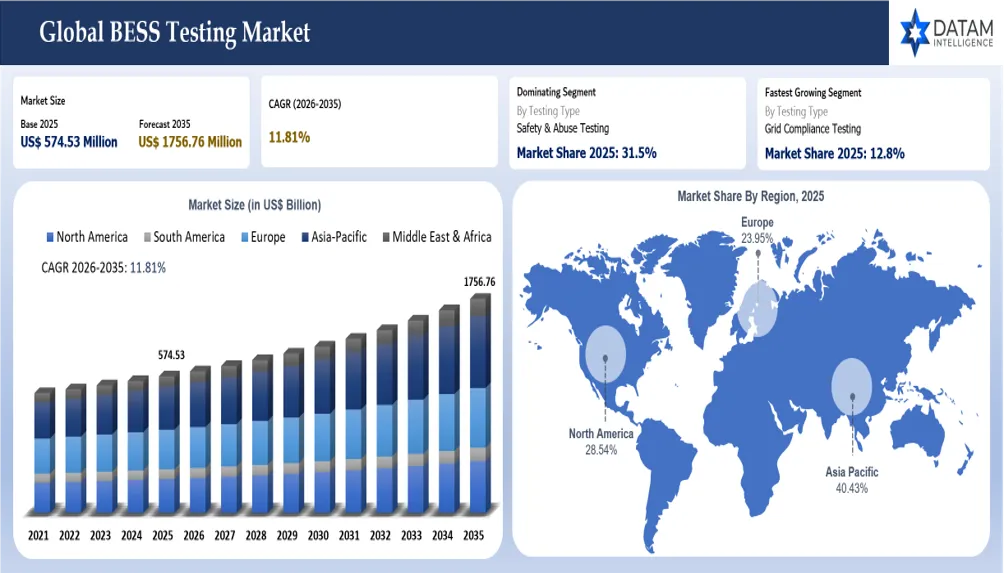
The global BESS testing market reached US$ 574.53 million in 2025 and is expected to reach US$ 1756.76 million by 2035, growing with a CAGR of 11.81% during the forecast period 2026-2035.
The BESS testing market is being fueled due to the fast-growing popularity of utility-scale batteries which require system level testing in terms of performance, grid compliance, commissioning and safety. The International Energy Agency (IEA) estimates that around 108 GW of new battery capacity was installed globally in 2025, which is impressive 40% increase from 2024, noting that about 80% of the new capacity is being deployed on a utility-level. This exponential growth in capacity is driving the demand for special testing of large-sized BESS, power electronics, grid compliance, thermal performance and other operational performance parameters.
The changes in the market are also driven by much stricter fire-testing and thermal-runaway testing requirements. As reported by UL Solutions, the 2026 version of NFPA 855 has placed a greater emphasis on large-scale fire testing. Additionally, the sixth edition of UL 9540A, which was published on March 13, 2026, brought installation-level large-scale testing such as fire propagation, enclosure, heat and gas release, separation distances and fire-protection performance. Such developments will lead to a greater demand for testing and validation, moving from component testing to installation-level fire testing and comprehensive BESS safety evaluatio
BESS Testing Market Key Takeaways
- The Safety & Abuse Testing segment was the most dominant in the global BESS testing market, representing approximately 31.5% market share, owing to the growing need for thermal runaway, fire, overcharge and short circuit testing.
- The Grid Compliance Testing is expected to be the fastest-growing testing category, growing at around 13.6% CAGR, due to increasing integration of BESS with renewable energy and electricity grids.
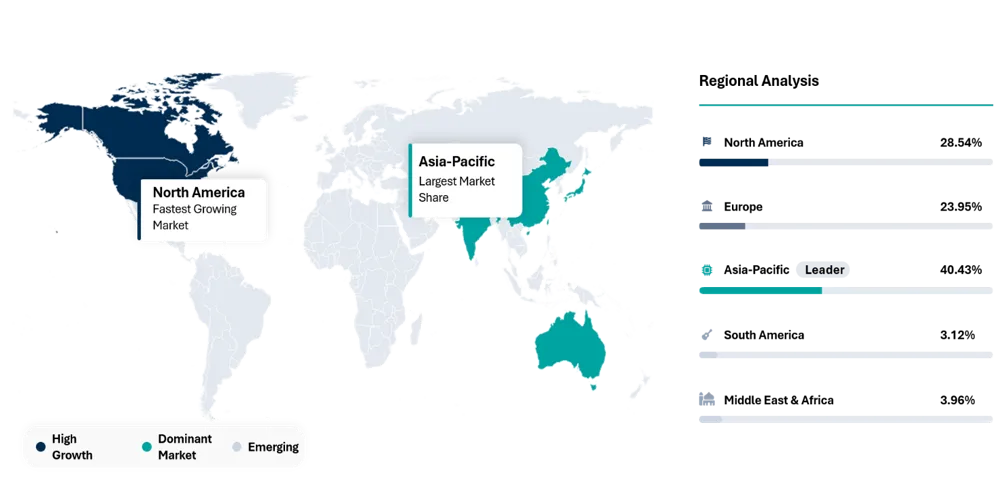
- The Asia Pacific region held the largest market share in the global BESS testing market with 40.43%, owing to high implementation rates of BESS, production of batteries and modernization of grids in countries like China, Japan, South Korea, India and Australia.
- NFPA 855 and UL 9540A sixth editions of 2026 are generating increased demand for installation-scale large-scale fire testing, including fire spread, heat and gaseous emissions, separation distance and fire protection performance.
- Increased BESS operation times are leading to an increased demand for performance, degradation, lifecycle and warranty testing. Average utility-scale BESS operating time reached about three hours in 2025, according to the IEA, compared to around two hours in 2023.
BESS Testing Industry Trends and Strategic Insights
- Shift toward installation-level safety and fire testing: Increased usage of UL 9540A, NFPA 855 and other fire safety standards is resulting in more and more need for thermal runaway, fire propagation, gas evolution and explosion risk testing, especially for utility-scale BESS.
- Expansion of system-level performance validation: Testing is gradually shifting from testing at cell and module level to overall system-level testing of the BESS, including its capacity, efficiency, response, degradation and availability and operational performance.
- Rising demand for grid-compliance testing: The growing use of BESS systems in electric power systems is bringing about higher needs for voltage/frequency response, reactive power, ramp rate, power quality, ride through, synchronization and ancillary services testing.
- Integration of simulation with physical testing: Test centers are employing both field testing and laboratory testing along with computer simulations, thermal modeling, fire/explosion CFD simulations and performance prediction to analyze risks in systems.
- Growing focus on lifecycle and degradation testing: As the contract period for BESS becomes longer, there is increasing use of cycle-life, degradation, state of health, warranty performance, periodic and end-of-life tests to prove the performance of the systems.
BESS Testing Market Scope
| Metrics | Details | |
| 2025 Market Size | US$ 574.53 Million | |
| 2035 Projected Market Size | US$ 1756.76 Million | |
| CAGR (2026-2035) | 11.81% | |
| Largest Market | Asia-Pacific | |
| Fastest Growing Market | Asia-Pacific | |
| By Testing Type | Safety & Abuse Testing, Performance Testing, Electrical Testing, Thermal & Fire Testing, Environmental Testing, Grid Compliance Testing, Electromagnetic Compatibility (EMC) Testing, Functional & Communication Testing, Cybersecurity Testing, Reliability & Durability Testing and Others | |
| By Testing Level | Cell Testing, Module Testing, Battery Pack/Rack Testing, BESS Unit/Container Testing, Complete BESS/System Testing and Installation/Site Testing | |
| By Testing Stage | R&D and Prototype Testing, Design Validation & Type Testing, Factory Acceptance Testing (FAT), Site Acceptance Testing (SAT), Commissioning Testing, Operational & Performance Testing, Warranty & Periodic Testing and End-of-Life Testing | |
| By Battery Chemistry | Lithium-Ion, Sodium-Ion, Lead-Acid, Vanadium Redox Flow Battery, Zinc-Based Batteries and Other Chemistries | |
| By End Use | Residential, Commercial & Industrial and Utility-Scale | |
| By Application | Grid Stabilization & Ancillary Services, Renewable Energy Integration, Energy Arbitrage & Load Shifting, Peak Shaving, Backup Power & Resilience, Microgrids & Off-Grid, EV Charging, Data Centers and Other Applications | |
| By BESS Energyy Capacity | Below 1 MWh, 1-10 MWh, 10-50 MWh, 50-100 MWh, 100-500 MWh and Above 500 MWh | |
| By Service Provider Type | Independent Testing, Inspection & Certification (TIC) Companies, Battery & BESS Testing Laboratories, Certification Bodies, Engineering & Technical Consulting Firms and Research Institutes & Universities | |
| By Region | North America | U.S., Canada, Mexico |
| Europe | Germany, UK, Russia, France, Spain, Italy, Poland | |
| Asia-Pacific | China, India, Japan, Australia, South Korea, Indonesia, Malaysia, Singapore, Vietnam, Thailand, Philippines, Taiwan | |
| South America | Brazil, Argentina | |
| Middle East and Africa | UAE, Saudi Arabia, South Africa, Israel, Turkiye, Nigeria | |
| Report Insights Covered | Competitive Landscape Analysis, Company Profile Analysis, Market Size, Share, Growth | |
Why does this report matter in 2026?
2026 marks an important period for the BESS testing market due to the rising complexity and scale of battery energy storage systems along with the integration of these systems with electrical grid systems. The current advances in the standards of UL 9540A and NFPA 855 increase demands related to the fire testing of large-scale installations, thermal runaway, fire spread, gas evolution, risk of deflagration and installation level safety testing. These developments are making the necessity of specific tests on BESS more evident prior to their commercial implementation and approval from regulatory agencies.
This report is vital in the understanding of the changing testing needs in terms of moving away from component testing to system-wide, grid and lifecycle testing. With the increased deployment of BESS technologies, there are new testing needs arising in terms of capacity testing, efficiency testing, degradation testing, grid performance testing, commissioning performance testing and overall reliability of the systems. This report will assist stakeholders in identifying high growth testing segments, compliance needs, region specific opportunities, competitive positioning and service needs.
BESS Testing Market White Space & Investment Opportunities
- Large-Scale Fire & Thermal Runaway Testing Infrastructure: Growing need for installation validation is leading to creation of new opportunities for development of large capacity fire, thermal runaway, gas release and deflagration test infrastructure for utility scale BESS.
- Grid-Integrated BESS Testing Services: Rising engagement of BESS in grid services is creating white space for testing frequency response, voltage ride through, reactive power, ramp rate, power quality and ancillary service performance of BESS.
- Independent Lifecycle & Degradation Testing: Focusing on lifecycle of an asset is creating opportunities in lifecycle, degradation, state of health, cycle life, capacity retention and warranty validation services.
- Localized Testing Facilities in Emerging BESS Markets: Building regional testing centers in new BESS markets such as Asia-Pacific, the Middle East, Latin America and others would help shorten testing time and comply with any cross-border regulations.
- Digital BESS Testing & Predictive Validation: Combining physical testing with thermal modeling, fire/explosion modeling, diagnostic software tools and predictive degradation modeling may provide an opportunity for testing optimization and failure risk identification.
BESS Testing Future Market Transformation
BESS testing market is moving away from individual component testing to system-wide installation and grid-integration testing. With battery energy storage systems growing bigger and becoming more integrated with electric grids, testing needs have moved far beyond basic battery safety and into areas such as thermal runaway, fire spread, gas emission, deflagration, electrical safety, grid performance, power quality, control systems and overall system testing. The emergence of grid-integrated BESS safety testing techniques and changing fire safety standards will further drive the need for specialized testing.
Integrated testing, simulations, prediction and validation through the lifecycle will be adopted in increasing measure. Test suppliers will merge laboratory and field testing with thermal/CFD modeling, degradation analysis, state-of-health testing, digital monitoring and failure prediction to enhance safety and lower testing times. In addition, the growing number of deployed BESSs will generate an ongoing need for commissioning, performance testing, validation of warranty coverage, periodic evaluation, degradation testing and end-of-life testing, changing BESS testing from a compliance-based task to one based on lifecycle assurance.
BESS Testing Market Buyer Decision-Making Criteria
BESS testing buyers including battery suppliers, BESS system integrators, utilities, developers, EPC providers and asset owners judge testing providers on their capability to provide validated and credible technical assessment regarding safety, performance, grid compliance and longevity for the specific project. Apart from the standard requirements, other key considerations for purchasers include the testing provider’s capability to manage large format BESS testing, thermal runaway and fire scenarios, grid-performance validation, complex test programs, turnaround requirements and technically defensible reporting that can support permitting, insurance, financing and commercial acceptance.
Major Buyer Decision-Making Criteria
- Applicable BESS Standards & Regulatory Compliance
- Thermal Runaway, Fire & Deflagration Testing Capability
- Accreditation & Regulatory Recognition
- Large-Scale BESS Testing Capacity
- Grid-Compliance & Performance Testing Expertise
- Testing Accuracy, Repeatability & Data Quality
- Testing Turnaround Time
- Battery Chemistry & BESS Technology Expertise
- Geographic Availability of Testing Facilities
- Testing Cost & Overall Project Economics
- Customized Testing Program Capability
- Lifecycle Testing & Performance Validation
- Technical Reporting & Certification Documentation
- Failure Analysis & Root-Cause Expertise
- Simulation, Modeling & Digital Testing Capabilities
BESS Testing Market Economic & Investment Analysis
Market for BESS testing is experiencing growth due to fast expansion, growing capacities and increasing technical complexity of BESS systems. Due to increasing scale of the installation of BESS systems at utility-scale and their integration with renewable energy production and grid infrastructure, there is increased risk exposure related to fire hazards, electricity, performance and grid integration. This makes demand for independent safety validation, performance verification and grid compliance more relevant than ever.
The opportunity lies more in testing facilities related to large-scale thermal runaway testing and fire testing, grid performance testing, life-cycle testing and degradation testing and regional test facility infrastructure. Changing safety regulations are increasing the need for installation-level testing services, while the growth in the number of installations of BESS systems is increasing the demand for commissioning, warranty testing, performance testing, state of health testing and end of life testing. Testing companies which can do physical testing as well as simulation and predictive diagnostics are well placed to capture these opportunities.
BESS Testing Investment Trends in the Market
- Expansion of Large-Scale Fire Testing Infrastructure: Testing companies are building testing facilities capable of carrying out fire, thermal runaway, gas release and deflagration testing due to the increased safety demands of BESSs.
- Growth of Regional BESS Testing Capacity: Investments are being made in localized BESS testing facilities and field testing capacities, especially in Asia Pacific and other high growth storage regions, due to reduced testing times and regional compliance.
- Investment in Grid-Performance Testing Infrastructure: Testing companies are enhancing their testing capacity for voltage and frequency response, reactive power, ramp rate, power quality, grid synchronization and ancillary service validation tests due to BESS grid penetration.
- Investment in Digital Testing and Simulation: Investments are being made in thermal/CFD simulation, fire and explosion simulation, digital diagnosis and predictive analytics to supplement physical tests of BESS and enable risk assessment.
- Growth of Lifecycle Testing Services: Providers are investing in technologies to enable degradation, state-of-health, cycle-life, warranty validation, performance testing and end-of-life testing, thereby providing multiple opportunities for testing the BESS assets.
Strategic Indicators For BESS Testing Market
High Regulation Impact
The BESS testing market is characterized by strong regulations impact due to the growing relevance of safety, fire protection, electrical characteristics, connection to power grid and licensing issues requiring proven testing and certification. The new demands like UL 9540A and NFPA 855 raise the necessity for specific testing of thermal runaway behavior, fire spreading behavior, gas release, risks of deflagration, separation distances and fire protection effectiveness, especially when it comes to big systems. Therefore, any changes to BESS safety standards and grid requirements have a direct impact on testing scope, need for labs, compliance deadlines and testing costs.
High Investment Activity
BESS testing market has seen increasing investment interest with the development of specialized infrastructure by independent testing firms to conduct testing for energy storage systems which are larger and more powerful than before. There is an increasing emphasis on investments in the area of megawatt-scale performance testing, large-scale fire and thermal-runaway testing, grid-integration validation and advanced battery testing laboratories. The growth of specialized high power test facilities is a response to the increasing amount of capital needed for BESS testing, as well as testing providers’ ability to respond to safety standards and stringent grid performance specifications.
Supply Chain Disruption
The BESS testing market is vulnerable to disruptions in the supply chain based on reliance on specific high-power testing equipment, battery test systems, power electronics, sensors, measuring devices and safety control systems. Any delays or shortages of such equipment can result in delayed or postponed expansion or commissioning of testing facilities, thus reducing testing capacities available for large format BESS. Moreover, increasingly sophisticated designs and novel chemistries of the batteries can result in the necessity for upgrading of equipment and testing setups by the testing companies. The growing demand for testing of megawatt-scale BESS increases such reliance even further, as evidenced by recent investments in high-power testing facilities.
Pricing Volatility
BESS testing market shows variations in pricing since the cost of testing depends on system capacity, testing extent, technical complexity, applicable standards and the facility requirement. For instance, at the moment of writing, the cost incurred in a BESS site acceptance test is approximately in the range of US$ 3400 + US$ 11.7/MWh for the simplest tests and US$ 6900 + US$ 35/MWh for complicated ones, as taken from the prices procured in euros. Hence, in case of a 250 MWh BESS, the costs of simplicity tests, therefore, could be calculated in US$ 6300, with advanced testing approximated to take some US$ 15700. The provider also indicates that if the assets are more than 1 GWh, quoting is done separately as the tests turn out more targeted when it comes to large BESS projects.
Procurement Pressure
The BESS testing market will have procurement challenges due to competition among developers, manufactures and systems integration services providers in accessing specialized testing facilities, especially in high-power performance testing, thermal runaway testing, fire propagation testing and grid compliance testing. Lack of adequate laboratories that are accredited, specialized testing facilities and skilled staff may cause delays and backlog in testing. Consequently, buyers assess the providers more on the basis of their test-slot availability, lab facilities, accreditations, turnaround times, geographic location, technological know-how and capability to bundle multiple test requirements into one program.
New Technology Adoption
The BESS testing market is embracing innovative testing technologies in light of innovations in batteries' chemistry, higher energy density, long-duration applications and increasing complexity of their controls. The testing services firms are increasingly using automated high-power testing facilities, battery emulation, digital twin testing technology, thermal simulation, CFD simulation, real-time monitoring and AI-enabled diagnostics to simulate complicated scenarios in a faster and more efficient manner. Innovations like sodium-ion and other emerging battery types are giving rise to demands for updated testing methods and specialized safety, performance and degradation assessment capabilities.
Regional Expansion Opportunity
There is tremendous growth potential for the BESS testing market due to the increasing installation of battery energy storage systems in markets that lack a testing infrastructure at the local level. There are good growth prospects for APAC region countries like China, India, South Korea, Japan and Australia because of increasing utility scale installations of BESS and changing safety and grid regulations. Similarly, the Middle East and South American countries are emerging markets for BESS testing as renewables projects start incorporating energy storage into their operations. The establishment of regional high-voltage test laboratories, mobile field testing facilities and local testing certification services may help in avoiding border crossing testing needs, saving time and resources and satisfying market-specific safety and grid integration standards.
Government Policy Support
Government policy is beginning to foster the BESS testing market with mandatory safety verification, fire protection needs, interconnect requirements and technical compliance standards for energy storage systems. In the United States, NFPA 855 and UL 9540A are two very important standards that have contributed towards setting up testing and installation requirements for stationary energy storage systems through risk assessments like thermal runaways and fire risks. In Europe and Asia-Pacific, grid codes, battery safety policies and certifications have brought about rigorous testing for safety in electricity, performance in system, environmental conditions, grid reaction and installation compliance. With governments increasing efforts to deploy grid-scale storage at faster rates and also tightening safety and permitting regulations, testing and certification have become essential prerequisites to ensure approval, grid connections, insurance and operation of projects.
Pricing Intelligence
BESS testing prices are progressively determined by implementation scope, system capacity and diagnostic depth instead of a conventional project fee. Presently, the advertised prices for BESS site acceptance testing are about US$3,400 + US$11.7/MWh for standard validation and US$6,900 + US$35/MWh for more advanced diagnostics and for systems having a capacity greater than 1 GWh the estimates will be made on a case-by-case basis. This tier system allows testing expenses to grow along with BESS size, measuring requirements, testing duration and technical difficulty of the procedure.
| HS Code | Reporter | Trade Flow | 2025 Trade Value | Interpretation |
| 8507.60 (Lithium-Ion Accumulators) | China | Exports | US$62.5 Billion | Indicates China's dominant position in global lithium-ion battery supply, supporting downstream BESS deployment and associated testing requirements. |
| 8507.60 (Lithium-Ion Accumulators) | United States | Imports | US$24.1 Billion | Reflects substantial U.S. demand for lithium-ion battery systems, supporting BESS safety, performance, commissioning and compliance testing. |
| 8504.40 (Static Converters) | Germany / EU | Intra- & Extra-EU Trade | US$13.8 Billion | Indicates strong regional trade in power-conversion equipment relevant to BESS, supporting electrical, performance and grid-integration testing. |
| 9030.33 / 9031.80 (Measuring & Checking Instruments) | Global | Imports & Exports | US$1.6 Billion | Provides a proxy for trade in measurement and checking equipment applicable to BESS electrical, diagnostic, performance and safety testing. |
AI Impact Analysis of BESS Testing Market
Artificial intelligence is changing the process of BESS testing from being a sporadic process of checking and testing to being a continuous one that relies on data and predictive assessments. With the help of machine learning technology, it is possible to analyze the battery cells' and racks' data, as well as the data of BMS, PCS and thermal management systems, discovering the patterns of abnormal voltage, temperature, current, SOC and SOH. The process helps testing service providers enhance the quality of degradation analysis, anomaly detection, remaining-useful-life estimations, thermal risk assessments and test data interpretations, especially when dealing with huge utility-scale BESS installations.
AI can also enhance system-level and lifecycle testing by fusing information from operational data, historical test data, digital twins and simulated test results to determine high-risk operating conditions and optimize testing scenarios. This can lead to reduced unnecessary physical tests as well as better fault localization, predictive maintenance and performance evaluation of the warranties. However, the use of AI is supplementary to any other form of certified testing since, for safety-critical systems like BESS, the validation process needs validated test procedures, verifiable measurements, model validation and technical human supervision to meet applicable safety and grid-compliance requirements.
Disruption Analysis of BESS Testing Market
The BESS testing market is experiencing disruptions with the shift from component-focused, point-in-time testing to integrated system and installation-level validation. As the size and complexity of BESS continues to grow, there will be more need for the combination of validation testing of thermal runaway, fire spread, electric performance, grid response, controls and environment effects. This can be enabled by high power automated testing facilities, battery emulation, digital twins and simulation aided testing which enables providers to replicate complex operating and failure modes without component testing.
The second disruptor is the shift from compliance testing prior to deployment to lifecycle assurance. BESS owners demand that testing and diagnostics be done at the time of commissioning and operation to demonstrate capacity retention, degradation, state of health, warranty performance, grid responsiveness and safety. This trend is driving up the opportunities for providers of testing services to offer repeatable solutions consisting of on-site testing, remote monitoring, predictive diagnostics and engineering, thereby giving an advantage to companies with testing capabilities throughout the lifecycle of BESS assets.
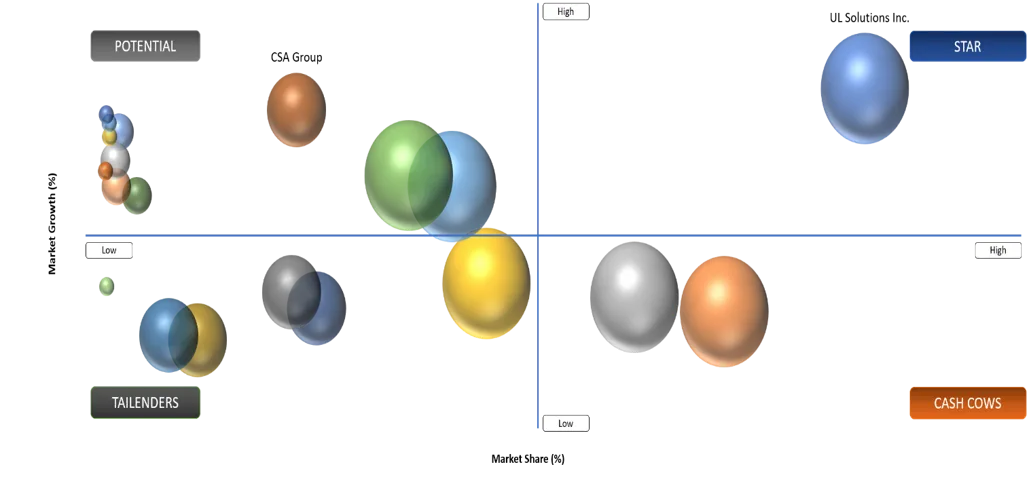
BESS Testing Market BCG Matrix: Company Evaluation
STAR
UL Solutions Inc. has been classified as a Star in the BESS testing market owing to its prominent market positioning and its proficiency in providing services related to UL 9540/UL 9540A certification, thermal runaway evaluation, fire test at large scale and system level safety assessment of BESS. Its emphasis on meeting the demands for fire, deflagration and installation level safety needs will help it gain from rising demand.
POTENTIAL
CSA Group is considered a Potential/Emerging Leader owing to its strong capabilities of North American ESS certification, battery testing, electrical safety and fire safety. CESI/KEMA Labs, VDE Group, TÜV NORD GROUP and RINA S.p.A. have also been identified as potential growth opportunities owing to their capabilities in grid compliance testing, high power performance testing, electrical safety, certification and utility scale BESS evaluation. The existing technical infrastructure and regional expertise would enable the organization to capitalize on the growing demands for the increased size of BESS projects and related testing.
BESS Testing Market Dynamics
Driver Impact Analysis
| Driver | Market Growth Impact (%) | Demand Concentration | Impacted Use Case | Strategic Impact |
| Increasing Utility-Scale BESS Deployment | 28% | Utility-Scale BESS | Grid Storage & Renewable Integration | Expands demand for system-level performance, commissioning and grid-compliance testing as BESS project scale increases. |
| Stricter Fire & Thermal-Runaway Requirements | 24% | Utility-Scale & C&I BESS | Safety & Fire Validation | Increases demand for thermal-runaway, fire-propagation, gas-release and deflagration testing. |
| Growing Grid-Integration Requirements | 20% | Grid-Connected BESS | Grid Compliance & Performance Testing | Drives testing of voltage/frequency response, ramp rates, reactive power, power quality and synchronization. |
| Expansion of BESS Lifecycle Validation | 15% | Utility-Scale & C&I BESS | Degradation, Warranty & Periodic Testing | Creates recurring demand for degradation, state-of-health, warranty and periodic performance testing. |
Driver: Increasing Utility-Scale BESS Deployment
A notable factor driving the BESS testing market is the fast-growing utility-scale battery energy storage systems, especially because large and complicated configurations call for thorough verification prior to being connected to the power grid operations. Utility-scale technologies also incorporate high capacity battery systems, power conditioning systems, battery management systems, energy management systems, thermal management and safety systems, leading to the escalating need for testing, commissioning, acceptance testing, verification of grid operations and thermal runaway and fire propagation tests. The attention of utilities, project developers and investors is increasingly directed to independent verification of systems regarding their safety, reliability and performance, thus creating a demand for testing of utility-scale battery systems.
Restraint Impact Analysis
| Restraint | Drag on Market Growth (%) | Primary Impact Area | Impacted Use Case | Strategic Impact |
| High Cost of Specialized BESS Testing | 24% | Testing Infrastructure & Project Cost | Large-Scale BESS Testing | Raises compliance expenditure and can discourage comprehensive testing among smaller projects. |
| Limited Availability of Accredited Testing Capacity | 21% | Laboratory Capacity & Scheduling | Utility-Scale BESS Testing | Creates testing backlogs that can delay certification, commissioning and commercial operation. |
| Complexity of Regional Standards & Grid Requirements | 19% | Compliance & Testing Scope | Grid-Connected BESS | Increases the number of testing protocols, compliance requirements and validation costs across markets. |
| Shortage of Specialized Testing Expertise | 16% | Technical Workforce | Advanced Safety & Performance Testing | Constrains testing capacity for complex BESS technologies and increases reliance on specialized providers. |
Restraint: High Cost and Complexity of Specialized BESS Testing
Expensive and technically demanding nature of testing the dedicated BESSs is a key limitation of the market development, especially for large systems, which require the destruction tests, high power and installation level tests. The testing companies will have to invest in test infrastructure of megawatts scale, thermal runaway facilities, precise measuring devices and qualified personnel, whereas complicated test procedures may require special setups and preparation. This will raise the cost of testing, which may lead to schedule limitations, especially for small manufacturers of the BESSs, who lack the budget for their compliance.
BESS Testing Market Segment Analysis
The global BESS testing market is segmented based on the testing type, testing level, testing stage, battery chemistry, end use, application, BESS energyy capacity, service provider type and region.
By Testing Type
Safety & Abuse Testing leads the Market through increasing thermal and fire-safety requirements
The Safety and Abuse Testing sector held a leading position in the BESS testing industry in 2025 with an estimated share of 31.5%. Favorable growth is attributed to developing technologies in thermal runaway, ignition, gas discharge, overcharging, short circuit and deflagration processes in cells, assemblies, racks, containers and overall BESS systems. Additionally, the increased dimensions and energy density of utility-scale installations are also boosting demand for safety and fire testing services.
By Testing Type
Grid Compliance Testing expands rapidly with growing grid-connected BESS deployment
The Grid Compliance Testing is projected to be the fastest-growing segment, with an estimated growth rate of 13.6% CAGR. This growth is driven by the rising demand for testing of voltage and frequency response, reactive power, ramp rates, synchronization, power quality and grid-code compliance as a result of increasing installation of grid-connected BESS. The IEA finds out that utility-scale energy storage made up for 87 GW of the total of 108 GW added in 2025, which provides a strong case for grid integration testing.
BESS Testing Market Geographical Penetration
U.S. BESS Testing Market Landscape
The U.S. BESS testing market is influenced by the demanding nature of battery safety, fire protection, electrical and grid connection regulations. The testing is gradually shifting towards systems and installation level testing in energy storage on the utility-scale side. UL 9540A plays an important role in the testing of thermal runaway, fire propagation, gas evolution and explosion risks while NFPA 855 is making it more demanding in terms of large scale fire testing and installation level safety testing. This is fuelling the need for testing against thermal runaway and fire risk, electrical and functional testing, grid testing and commissioning, along with certification through dedicated laboratories and high power BESS testing facilities.
Japan BESS Testing Market Outlook
Japan BESS testing market is driven by the existing battery technology eco-system in the country, growing stationary energy storage adoption and the increasing focus on safety, performance and integration. Japan is enhancing the process of standardization and evaluation of stationary energy storage, which includes performance and safety evaluations of stationary energy storage systems as well as development of JIS standards for grid-connected EES. The need for large-scale safety tests, battery performance verification, integration tests, commissioning and life-cycle assessment tests is being generated due to growing utilization of stationary batteries in balancing power systems and renewable-energy integration.
China BESS Testing Market Trends
China’s BESS testing market is becoming more influenced by fast growing Chinese battery manufacturers and stricter safety and grid-integration regulations. China’s GB 44240-2024, which becomes mandatory as of August 2025, sets safety standards and test methods for lithium cells and batteries used in energy storage systems (including high capacity grid- connected and off-grid), while GB/T 46957-2025, which becomes mandatory as of July 2026, sets safety standards for grid integrated energy storage systems and aligns with IEC 62933-5-1:2024. These advancements have helped increase testing demands from safety testing at battery level to system level safety, grid integration, performance and commissioning tests.
India BESS Testing Market Analysis
The India BESS testing market is witnessing a lot of changes as the country ramps up its usage of battery energy storage systems and also implements stringent system safety measures and grid reliability norms. The safety standards for BESS being developed by the Central Electricity Authority include testing as per applicable standards as well as fire and explosion protection for cells, modules, containers and specific site installations, along with new measures introduced by the CEA for independent third-party audits of BESS fire safety. These developments have resulted in the requirement for thermal and fire safety testing, battery performance verification, electrical testing, grid testing, commissioning testing and safety audit, thus increasing the need for BESS testing facilities in India.
Germany BESS Testing Market Projection
The Germany BESS testing market is projected to grow due to increased battery storage installation and grid integration, certification and system stability needs in the country. In 2026, VDE FNN has set forth new demands for grid forming BESS functionalities in the extra-high voltage grid, which include certification and technical validation requirements for the system supporting functionality. It will lead to the growth of grid conformity testing, PCS and inverters validation, power quality testing, protection testing, certification and performance validation of BESS systems, especially large projects connecting to Germany’s high and extra-high voltage grids.
BESS Testing Market Competitive Landscape
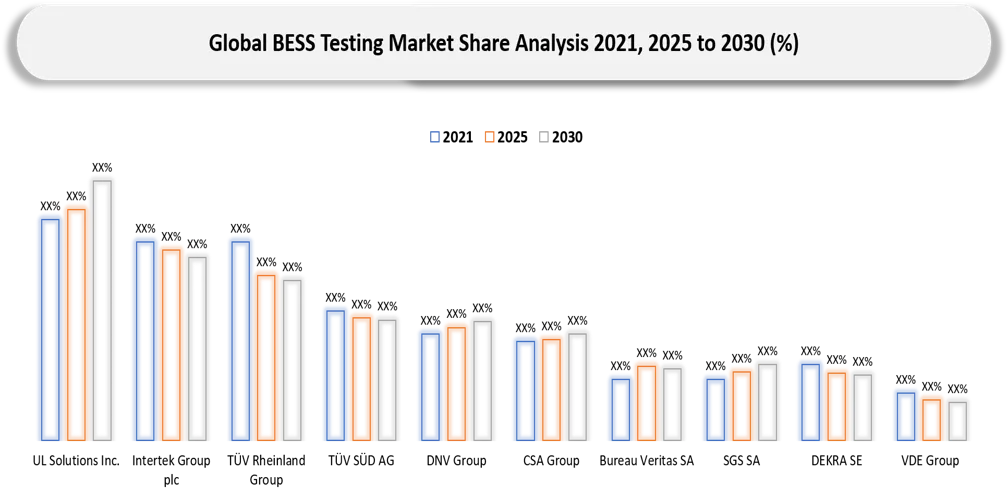
- UL Solutions and Intertek Maintain Strong Competitive Positions: The comprehensive range of services offered by them, covering everything from BESS safety, thermal runaway, fire, performance, certifications and systems tests, offer comprehensive coverage throughout the entire BESS testing ecosystem.
- Large-Scale Testing Capability Is a Key Competitive Differentiator: Providers with capability of conducting fire tests at container and installation level and large-scale test platforms, will be well-suited for utility-scale BESS projects.
- Grid-Compliance Expertise Is Increasingly Important: Grid testing providers are distinguishing themselves through PCS/inverter validation, grid-code compliance testing, power quality testing, protection testing and grid-integration testing services for more complicated BESS systems.
- Global Accreditation and Certification Reach Strengthen Market Positioning: Testing providers that have international accreditations, certification programs and test labs in major BESS markets can help manufacturers and developers attain market approvals.
- Lifecycle Testing Is Creating New Competitive Opportunities: Businesses are venturing beyond pre-deployment certification to commissioning, warranty testing, degradation testing, operations testing, safety testing on a regular basis and end-of-life testing.
Public Company Q1-Q2 2026 Performance Comparison
The following table highlights the comparison between five publically traded companies with substantial business involvement in the BESS testing market. Financial indicators have been expressed on the company level while the operational indicators have been given as specific to the BESS testing market.
| Company | Q1–Q2 2026 Performance | BESS Testing Exposure | Key Performance Driver |
| UL Solutions Inc. | US$1.57 billion H1 revenue, up 6.3% YoY; Q2 revenue US$816 million, up 5.2%. | High - Strong exposure to BESS safety, certification, UL 9540/9540A, battery and energy-storage testing. | Electrification, energy transition and specialized testing capacity. |
| Intertek Group plc | US$2.40 billion H1 revenue, up 5.9% YoY at actual rates; adjusted operating profit increased 12.1%. | High - Energy, battery, renewable-energy and energy-storage testing and assurance. | Growth in Industry & Infrastructure and clean-energy assurance. |
| Bureau Veritas SA | US$3.78 billion H1 revenue, up 2.1% YoY and 5.0% organically. | High - Battery, electrical, energy infrastructure, renewable-energy and certification capabilities. | Organic growth in technical testing and certification supported by energy-transition demand. |
| SGS SA | US$4.54 billion H1 sales, up 7.6% YoY; organic sales growth of 5.6%. | High - Battery, energy-storage, electrical safety, testing and certification capabilities. | Sustainability, Digital Trust and Applied Technical Services growth. |
| Eurofins Scientific SE | US$4.30 billion H1 revenue, up 2.5% YoY and 2.7% organically. | Medium to High - Battery, electrical/electronic, materials, environmental and energy-related testing. | Consumer & Technology Products Testing, laboratory investment and digitalization. |
Note: Financial parameters represent company/group-level performance and should not be interpreted as BESS-testing revenue unless separately disclosed. Financial periods may differ slightly because companies follow different fiscal reporting calendars. The comparison therefore combines company-level financial performance with BESS-specific operational exposure to assess competitive positioning in the BESS Testing Market.
Key Companies of BESS Testing Market
- UL Solutions Inc. (United States)
- Intertek Group plc (United Kingdom)
- TÜV Rheinland Group (Germany)
- TÜV SÜD AG (Germany)
- DNV Group (Norway)
- CSA Group (Canada)
- Bureau Veritas SA (France)
- SGS SA (Switzerland)
- DEKRA SE (Germany)
- VDE Group / VDE Testing and Certification Institute (Germany)
- CESI S.p.A. / KEMA Labs (Italy)
- Element Materials Technology Group (United Kingdom)
- Applus+ Laboratories (Spain)
- Eurofins Scientific SE (Luxembourg)
- Kiwa Group (Netherlands)
- TÜV NORD GROUP (Germany)
- RINA S.p.A. (Italy)
- China Quality Certification Centre (China)
- China Certification & Inspection Group (China)
- Korea Testing Certification (South Korea)
Company Profiles
UL Solutions Inc.
UL Solutions is a safety science organization that is positioned in the area of BESS safety testing, certification and fire-risk assessment. The company's energy-storage capabilities include cell, module, unit and system installation testing such as UL 9540A thermal runaway testing and fire propagation testing, UL 9540 certification and large-scale fire testing. These capabilities help the company to be competitive in serving BESS manufacturers, integrators, developers and regulators.
Competitive priorities for UL Solutions include scaling up of large-scale fire testing, accommodating new UL 9540A and NFPA 855 testing, enhancing global BESS certification capabilities and integrating physical testing with engineering and simulation.
Intertek Group plc
Intertek offers global services in testing, inspection and certification and has considerable experience in the testing of batteries and energy storage systems. These testing solutions cover safety, performance, environmental, life cycle and certification of BESS, adhering to the standards of UL 9540, UL 9540A, UL 1973 and IEC 62933.
Some competitive priorities include increasing laboratory capacity for energy storage, testing new battery chemistry and BESS architecture, rapid certification and market access and testing from prototype to operation.
TÜV Rheinland Group
TÜV Rheinland offers independent testing, inspection and certification for batteries and BESS with regard to safety, performance, environmental aspects, electrical considerations and market access. The company’s services can assist in validating components as well as systems for BESS in accordance with international standards and regional specifications.
The company’s priorities in the competitive landscape include large scale testing of BESS, BESS system-level safety and performance validation, international certification of BESS and increasing BESS complexity.
TÜV SÜD AG
TÜV SÜD offers battery and energy storage testing and certification services for aspects such as safety, performance, reliability, environmental impact and grid connection. TÜV SÜD's global laboratory network allows for the testing of stationary energy storage systems to meet international standards as well as regional standards.
Key areas of competitiveness include BESS testing for utility-scale projects, grid connection and performance verification, new battery technologies and testing combined with certification and technical support services.
DNV Group
DNV's combination of testing and certification together with energy systems engineering and grid integration knowledge provides it with a competitive advantage regarding BESS assurance on a system level. The services offered by DNV related to energy storage cover aspects like performance, safety, degradation, grid integration, risk assessment and operational performance.
Competitive priorities include further development of system and grid performance validation, improvement of technical due diligence for BESS projects and lifecycle performance evaluation.
CSA Group
The CSA Group is a leading standards testing, inspection and certification body with significant exposure to North American battery and energy storage safety certification. The competencies offered by the company include stationary battery system safety certification and testing as well as safety requirements for electrical equipment performance and certification.
Competitive priorities include BESS testing and certification services, fire and electrical safety requirements, battery system safety evaluation and enabling entry into markets for energy storage manufacturers.
Bureau Veritas SA
Bureau Veritas is an international TIC service company that offers services in the battery, electrical, renewable energy and energy infrastructure testing and certification categories. The company’s energy transition offerings include product compliance, inspections, certification and project-specific technical assurance for the BESS manufacturers, developers and infrastructure owners.
Its competitive advantages include expansion of the energy transition TIC service offering, battery and energy storage testing capacity, electrical/grid compliance services and global certification network for BESS projects.
SGS SA
The SGS is an international testing, inspection and certification company that offers various competencies including battery testing, electrical safety testing, energy system testing, performance validation and certification. Its international laboratory infrastructure allows it to provide its services to BESS manufacturers and developers in different phases of development.
Competitive priorities include the establishment of specialized laboratories for battery and energy storage devices, conducting lifecycle and performance testing and meeting international market entry requirements.
DEKRA SE
DEKRA’s services involve testing and certifications for battery systems, electrical equipment, functional safety, EMC and energy storage technology. The services offered by DEKRA ensure validation of the BESS component and system according to safety, reliability, electrical, EMC and market access standards.
The competitive advantages for the company include development of the stationary storage testing process, system level validation, certification in Europe and internationally and functional safety and cyber security.
VDE Group / VDE Testing and Certification Institute
VDE is well-positioned in the areas of electrical safety, grid compliance, testing of power systems and certification. These competencies apply to BESS projects in particular since VDE has knowledge in the area of electrical equipment, power quality, grid connection and certification for energy storage technologies.
Key competitive advantages comprise expansion of BESS grid compliance testing services, support of requirements for grid forming and inverters of BESS, development of high-voltage BESS certification and growing grid interconnection requirements.
BESS Testing Market Major Pain Points
- High Cost of Large-Scale Fire and Thermal-Runaway Testing: Installation of BESS at utility-scale requires specialized laboratories, expensive power equipment, firefighting system, instrumentation and destructive testing of BESS increasing its validation expenses.
- Limited Availability of Specialized BESS Testing Infrastructure: Laboratories that test fires, explosions and high-power BESS performance at installation level are specialized laboratories hence limiting its availability for large-scale projects.
- Evolving and Region-Specific Testing Requirements: Differences in UL, NFPA, IEC, national and grid codes will result in the increased need for tests, documents and validation procedures in cross-border deployment of BESS.
- Complexity of System-Level BESS Testing: The system-level validation entails the coordination of testing of the various systems within the BESS rather than individual components such as batteries, BMS, PCS, EMS, fire safety systems and grid interface.
- Long Validation Cycles for New BESS Designs and Chemistries: Changes in battery chemistry, battery energy density, enclosure design, thermal management systems and safety systems can necessitate additional testing requirements, thereby prolonging the development process.
BESS Testing Market Recent Developments
- Intertek Group plc - July 2026: Awarded the first lot of EU Battery Regulation (EU) 2023/1542 Notified Body conformity certificates to RelyEZ Energy and StarCharge for their stationary energy storage systems, enhancing its regulatory compliance and access to the European market for BESS.
- Kiwa Group - July 2026: Emphasized the significance of new EU Battery Regulation mandates on BESS projects, covering fire safety needs, thermal runaway testing and soon-to-come Battery Passport, underscoring the importance of independent verification of compliance and quality assurance through the entire BESS process life cycle.
- UL Solutions Inc. - June 2026: Introduced BESS evaluation services that comply with the NFPA 855, NFPA 68 and NFPA 69 standards, adding further testing and certification services to their portfolio.
- TÜV SÜD AG - June 2026: Certified the PP-S2 residential energy storage system from Weiheng Intelligent Technology (WHES), which is designed for the European grid connection and energy storage standards including Spain’s NTS V2.1 and the UK’s G100.
- SGS SA - June 2026: Technical publication regarding ANSI/CAN/UL 9540A:2026, emphasizing the movement towards performance-based fire safety validation and its relevance to BESS testing programs and certification schedule.
Analyst View / Opinion on BESS Testing Market
- Testing Is Shifting from Component Validation to System-Level Assurance: BESS testing is shifting its focus from individual cell and module tests to system-level assessment of thermal runaway, fire propagation, electrical tests, control tests and grid interface tests.
- Large-Scale Fire Testing Will Become a Major Growth Segment: With the implementation of NFPA 855 guidelines in 2026 and 6th edition of UL 9540A, large-scale fire test is expected to grow in its significance, especially for large BESS installations.
- Independent Testing Will Gain Strategic Importance: Technical validation by an independent body is becoming increasingly significant for permitting, safety approval, insurance, financing, commissioning and commercial acceptance.
- Specialized Testing Infrastructure Will Become a Competitive Differentiator: Having access to megawatt scale testing facilities, large format fire tests, instrumentation and expert BESS testing engineers is going to be a differentiator for testing companies.
- Digital Testing and Simulation Will Complement Physical Validation: It can be expected that simulation and modeling will become more prevalent and combined with physical tests in order to mimic real-life situations of BESS failure and operation.
BESS Testing Market Target Audience
| INDUSTRY | WHO SHOULD BUY THIS REPORT? | REASON TO BUY THIS REPORT |
| BESS Manufacturing | BESS Manufacturers | Assess testing requirements, safety standards, validation costs and competitive testing capabilities. |
| Battery Manufacturing | Battery Cell & Module Manufacturers | Evaluate demand for battery-level safety, performance, degradation and lifecycle testing. |
| BESS Integration | BESS System Integrators | Identify system-level testing requirements across batteries, PCS, BMS, EMS and complete BESS installations. |
| Utilities & Grid Infrastructure | Utilities & Grid Operators | Evaluate grid-compliance, commissioning, performance and operational testing requirements. |
| Renewable Energy | Renewable Energy Developers & IPPs | Assess testing requirements for BESS projects integrated with solar and wind generation. |
| Engineering & Construction | EPC Contractors | Understand FAT, SAT, commissioning, acceptance-testing requirements and potential project delays. |
| Testing & Certification | TIC Providers & Testing Laboratories | Identify high-growth testing segments, regulatory requirements, capacity gaps and expansion opportunities. |
| Energy Storage Operations | BESS Asset Owners & Operators | Evaluate lifecycle, degradation, warranty, state-of-health and periodic testing requirements. |
| Finance & Risk | Investors, Lenders & Insurers | Assess technical risks, independent validation requirements, project bankability and asset-performance risks. |
| Government & Regulation | Regulators & Safety Authorities | Track BESS safety standards, fire-testing requirements, grid-compliance frameworks and testing needs. |
Why Choose DATAM?
- Data-Driven insights: Dive into detailed analyses with granular insights such as pricing, market shares and value chain evaluations, enriched by interviews with industry leaders and disruptors.
- Post-Purchase Support and Expert Analyst Consultations: As a valued client, gain direct access to our expert analysts for personalized advice and strategic guidance, tailored to your specific needs and challenges.
- White Papers and Case Studies: Benefit quarterly from our in-depth studies related to your purchased titles, tailored to refine your operational and marketing strategies for maximum impact.
- Annual Updates on Purchased Reports: As an existing customer, enjoy the privilege of annual updates to your reports, ensuring you stay abreast of the latest market insights and technological advancements. Terms and conditions apply.
- Specialized Focus on Emerging Markets: DataM differentiates itself by delivering in-depth, specialized insights specifically for emerging markets, rather than offering generalized geographic overviews. The approach equips our clients with a nuanced understanding and actionable intelligence that are essential for navigating and succeeding in high-growth regions.
- Value of DataM Reports: Our reports offer specialized insights tailored to the latest trends and specific business inquiries. The personalized approach provides a deeper, strategic perspective, ensuring you receive the precise information necessary to make informed decisions. The insights complement and go beyond what is typically available in generic databases.
What DATAM Uniquely Provides
- BESS Testing-Specific Market Segmentation: Quantifies demand based on testing type, testing level, testing phase, battery chemistry, BESS size, application and region, allowing a pinpoint determination of high growth testing opportunities.
- Regulatory-Driven Testing Opportunity Mapping: Links changing regulations, such as UL 9540A, NFPA 855 and IEC 62933-5-4:2026, with the increasing demand for fire, safety, grid integration and systems level testing.
- System-Level Testing Demand Intelligence: Focuses on the shift from the testing of cells and modules to container level, complete system, installation level, grid performance testing, FAT, SAT and commissioning testing.
- Testing Infrastructure & Capacity Gap Analysis: Identifies possibilities offered by the scarcity of fire testing facilities, high-power BESS testing facilities, grid compliance testing laboratories and specialized testing expertise.
- Lifecycle & Emerging-Technology Testing Intelligence: Analyzes the demand generated through new battery chemistry, energy density, degradation testing, digital diagnostics, simulation-based testing, warranty testing and BESS performance testing.


























































