


Beryllium Market Size & Share by 2033
Beryllium Market reached US$ 299.72 million in 2025 and is expected to reach US$ 527.53 million by 2033, growing with a CAGR of 7.22% during the forecast period 2026-2033.
The global beryllium market is experiencing exceptional growth as a result of its diverse applications in aerospace, military, and telecommunications, as well as its integration with sustainable energy sources. Beryllium is a critical material for applications in semiconductors, nuclear reactors, high-speed aircraft, and satellites due to its high stiffness-to-weight ratio, thermodynamic stability, and corrosion resistance. Moreover, growing numbers of partnerships and agreements among big firms for geographic growth have become a prominent trend in the industry.
The beryllium market exhibits significant geographic variations, with the United States holding the largest market size at $124.71 million which accounts for the 47% market share. The country has a competitive advantage in mining, as well as developed infrastructure and industrial sectors that are related to industrial electronics, particularly aerospace and defense. China, with its expanding manufacturing base and increasing demand for performance materials on the rise, is the second largest market share with 18.91%. Brazil can compete favorably in the region due to its rich resource base and rapid industrial development, even though the market is only worth $24.34 million. Simultaneously, Canada, which has a market share of 4.59%, can leverage its mining capabilities and relationships in the aerospace and defense sectors.
Looking ahead to the period from 2026 to 2033, various countries are going to experience varying degrees of growth, in the beryllium market, during the forecast period of 2026 to 2033. In this instance, India is expected to experience a maximal compound annual growth rate (CAGR) of 9.6%. This is a result of the growing manufacturing sector in India, which includes products such as electronics and defense, which have a high demand for beryllium.China is expected to maintain its market position as a leader in the industry, with a 9.0% CAGR, which is further supported by the globalization of beryllium and ongoing industrial advancement. Argentina's case is also noteworthy, as the country is expected to experience a compound annual growth rate (CAGR) of 8.8% as it expands its beryllium mining industry and capitalizes on the increasing global demand for beryllium. These projected growth rates reflect the evolving dynamics of the beryllium market and the importance of these countries in shaping the future of this critical resource.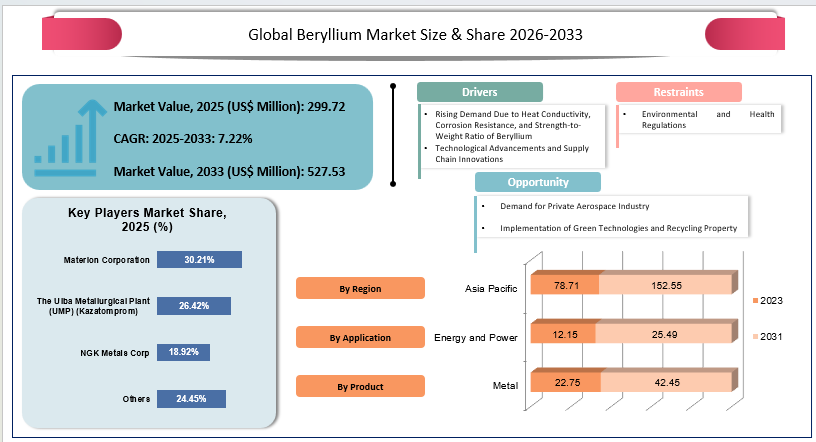
Beryllium Market Trend
The growth of electric vehicles (EVs) is a key trend driving demand in the beryllium market due to the metal’s unique properties like high strength, light weight, and excellent thermal conductivity. According to the IEA, Electric car sales exceeded 17 million globally in 2024, capturing over 20% of total car sales, signaling a strong global shift toward clean transportation. Notably, an additional 3.5 million EVs were sold compared to 2023, highlighting rapid adoption. This surge directly boosts the beryllium market, as EVs rely on beryllium alloys for battery connectors, sensors, and thermal management systems. Beryllium’s lightweight, conductive, and heat-resistant properties make it ideal for high-performance electric drivetrains.
For more details on this report Request for Sample
Beryllium Market Scope
| Metrics | Details |
| By Product | Copper Alloys, Ceramics, Metal, Others |
| By Application | Aerospace and Defense, Industrial Components, Consumer Electronics, Telecommunication, Medical Equipment, Automotive and Transportation, Energy and Power, Oil & Gas, Others |
| By Region | North America, South America, Europe, Asia-Pacific, Middle East and Africa |
| Report Insights Covered | Competitive Landscape Analysis, Company Profile Analysis, Market Size, Share, Growth |
Beryllium Market Dynamics
Market Driver
- Rising Demand Due to Heat Conductivity, Corrosion Resistance, and Strength-to-Weight Ratio of Beryllium
- Technological Advancements and Supply Chain Innovations
Rising Demand Due to Heat Conductivity, Corrosion Resistance, and Strength-to-Weight Ratio of Beryllium
The beryllium market is anticipated to experience rapid growth as a result of the increase in its consumption in significant industries, including aerospace, defense, telecommunications, and renewable energy sources. The properties of beryllium, such as its high heat conductivity, resistance to corrosion, and exceptional strength-to-weight ratio, are driving its growth, rendering it a critical material for high-tech applications.
The US Department of Defense regards beryllium as a strategic and critical material. Additionally, the government is investing in private-sector support for the construction of a primary beryllium facility in Ohio. The US produced between 165 to 170 metric tons of beryllium, with 9 metric tons of beryllium imported.
Beryllium is also one of the critical materials that the U.S. Department of Defense has incorporated into some national strategy within the framework of stockpiling activities designed to meet demand. Lockheed Martin and Raytheon, for instance, extensively implement beryllium components in their forthcoming weapon systems and aircraft. This particular characteristic has led to the material being referred to as a game-changer in the design of military and aerospace components, as all designers strive to create lightweight structures.
Environmental and Health Regulations
Beryllium, despite its utility, is constrained by restrictive environmental policies and toxic effects, which restrict its market expansion in all regions of the globe. The material's toxicological consequences exacerbate the situation, particularly in the growing emphasis on environmental sustainability, which presents numerous obstacles for both manufacturers and consumers.
The health risks associated with chronic beryllium disease (CBD), lung cancer, and other conditions are predominantly posed by aggressive exposure to beryllium among those employed in beryllium mining, refining, and machining. In the United States, the Occupational Safety and Health Administration (OSHA) and other equivalent bodies in the majority of states have already established recommended limits on workplace exposure levels in response to risks such as these.
For instance, OSHA establishes an eight-hour average ceiling of 0.2 micrograms per cubic meter for ambient beryllium levels. These regulations are for the safety and health of workers; however, they also subject companies to high operational costs, which are the result of a variety of factors. To adhere to these stringent health standards, it is necessary to allocate significant resources to the provision of safety equipment, the implementation of efficient air circulation systems, and the ongoing monitoring of the health status of the workforce. The small-scale processors and manufacturers of beryllium are unable to meet these conditions, thereby restricting its global supply.
Beryllium Market Segment Analysis
The global beryllium market is segmented based on product, application and region.
by Product
Beryllium–copper alloys are used in the electronics, automotive, defense, and aerospace industries. Beryllium metal is employed in fusion reactors, nuclear equipment, radar systems, and military infrared countermeasure technology.Beryllium's most intriguing characteristic, vital for the advancement of industrial alloys, is its capacity to induce precipitation hardening in other metals, notably nickel, aluminum, and particularly copper. The genesis of these two alloys is attributed to the ability of beryllium, nickel, or copper to induce hardening through low-temperature precipitation annealing treatment.Copper-based beryllium alloys are categorized according to their applications, with substantial demand stemming from their distinctive blend of strength, electrical conductivity, and thermal properties. These alloys are extensively employed in the electrical, electronics, telecommunications, and automotive industries. Applications in the electrical and electronics sector encompass connectors, sockets, computer chip heat sinks, thermostats, and bellows.Nickel beryllium alloy resemble copper beryllium alloys, differing in that the primary metal is nickel rather than copper, comprising up to 98% nickel and up to 2% beryllium. They are age-hardenable alloys that offer high strength, excellent elevated temperature relaxation resistance, adequate conductivity, and favorable formability. Their further advantages over copper-based alloys include superior corrosion resistance and the ability to endure significantly greater temperatures.BeO ceramic substrates are widely utilized across numerous industries, including consumer electronics, aerospace, defense, automotive, semiconductor, and telecommunications. In these sectors, BeO serves as a highly effective thermal conductor and electrical insulator, ensuring efficient heat dissipation for components such as power transistors, LEDs, and RF devices. Its combination of high thermal conductivity and excellent dielectric properties makes it particularly well-suited for advanced applications. The semiconductor sector, in particular, represents the fastest-growing application segment, driven by the increasing demand for efficient thermal management in modern electronic devices. BeO's properties are essential in meeting the rigorous thermal requirements of these applications.By Application
Aerospace and Defense in the Global Beryllium market was valued at US$ 50.92 million in 2025, growing with a CAGR of 8.5% between 2026 and 2033.Beryllium, one of the lightest metals on Earth, is esteemed for its remarkable features, including superior strength-exceeding that of structural steel-minimal weight, and resilience at elevated temperatures. Its melting point exceeds that of magnesium and aluminum, rendering it a crucial material for sophisticated aviation and defense applications. Components of aircraft constructed from beryllium are 1.5 times lighter than those made of aluminum, offering unparalleled efficiency and performance.The incorporation of pure beryllium in military fighter aircraft decreases weight, hence improving speed and maneuverability, while facilitating enhanced targeting and strike capabilities. Copper-beryllium alloys are utilized in electrical connectors, fasteners, and structural components for renowned fighter jets such the F-22 Raptor, F-35 Lightning II, and F-18 Super Hornet, among others.In the global market, industrial-grade beryl is a crucial raw material for the manufacture of beryllium metal, alloys, and oxide, all of which are essential in several high-tech applications. These applications are predominantly located in sectors such as nuclear, electronics, and ceramics. Beryllium is prominently utilized as a structural material in aerospace technology and inertial guiding systems, in addition to serving as an additive in rocket propellants. It also serves as a neutron moderator and reflector in nuclear reactors, notably those at institutions such as ANSTO in Lucas Heights.Pure beryllium metal has various applications, including the manufacture of aircraft disc brakes, nuclear weapons and reactors, satellite and space vehicle structures, X-ray transmission windows, missile components, fuel containers, precision instruments, rocket propellants, navigational systems, heat shields, and mirrors. Additionally, beryllium alloys, notably beryllium-copper, are utilized in the fabrication of electrical connectors and relays, springs, precise instruments, aircraft engine components, non-sparking tools, submarine cable housings, pivots, wheels, and pinions.Beryllium Market Geographical Share
North America Holds a Significant Share Due to Its Advanced Aerospace, Defense, and Electronics Industries, Driving High Demand
North America holds a significant share in the global beryllium market due to its abundant natural reserves, particularly in the US, which hosts the world’s only operational primary beryllium production facility. The US is a leading producer and consumer of beryllium, driven by strong demand from the aerospace, defense, and electronics industries. Beryllium is critical for manufacturing high-performance alloys, precision instruments, and lightweight components, all of which are essential in defense technologies, satellite systems, and telecommunications.
Moreover, in response to the growing demand for beryllium across aerospace, defense, electronics, and clean energy sectors, companies in North America are significantly enhancing their production capabilities. For instance, in January 2024, Materion Beryllium & Composites completed a major expansion of its investment casting capabilities for its proprietary AlBeCast aluminum-beryllium products at its Elmore, Ohio, facility.
Sustainability Analysis
The sustainability analysis of the beryllium market highlights both opportunities and challenges. Beryllium is critical in high-tech applications such as aerospace, defense, and electronics, driving demand for advanced, lightweight, and durable materials. However, its extraction and processing pose environmental and health risks due to toxic dust and waste byproducts. Sustainable practices focus on improving mining efficiency, recycling beryllium-containing materials, and minimizing hazardous emissions. Innovations in green extraction technologies and circular economy approaches are gaining traction. Regulatory pressures are increasing to ensure worker safety and environmental protection. Overall, balancing market growth with responsible resource management is key to the sustainable future of the beryllium industry.
Beryllium Market Major Players
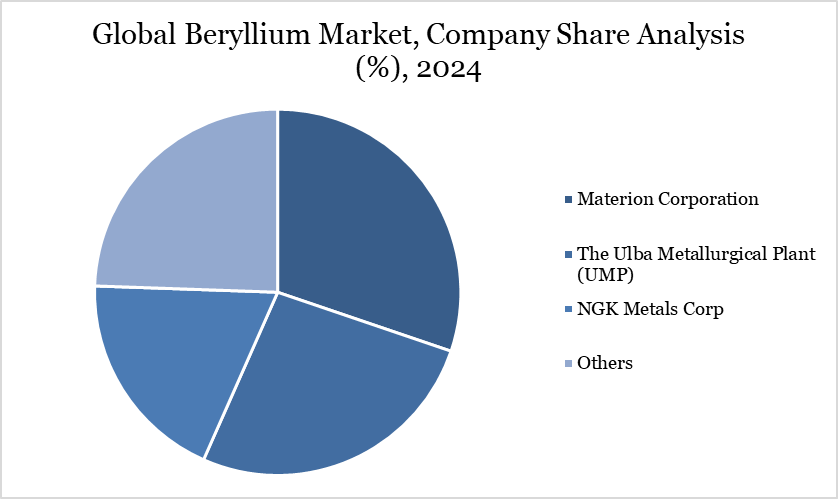
The major global players in the market include Materion Corporation, NGK Metals Corp, Kazatomprom, IBC Advanced Alloys Corp, American Beryllia Inc, Texas Mineral Resources Corp, DL INDUSTRY GROUP LIMITED, Le Bronze Alloys, Belmont Metals, BVG Group Management.
Key Developments
- Materion Corporation Strengthening Supply Chain – The company continues to expand production from its Spor Mountain, Utah operations to support increasing demand for beryllium in aerospace, defense, and satellite technologies in the U.S.
- United States Geological Survey Industry Update – U.S. beryllium production remained relatively stable in 2025, with steady demand from defense and aerospace sectors despite fluctuations in consumer electronics demand.
- Rising Defense and Space Demand in the U.S. – Growing investments in advanced military systems, satellites, and aerospace structures are increasing the demand for lightweight and high-strength beryllium materials.
- Expansion of Beryllium Copper Alloy Applications in Japan – Japanese manufacturers are increasing the use of beryllium copper alloys in precision connectors, electronic components, and automotive electronics.
- Growth in Semiconductor and Electronics Manufacturing in Japan – Japan’s advanced manufacturing sector continues to drive demand for high-performance beryllium alloys used in semiconductor equipment and miniaturized electronic devices.
Why Choose DataM?
Data-Driven Insights: Dive into detailed analyses with granular insights such as pricing, market shares and value chain evaluations, enriched by interviews with industry leaders and disruptors.
Post-Purchase Support and Expert Analyst Consultations: As a valued client, gain direct access to our expert analysts for personalized advice and strategic guidance, tailored to your specific needs and challenges.
White Papers and Case Studies: Benefit quarterly from our in-depth studies related to your purchased titles, tailored to refine your operational and marketing strategies for maximum impact.
Annual Updates on Purchased Reports: As an existing customer, enjoy the privilege of annual updates to your reports, ensuring you stay abreast of the latest market insights and technological advancements. Terms and conditions apply.
Specialized Focus on Emerging Markets: DataM differentiates itself by delivering in-depth, specialized insights specifically for emerging markets, rather than offering generalized geographic overviews. This approach equips our clients with a nuanced understanding and actionable intelligence that are essential for navigating and succeeding in high-growth regions.
Value of DataM Reports: Our reports offer specialized insights tailored to the latest trends and specific business inquiries. This personalized approach provides a deeper, strategic perspective, ensuring you receive the precise information necessary to make informed decisions. These insights complement and go beyond what is typically available in generic databases.
Target Audience 2026
Manufacturers/ Buyers
Industry Investors/Investment Bankers
Research Professionals
Emerging Companies




























































