


Battery-Grade Graphite Market Size and Overview
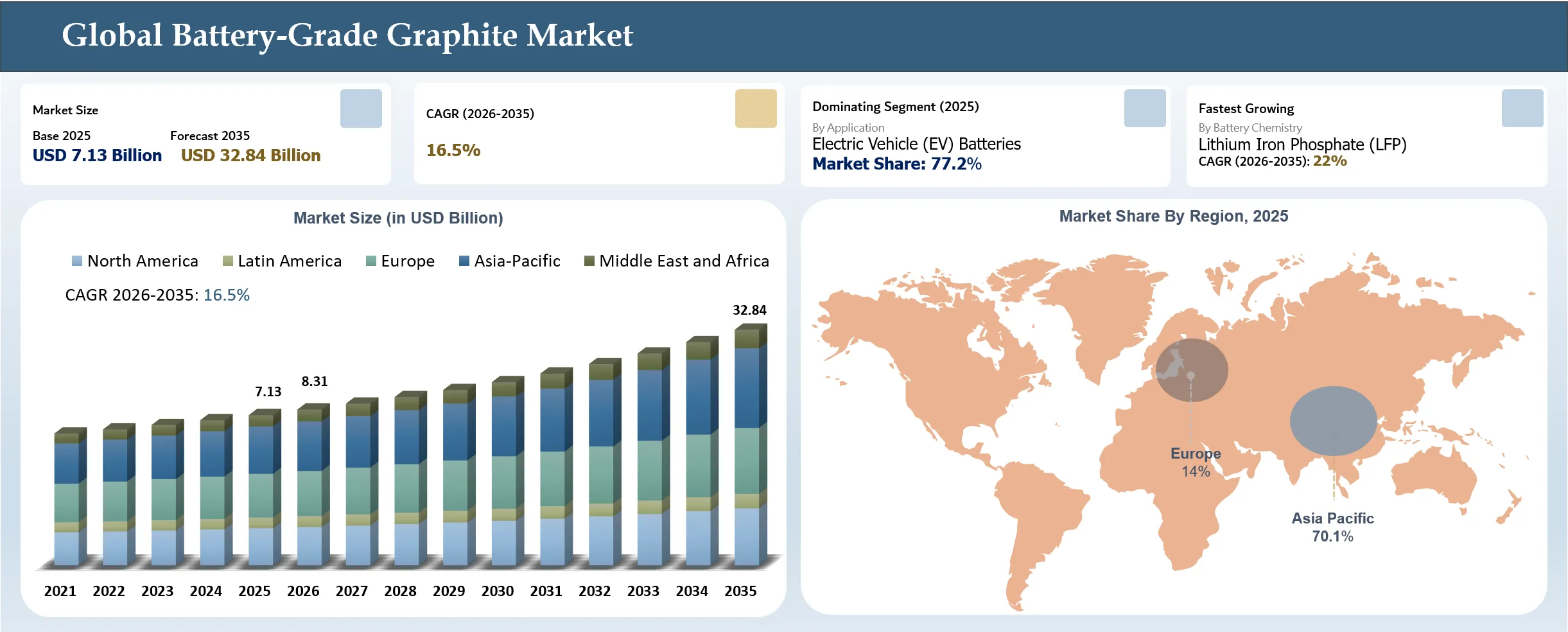
The global battery-grade graphite market Size reached USD 7.13 billion in 2025 and is expected to reach USD 32.84 billion by 2035, growing with a CAGR of 16.5% during the forecast period 2026-2035. The market is expanding alongside the rapid growth of lithium-ion battery anode demand, with the Oxford Institute for Energy Studies (OIES) reporting that battery sector graphite demand stood at about 1.3 million tonnes, and it was expected to surpass steel sector graphite demand by late 2025. The International Energy Agency (IEA) projects demand for cleantech graphite to increase from 1.505 million tonnes to 4.114 million tonnes by 2030, while the total graphite demand would stand at 8.219 million tonnes, reflecting increased demand for the material from batteries and other clean-energy technologies. Supply chain concentration is another market factor, considering that China has control of 95% of the global graphite supply. According to a Reuters report, in reaction, GM and Vianode entered into a multi-year, multi-billion-dollar deal in 2025 for synthetic graphite anode materials, which would see Vianode produce 80,000 tonnes annually by 2030, enough to serve 1.5 million EVs. In November 2025, the Government of India reported that 60% of the country's graphite needs were being imported, while 9 graphite mines were active, 27 blocks had been auctioned, 20 more blocks had been handed over for auction, and 26 blocks were being explored.
Australia continues to cement its role in the battery-grade graphite value chain through increased production of graphite processing and anode materials within the country itself. In April 2026, according to Mining Technology, the first integrated graphite-to-anode demonstration plant was launched in Townsville, Queensland, where Graphinex is producing battery-grade graphite for exports to foreign markets. This plant converts graphite from Graphinex’s Esmeralda project near Croydon in north-west Queensland into an anode, and this integrated process chain is expected to generate over 200 jobs. Additionally, the project secured a US Export-Import Bank Letter of Interest, valued at USD 1.3 billion, which the Queensland Government referred to as the largest commitment under the US–Australia Critical Minerals Framework. World output of natural graphite is expected to grow 25.1% to reach 2.1 million tonnes in 2026 compared to 1.7 million tonnes in 2025 and 4.9 million tonnes by 2035 – the estimated CAGR is 9.8%. In 2025, China produced 74.9% of the world’s graphite, but by 2035, this market share is expected to decline to 29.6%, while that of Australia is forecasted to rise to 7.4%.
White-Space Opportunities for U.S. Battery-Grade Graphite Supply Chain Development
In August 2025, the U.S. Department of Energy (DOE) announced nearly USD 1 billion in proposed investments to strengthen the U.S. critical minerals and materials supply chain, creating a significant opportunity in domestic battery-grade graphite processing and anode-material production. The largest relevant investment is the up to USD 500 million battery materials processing and battery manufacturing and recycling grant program, which supports demonstration and commercial-scale facilities for critical-mineral processing, battery manufacturing, and recycling, with graphite explicitly included among eligible battery materials. Additional funding targets domestic critical-mineral mining, processing, recycling, and manufacturing capacity, creating opportunities across graphite purification, spherical graphite production, anode manufacturing, recycling, and supporting infrastructure. The highest-investment opportunity for the battery-grade graphite is therefore downstream processing and battery-material manufacturing, where companies can develop U.S.-based capacity to convert graphite feedstock into battery-ready anode material and reduce reliance on overseas supply chains. Other areas include graphite recycling and recovery, critical-mineral separation and refining, demonstration-to-commercial-scale processing facilities, and integrated mine-to-anode supply chains.
The investment creates potential opportunities for companies across different stages of the battery-grade graphite value chain. Anovion Technologies and Novonix can benefit from increased investment in U.S. synthetic/natural graphite anode-material production, while Syrah Resources and its U.S. operations are positioned in natural graphite active-anode-material processing; Westwater Resources can benefit from investment in graphite purification and anode-material manufacturing, and American Battery Technology Company (ABTC) and Redwood Materials can benefit from opportunities in battery-material recycling and critical-mineral recovery. Other potential beneficiaries include Ascend Elements in battery-material recycling and production, Nouveau Monde Graphite in natural graphite processing and anode-material development, and Graphite One in integrated U.S. graphite mining and advanced-material production. Funding directed toward critical-mineral mining, processing, recycling, and commercial-scale manufacturing expands opportunities across the graphite value chain, with companies such as Graphite One and Westwater Resources positioned in upstream graphite mining and feedstock supply; Syrah Resources and Westwater Resources in graphite processing and purification; Graphite One, Syrah Resources, Westwater Resources, and Anovion Technologies in battery-grade graphite and active-anode-material manufacturing; and Redwood Materials and Ascend Elements in battery-material recycling and critical-mineral recovery.
Battery-Grade Graphite Market Strategic Takeaways
- The Asia-Pacific region captured a 70.1% market share in 2025, bolstered by China manufacturing over 90% of global active anode materials. Furthermore, Indonesia's battery-grade graphite production is projected to nearly triple from 32,000 tonnes in 2025 to 93,000 tonnes by 2030.
- Electric vehicle batteries dominated application demand in 2025, holding a 77.2% market share. This volume was driven by global EV battery deployment exceeding 1 TWh and total battery manufacturing capacity topping 4 TWh.
- China controlled 95% of global graphite processing supply and accounted for 74.9% of global graphite production in 2025. However, China's market share is projected to drop to 29.6% by 2035 as alternative regional processing expands.
- In August 2025, the U.S. Department of Energy announced nearly USD 1 billion in proposed funding for critical minerals and materials supply chains. Up to USD 500 million of this total is targeted directly toward battery materials processing and recycling grants.
Battery-Grade Graphite Market Industry Trends and Strategic Insight
- Battery manufacturers are increasingly evaluating natural and synthetic graphite according to cell chemistry, charging requirements, cost structure, and supply availability rather than treating them as interchangeable materials.
- Graphite coating is evolving beyond basic surface protection toward deliberate control of the solid–electrolyte interphase, lithium-ion transport, mechanical stability, and fast-charging behavior.
- Conventional synthetic graphite production is energy intensive, creating pressure to develop catalytic and lower-temperature graphitization routes that reduce processing intensity while maintaining the crystallinity and electrochemical characteristics required for lithium-ion anodes.
- Companies that combine graphite sourcing with purification, spheroidization, coating, and anode qualification can capture greater value and reduce dependence on external processing networks.
- Establishing alternative graphite capacity is not sufficient by itself; competitive projects need access to suitable feedstock, low-cost energy, purification technology, coating expertise, qualified customers, and long-term offtake arrangements.
Battery-Grade Graphite Market Scope
| Metrics | Details | |
| 2025 Market Size | USD 7.13 Billion | |
| 2035 Projected Market Size | USD 32.84 Billion | |
| CAGR (2026-2035) | 16.5% | |
| Largest Market | Asia-Pacific | |
| Fastest Growing Market | Europe | |
| By Graphite Type | Natural Graphite, Synthetic Graphite | |
| By Product Form | Flake Graphite, Spherical Graphite, Micronized Graphite, Coated Spherical Purified Graphite (CSPG), Graphite Powder, Others | |
| By Purity Level | 99.9%–99.95%, 99.95%–99.99%, Above 99.99% | |
| By Battery Chemistry | Lithium Iron Phosphate (LFP), Nickel Manganese Cobalt (NMC), Nickel Cobalt Aluminum (NCA), Lithium Cobalt Oxide (LCO), Others | |
| By Processing Stage | Flotation and Beneficiation, Chemical Purification, Thermal Purification, Spheroidization, Coating, Graphitization, Micronization and Classification, Others | |
| By Application | Electric Vehicle (EV) Batteries, Energy Storage Systems (ESS), Consumer Electronics Batteries, Power Tool Batteries, Industrial Batteries, Others | |
| By Region | North America | U.S., Canada, Mexico |
| Europe | Germany, UK, France, Spain, Italy, Poland | |
| Asia-Pacific | China, India, Japan, Australia, South Korea, Indonesia, Malaysia | |
| Latin America | Brazil, Argentina | |
| Middle East and Africa | UAE, Saudi Arabia, South Africa, Israel, Türkiye | |
| Report Insights Covered | Competitive Landscape Analysis, Company Profile Analysis, Market Size, Share, Growth | |
Battery-Grade Graphite Market Disruption Analysis
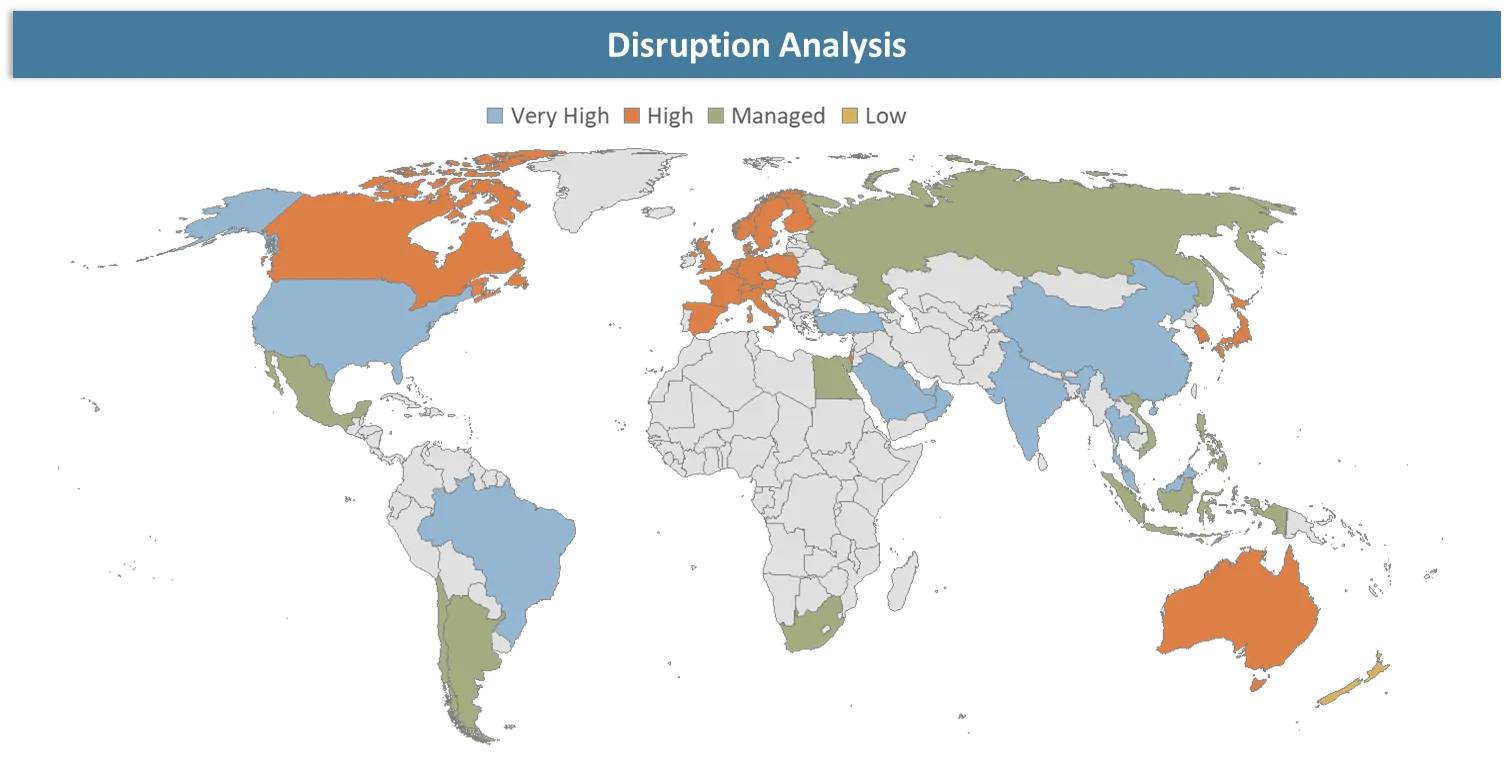
Rapid Adoption of Silicon–Graphite Anodes Disrupting Conventional Graphite Demand and Anode Material Formulations
The disruption in the battery-grade graphite market is increasingly associated with the rapid development of silicon–graphite composite anodes that are posing competition to the traditional practice of using graphite as the leading anode component. Lithium capacity storage capability of silicon is much higher compared to graphite, thereby motivating the battery developers to utilize silicon in combination with graphite to boost capacity without losing the entire graphite manufacturing process and cell-making process. In May 2026, according to Royal Society of Chemistry, studies indicated that silicon-graphite anode composition of 20 wt% of silicon exhibited capacity greater than 1,000 mAh/g, which is much higher than the practical capacity of graphite anode.
There is a further disruption that comes with the use of silicon-laden anodes; that is in the requirements for graphite for batteries. In June 2026, according to ACS publications, study on fast charging electrodes which found out that there were positive impacts in terms of rate capabilities and also lithium plating, and mechanical degradation was lessened through the use of 80 wt% graphite with 20 wt% silicon. Furthermore, according to the International Energy Agency (IEA), one of the important technology paths is silicon-doped graphite anodes, and if the move towards silicon-enriched anodes accelerates, there would be almost triple silicon demand in 2030, with 6% lower graphite demand. The disruption, therefore, does not affect the demand for graphite, but the market is transitioning from graphite anodes to higher-performance silicon-graphite anodes, which will bring changes for the graphite producers in terms of specifications and processing technologies for next-generation lithium-ion batteries.
Battery-Grade Graphite Market BCG Matrix: Company Evaluation
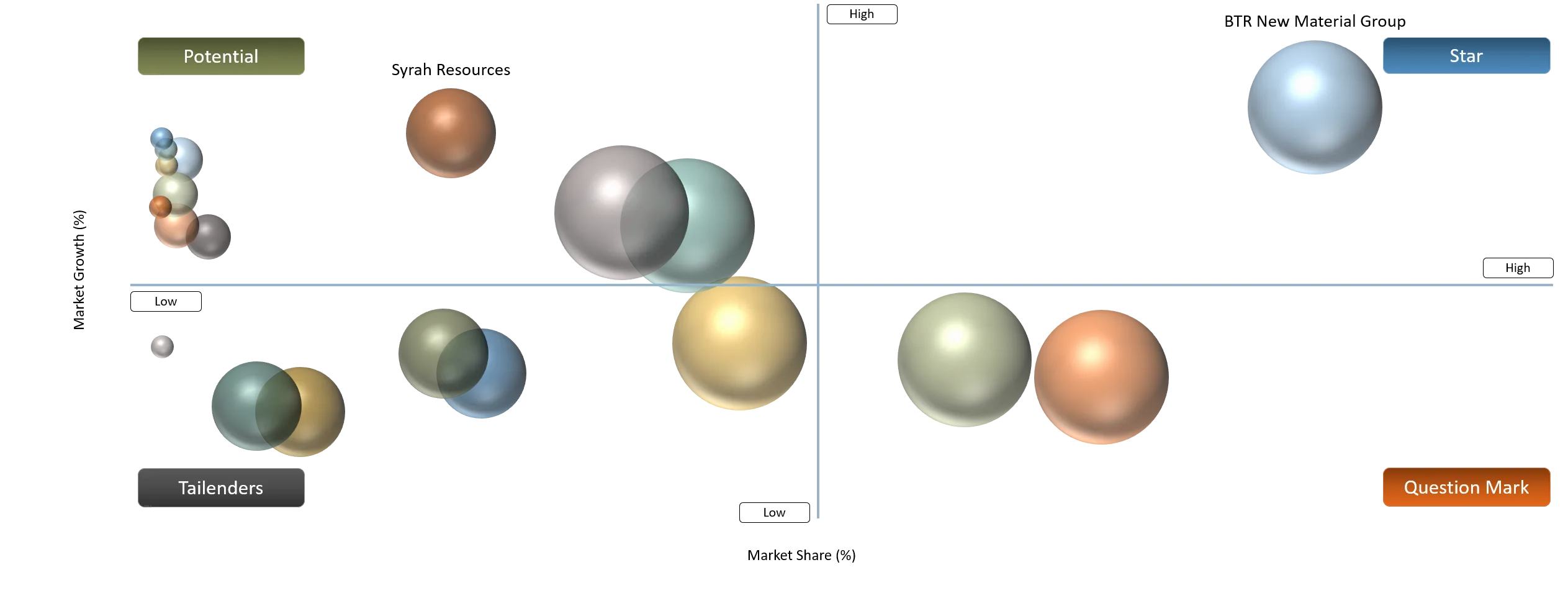
Stars include BTR New Material Group, Hunan Zhongke Shinzoom Technology, POSCO Future M, and Resonac Holdings Corporation because they have established large-scale graphite anode-material operations, strong customer relationships, and broad product portfolios covering natural and/or synthetic graphite. BTR has maintained a leading position in global lithium-ion anode-material shipments, while Shinzoom has expanded its position in China's anode-material industry. Question Marks include Mitsubishi Chemical Group, Tokai Carbon Co., Ltd., Himadri Speciality Chemical, and Epsilon Advanced Materials because they possess relevant graphite, carbon-material, or anode-material technologies but are still expanding their position relative to the established global leaders.
Potential includes Syrah Resources, NOVONIX Limited, Vianode, and Nouveau Monde Graphite (NMG) because they are developing strategically important non-China sources of battery-grade graphite and active anode material but remain in the scale-up or commercialization phase compared with established Asian producers. Syrah's integrated natural-graphite-to-active-anode-material model, NOVONIX's U.S. synthetic-graphite production, Vianode's low-emission synthetic-graphite strategy, and NMG's Québec-based integrated graphite project provide strong positioning as automakers and battery manufacturers seek regional supply diversification. Tailenders would be none of the 12 selected companies, because each has a meaningful connection to graphite, synthetic graphite, anode materials, or the emerging battery-material supply chain.
Battery-Grade Graphite Market Dynamics
Driver Impact Analysis
| Driver | Market Growth Impact (%) | Demand Concentration | Impacted Use Case | Strategic Impact |
Rapid expansion of lithium-ion battery manufacturing is increasing structural demand for high-purity graphite used in anode production. | 28% | Very High – China & Asia Pacific | EV batteries, battery cells, energy-storage batteries | Expands baseline graphite consumption and encourages anode manufacturers to secure long-term supplies of natural and synthetic battery-grade graphite. |
Expansion of battery energy storage systems (BESS) is creating an additional demand channel for graphite-based anode materials beyond automotive batteries. | 18% | High – China, North America & Europe | Grid-scale BESS, renewable-energy storage, commercial & industrial storage | Diversifies graphite demand beyond EVs and strengthens requirements for scalable, cost-efficient graphite anode materials. |
Rising demand for high-energy density batteries is driving greater use of engineered graphite with controlled particle morphology, purity, and electrochemical characteristics. | 20% | High – EVs, premium batteries & advanced energy storage | High-energy-density EV batteries, high-performance cells, premium portable electronics | Shifts competition from commodity graphite toward engineered grades with tighter purity, particle-size, coating, and electrochemical specifications. |
Expansion of regional battery manufacturing capacity is stimulating investment in localized graphite purification, graphitization, coating, and anode-material production. | 21% | High – China, Europe, North America & emerging Asian hubs | Regional battery gigafactories, localized anode-material supply chains | Accelerates downstream graphite capacity outside China and increases demand for integrated mine-to-anode supply chains. |
Increasing demand for fast charging batteries is encouraging anode manufacturers to develop graphite materials. | 13% | Medium–High – EVs & high-performance battery applications | Fast-charging EV batteries, electric commercial vehicles, high-power batteries | Drives development of optimized graphite morphology, surface treatment and coating technologies while increasing qualification requirements for suppliers. |
Rapid expansion of lithium-ion battery manufacturing is increasing structural demand for high-purity graphite used in anode production
The rapid expansion of lithium-ion battery production capacity is one of the major forces behind the rising demand for graphite anodes, as graphite is the primary anode material that is being used in lithium-ion batteries. Global lithium-ion battery production capacity surpassed 4 TWh, while EV battery deployment worldwide in 2025 came to 1.2 TWh, with China producing over 90% of all anode active materials for EV batteries, highlighting the underlying demand for graphite. Increasing capacity of battery cell production is driving the need for battery-grade graphite supply from battery makers and anode producers.
The growing use of batteries in the region will make Indonesia a strategic supplier of graphite for battery making. In July 2026, according to Petromindo, citing the International Energy Agency (IEA), the production of battery-grade graphite in Indonesia will be close to tripling by 2030 to reach 93,000 tonnes from 32,000 tonnes in 2025. This is because of the increasing importance of Indonesia in the production of battery materials due to the expansion of battery production in Southeast Asia. In addition, according to the International Energy Agency, the total demand for graphite cleantech worldwide will increase to 4.114 million tonnes in 2030 from 1.505 million tonnes in 2024.
Restraint Impact Analysis
| Restraint | Drag on Market Growth (%) | Primary Impact Area | Impacted Use Case | Strategic Impact |
Energy-intensive graphitization and purification processes increase production costs and create challenges. | 15% | Processing Cost & Production Economics | Battery-anode material production | Raises conversion costs and pressures producers to adopt lower-energy purification and graphitization technologies to remain cost competitive. |
High technical requirements for battery-grade purity and particle morphology increase qualification complexity. | 13% | Product Qualification & Quality Control | EV and energy-storage lithium-ion battery anodes | Extends customer qualification cycles and increases testing requirements because battery-grade graphite must meet tightly controlled purity, particle-size, morphology, surface-area, density, and crystal-structure specifications. |
Long qualification cycles with battery and cell manufacturers delay commercialization of new battery-grade graphite projects and increase financing risks for emerging producers. | 11% | Commercialization & Project Financing | New graphite projects supplying EV and energy-storage cells | Delays revenue realization for emerging producers, increases working-capital requirements, and raises the risk that projects require additional financing before reaching commercial offtake. |
High capital requirements for integrated graphite processing facilities create barriers to establishing competitive mine-to-anode supply chains outside established production hubs. | 12% | Capital Investment & Supply-Chain Development | Integrated natural graphite-to-CSPG production | Limits new entrants and slows geographic diversification of battery-grade graphite supply by requiring investment across purification, spheroidization, classification, and coating stages. |
High technical requirements for battery-grade purity and particle morphology increase qualification complexity
One of the key restraints affecting the battery-grade graphite market is the stringent specifications needed for the purity, particle size distribution, morphology, tap density, and crystal structure needed in lithium-ion battery anodes. As per Titan Mining, in 2025, downstream tests confirmed that the natural flake graphite can be upgraded to spherical graphite with 99.99% purity, good tap density, and good particle size distribution for use in battery anodes. Similarly, according to Focus Graphite, in July 2025, battery-grade coated spherical natural graphite samples with approximate 23.9 µm D50 particle size and greater than 99.95% purity were sent to potential clients.
Battery-grade graphite needs strict purification processes in order to satisfy standards of high purity levels in carbon. In January 2026, as per Taylor & Francis, the study assesses leaching and thermal treatment processes that can be used to obtain high-purity graphite. It has been shown how difficult it is to obtain battery-relevant purity levels: the percentage of carbon in the natural graphite was raised from 78.4 wt% to 97.6 wt% through sulfuric acid leaching and thermal treatment, while the reference battery-grade graphite contained 98.0 wt% of carbon. The findings further highlight the technical difficulty of removing impurities, thus justifying the development of purification techniques that are environmentally friendly to achieve high-purity graphite.
Battery-Grade Graphite Market Segmentation Analysis
The global battery-grade graphite market is segmented based on graphite type, product form, purity level, battery chemistry, processing stage, application, and region.
Electric Vehicle (EV) Batteries Driving Dominant Demand for Battery-Grade Graphite
The electric vehicle (EV) batteries segment dominates the application landscape in the battery-grade graphite market, with a 77.2% market share in 2025. The leading position of the segment is largely explained by the fast development of lithium-ion battery production for electric vehicles, where graphite acts as a vital component in the anodes due to its excellent ability to store energy, electrochemical stability, and commercial feasibility. In 2025, global demand for EV batteries was more than 1 TWh, which proves the necessity of using battery-grade graphite owing to increased cell manufacturing capacity. Increasing trends towards more advanced batteries with increased capacities and greater driving range are only adding to the demand for more graphite in electric vehicle batteries.
Graphite material manufacturers and battery makers are beginning to focus on the development of high-purity, spherical, and coated graphite materials for the satisfaction of the requirements set by EV batteries. Rising usage of LFP and NMC battery technology is another factor contributing to the growth of demand for processed graphite anodes for batteries. Moreover, the rise in manufacturing capacity of EVs and batteries during 2025–2026 is making the need for domestic and regional graphite supplies even more important. All these factors will make EV batteries the largest revenue-generating segment in the market for battery-grade graphite.
Battery-Grade Graphite Market Geographical Penetration
Rapid EV Battery Manufacturing and Graphite Processing Expansion in Asia-Pacific
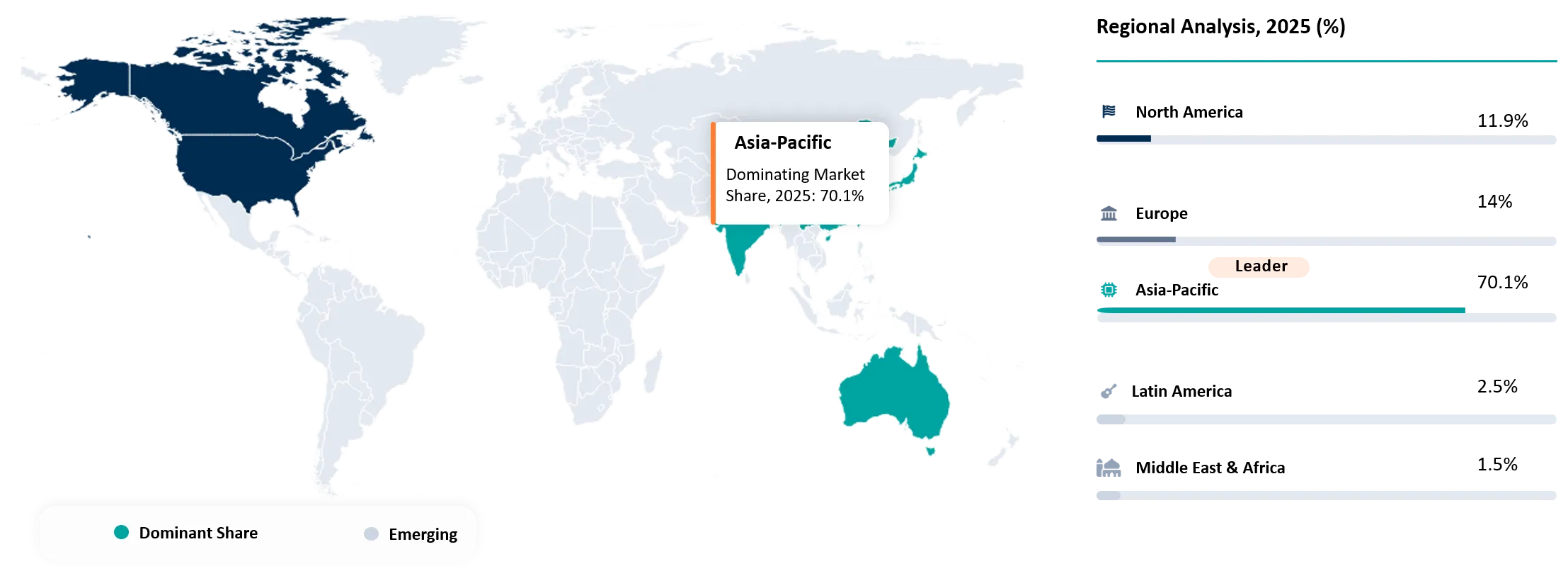
Asia-Pacific region dominates the battery-grade graphite market, with a 70.1% market share in 2025, owing to the presence of lithium-ion battery production facilities, EV manufacturing operations, graphite manufacturing units, and anode material producing facilities in the Asia-Pacific region. China continues to be one of the key players for the supply chain in the region due to its capability in producing purified graphite, spheroidized graphite, and anode materials. The fast-growing production of batteries for electric vehicles and energy storage in countries such as China, Japan, South Korea, and many others in Asia is leading to growing demand for graphite anodes.
In May 2025, Himadri Speciality Chemical Ltd, an India-based specialty chemicals and advanced battery-materials company headquartered in Kolkata, India, partnered with Sicona Battery Technologies Pty Ltd, an Australia-based battery-materials technology company headquartered in Wollongong, Australia, to establish India’s first silicon-carbon anode plant. Himadri invested a total of USD 14.52 million (₹139 crore) in Sicona, comprising USD 60.6 million (₹58 crore) for a 12.5% stake and USD 8.46 million (₹81 crore) through convertible notes. Sicona’s SiCx® technology, which is typically integrated with 5–20% graphite, is designed to increase lithium-ion battery energy density by 20% and charging performance by 40%. The proposed plant is expected to be established in Odisha, India, supporting localization of advanced anode-material production in the Asia-Pacific region.
China Battery-Grade Graphite Market Trends
China holds a dominant position in the battery-grade graphite market because of its developed mining and processing of graphite industry, advanced production of lithium-ion batteries and significant share in the whole supply chain for anode materials. China has managed to create capacities that include purification of graphite, creation of spheres, coating, and production of anode materials and thus allows producing battery-grade graphite in a mass scale. In 2025, China kept its leadership in the global graphite supply chain owing to high domestic demand for electric cars and energy storage units and the presence of battery manufacturing facilities.
In July 2026, Contemporary Amperex Technology Co. Ltd. (CATL), a China-based battery manufacturer headquartered in Ningde, China, acquired a strategic interest in CarbonScape, a New Zealand-based battery-materials technology company that converts forestry by-products into graphite for lithium-ion batteries. CATL and Hong Kong-based investment firm Lochpine Capital will take a combined 20% stake in CarbonScape to scale bio-based battery-grade graphite for the global automotive and energy-storage industries. CarbonScape’s technology will undergo demonstration-scale testing at CATL facilities in China, while the company targets commercial biographite production by the end of the decade, with its first industrial-scale facility targeted to supply the market during 2029–2030.
Japan Battery-Grade Graphite Market Outlook
Japan is one of the significant participants in the Asia-Pacific battery-grade graphite market owing to its existing lithium-ion batteries industry and auto manufacturing industry, as well as its expertise in developing battery materials. Japan has been engaged in producing high-performance batteries for a long time, but its growth in electric mobility and energy storage during the period 2025-2026 is expected to fuel the demand for graphite in lithium-ion battery anodes. Moreover, Japan’s pre-existing connections between car manufacturers, battery makers, and material suppliers also aid the development and commercialization of high-tech battery materials.
In February 2026, Idemitsu Kosan Co., Ltd., a Japan-based energy and petroleum company, partnered with Graphinex Pty Ltd, an Australia-based critical-minerals and graphite company, Marubeni Corporation, a Japan-based trading and investment company, and NSC, a Japan-based chemicals-processing company, to develop an integrated Japan–Australia natural graphite-to-anode supply chain. The project will use high-grade graphite from Graphinex’s Queensland resources and establish downstream anode-material manufacturing in Japan, with commercialization targeted within several years, primarily supplying battery manufacturers and automakers.
Battery Manufacturing Expansion and Supply-Chain Localization Strengthening North America’s Battery-Grade Graphite Market
The North America market is an important regional market for battery-grade graphite, accounting for an estimated 11.9% market share in 2025, supported by the expansion of electric-vehicle battery manufacturing, energy-storage deployment, and efforts to establish a more localized battery-material supply chain. The region is increasingly focused on reducing dependence on overseas sources of critical battery materials, creating opportunities for domestic graphite processing, purification, and anode-material production. The growing deployment of EVs and battery energy-storage systems is increasing demand for high-purity graphite required in lithium-ion battery anodes.
In April 2025, Northern Graphite Corporation, a Canada-based natural graphite mining and battery-materials company, partnered with The BMI Group, a Canada-based industrial and infrastructure development company, to evaluate a Battery Anode Material (BAM) facility at a former paper mill in Baie-Comeau, Quebec. The proposed Stage 1 facility is planned for 50,000 tonnes per year of BAM, with graphite feedstock supplied from Northern Graphite’s Lac des Iles mine in Quebec and development projects in Ontario and Namibia. The facility is intended to upgrade graphite concentrate to the specifications required by EV battery manufacturers, strengthening North America’s domestic battery-material supply chain.
U.S. Battery-Grade Graphite Market Trends
The U.S. holds a strong position in the North American battery-grade graphite market owing to the rapid expansion of domestic lithium-ion battery manufacturing, increasing electric-vehicle adoption, and government efforts to establish secure critical-mineral supply chains. The availability of major battery manufacturers, EV producers, and emerging graphite and anode-material developers is encouraging closer integration across the battery value chain. During 2025–2026, the continued expansion of U.S. battery-cell and energy-storage manufacturing capacity increased the need for reliable supplies of high-purity graphite, while companies increasingly focused on domestic production of processed anode materials to reduce dependence on imported supply.
In February 2026, Green Graphite Technologies Inc. (GGT), an emerging Canadian graphite-manufacturing technology company, signed an MOU with the Shepherd Chemical Company, a U.S.-based specialty chemical manufacturing company headquartered in Cincinnati, Ohio, to commercialize cleaner and cost-effective battery-grade graphite for North American EV and energy-storage markets. Shepherd will support GGT’s first technology-demonstration phase beginning in March 2026, with both companies exploring commercial-scale opportunities and a potential definitive agreement later in 2026. GGT’s patented process converts mined natural flake graphite and recycled graphite into lithium-ion battery-grade graphite, while the company is also pursuing a USD 7 million financing to support its demonstration plant.
Battery-Grade Graphite Market Competitive Landscape
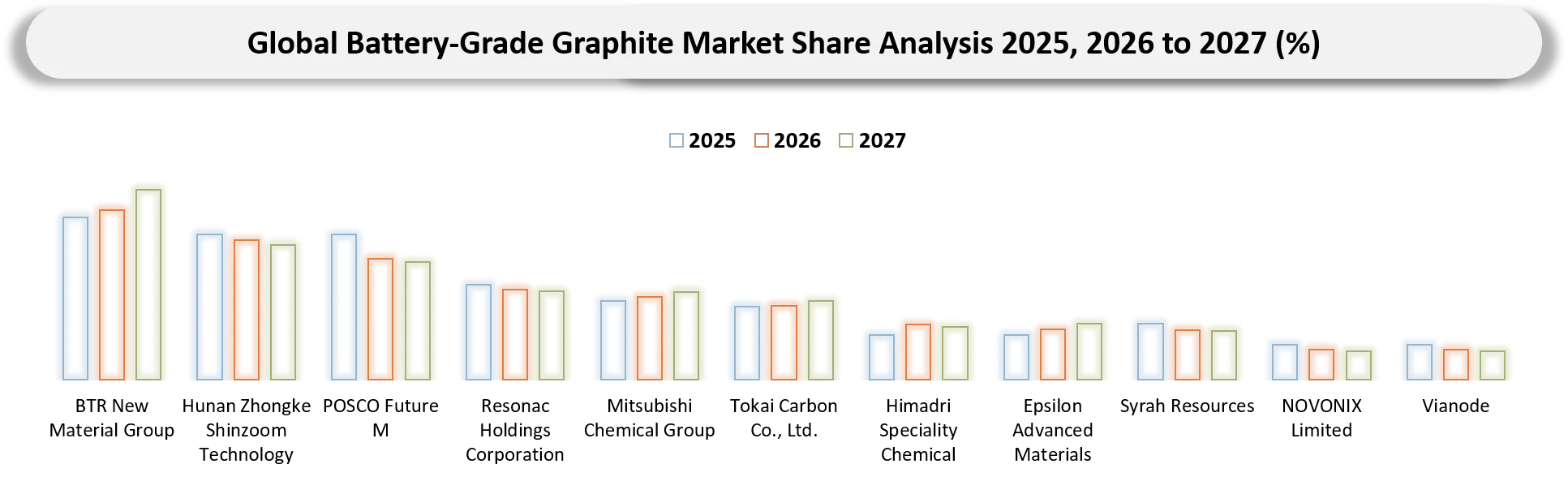
- The market is characterized by three key participant groups: large-scale graphite anode-material producers, integrated battery-material companies, and emerging regional graphite and anode-material developers. BTR New Material Group, Hunan Zhongke Shinzoom Technology, POSCO Future M, Resonac Holdings Corporation, Mitsubishi Chemical Group, and Tokai Carbon compete through large-scale anode-material production, advanced natural and synthetic graphite capabilities, and established relationships with battery manufacturers; Himadri Speciality Chemical, Epsilon Advanced Materials, Syrah Resources, NOVONIX Limited, Vianode, and Nouveau Monde Graphite (NMG) focus on localized graphite purification, spherical graphite, coated anode materials, and integrated supply-chain development. This creates a highly competitive landscape where production scale, graphite-processing capabilities, product quality, technological advancement, supply-chain localization, and long-term battery-manufacturer partnerships define competitiveness.
- Key players include: BTR New Material Group, Hunan Zhongke Shinzoom Technology, POSCO Future M, Resonac Holdings Corporation, Mitsubishi Chemical Group, Tokai Carbon Co., Ltd., Himadri Speciality Chemical, Epsilon Advanced Materials, Syrah Resources, NOVONIX Limited, Vianode, and Nouveau Monde Graphite (NMG).
Key Developments
- November 2025: Vianode, a Norwegian advanced battery-materials company headquartered in Oslo, Norway, signed a Letter of Intent with C4V, a U.S.-based lithium-ion battery technology company headquartered in Vestal, New York, to supply high-performance synthetic anode graphite for battery energy storage systems (BESS).
- January 2025: NOVONIX Limited, an Australia-based battery materials and technology company, entered an exclusive licensing agreement with Harper International Corporation, a U.S.-based advanced-materials thermal processing technology company, for Harper’s continuous, induction-based graphitization furnace technology used to produce synthetic graphite anode material for lithium-ion batteries.
- January 2025: General Motors (GM), a U.S.-based automotive manufacturer headquartered in Detroit, Michigan, signed a multi-billion-dollar agreement with Vianode, a Norwegian advanced battery-materials and synthetic graphite company headquartered in Oslo, Norway, to develop and supply synthetic anode graphite for EV batteries through 2033.
- August 2025: NextSource Materials Inc., a Canada-based battery-materials and graphite mining company, entered a binding multi-year offtake agreement with Mitsubishi Chemical Corporation (MCC), a Japan-based chemical and advanced-materials company, to supply approximately 9,000 tonnes per year (tpa) of anode active material (AAM) for a major OEM’s North American EV market.
- November 2025: OneD Material Inc. (doing business as OneD Battery Sciences), a U.S.-based battery-technology company, entered a Joint Development Agreement with Shanghai Putailai New Energy Technology Co., Ltd. (Putailai), a China-based lithium-ion battery-materials and automation company, to develop and scale next-generation silicon-graphite anode materials for lithium-ion batteries.
- February 2025: Northern Graphite Corporation, a Canada-based natural graphite mining and battery-materials company, began supplying three standard Battery Anode Material (BAM) products and its patented Porocarb material to battery manufacturers for lithium-ion and all-solid-state batteries.
Key Procurement Priorities and Buyer Evaluation Criteria
- Organizations procuring battery-grade graphite increasingly prioritize suppliers capable of delivering high-purity, consistent, and battery-qualified graphite with controlled particle-size distribution, tap density, surface characteristics, and electrochemical performance required for lithium-ion battery anodes.
- The procurement decision is increasingly influenced by the expansion of EV batteries, energy-storage systems, and high-performance lithium-ion cells, along with the need for reliable and diversified graphite supply chains. Buyers are therefore evaluating suppliers based on their ability to support large-volume, long-term requirements while maintaining consistent product quality.
- Buyers consider factors such as graphite purity, particle-size distribution, tap density, first-cycle efficiency, specific capacity, impurity levels, moisture content, coating uniformity, and batch-to-batch consistency when evaluating battery-grade graphite suppliers.
Why Choose DataM?
- Technological Innovations: Explores advancements in battery-grade graphite production, including high-purity purification, spheroidization, micronization, coating, graphitization, and particle-size classification, enabling manufacturers to meet the performance requirements of lithium-ion battery anodes for EVs, energy-storage systems, consumer electronics, and power tools.
- Product Performance & Market Positioning: Evaluates how graphite suppliers differentiate through purity, particle-size distribution, tap density, specific capacity, first-cycle efficiency, coating quality, and electrochemical performance, highlighting competitive positioning across natural graphite, synthetic graphite, spherical graphite, and coated spherical purified graphite (CSPG).
- Real-World Evidence: Highlights the adoption of battery-grade graphite in EV batteries, energy-storage systems, consumer electronics, power tools, and industrial batteries, demonstrating its role in improving anode performance, energy density, cycle life, charging capability, and overall battery efficiency.
- Market Updates & Industry Changes: Tracks key developments such as graphite-processing capacity expansions, new anode-material plants, battery-grade graphite projects, supply-chain localization, government initiatives, and strategic investments across Asia-Pacific, North America, and Europe, supporting the development of diversified battery-material supply chains.
- Competitive Strategies: Analyzes how leading companies expand through production-capacity additions, purification and coating technology development, vertical integration, strategic partnerships, long-term supply agreements, and regional manufacturing investments to address growing demand from EV and energy-storage battery markets.
- Pricing & Market Access: Explains pricing variations based on graphite type, purity level, particle size, processing requirements, coating specifications, production scale, and geographic origin, while assessing access through graphite producers, anode-material manufacturers, battery suppliers, and integrated battery-material supply chains.
- Market Entry & Expansion: Identifies growth opportunities driven by EV battery production, energy-storage deployment, battery manufacturing localization, and demand for diversified critical-mineral supply chains, while outlining strategies such as regional capacity expansion, advanced processing capabilities, vertical integration, and partnerships with battery manufacturers.
Target Audience 2026
- Graphite Mining & Processing Companies
- Battery Anode Material Manufacturers
- Lithium-Ion Battery Manufacturers
- Electric Vehicle Manufacturers & Automotive OEMs
- Energy Storage System (ESS) Manufacturers
- Battery Material Procurement & Sourcing Teams
- Chemical & Advanced Material Companies


























































