


Battery Black Mass Recycling Market Size and Overview
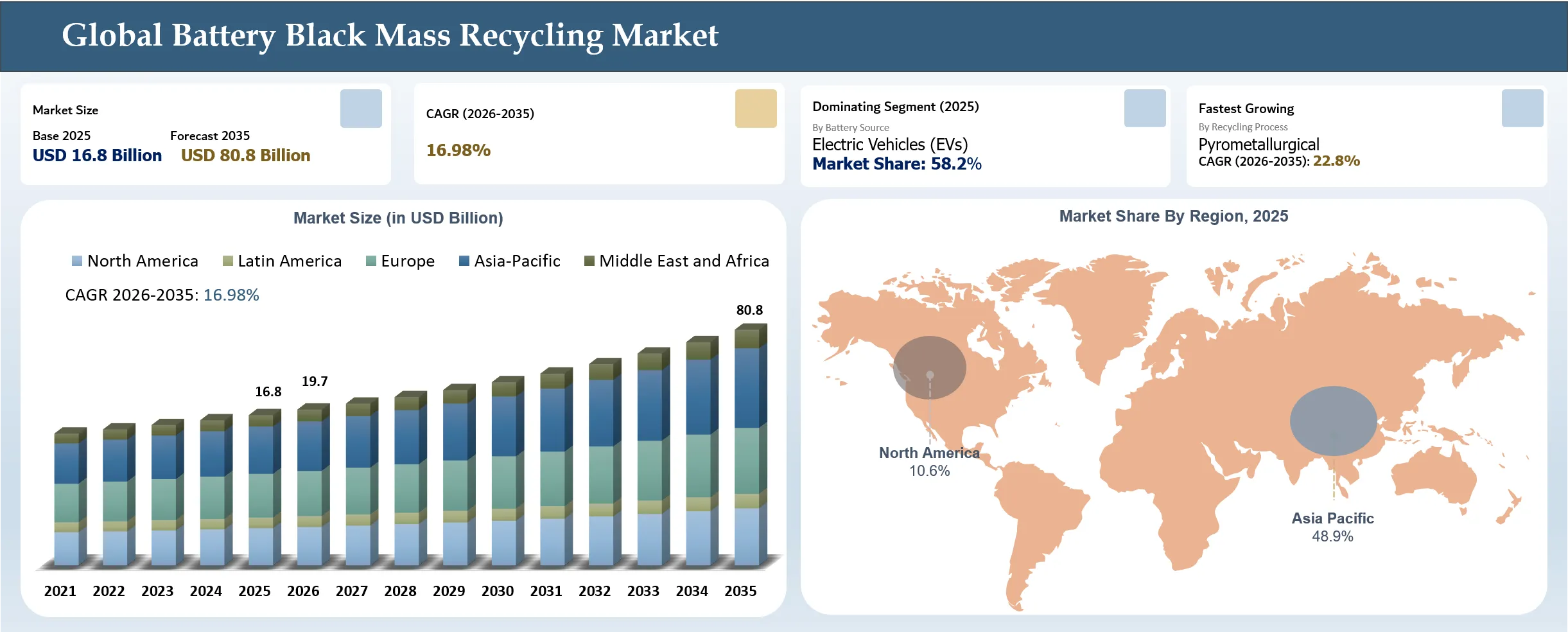
The global battery black mass recycling market reached USD 16.8 billion in 2025 and is expected to reach USD 80.8 billion by 2035, growing with a CAGR of 16.98% during the forecast period 2026-2035. The market is gaining momentum as increasing volumes of end-of-life electric vehicle batteries and lithium-ion battery production are being collected, leading to increased amounts of black mass that consists of such valuable materials as lithium, nickel, cobalt, manganese, copper, among others. In June 2025, BASF started the commercial operation of its Schwarzheide black mass plant in Germany, which is capable of handling up to 15,000 tonnes of end-of-life lithium-ion batteries and scrap yearly, or around 40,000 EV batteries, which indicates that the industry is moving to commercial-scale processing. In April 2026, Fortum Battery Recycling obtained an upgraded environmental permit for its Kirchardt plant in Germany, with the handling capacity rising from 10 to 25 tonnes of end-of-life lithium-ion batteries daily, while at its Harjavalta plant, there is hydrometallurgical processing of black mass that allows the recovery of valuable battery metals.
Companies like BASF, Umicore, Fortum Battery Recycling, Li-Cycle, Redwood Materials, and Ascend Elements are working on improving their integrated recycling capacities that would allow turning black mass into recovered battery materials. This is evident in the Umicore process whereby 90% recovery rates of lithium and 95% recovery rates of cobalt, nickel, and copper are recorded in what they call pyro-hydro technology.
The growth of capacity to recycle large amounts of black mass is bolstering battery recycling in the United States. In August 2025, according to Shanghai Metals Market (SMM), Princeton NuEnergy (PNE) announced the successful start of operations at its state-of-the-art black mass recycling and cathode active material production facility based in Chester, South Carolina, in the United States. This is the first-ever industrial-scale recycling facility for recycling black mass of this type in the country. Currently, its processing capacity stands at 5,000 metric tons per year and is expected to be increased up to 15,000 metric tons per year by 2026, potentially growing up to 50,000 metric tons per year. The facility uses mainly high-purity black mass from battery manufacturing waste, ensuring more than 97% yield of the product.
White-Space Opportunities for U.S. Battery Black Mass Recycling and Critical-Material Recovery from DOE Funding
In March 2026, the U.S. Department of Energy (DOE) announced a Notice of Funding Opportunity (NOFO) of up to USD 500 million to expand domestic critical-mineral and materials processing, derivative battery manufacturing, and recycling, creating significant whitespace opportunities across the U.S. battery and critical-materials value chain. The largest investment opportunity is in critical-mineral and materials processing and battery manufacturing and recycling, with the program specifically targeting facilities that can strengthen domestic supply chains for batteries and other strategic industries. The funding supports critical-mineral processing, derivative battery manufacturing, and battery recycling, including recovery of materials from battery manufacturing scrap and end-of-life batteries, making black mass recycling and critical-material recovery an important opportunity within the broader program. The investment also creates opportunities in advanced processing technologies, downstream battery-material production, and commercial-scale recycling infrastructure, with the overall funding envelope reaching up to USD 500 million.
The investment is expected to benefit companies operating across battery recycling, black mass processing, critical-mineral recovery, and battery-material manufacturing, including Princeton NuEnergy, Nth Cycle, Li-Cycle, Redwood Materials, and Ascend Elements, which are positioned across different stages of the battery recycling and recovered-material value chain. Princeton NuEnergy can benefit from opportunities in black mass recycling and recovery of battery materials, while Nth Cycle is positioned in critical-mineral recovery from battery-related feedstocks; Li-Cycle and Redwood Materials can benefit from expanded domestic battery recycling and recovered-material processing capacity, while Ascend Elements can benefit from downstream production of recycled battery materials. In addition, companies involved in processing lithium, graphite, nickel, copper, and other critical materials can capture opportunities from the domestic processing component of the program.
Battery Black Mass Recycling Market Strategic Takeaways
- The Asia-Pacific region dominated the market by holding a 48.9% share of global revenues in 2025. This leading position is supported by major battery manufacturing networks in China, South Korea, and Japan.
- Electric vehicles (EVs) served as the primary application source, accounting for 58.23% of total market share in 2025. Global EV sales surpassed 20 million units in 2025 and are expected to reach 23 million in 2026, representing nearly 30% of all car sales worldwide.
- Pyro-hydrometallurgical processing achieves recovery yields of 90% for lithium and 95% for cobalt, nickel, and copper. Additionally, specialized commercial direct recycling facilities report material recovery yields exceeding 97%.
- A USD 500 million U.S. Department of Energy (DOE) Notice of Funding Opportunity creates significant whitespace in domestic critical-mineral processing, derivative battery manufacturing, and commercial recycling infrastructure.
Battery Black Mass Recycling Market Industry Trends and Strategic Insight
- Shift toward chemistry-specific recycling is accelerating, as recyclers adapt black-mass treatment routes to the changing composition of NMC, LFP, and other lithium-ion battery chemistries rather than relying on a single recovery configuration.
- LFP-focused recycling is becoming a strategic priority, as the lower concentration of high-value nickel and cobalt makes conventional recycling economics less attractive and increases the need for selective lithium recovery and lower-cost processing routes.
- Closed-loop hydrometallurgy is gaining importance, with recyclers increasingly targeting direct conversion of black-mass-derived materials into battery-grade precursors and cathode materials rather than selling partially refined intermediates.
- Investment should increasingly favor integrated black-mass-to-battery-material facilities, where downstream refining and cathode-material production can reduce dependence on external processors and improve value capture.
- Recyclers should treat black-mass specification and traceability as strategic assets, establishing tighter controls over battery chemistry, contamination, particle size, and feedstock origin to improve downstream process stability.
Battery Black Mass Recycling Market Scope
| Metrics | Details | |
| 2025 Market Size | USD 16.8 Billion | |
| 2035 Projected Market Size | USD 80.8 Billion | |
| CAGR (2026-2035) | 16.98% | |
| Largest Market | Asia-Pacific | |
| Fastest Growing Market | North America | |
| By Recycling Process | Direct Recycling, Pyrometallurgical Recycling, Hydrometallurgical Recycling | |
| By Recovered Material | Lithium, Nickel, Cobalt, Manganese, Copper, Graphite, Other Materials | |
| By Battery Type | Lithium-Ion Batteries, Nickel-Based Batteries, Others | |
| By Battery Source | Electric Vehicles (EVs), Consumer Electronics, Energy Storage Systems (ESS), Power Tools, Industrial Batteries, Others | |
| By Region | North America | U.S., Canada, Mexico |
| Europe | Germany, UK, France, Spain, Italy, Poland | |
| Asia-Pacific | China, India, Japan, Australia, South Korea, Indonesia, Malaysia | |
| Latin America | Brazil, Argentina | |
| Middle East and Africa | UAE, Saudi Arabia, South Africa, Israel, Türkiye | |
| Report Insights Covered | Competitive Landscape Analysis, Company Profile Analysis, Market Size, Share, Growth | |
Battery Black Mass Recycling Market Disruption Analysis
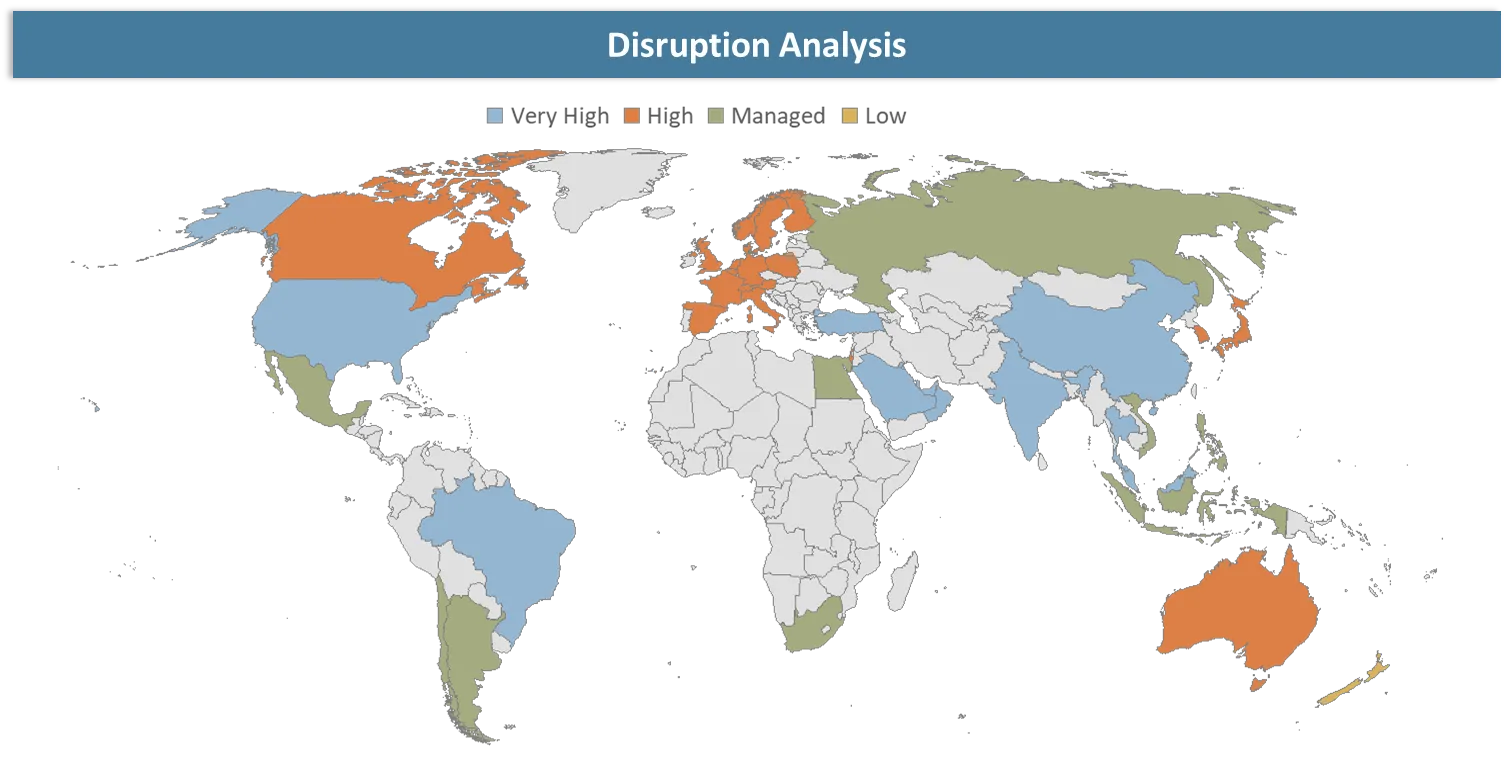
Shift Toward LFP and Lower-Value Battery Chemistries Disrupting Conventional Black Mass Recycling Economics
The disruption in the battery black mass recycling market is primarily associated with the rapid shift towards lithium iron phosphate (LFP) batteries since it alters the content of the recyclable battery feedstock. According to the International Energy Agency (IEA), the share of LFP batteries in EV batteries installed across the globe in 2025 increased from 50% to more than 55%. It should be noted that LFP batteries do not contain nickel or cobalt, as in the case of NMC and NCA batteries. In addition, the IEA data show that LFP battery packs cost more than 40% less per kWh compared to NMC battery packs in 2025, reinforcing their rapid adoption and increasing the likelihood that future recycling streams will contain a larger proportion of lower-value LFP black mass.
The shift is forcing recyclers to reconfigure their processing economics based on lithium recovery efficiency, reduced costs of operations, and chemistry-specific process flows rather than being heavily dependent on the recovery of nickel and cobalt. In March 2026, according to Mysteel.net, the trade price for LFP black mass with ≥3.8% lithium was approximately CNY 6,650 per mtu, whereas much higher-value streams of NMC black mass with nickel and cobalt were available, showcasing the differential value of the materials by chemistry. At the same time, 2026 industry analysis demonstrates the limited economic viability of traditional recycling processes for low-value materials like LFP. As the share of LFP increases, recyclers are increasingly moving to selective lithium extraction, hydrometallurgical processes, direct recycling, improved sorting of feedstocks, and cost-effective recovery systems.
Battery Black Mass Recycling Market BCG Matrix: Company Evaluation
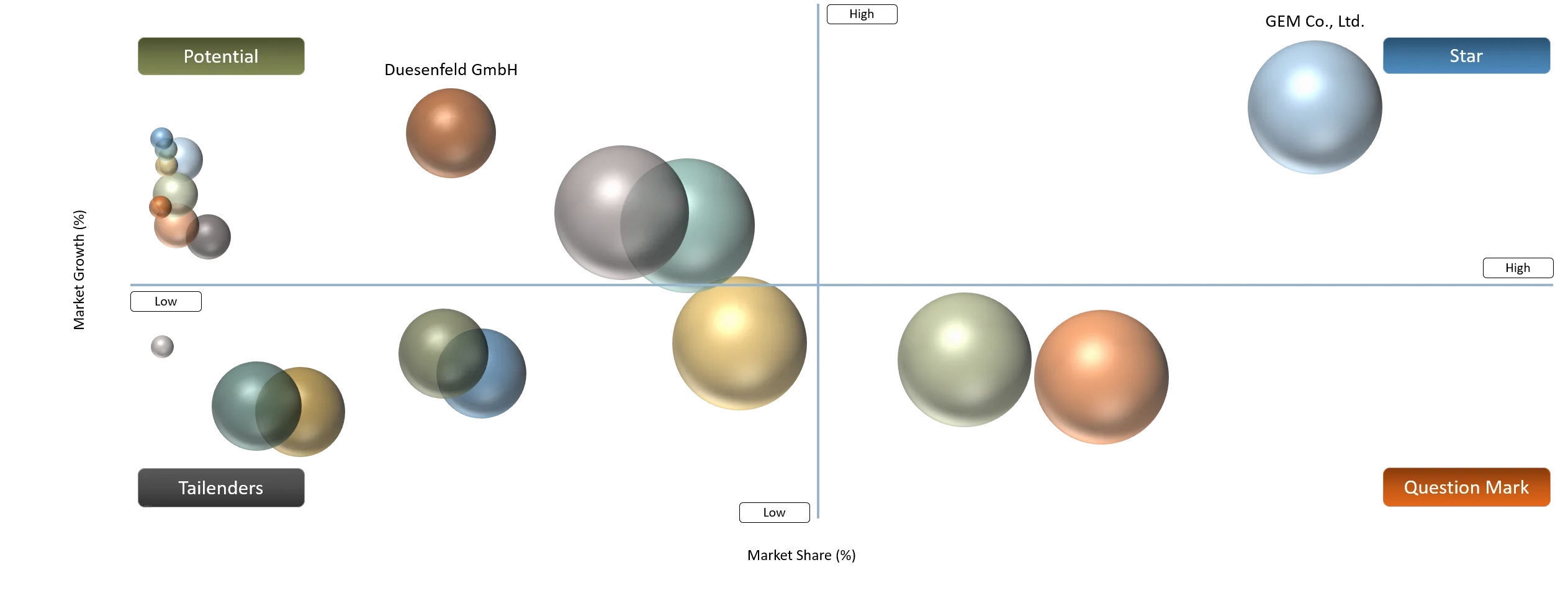
Stars include GEM Co., Ltd., Umicore, Redwood Materials, and Ecobat, as these companies have established large-scale battery recycling operations, strong black-mass processing capabilities, and integrated downstream recovery of critical battery materials. GEM benefits from its large Chinese battery-recycling ecosystem and integration with battery-material supply chains, while Umicore combines black-mass processing with downstream metal refining. Question Marks include Fortum Battery Recycling, SungEel HiTech, SK tes, and BASF, which possess significant technological capabilities and are expanding commercial black-mass processing but are operating in a market where capacity expansion, feedstock availability, and downstream integration remain highly competitive.
Potential includes Duesenfeld GmbH, Accurec Recycling GmbH, and American Battery Technology Company (ABTC), which possess differentiated recycling technologies and opportunities to scale their black-mass processing capabilities as demand for domestic battery-material recovery increases. Duesenfeld focuses on mechanical and low-temperature processing, Accurec combines mechanical and thermal treatment with lithium recovery, and ABTC has developed an integrated recycling process for recovering battery materials from lithium-ion batteries. Tailenders include RecycLiCo Battery Materials, whose technology is focused primarily on hydrometallurgical processing of lithium-ion battery black mass and conversion into battery-grade materials.
Battery Black Mass Recycling Market Dynamics
Driver Impact Analysis
| Driver | Market Growth Impact (%) | Demand Concentration | Impacted Use Case | Strategic Impact |
Rising demand for critical battery materials is driving recovery from battery black mass. | 24% | High – EV batteries, battery storage, cathode-material supply chains | Lithium, nickel, cobalt, manganese and graphite recovery for battery-material manufacturing | Strengthens the economic case for black-mass processing and encourages recyclers to integrate downstream refining and battery-grade material production. |
Increasing battery waste generation from EVs and energy storage systems is expanding the feedstock base for black mass recycling facilities. | 22% | High – EVs and energy storage systems | End-of-life EV batteries, stationary storage batteries and battery manufacturing scrap | Encourages capacity expansion, long-term feedstock agreements and localized preprocessing infrastructure; however, the IEA notes that production scrap currently dominates recycling feedstock and end-of-life EV batteries will become increasingly important later. |
Stringent regulations for battery waste management and material recovery are encouraging the recycling and recovery of valuable materials. | 19% | High – Europe, North America and regulated battery markets | Battery collection, material recovery and recycled-content compliance | Increases the need for compliant recycling infrastructure and supports contractual/toll-based recycling models, particularly for lower-value chemistries such as LFP. |
Growing emphasis on domestic and secure battery-material supply chains is accelerating investment in battery black mass recycling capacity. | 21% | High – China, Europe and North America | Domestic critical-mineral recovery and closed-loop battery-material supply | Positions black mass as a strategic secondary feedstock and encourages integration between recyclers, battery manufacturers, cathode producers and material refiners. |
Expansion of lithium-ion battery manufacturing capacity is increasing production scrap and off-specification batteries that can be processed into black mass. | 14% | High – Battery manufacturing hubs | Gigafactory production scrap, rejected cells and electrode manufacturing waste | Supports near-term recycler utilization because manufacturing scrap is currently a major available feedstock, encouraging recyclers to establish direct supply agreements with cell manufacturers. |
Rising demand for critical battery materials is driving recovery from battery black mass
With the accelerating requirement for lithium, nickel, cobalt, manganese, and graphite, there is now more economic justification for recovery of these metals through black mass recycling. According to the IEA, in 2025, clean energy applications made up a bigger portion of the demand for critical metals, with battery production still accounting for much of the material use. The growing need for electric vehicles, batteries, and the production of lithium-ion cells is putting pressure on the supply chain to ensure a consistent supply of these materials. Black mass acts as an effective secondary feedstock containing several recoverable materials.
The increasing gaps in U.S. supplies of battery materials are providing robust opportunities for recycling within the United States. In May 2026, according to Nature Energy reported that expanding U.S. domestic production together with demand-side measures such as battery recycling, improved material efficiency, battery chemistry shifts, and vehicle efficiency can substantially reduce future EV battery-material shortages, but will not fully close the gap by 2035. The accompanying analysis found that even with announced projects and demand-side strategies, 30–70% supply shortfalls are expected for upstream cobalt, graphite, and nickel and their midstream refined materials, while cathode and anode active materials could face 15–75% shortfalls. For some materials, approximately 30–100% of projected domestic supply depends on early-stage projects, highlighting the need for recycling and other domestic supply strategies.
Restraint Impact Analysis
| Restraint | Drag on Market Growth (%) | Primary Impact Area | Impacted Use Case | Strategic Impact |
Complexity and variability of battery chemistries make black mass composition inconsistent and complicate efficient material recovery. | 20% | Feedstock consistency & recovery efficiency | Mixed-chemistry EV and consumer battery recycling | Requires advanced sorting, feedstock characterization and chemistry-specific recovery processes; increases processing complexity and can reduce recovery consistency. |
Safety risks associated with handling and processing spent lithium-ion batteries increase operational complexity and recycling costs. | 17% | Safety, handling & operating costs | Collection, transportation, storage, discharge and shredding of spent batteries | Requires fire-prevention systems, safe discharge, specialized storage, worker protection and emergency-response procedures, increasing capital and operating expenditure. |
Contamination and impurities in battery black mass can reduce recovery efficiency and the quality of recovered battery materials. | 15% | Purity & downstream processing | Hydrometallurgical and pyrometallurgical recovery of lithium, nickel, cobalt and manganese | Drives additional purification, separation and quality-control requirements and can reduce the suitability of recovered materials for direct battery-material production. |
Changing battery designs and chemistries can require frequent modifications to black mass processing and recovery technologies. | 12% | Technology adaptability & capital expenditure | Recycling of next-generation EV, energy-storage and advanced Li-ion batteries | Shortens equipment and process-development cycles, increases technology-upgrade requirements and makes standardized recycling infrastructure more difficult to establish. |
Complexity and variability of battery chemistries make black mass composition inconsistent and complicate efficient material recovery
One of the significant constraints hindering the effective expansion of the battery black mass recycling market is the growing complexity and diversification of the lithium-ion battery chemistries, which results in inconsistent black mass composition and material separation in the later stages of recycling. The black mass produced as a result of the battery shredding process is not a uniform material because its composition relies on various factors, including the battery chemistry used, the battery types used as the feedstock, manufacturer, battery generation, and the type of shredding process. According to the U.S. Environmental Protection Agency, by 2025, black mass may show significant differences in composition and liquid content based on the batteries shredded.
The heterogeneous composition of black mass complicates the process and makes it difficult to attain consistent material recovery rates. In July 2026, according to ACS Publications, researchers from Aalto University characterized industrial lithium iron phosphate (LFP)-based black mass and found that the material was highly heterogeneous, containing Li (2.9 wt%), Fe (11.7 wt%), P (6.2 wt%), Mn (7.7 wt%), Ni (3.5 wt%), and Co (1.1 wt%), along with 30.5 wt% total carbon and 2.1 wt% fluorine. The study also identified particles associated with LFP, LMFP, LMO, NMC, and NCA chemistries, demonstrating that industrial black mass can contain multiple battery chemistries and impurities. The researchers concluded that this heterogeneity creates challenges for designing efficient recycling processes and highlights the need for flexible and robust recycling technologies.
Battery Black Mass Recycling Market Segment Analysis
The global battery black mass recycling market is segmented based on recycling process, recovered material, battery type, battery source, and region.
Electric Vehicles (EVs) Driving High-Volume Demand for Battery Black Mass Recycling
The Electric Vehicles (EVs) segment dominates the Battery Source category of Battery Black Mass Recycling Market and holds 58.23% of market share in 2025 due to fast-growing usage of EVs and consequently installation of large amounts of lithium-ion batteries. In May 2025, according to the International Energy Agency (IEA), sales of electric cars increased by 20% in 2025 to more than 20 million units. Thus, one in four cars sold worldwide is an electric car. The number of countries with record-high sales of electric cars reached nearly 100.
The increase in the EV vehicle fleet is presenting a significant potential feedstock opportunity for the black mass recyclers due to the fact that EV end-of-life batteries have recoverable materials including lithium, nickel, cobalt, manganese, and graphite. In May 2026, according to the IEA, an estimated 23 million electric vehicles will be sold globally by 2026 which represents about 30 percent of all car sales globally. Moreover, there has been more than a doubling of the sales of electric trucks in 2025, where electric trucks make up almost one in ten trucks sold globally. The above-mentioned factors will help strengthen EVs as the top source of batteries for the Battery Black Mass Recycling Market because of the increasing number of lithium-ion batteries in the recycling system.
Battery Black Mass Recycling Market Geographical Penetration
Expanding Battery Manufacturing and Recycling Infrastructure Supporting Asia-Pacific Dominance
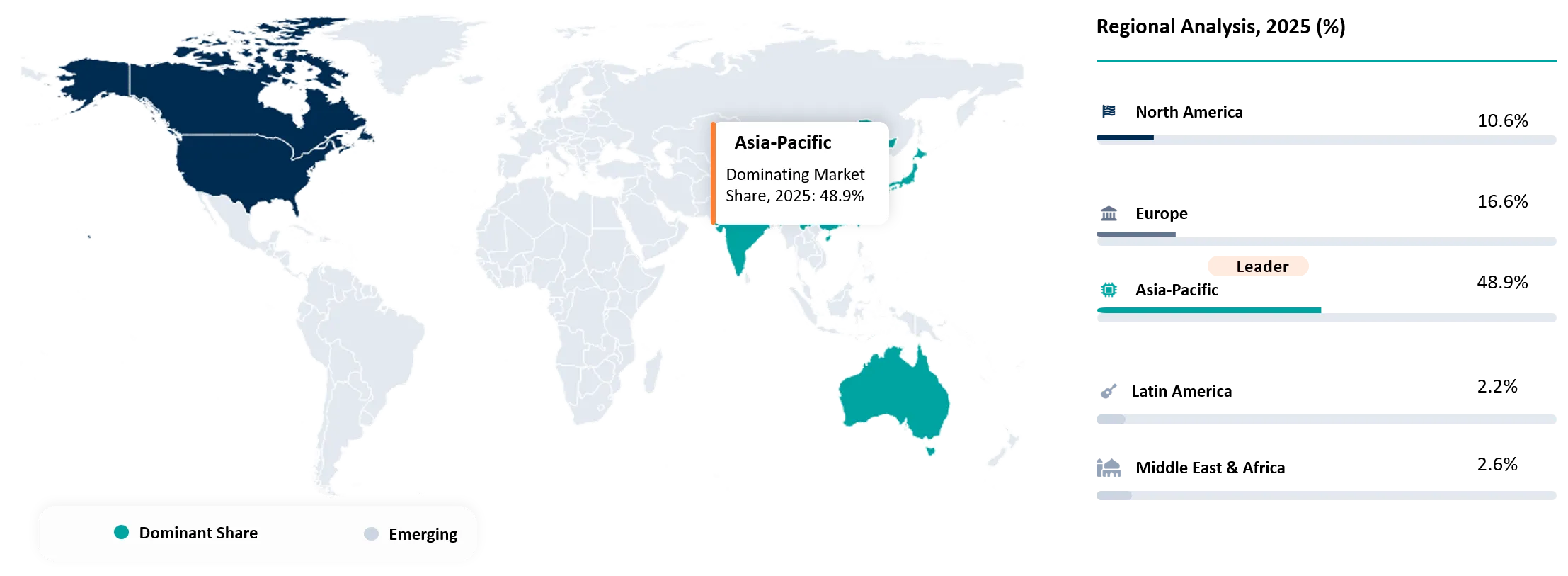
The Asia-Pacific region dominates the battery black mass recycling market, accounting for 48.9% of the market in 2025, driven by the region's strong concentration of battery manufacturing, electric vehicle production, battery materials, and recycling infrastructure. China, South Korea, Japan, and emerging Southeast Asian economies have established integrated battery value chains covering cell manufacturing, cathode and anode materials, EV production, battery collection, pretreatment, black mass production, and metal recovery. The presence of major battery manufacturers and a large installed base of electric vehicles provides recyclers with consistent access to production scrap and end-of-life lithium-ion batteries.
Strategic partnerships between battery manufacturers and material producers are strengthening closed-loop black mass recycling supply chains in Asia-Pacific. In August 2025, SK On, a South Korea-based lithium-ion battery manufacturer, signed a five-year black mass supply agreement with Ecopro, a South Korea-based cathode active material manufacturer, to establish a closed-loop battery recycling ecosystem. Under the agreement, SK Battery America (SKBA), SK On’s U.S. subsidiary, will supply approximately 200 metric tons of battery black mass per month to Ecopro by 2029, containing critical materials such as lithium, nickel, and cobalt. Ecopro will process the black mass into cathode materials and return them to SKBA, creating a closed-loop “scrap - black mass - cathode material - new battery” supply chain. The companies had also signed a 6,000-metric-ton lithium hydroxide supply agreement one month earlier, further strengthening their battery-material supply relationship.
China Battery Black Mass Recycling Market Trends
China holds a dominant position in the Asia-Pacific battery black mass recycling market owing to its highly integrated battery manufacturing ecosystem, large electric vehicle industry, established battery-materials supply chain, and extensive recycling and metal-refining capabilities. The country brings together battery manufacturers, EV producers, recyclers, cathode-material producers, and refiners, enabling black mass to move efficiently from collection and pretreatment to the recovery of valuable battery metals. The presence of major recycling companies and established processing infrastructure provides China with a strong advantage in handling both production scrap and end-of-life lithium-ion batteries, while the growing emphasis on resource security and circularity is further supporting the development of domestic battery recycling.
Cross-border partnerships are expanding black mass recycling capabilities and strengthening international battery-material recovery networks. In September 2025, GEM Co., Ltd., a China-based battery recycling and new-energy materials company, signed a memorandum of understanding (MoU) with Ascend Elements, a U.S.-based battery recycling and engineered battery materials company, to jointly explore the European lithium-ion battery recycling market. The companies plan to develop a European recycling system covering battery dismantling, black mass production, lithium-nickel-cobalt recovery, and battery-material remanufacturing, while also exploring cooperation in the U.S. battery recycling and engineered-materials market. Ascend Elements' direct recycling process can reduce the cost of producing new cathode materials by up to 50% and reduce their carbon footprint by more than 90%, according to SMM.
Japan Battery Black Mass Recycling Market Outlook
Japan is a key player in the Asia-Pacific battery black mass recycling market due to its established battery manufacturing ecosystem, advanced metal refining capabilities, strong automotive industry, and growing focus on securing a circular battery supply chain. The country has extensive expertise in processing nickel, cobalt, copper, and other battery materials, providing a technological foundation for recovering valuable metals from spent lithium-ion batteries and black mass. In addition, Japanese battery and materials companies are increasingly expanding recycling capabilities and establishing partnerships with overseas technology providers, supporting the development of domestic and international battery recycling networks.
Japan is accelerating advanced battery recycling technologies to improve the recovery and reuse of critical materials from lithium-ion battery waste. In March 2026, according to Japan’s New Energy and Industrial Technology Development Organization (NEDO), Japan is advancing lithium-ion battery recycling technologies from laboratory development toward mid-scale demonstration and validation, with JX Metals Circular Solutions, a Japanese battery recycling and metals recovery company, developing pretreatment and hydrometallurgical technologies that achieved 90% lithium recovery at laboratory level and are scheduled for mass-production validation at its Tsuruga facility from April 2027. Sumitomo Chemical, a Japanese chemical and battery-materials company, is developing direct recycling of black mass and restored degraded cathode materials from approximately 80% of their initial capacity to nearly their original performance, while its upcycling technology has demonstrated conversion of NMC622 to NMC811.
Expansion of Battery Recycling Capacity and Domestic Supply Chain Development in North America
North America is one of the key regions in the battery black mass recycling market, accounting for 10.6% of the market in 2025, supported by the rapid expansion of electric vehicle adoption, lithium-ion battery manufacturing, and domestic battery recycling infrastructure. The region, particularly the U.S., is developing an increasingly integrated battery value chain covering battery production, collection, discharging, dismantling, black mass processing, and recovery of critical materials. Growing efforts to reduce dependence on imported battery materials and establish localized circular supply chains are encouraging investments in recycling facilities and strengthening the availability of black mass feedstock from battery manufacturing scrap and end-of-life EV batteries.
Strategic collaborations are expanding regional battery recycling infrastructure and increasing black mass processing capacity across North America. In February 2026, EVSX Corp., a Canada-based battery recycling and resource-recovery company, entered into a joint venture with Voltrinov, a Canada-based battery recycling and battery-materials company, to expand the processing of end-of-life EV and micromobility batteries. EVSX’s facility in Thorold, Ontario, has processing capacity of approximately 10,000 metric tons per year, where batteries can be shredded and separated to produce black mass, while Voltrinov’s Québec operations use hydrometallurgical processing to recover battery-grade materials from the black mass. The partnership is expected to expand battery processing and repurposing capacity in Québec and strengthen the regional battery recycling supply chain.
U.S. Battery Black Mass Recycling Market Trends
The U.S. holds a leading position in the North American battery black mass recycling market owing to its expanding electric vehicle ecosystem, growing domestic lithium-ion battery manufacturing base, advanced recycling technologies, and increasing focus on securing critical battery materials. The presence of established battery recyclers, automotive manufacturers, and battery-material companies supports the development of an integrated recycling ecosystem covering battery collection, dismantling, pretreatment, black mass production, and recovery of lithium, nickel, cobalt, manganese, and other valuable materials. In addition, federal initiatives aimed at strengthening domestic battery supply chains are encouraging investment in recycling infrastructure and reducing reliance on imported critical minerals.
Commercial-scale black mass recycling capacity is expanding in the U.S. to strengthen domestic recovery of critical battery materials. In September 2025, Princeton NuEnergy (PNE), a U.S.-based lithium-ion battery direct-recycling, materials-rejuvenation, and cathode-manufacturing company, opened its first commercial-scale Advanced Black Mass (ABM) recycling facility in Chester, South Carolina. The facility has an initial processing capacity of 5,000 metric tons per year and produces high-purity ABM from battery manufacturing scrap, achieving a recovery yield exceeding 97%. PNE plans to expand the facility’s capacity to 15,000 metric tons per year in 2026, with potential scaling to 50,000 metric tons per year, while the recovered materials can be used as feedstock for battery production across NCM and LFP chemistries.
Battery Black Mass Recycling Market Competitive Landscape
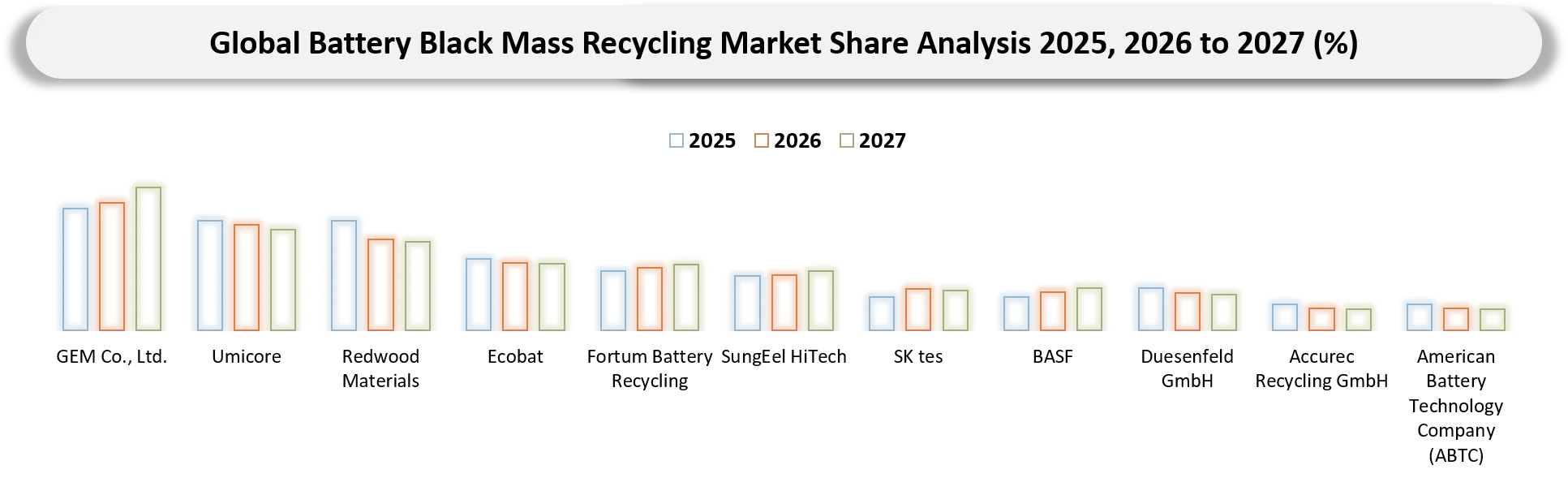
- The market is characterized by three key participant groups: integrated battery recyclers and material recovery companies, specialized battery recycling and black mass processing providers, and diversified chemical and battery-material companies. GEM Co., Ltd., Umicore, Redwood Materials, Ecobat, Fortum Battery Recycling, SungEel HiTech, and SK tes lead in large-scale battery recycling, black mass production, and downstream material recovery; Duesenfeld GmbH, Accurec Recycling GmbH, American Battery Technology Company (ABTC), and RecycLiCo Battery Materials focus on specialized recycling, pretreatment, and advanced recovery technologies; while BASF combines battery recycling with its broader battery-materials and chemical operations. This creates an increasingly technology-driven and vertically integrated landscape where processing capabilities, feedstock access, recovery technologies, and downstream material integration define competitiveness.
- Key players include GEM Co., Ltd. (China), Umicore (Belgium), Redwood Materials (U.S.), Ecobat (U.S.), Fortum Battery Recycling (Finland), SungEel HiTech (South Korea), SK Tes (Singapore), BASF (Germany), Duesenfeld GmbH (Germany), Accurec Recycling GmbH (Germany), American Battery Technology Company (ABTC) (U.S.), and RecycLiCo Battery Materials (Canada).
Key Developments
- January 2026: Envision Greenwise, a Hong Kong-based reverse supply chain management and green energy solutions company, entered into a strategic framework agreement with Tianqi Grand Vision Energy Limited, a Hong Kong-based lithium-battery industry company and wholly owned subsidiary of China-based Tianqi Lithium Corporation, to cooperate on lithium-battery recycling, dismantling, black mass processing, and valuable-metal recovery.
- January 2025: Licovolt, an Ireland-based battery-recycling technology company and UCD spin-out, entered into a joint development agreement with Pure Battery Technologies (PBT), an Australia-based battery-materials technology company, to advance sustainable battery-material production for the EV industry.
- June 2025: LG Energy Solution, a South Korea-based lithium-ion battery manufacturer, and Toyota Tsusho Corporation, a Japan-based trading and business-development company, established Green Metals Battery Innovations, LLC (GMBI), a U.S.-based joint venture focused on battery recycling.
- March 2026: Tozero, a Germany-based lithium-ion battery recycling company, launched a pilot battery recycling plant in Upper Bavaria, Germany, to recover high-purity materials from end-of-life batteries.
- May 2026: Marwynn Holdings, Inc., a U.S.-based technology and infrastructure company, announced its expansion into battery recycling infrastructure through its EcoLoopX platform, with plans to develop its first physical facility dedicated to black mass production.
Key Procurement Priorities and Buyer Evaluation Criteria
- Organizations procuring battery black mass recycling services are increasingly selecting recycling partners based on their ability to provide consistent black mass quality, high material recovery efficiency, and scalable processing capacity across different lithium-ion battery chemistries and feedstock types.
- The decision-making process for procurement is increasingly influenced by the rapid growth of electric vehicle batteries, tightening critical-material supply chains, battery chemistry diversification, and the need to establish closed-loop battery-material recovery systems. Buyers are therefore prioritizing suppliers capable of securing reliable feedstock and delivering recovered materials suitable for downstream battery-material production.
- Buyers consider factors such as black mass composition and purity, lithium/nickel/cobalt/manganese recovery rates, processing yield, contamination control, battery chemistry compatibility, environmental compliance, and traceability when selecting a recycling partner. Consistency in recovered material quality is particularly important for companies using recycled outputs in cathode and other battery-material manufacturing.
Why Choose DataM?
- Technological Innovations: Explores advancements in battery black mass recycling technologies, including mechanical pretreatment, hydrometallurgical processing, pyrometallurgical recovery, direct recycling, and integrated recycling processes, enabling higher recovery of lithium, nickel, cobalt, manganese, and other critical battery materials from end-of-life batteries and manufacturing scrap.
- Product Performance & Market Positioning: Evaluates how different players deliver recycling solutions based on material recovery efficiency, black mass purity, processing yield, feedstock flexibility, operating efficiency, and scalability, highlighting how leading companies differentiate through advanced recovery technologies and integrated battery-material production capabilities.
- Real-World Evidence: Highlights the adoption of black mass recycling across electric vehicle batteries, consumer electronics batteries, energy storage systems, and battery manufacturing scrap, demonstrating how recycling technologies support the recovery of valuable materials and contribute to closed-loop battery supply chains.
- Market Updates & Industry Changes: Tracks key developments such as recycling capacity expansions, new black mass processing facilities, technology commercialization, battery recycling regulations, feedstock partnerships, and investments across Asia-Pacific, North America, and Europe, supporting the development of localized and circular battery-material ecosystems.
- Competitive Strategies: Analyzes how leading companies expand through processing-capacity scaling, technology innovation, strategic partnerships, acquisitions, feedstock agreements, and downstream integration into battery-material production to address the increasing availability of end-of-life batteries and manufacturing scrap.
- Pricing & Market Access: Explains variations in recycling economics based on battery chemistry, black mass composition, metal content, processing technology, recovery rates, feedstock availability, transportation requirements, and recovered-material value, along with access through battery manufacturers, EV producers, recyclers, material suppliers, and collection networks.
- Market Entry & Expansion: Identifies growth opportunities driven by increasing EV adoption, rising battery manufacturing volumes, critical-material supply security, tightening recycling requirements, and the development of circular battery supply chains, while outlining strategies such as regional recycling capacity expansion, technology differentiation, feedstock partnerships, and downstream material integration.
Target Audience
- Battery Recycling Companies & Black Mass Processors
- Battery Manufacturers & Cell Producers
- Electric Vehicle OEMs & Automotive Companies
- Battery Material & Chemical Companies
- Consumer Electronics & Energy Storage Companies
- Raw Material Suppliers & Metal Refiners
- Automotive Dealers, Fleet Operators & Battery Collection Networks


























































