


Battery Anode Materials Market Size and Overview
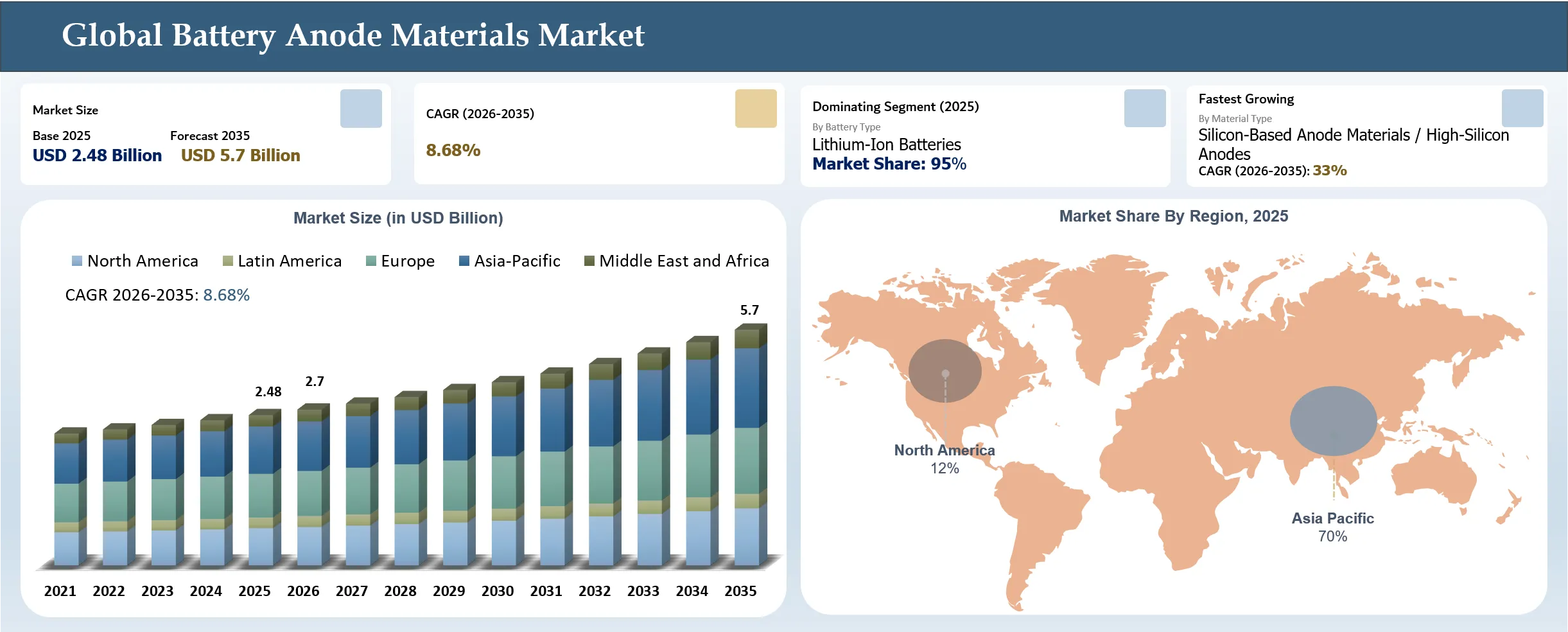
The global battery anode materials market reached USD 2.48 billion in 2025 and is expected to reach USD 5.7 billion by 2035, growing with a CAGR of 8.68% during the forecast period 2026-2035. The market demand is being strengthened by the expansion of lithium-ion battery manufacturing, with global lithium-ion battery demand growing by 29% in 2025 to 1.59 TWh, according to Benchmark Mineral Intelligence. EVs make up 75% of global battery demand in 2025, but the fastest-growing type of battery was the battery energy storage system (BESS), where battery demand from BESS increased by 51% on a yearly basis, whereas EV battery demand increased by 26%. Graphite is still the most widely used anode material, with approximately a 95% share in the anode material market and anode being 10%–15% of the cell mass, as stated by Benchmark Minerals. Diversification of the supply chain is becoming a huge part of the market, as China produces more than 90% of anode manufacturing capacities and processes over 90% of the graphite to produce anode materials used in practically all EV battery anodes. In the US, the annual demand is around 500,000 tonnes of anode materials, making a place for an alternative supplier such as Epsilon Advanced Materials, planning to build a 30,000 tonne per year facility in North Carolina that is planned to be launched by mid-2027, as per Reuters. These supply chain limitations, in addition to increased battery production requirements and research on anodes enhanced by silicon, are driving more graphite processing and anode material manufacturing.
The rapid advancements in the technology of silicon anodes are increasing attempts to address the capacity and stability problems associated with the current anode materials of lithium-ion batteries. In May 2026, according to Springer Nature, a study designed a hierarchical p-cSi@aSi@MgSi₂N@C amorphous silicon-dominant anode through molten-salt electrolysis for enhancing the performance of lithium-ion batteries. Silicon-based anodes have a theoretical capacity of 4,200 mAh g⁻¹; however, they suffer from over 300% volume expansion. The designed anode provided an initial Coulombic efficiency of 81.4%, decreased the charge transfer resistance by 64% to 16.4 Ω after 200 cycles, and provided 1,719.3 mAh g⁻¹ after 200 cycles at 0.2 C and 823.8 mAh g⁻¹ after 500 cycles at 0.5 C, demonstrating improved capacity retention and cycling stability.
White-Space Opportunities Arising from the DOE Notice of Intent (NOI) for Battery Anode Materials
In January 2025, the U.S. Department of Energy (DOE), the agency announced a Notice of Intent for up to USD 725 million to strengthen domestic production of battery critical materials, components, and advanced batteries, creating significant opportunities for the Battery Anode Materials Market. The highest-priority opportunity directly related to anode materials is the development of U.S. manufacturing and recycling capacity for cathode and anode materials, although DOE did not disclose a separate dollar allocation for this area. Other investment areas include electrolytes and electrolyte salts, where DOE identified a supply-chain investment gap because nearly all electrolyte salt is sourced through foreign entities of concern; pre-industrial-scale cell manufacturing, supporting shared-access battery production lines; and materials, processing, and manufacturing, covering precursors, materials processing, catalysts, binders, separators, conductive additives, and current collectors. DOE anticipated awarding up to 14 grants with project periods of 2–5 years, while applications could also address commercial-scale output validation and qualification to secure offtake agreements, highlighting white-space opportunities in domestic anode production, recycling, processing, and qualification infrastructure.
The investment creates opportunities across the battery-anode value chain, particularly for companies such as Group14 Technologies, Sila Nanotechnologies, NOVONIX, Syrah Technologies, Ascend Elements, and American Battery Technology Company, which are active in areas including advanced silicon-based anodes, graphite-based anode materials, battery-material processing, and recycling and could benefit from increased demand for U.S.-based anode manufacturing and recycling capacity; however, these companies should be considered potential beneficiaries rather than confirmed recipients of the USD 725 million NOI because DOE did not identify individual awardees in the announcement. Group14 Technologies and Sila Nanotechnologies are positioned in advanced silicon-based anode materials, NOVONIX and Syrah Technologies in synthetic and natural graphite/anode-material supply, while Ascend Elements and American Battery Technology Company are positioned in battery-material processing and recycling. Additional opportunities extend to companies supplying electrolyte salts, separators, binders, conductive additives, current collectors, precursor materials, and battery manufacturing equipment, making the strongest white-space areas domestic anode-material manufacturing, graphite and silicon supply-chain localization, anode-material recycling, and commercial-scale qualification of advanced anode technologies.
Battery Anode Materials Market Strategic Takeaways
- Asia-Pacific captured 70% of the global battery anode materials market share in 2025. This regional control is anchored by China, which maintains over 80% of global battery cell manufacturing capacity.
- Lithium-ion batteries held a dominant 95% share of the anode material market in 2025. Within stationary storage, LFP chemistry accounted for roughly 90% of the 108 GW installed globally that year.
- China manufactures over 90% of global anode active materials and refines more than 90% of battery-grade graphite. Single suppliers like Ningbo Shanshan hold up to 21% of the global anode material market share.
- The U.S. DOE announced an NOI for up to USD 725 million in January 2025 to build out domestic production for critical battery materials, advanced batteries, and components.
Battery Anode Materials Market Industry Trends and Strategic Insight
- Silicon-enhanced anodes are moving from laboratory development toward commercial qualification, as manufacturers focus on silicon–graphite and silicon–carbon architectures to overcome the capacity ceiling of conventional graphite and enable higher-energy-density, faster-charging batteries.
- Artificial graphite remains strategically important for mainstream battery applications, particularly where manufacturers prioritize predictable cycle life, charging characteristics, and established electrode-processing compatibility.
- Localization is shifting from raw-material extraction toward active anode material manufacturing, because access to graphite resources alone does not provide sufficient control over battery-grade processing.
- Battery anode producers should prioritize differentiated material platforms rather than competing solely on graphite volume, particularly through silicon–carbon composites, advanced coatings, and application-specific formulations.
- Securing qualified feedstock and downstream offtake simultaneously will be critical, because anode-material projects require both reliable graphite or silicon inputs and lengthy customer qualification before achieving commercial scale.
Battery Anode Materials Market Scope
| Metrics | Details | |
| 2025 Market Size | USD 2.48 Billion | |
| 2035 Projected Market Size | USD 5.7 Billion | |
| CAGR (2026-2035) | 8.68% | |
| Largest Market | Asia-Pacific | |
| Fastest Growing Market | North America | |
| By Material Type | Natural Graphite, Synthetic Graphite, Silicon-Based Anode Materials, Silicon-Graphite Composites, Lithium Titanate (LTO), Hard Carbon, Other Anode Materials | |
| By Battery Type | Lithium-Ion Batteries, Sodium-Ion Batteries, Other Rechargeable Batteries, Solid-State Batteries, Lithium-Metal Batteries, Lithium-Sulfur Batteries, Other Rechargeable Batteries | |
| By Form | Powder, Granules, Composite Materials, Pellets, Others | |
| By Application | Electric Vehicles, Portable Electronics, Stationary Energy Storage, Power Tools, Industrial Equipment, Medical Devices, Aerospace & Defense Batteries, Others | |
| By Region | North America | U.S., Canada, Mexico |
| Europe | Germany, UK, France, Spain, Italy, Poland | |
| Asia-Pacific | China, India, Japan, Australia, South Korea, Indonesia, Malaysia | |
| Latin America | Brazil, Argentina | |
| Middle East and Africa | UAE, Saudi Arabia, South Africa, Israel, Türkiye | |
| Report Insights Covered | Competitive Landscape Analysis, Company Profile Analysis, Market Size, Share, Growth | |
Battery Anode Materials Market Disruption Analysis
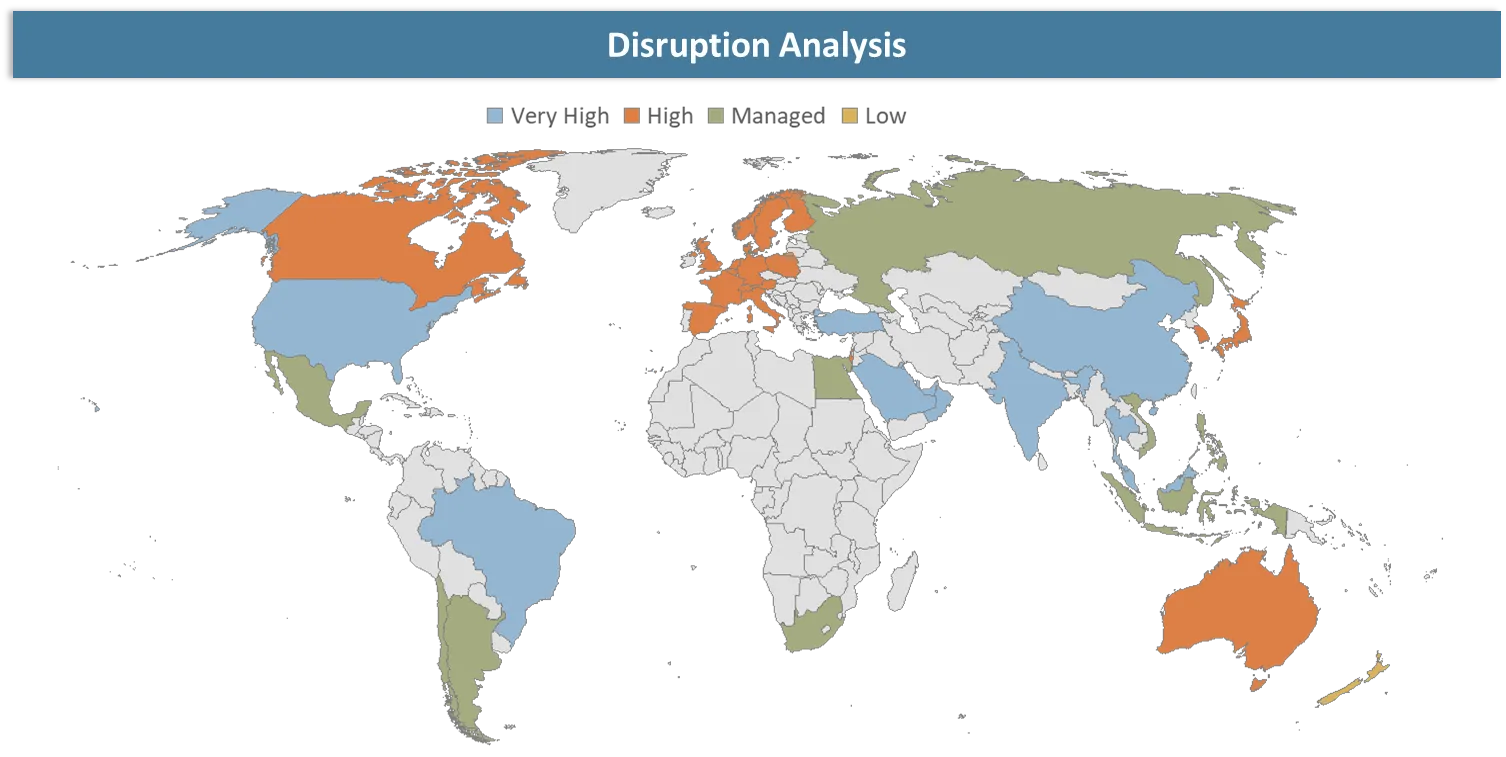
China-Centric Anode Supply Chain Reshaping Battery Anode Materials Market
The disruption in the Battery Anode Materials Market is mostly associated with the extreme concentration of anode-material production in China. According to the International Energy Agency (IEA), “In 2025, China alone produced more than 90% of global anode active material production used in electric car batteries, as well as more than 80% of global battery cell production.” This concentration of production creates disruptions in the procurement structure since battery producers are now vulnerable to geopolitical risks and supply interruptions, and dependence on a single major processing hub.
Additionally, the producers of batteries and automobile firms have redesigned their supply chains by enhancing the production of non-Chinese anode material and finding other graphite sources. For instance, in January 2025, according to Reuters, General Motors signed a multi-year deal with Vianode regarding synthetic graphite anode material, and Vianode is looking to create capacity for North American production of around 80,000 tonnes of synthetic graphite yearly by 2030. Also, the IEA shows that there is a possibility of diversifying from Chinese suppliers for anode active materials in Korea, Indonesia, and Japan; however, their total capacity does not cover the demand from outside of China. This development is shifting away from the China-centric sourcing of raw materials towards regionalization and supplier diversification for the manufacture of anode materials.
Battery Anode Materials Market BCG Matrix: Company Evaluation
Stars include BTR New Material Group Co., Ltd., POSCO Future M Co., Ltd., Umicore, and Hunan Zhongke Shinzoom Technology Co., Ltd. because they have strong positions in commercial anode-material production and are expanding capabilities across graphite and next-generation silicon-based anodes. BTR benefits from its large-scale graphite anode portfolio and established battery-customer base, while POSCO Future M is strengthening its position through natural and artificial graphite as well as silicon-carbon anode technologies. Question Marks include Dongguan Kaijin New Energy Technology Co., Ltd., Daejoo Electronic Materials Co., Ltd., NOVONIX Limited, GB Materials, and JFE Chemical Corporation. These companies have attractive growth opportunities through artificial graphite, silicon-based anodes, and localized supply chains, but face strong competition from established Chinese, Japanese, and Korean producers.
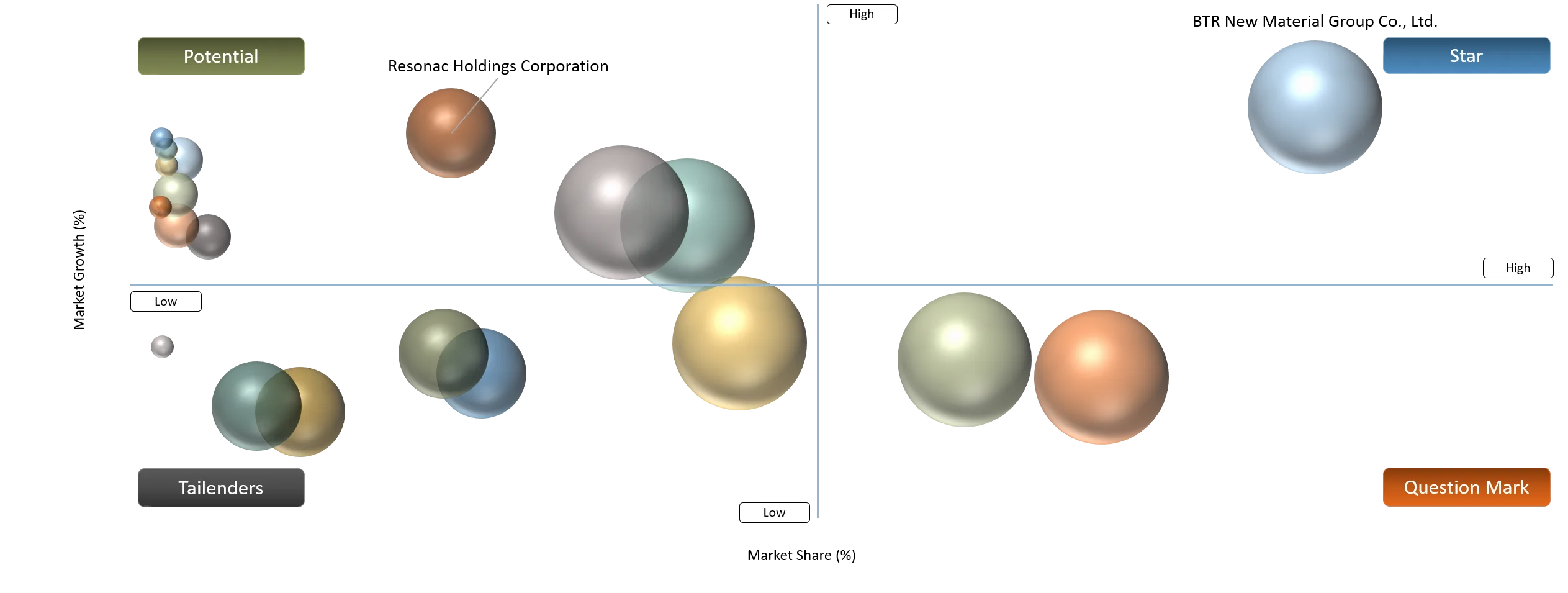
Potential includes Resonac Holdings Corporation, Mitsubishi Chemical Group Corporation, and Tokai Carbon Co., Ltd., which possess established carbon-material technologies and technical expertise applicable to battery anodes but have comparatively narrower positions in the rapidly expanding dedicated anode-material market. Their existing carbon-material manufacturing capabilities provide a foundation for growth as demand increases for high-performance graphite, silicon-carbon, and alternative carbon anodes. Tailenders include Nippon Carbon Co., Ltd. and Shin-Etsu Chemical Co., Ltd. because their participation in the battery anode-material market is more specialized relative to large-scale dedicated anode producers. Both companies possess relevant carbon and advanced-material technologies, but their battery-anode activities remain comparatively niche within the broader market.
Battery Anode Materials Market Dynamics
Driver Impact Analysis
| Driver | Market Growth Impact (%) | Demand Concentration | Impacted Use Case | Strategic Impact |
Increasing demand for higher energy density is accelerating adoption of silicon-graphite and silicon-based anodes. | 24% | High in EVs and premium lithium-ion batteries | Electric Vehicles; High-Performance Energy Storage | Accelerates the transition from conventional graphite toward silicon-enhanced anode formulations and increases demand for advanced material engineering. |
Fast-charging battery development is stimulating demand for engineered graphite and silicon- enhanced anode formulations capable of supporting higher charging rates. | 21% | High in EVs, power tools, and premium consumer electronics | Fast-Charging EVs; Power Tools; Smartphones | Pushes suppliers toward particle engineering, surface treatment, coating, and silicon-carbon technologies that improve charging kinetics without compromising cycle life. |
Expansion of artificial graphite production is supporting demand for anode materials where manufacturers prioritize consistent particle structure. | 19% | High in EV and large-format lithium-ion cells | EV Batteries; Energy Storage Systems; Industrial Batteries | Encourages investment in graphitization, purification, coating, and localized synthetic-graphite capacity while strengthening vertically integrated supply chains. |
Development of silicon-rich anode technologies is creating additional demand for silicon-carbon composites and other advanced anode formulations designed to increase cell-level energy density. | 20% | Concentrated in next-generation EV and high-energy-density batteries | Premium EVs; High-Performance Batteries; Energy Storage | Creates opportunities for advanced-material suppliers while increasing the importance of silicon expansion control, composite architecture, and electrode-process compatibility. |
Rising electric two-wheeler, commercial EV, and hybrid vehicle battery production is broadening demand for anode materials across multiple battery formats and performance requirements. | 16% | High in Asia-Pacific, particularly China and emerging EV markets | Electric Two-Wheelers; Commercial EVs; Hybrid Vehicles | Broadens the addressable customer base for graphite and advanced anodes and encourages suppliers to develop application-specific formulations for different cell formats and operating conditions. |
Increasing demand for higher energy density is accelerating adoption of silicon-graphite and silicon-based anodes
The growing requirement for higher energy density in rechargeable batteries is accelerating the development and adoption of silicon-carbon and silicon-based anodes, especially in electric vehicles and high-performance energy storage solutions. Global battery installations for EVs have crossed 1.2 TWh in 2025 as per the International Energy Agency (IEA). This is putting pressure on battery producers to get more energy out of the cells that they produce without necessarily expanding the size of the battery. With conventional graphite approaching its limits in terms of energy capacity, there is an increased focus on silicon-based materials, which have significantly higher lithium storage capability compared to graphite.
Higher energy density is fueling the efforts to use silicon in anode materials, while the quest to enhance the stability of these anode materials is becoming ever more imperative for commercial application. In August 2025, according to the Oak Ridge National Laboratory (ORNL), the scientists developed boron-alloyed silicon nanoparticle-based anodes for lithium-ion batteries for better performance in terms of cycle life and stability of silicon anodes. The result of the study was that adding more boron led to almost linear improvements in the cycle lifetime, and silicon-boron alloy anodes had almost 3 times more calendar life than the silicon anodes. It was explained that the improvement was due to improved surface passivation to avoid the electrolyte decomposition process.
Restraint Impact Analysis
| Restraint | Drag on Market Growth (%) | Primary Impact Area | Impacted Use Case | Strategic Impact |
High energy consumption and processing costs for synthetic graphite constrain cost competitiveness compared with conventional graphite-based anode materials. | 27% | Production Cost & Profitability | EV Batteries; Energy Storage Systems | Encourages energy-efficient graphitization, renewable-power integration, process optimization, and localized production to reduce anode-material costs. |
Silicon anode volume expansion during lithiation and delithiation creates electrode degradation and cycle-life challenges, limiting the large-scale replacement of graphite with silicon-rich formulations. | 30% | Material Performance & Cycle Life
| High-Energy-Density EV Batteries; Fast-Charging Batteries | Drives investment in silicon-carbon composites, protective coatings, nano-engineering, and expansion-control technologies to improve silicon-anode durability. |
Complex purification, coating, graphitization, and particle- engineering processes increase manufacturing complexity and capital requirements for battery-grade anode materials. | 23% | Manufacturing Cost & Production Scalability | Battery Cell Manufacturing; Advanced EV Batteries | Favors vertically integrated producers and automated processing while raising entry barriers for new anode-material manufacturers. |
Limited availability of qualified non-Chinese anode-material capacity constrains supply-chain diversification despite increasing investments in alternative production regions. | 20% | Supply Chain & Material Availability | EV Batteries; Grid Energy Storage; Industrial Batteries | Accelerates regional capacity development, long-term offtake agreements, alternative graphite sourcing, and strategic inventory planning outside China. |
High energy consumption and processing costs for synthetic graphite constrain cost competitiveness compared with conventional graphite-based anode materials
One of the primary factors that restricts the battery anode materials market is the considerable energy input needed for the synthesis of graphite. The process of manufacturing synthetic graphite involves several steps, such as calcination, graphitization, purification, molding, and coating, where the latter involves particularly high temperatures and electricity inputs. All these factors lead to increased cost of production and make synthetic graphite more dependent on electricity prices compared to other anode materials.
Production of synthetic graphite is extremely energy-intensive, which is an expensive and environmentally taxing process for anode materials manufacturers. In October 2025, according to the Royal Society of Chemistry (RSC), researchers at Argonne National Laboratory conducted a life-cycle assessment of synthetic graphite battery anode material (BAM) manufacturing in the US. It has been found that the production of 1 kg of synthetic graphite BAM needs 580 MJ of energy input and 121 L of water and results in 29.7 kg CO₂-eq. of greenhouse gas emissions in the base case scenario. It has been observed that the graphitization stage has caused more than 74% of the overall impact and about 70% of the energy input due to its high energy and material intensity.
Battery Anode Materials Market Segment Analysis
The global battery anode materials market is segmented based on material type, battery type, form, application, and region.
Dominance of Lithium-Ion Batteries Driving High-Volume Demand for Battery Anode Materials
The Lithium-Ion Batteries segment dominates the battery anode materials market, with a 95% market share in 2025, owing to the adoption of the batteries for use in electric vehicles, energy storage, consumer electronic goods, power tools, and industrial applications. According to the International Energy Agency (IEA), the global lithium-ion battery market surpassed USD 150 billion in 2025, showing the size of the overall battery market and directly affecting the consumption of graphite, artificial graphite, silicon-graphite composite, and other anode materials.
Simultaneously, developments in lithium-ion technology continue to be supported by increased use of EVs and stationary batteries. According to the IEA, 108 GW of battery storage installations were installed globally in 2025, where LFP batteries made up around 90% of installations, proving the need for anode materials compatible with lithium-ion batteries. In 2025, the capacity of lithium-ion battery manufacturing globally surpassed 4 TWh, while over 80% of global battery manufacturing capacity was held by China.
Battery Anode Materials Market Geographical Penetration
Rapid Battery Manufacturing Expansion and Anode Supply-Chain Concentration in Asia-Pacific
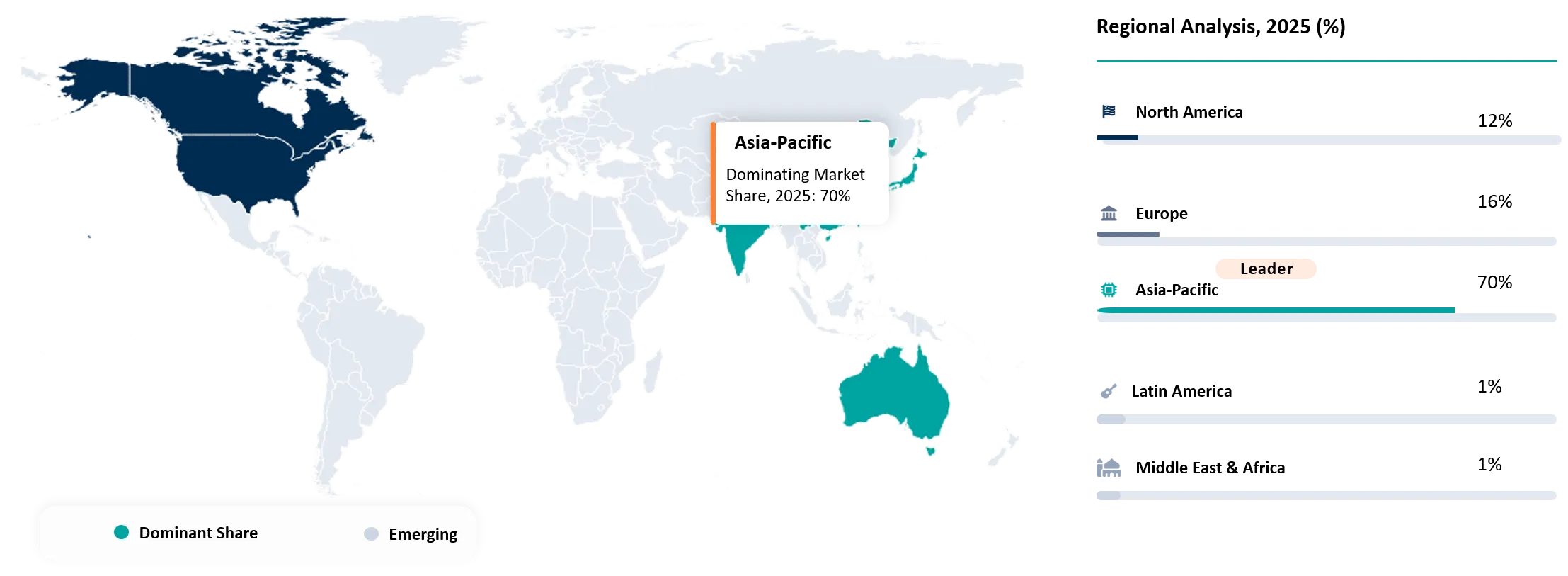
The Asia-Pacific region dominates the battery anode material market, with 70% of the global market share in 2025, owing to the presence of battery cell manufacturing plants, electrode manufacturing plants, graphite processing facilities, and EV manufacturing chains in this region. The region has an integrated chain of operations from the processing of raw materials to anode material manufacturing, cell manufacturing, and battery packs, especially in countries such as China, South Korea, Japan, and Indonesia. In 2025, China alone was responsible for more than 80% of global battery cell manufacturing, and companies from China, Korea, and Japan manufactured almost all lithium-ion battery cells globally.
Strategic investments and acquisitions in silicon-anode technologies are accelerating the expansion of advanced battery-anode manufacturing capacity in Asia-Pacific. In November 2025, HS Hyosung, a South Korea-based diversified materials and technology company, acquired Extra Mile Materials (EMM), Umicore’s battery-anode subsidiary in Belgium, through a €120 million (USD 138 million) investment in Umicore, a Belgium-based materials technology and battery-materials company. The transaction gives HS Hyosung access to EMM’s silicon-anode material technology, while the companies also agreed to establish a joint venture for silicon-anode commercialization. HS Hyosung plans to invest an additional KRW 1.5 trillion (approximately USD 1.1 billion) over five years in its Ulsan, South Korea manufacturing plant to expand battery-material production and create new jobs. The company is targeting silicon anodes because silicon has approximately 10 times the energy density of graphite, while HS Hyosung cited expectations that the global silicon-anode-material market could reach USD 4.7 billion by 2031, up from USD 500 million in 2024.
China Battery Anode Materials Market Trends
China holds a dominant position in the battery anode materials market due to the highly integrated process of graphite processing, anode materials manufacturing, battery cell manufacturing, and the electric vehicle industry. China is fortunate to have a vast production network for natural graphite, artificial graphite, silicon anodes, and silicon graphite composite anodes, enabling close integration between material suppliers and battery manufacturers.
Strategic consolidation among China’s major battery-material producers is reshaping the competitive landscape and strengthening domestic control over anode-material supply chains. In October 2025, Ningbo Shanshan Co., Ltd., a China-based lithium-battery anode-material and display-panel polarizer manufacturer, was targeted for a court-led restructuring by a consortium led by Ren Yuanlin, a Chinese shipping entrepreneur, through Jiangsu Xinyangzi Trading, a China-based investment/trading company. The consortium agreed to invest approximately CNY 3.2 billion (USD 450 million) to obtain a 23.3% stake in Shanshan and make Ren Yuanlin its new actual controller. The restructuring also involved TCL-related investment interests, a China-based technology and electronics group, and China Orient Asset Management, a China-based asset-management company. Shanshan was identified as the world’s largest lithium-battery anode-material supplier, with approximately 21% global market share, making the transaction significant for China’s anode-material supply chain and industry consolidation.
Japan Battery Anode Materials Market Outlook
Japan emerges as a significant player in the battery anode materials market because of its experience in manufacturing carbon-based materials, research & development capabilities in the area of battery materials, and the availability of specialized anode manufacturers like JFE Chemical Corporation, Resonac Holdings Corporation, and Mitsubishi Chemical Group Corporation. Japanese manufacturers cover a wide range of anode materials like natural graphite, artificial graphite, hard carbon, and others. JFE Chemical Corporation specializes in the production of high-performance anode materials for lithium-ion batteries employed in electric cars. The range includes hard carbon, natural graphite, and artificial graphite.
Japanese EV-battery production is increasing demand for diversified and secure sources of battery anode materials beyond China. In July 2025, POSCO Future M, a South Korea-based battery-materials manufacturer, signed an anode-material supply agreement with a major Japanese battery company, a Japan-based battery manufacturer, to supply natural graphite-based anode materials produced at its Sejong, South Korea plant for EV batteries manufactured in Japan. The contract value, duration, supply volume, and customer name were not disclosed by mutual agreement. POSCO Future M has developed both natural and artificial graphite anode materials and is also advancing silicon-anode commercialization, while its natural-graphite supply chain includes graphite ore sourced from outside China, including Africa, supporting supply-chain diversification for Japanese battery production.
Regionalized Anode Manufacturing and Supply-Chain Localization Strengthening North America's Position
North America is one of the key regions in the battery anode materials market, as firms are evolving and striving to bring production of essential battery materials closer to their own territory and lower their reliance on the international graphite processing value chain. North America held around 12% of the worldwide Battery Anode Materials Market in 2025, aided by growth in manufacturing capabilities of EVs and energy storage, critical minerals policies of governments, and investment in domestic graphite and artificial anode production. The development of this ecosystem, which involves graphite mining, refining, production of anode material, battery cells manufacture, and automobile consumption, forms the basis for increasing regional integration within the anode supply chain.
Strategic M&A activity is strengthening North America’s domestic graphite supply base and accelerating the development of localized battery anode-material value chains. In July 2026, Global Battery Materials (GBM), a Canada-based battery-materials and graphite company, entered into a definitive agreement to acquire Lomiko Metals Inc., a Canada-based graphite development company, for USD 0.09 (C$0.13) per share, implying an equity value of approximately USD 7.94 million (C$11 million) on a fully diluted basis. GBM also agreed to provide Lomiko with a USD 577,404 (C$800,000) senior secured bridge loan, expandable to USD 0.87 million (C$1.2 million) under certain conditions, at an 8% interest rate. The acquisition would add Lomiko’s La Loutre Graphite Project, Yellow Fox property, and other graphite assets to GBM’s vertically integrated North American platform, which combines natural graphite resources with proprietary active-anode-material processing technology validated at a pilot plant in South Korea.
U.S. Battery Anode Materials Market Trends
The U.S. is dominating the battery anode materials market through the establishment of domestic synthetic graphite and natural graphite value chain processes, which will be driven by increased battery cell production and the reduction in dependency on imported anode materials. The country enjoys an increasing level of investments in graphite mining, purification, anode production, and battery manufacturing, while domestic firms are concentrating on synthetic graphite and advanced anode materials. The U.S. battery manufacturing value chain is still expanding as of 2025.
Strategic investments in silicon-carbon anode production are accelerating the commercialization of high-performance anode materials for next-generation lithium-ion batteries. In August 2025, Group14 Technologies, a U.S.-based silicon battery-materials company, acquired the remaining 75% stake in its joint venture with SK Materials, a South Korea-based advanced-materials company, gaining 100% ownership of the battery-active-materials (BAM) factory in Sangju, South Korea. The facility was established through an investment of approximately KRW 850 billion and produces SCC55 silicon-carbon anode material, with an initial production capacity of 2,000 tonnes per year, equivalent to approximately 10 GWh of battery capacity. The transaction was announced alongside Group14’s USD 463 million Series D funding round, led by SK Inc., to expand silicon-battery-material manufacturing in both the U.S. and South Korea.
Battery Anode Materials Market Competitive Landscape
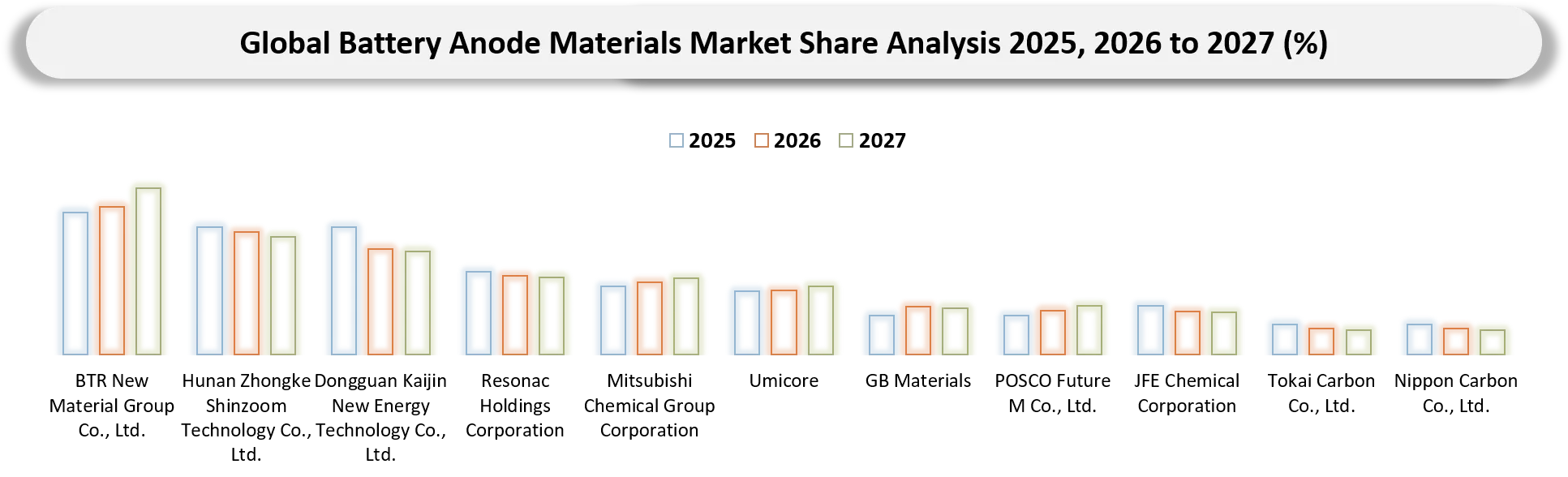
- The market is characterized by three key participant groups: large-scale graphite and anode-material producers, diversified advanced-material and carbon-material companies, and next-generation anode specialists. BTR New Material Group, Hunan Zhongke Shinzoom, Dongguan Kaijin, and POSCO Future M compete through established natural and synthetic graphite anode production; Resonac Holdings, Mitsubishi Chemical Group, Umicore, JFE Chemical, Tokai Carbon, Nippon Carbon, and Shin-Etsu Chemical leverage broad carbon, graphite, and specialty-material capabilities; while Daejoo Electronic Materials, NOVONIX, and GB Materials focus on silicon-based, synthetic-graphite, and other advanced anode technologies. This creates a technology- and supply-chain-driven landscape where production scale, battery-grade quality, customer qualification, cost competitiveness, and development of higher-energy-density anodes define competitiveness.
- Key players include BTR New Material Group Co., Ltd., Hunan Zhongke Shinzoom Technology Co., Ltd., Dongguan Kaijin New Energy Technology Co., Ltd., Resonac Holdings Corporation, Mitsubishi Chemical Group Corporation, Umicore, GB Materials, POSCO Future M Co., Ltd., JFE Chemical Corporation, Tokai Carbon Co., Ltd., Nippon Carbon Co., Ltd., Shin-Etsu Chemical Co., Ltd., Daejoo Electronic Materials Co., Ltd., and NOVONIX Limited.
Key Developments
- April 2025: Falcon Energy Materials plc, a UAE-based battery-materials and critical-minerals company, signed a strategic partnership term sheet with Shanghai Shanshan New Material Co., Ltd., a China-based lithium-ion battery anode-material manufacturer, to develop customers and market Falcon’s coated spherical purified graphite (CSPG) anode materials from its planned Morocco facility.
- November 2025: Vianode, a Norway-based advanced battery-materials and synthetic-graphite manufacturer, announced a USD 3.2 billion investment to build its first large-scale North American facility for low-emission synthetic anode graphite in St. Thomas, Ontario, Canada.
- March 2026: Vianode, a Norway-based advanced battery-materials and synthetic-anode-graphite company, signed a term sheet with an unnamed North American battery-technology company to supply 8,000 tonnes of high-performance synthetic anode graphite from its Via ONE facility in Norway for grid battery energy-storage systems (BESS).
- November 2025: 8 Clockwise, a U.S.-based industrial-decarbonization and clean-technology venture studio, announced a strategic partnership with CarboMat Inc., a Canada-based cleantech and advanced-carbon-materials company, to commercialize sustainable carbon fibers and battery-grade anode materials derived from carbon-rich industrial by-products.
- May 2026: C-BATT, a U.S.-based advanced battery-materials company, joined the Defense Industrial Base Consortium, a U.S.-based defense-industry collaboration consortium, to advance domestically produced battery-anode materials for defense and energy-resilience applications.
Key Procurement Priorities and Buyer Evaluation Criteria
- Organizations procuring battery anode materials increasingly prioritize suppliers that can provide consistent battery-grade graphite, silicon-based, and composite anode materials with controlled particle size, purity, tap density, electrical conductivity, and electrochemical performance across high-volume cell production.
- The procurement decision-making process is increasingly influenced by the shift toward higher-energy-density, fast-charging, and longer-cycle-life batteries, requiring buyers to evaluate suppliers' ability to develop silicon-graphite, silicon-carbon, advanced graphite, and other engineered anode formulations compatible with next-generation cell chemistries.
- Buyers consider factors such as specific capacity, first-cycle coulombic efficiency, cycle retention, rate capability, particle morphology, coating uniformity, expansion control, and thermal stability when evaluating anode-material suppliers for EV batteries, energy-storage systems, consumer electronics, and power tools.
Why Choose DataM?
- Technological Innovations: Explores advancements in battery anode materials, including silicon-based anodes, silicon-graphite composites, synthetic graphite, hard carbon, and surface-coating technologies, highlighting their role in improving energy density, fast-charging capability, cycle life, and overall cell performance.
- Product Performance & Market Positioning: Evaluates how anode-material suppliers differentiate through specific capacity, first-cycle efficiency, particle-size distribution, tap density, conductivity, cycle retention, and expansion control, identifying competitive positioning across EV, energy-storage, consumer-electronics, and industrial battery applications.
- Real-World Evidence: Highlights commercial deployment of natural graphite, synthetic graphite, silicon-carbon, and other advanced anode materials in electric vehicles, stationary energy storage, portable electronics, power tools, and industrial batteries, demonstrating their contribution to energy density, charging performance, durability, and battery-life improvement.
- Market Updates & Industry Changes: Tracks anode-material capacity expansions, graphite-processing projects, silicon-anode commercialization, regional supply-chain investments, and battery manufacturing developments across Asia-Pacific, North America, and Europe, providing visibility into the transition toward diversified and localized anode-material supply chains.
- Competitive Strategies: Analyzes how leading companies strengthen their positions through production-scale expansion, vertical integration, advanced material development, long-term supply agreements, customer qualification, and regional manufacturing, particularly in graphite and next-generation silicon-based anode technologies.
- Pricing & Market Access: Assesses pricing differences across natural graphite, synthetic graphite, silicon-based anodes, silicon-graphite composites, and hard carbon, considering raw-material costs, purification, graphitization, coating, particle engineering, processing intensity, production scale, and battery-grade qualification requirements.
- Market Entry & Expansion: Identifies growth opportunities arising from EV adoption, stationary energy storage, fast-charging batteries, higher-energy-density cells, sodium-ion batteries, and next-generation battery technologies, while outlining strategies such as regional production, technology specialization, upstream integration, and strategic partnerships for market expansion.
Target Audience
- Battery Cell Manufacturers
- Battery Anode Material Manufacturers
- Automotive OEMs & EV Manufacturers
- Battery Pack Manufacturers & Integrators
- Energy Storage System Manufacturers & Integrators
- Battery Material & Electrode Manufacturers
- Graphite Mining, Processing & Refining Companies


























































