


Overview
The global bale nets market reached US$1,356.76 million in 2024 and is expected to reach US$2,166.11 billion by 2032, growing at a CAGR of 6.12% during the forecast period 2025-2032.
The global bale nets market is witnessing strong growth driven by the increasing demand for efficient crop protection and storage solutions in modern agriculture. Rising mechanization in farming practices and the need to reduce post-harvest losses are pushing farmers toward advanced baling solutions. According to the US government, dry hay production in 2023 rose by 6% to 119 million tons, supported by an 8% increase in harvested area, which significantly boosts the requirement for bale nets to wrap and secure hay efficiently. Higher production of alfalfa and other hay types further strengthens the demand for durable and UV-resistant netting materials, ensuring better preservation during storage and transport.
Moreover, expanding livestock and dairy farming operations globally are creating consistent demand for high-quality forage, driving the use of bale nets. Manufacturers are introducing sustainable and recyclable materials in response to environmental regulations, aligning with the trend of eco-friendly farming practices. Growing investments in advanced agricultural equipment and record-high yields in regions like Idaho reflect the shift toward efficiency, directly contributing to bale net adoption. With strong growth in both developed and emerging markets, the bale nets sector is poised for steady expansion in the coming years.
Bale Nets Market Trend
The bale nets market is trending toward increased adoption of sustainable and biodegradable materials to address environmental concerns. There is also a shift toward high-strength, UV-resistant nets that improve durability and efficiency in large-scale farming. Additionally, growing mechanization and precision farming practices are driving demand for advanced netting solutions that reduce crop waste and enhance storage stability.

Market Scope
Metrics | Details |
By Type | Knitted Net Wrap, Extruded Net Wrap |
By Material Type | Polyethylene (PE), Polypropylene (PP), Others |
By Application | Baling Hay, Baling Straw, Baling Silage |
By Region | North America, South America, Europe, Asia-Pacific, Middle East and Africa |
Report Insights Covered | Competitive Landscape Analysis, Company Profile Analysis, Market Size, Share, Growth |
Market Dynamics
Increasing Demand for Efficient and Sustainable Hay and Straw Management
The rising need for efficient and sustainable hay and straw management is a major driver of the global bale nets market. Farmers are increasingly adopting bale nets as they enhance productivity, reduce handling time, and enable more efficient transport—producing up to 32% higher bale output compared to traditional twine use. This efficiency helps minimize labor costs while ensuring better preservation of forage quality, which is essential for livestock feeding. The growing emphasis on reducing post-harvest losses and meeting rising feed demand further strengthens the shift toward advanced bale net solutions.
Sustainability has become a key factor influencing adoption, with manufacturers innovating to address environmental concerns. A major development came in June 2025, when CNH Industrial partnered with Nature’s Net Wrap to launch the world’s first compostable bale net wrap, tackling the 2.5 million tons of plastic waste generated annually from net wrap and twine. Made from biopolymers and natural fibers, this certified solution is being distributed through CNH’s Case IH and New Holland dealer networks across North America. Such initiatives align with global efforts to reduce agricultural plastic waste, making sustainable bale net options an integral part of modern farming practices.
High Initial Investment for Advanced Netting
High initial investment for advanced bale netting acts as a major restraint for the global market as modern knitted or extruded nets require superior raw materials and advanced manufacturing technologies, making them costlier than traditional options like twine. Farmers, especially in developing regions, often hesitate to adopt these products due to high upfront costs and limited awareness of long-term benefits. This price sensitivity restricts market penetration, particularly among small and medium-scale farmers. Consequently, adoption remains concentrated in developed markets, slowing overall global growth.
Segment Analysis
The global bale nets market is segmented based on type, material type, application and region.

Knitted Net Wrap Dominates Due to Superior Strength, Flexibility, and Enhanced Bale Protection
Knitted net wrap holds a significant share in the global bale nets market because it offers superior flexibility and strength compared to extruded wraps, ensuring consistent bale shape and density. Farmers prefer knitted nets due to their ease of handling, faster wrapping speed, and ability to provide better crop protection during storage and transportation. These features reduce material wastage and improve operational efficiency, making knitted nets a cost-effective solution in the long run.
Additionally, the rising adoption of advanced baling equipment and demand for high-quality forage preservation have further driven the popularity of knitted net wraps. Their durability in harsh weather conditions and compatibility with various baling machines strengthen their dominance in the market. As agricultural mechanization grows globally, knitted net wraps continue to be the preferred choice for commercial farming operations.
Geographical Penetration
Asia-Pacific Leads the Global Bale Nets Market Due to Expanding Agriculture and High Fodder Demand
Asia-Pacific holds a significant share in the Global Bale Nets Market due to its strong agricultural base and rising demand for efficient fodder management solutions. Countries like India and China are witnessing rapid modernization in farming practices, increasing the need for durable bale nets for hay, silage, and straw baling. According to the Ministry of Fisheries, Animal Husbandry & Dairying, India’s livestock sector grew at a CAGR of 12.99% between 2014-15 and 2022-23, with its contribution to agriculture GVA rising from 24.38% to 30.23%, reflecting a strong demand for animal feed and fodder storage solutions. This growing livestock sector is boosting the use of bale nets for silage preservation and fodder baling in the region.
Additionally, Australia significantly contributes to this market through its export-oriented fodder industry. According to the Government of Australia, the export fodder sector generates AU$450–600 (US$288.91 -385.22) million annually, with most of the export hay, primarily oaten hay, shipped to Asia and the Middle East. Key production regions like Western Australia, South Australia, and Victoria ensure a steady supply of quality hay, which further strengthens bale net usage for packaging and transport. These factors collectively make Asia-Pacific a dominant region in the global bale nets market.
Sustainability Analysis
The global bale nets market is increasingly prioritizing sustainability as environmental regulations and farmer awareness drive the shift toward eco-friendly solutions. Manufacturers are focusing on biodegradable and recyclable materials to reduce plastic waste, aligning with circular economy goals. In line with this trend, companies are adopting innovative technologies that minimize resource use without compromising performance, helping reduce greenhouse gas emissions across the value chain.
A notable example of this sustainability push came in March 2025, when New Zealand farmer Grant Lightfoot introduced Kiwi Econet, an edible, plant-based bale netting made primarily from jute. Unlike conventional plastic nets, Kiwi Econet is fully biodegradable, safe for livestock consumption, and even provides nutritional value, eliminating labor-intensive removal processes. Manufactured in India and tested for safety by Eurofins Food Analytics, it demonstrates how innovation can address environmental, efficiency, and animal health concerns simultaneously. Such developments highlight how sustainability is not just a regulatory requirement but a key driver shaping the future of the global bale nets market.
Competitive Landscape
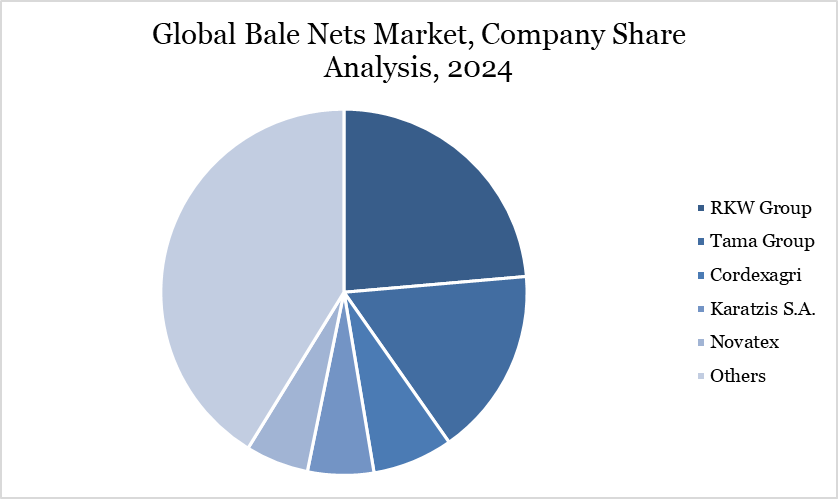
The major global players in the market include RKW Group, Tama Group, Cordexagri, Karatzis S.A., Novatex, Royal Brinkman, Piippo Oyj, UPU Industries, CLAAS KGaA mbH, and Syfilco Ltd.
Key Developments
In January 2024, CNH invested in Alberta-based start-up Nature's Net Wrap, which is developing a compostable bale net wrap as an alternative to plastic twine and wrap. The biopolymer material is designed to be strong during use but naturally decomposes in soil or through composting, aiming to cut plastic waste by 2.5 million tons annually. Testing is underway using a New Holland baler, with an initial product launch targeted for 2024.
Why Choose DataM?
Data-Driven Insights: Dive into detailed analyses with granular insights such as pricing, market shares and value chain evaluations, enriched by interviews with industry leaders and disruptors.
Post-Purchase Support and Expert Analyst Consultations: As a valued client, gain direct access to our expert analysts for personalized advice and strategic guidance, tailored to your specific needs and challenges.
White Papers and Case Studies: Benefit quarterly from our in-depth studies related to your purchased titles, tailored to refine your operational and marketing strategies for maximum impact.
Annual Updates on Purchased Reports: As an existing customer, enjoy the privilege of annual updates to your reports, ensuring you stay abreast of the latest market insights and technological advancements. Terms and conditions apply.
Specialized Focus on Emerging Markets: DataM differentiates itself by delivering in-depth, specialized insights specifically for emerging markets, rather than offering generalized geographic overviews. This approach equips our clients with a nuanced understanding and actionable intelligence that are essential for navigating and succeeding in high-growth regions.
Value of DataM Reports: Our reports offer specialized insights tailored to the latest trends and specific business inquiries. This personalized approach provides a deeper, strategic perspective, ensuring you receive the precise information necessary to make informed decisions. These insights complement and go beyond what is typically available in generic databases.
Target Audience 2024
Manufacturers/ Buyers
Industry Investors/Investment Bankers
Research Professionals
Emerging Companies


























































