


B1 Sheetfed Offset Press market Size and Overview
The global B1 Sheetfed Offset Press market reached US$ 1.37 billion in 2025 and is expected to reach US$ 2.32 billion by 2035, growing with a CAGR of 5.3% during the forecast period 2026-2035.
B1 Sheetfed Offset Press Market set for continued expansion led by Commercial printing and premium packaging demands. Market size projected to grow steadily, driven by the increasing demand for high-quality commercial print materials and sophisticated packaging solutions across the globe. B1 sheetfed offset presses, capable of handling sheets up to approximately 707x1000 mm, remain a dominant force in the production of folding cartons, brochures, catalogs, books, magazines, posters and various other commercial and marketing materials. The ability to produce outstanding color accuracy, fast print speeds and cost-effectiveness makes key investment for both commercial printers and packaging converters. Growing demand for premium printed materials in sectors including food & beverage, pharmaceutical, cosmetics and consumer goods provides further impetus for market expansion.
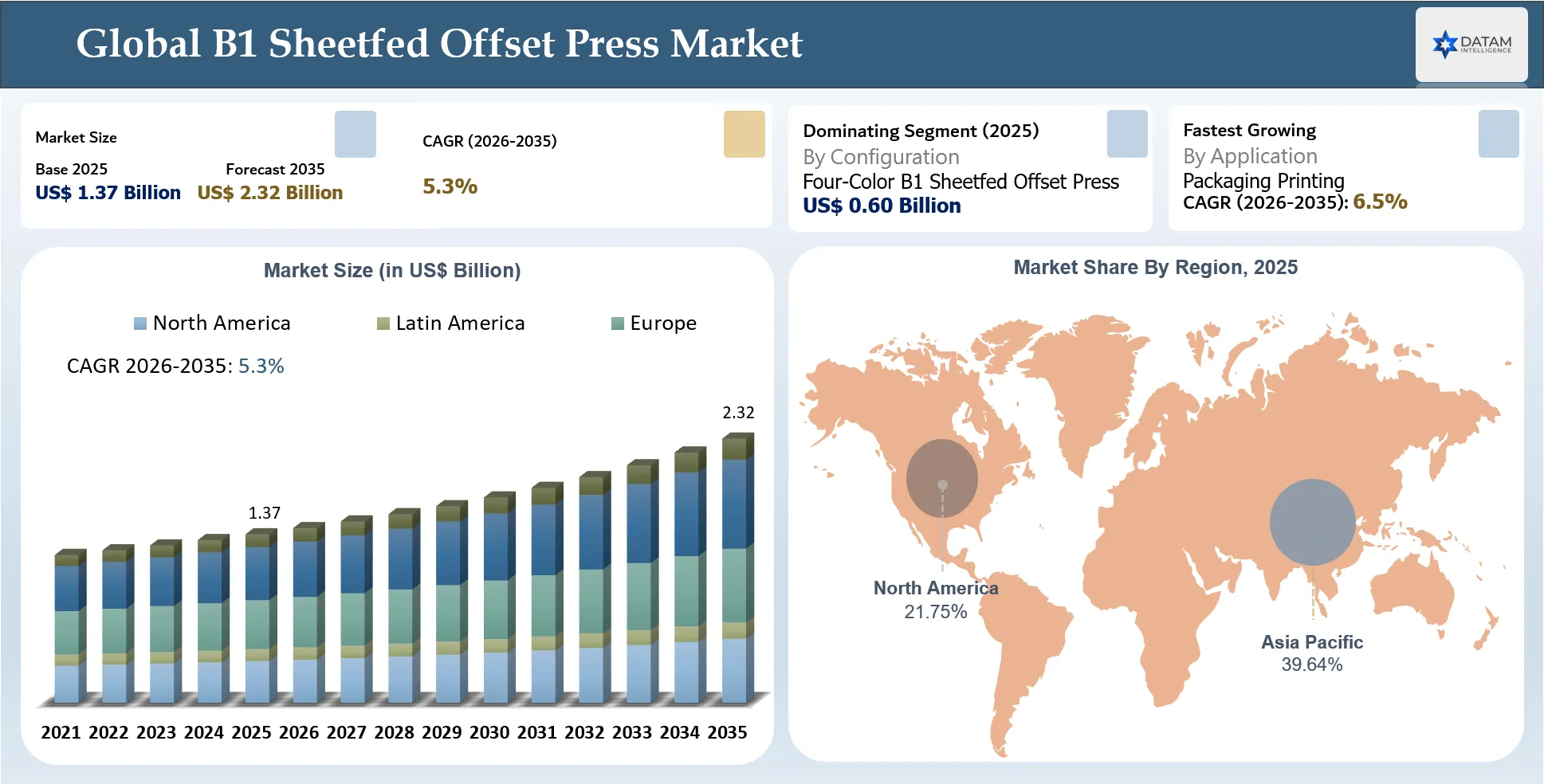
The B1 Sheetfed Offset Press Market is also being positively influenced by ongoing technological innovation, with features such as automated plate changing, inline print quality inspection systems, enhanced digital workflow integration, remote monitoring capabilities and the implementation of energy-efficient LED-UV curing systems enhancing efficiency. Technological developments assist in minimizing setup times, reducing material waste, boosting overall productivity and lowering operational expenditures. Although the ongoing trend towards digital printing presents a significant alternative in specific short-run and personalized print applications, the continued preference for B1 sheetfed offset presses persists for bulk production applications due to their inherent superiority in print consistency. Future growth of the B1 Sheetfed Offset Press Market is expected to be spurred by expansion of packaging needs, upgrades and modernizations of printing facilities and increased investment in sustainable printing technologies.
Key Takeaways
- The B1 Sheetfed Offset Press Market is experiencing consistent growth, fueled by rising demand for high-end packaging, folding cartons and superior commercial printing.
- Automation and digital transformation are revolutionizing the market, as AI-driven quality assurance, digital workflow integration and predictive maintenance enhance productivity and operational effectiveness.
- The packaging sector continues to be the main driver of growth, bolstered by increasing demand from food & beverage, pharmaceutical, cosmetics and consumer products industries.
- Sustainability is emerging as an important buying factor, promoting the use of energy-efficient presses, LED-UV curing technologies and eco-friendly printing methods.
- Top manufacturers are enhancing their competitive standing by means of ongoing product innovation, automation, strategic alliances and the expansion of global service and support networks.
- Emerging markets, especially in the Asia-Pacific region, are anticipated to present considerable growth potential, fueled by industrial growth, upgrades to printing operations and rising investments in cutting-edge printing technologies.
B1 Sheetfed Offset Press Market Industry Trends and Strategic Insights
- The rising need for high-quality packaging is fueling investments in sophisticated B1 sheetfed offset presses, especially for folding cartons utilized in the food & beverage, pharmaceutical, cosmetics, and consumer goods sectors.
- Automation and intelligent printing technologies are emerging as norms, with producers incorporating AI-driven quality checks, automated plate replacements, predictive upkeep and digital workflow systems to enhance output.
- Sustainability is impacting equipment choices, with printing firms progressively investing in LED-UV curing, energy-efficient presses, low-emission methods and options compatible with recyclable materials.
- Digital transformation and the integration of Industry 4.0 are improving manufacturing efficiency via cloud monitoring, real-time analysis, remote diagnostics and smart production management.
- Producers are enhancing their competitive approaches via ongoing R&D, product development, strategic collaborations and broadening global sales and post-sales service networks.
- Emerging markets are generating substantial growth prospects, backed by escalating investments in commercial printing and packaging infrastructure, upgrading of printing facilities and a growing demand for premium printed products.
Market Scope
| Metrics | Details | |
| 2025 Market Size | US$ 1.37 Billion | |
| 2035 Projected Market Size | US$ 2.32 Billion | |
| CAGR (2026-2035) | 5.3% | |
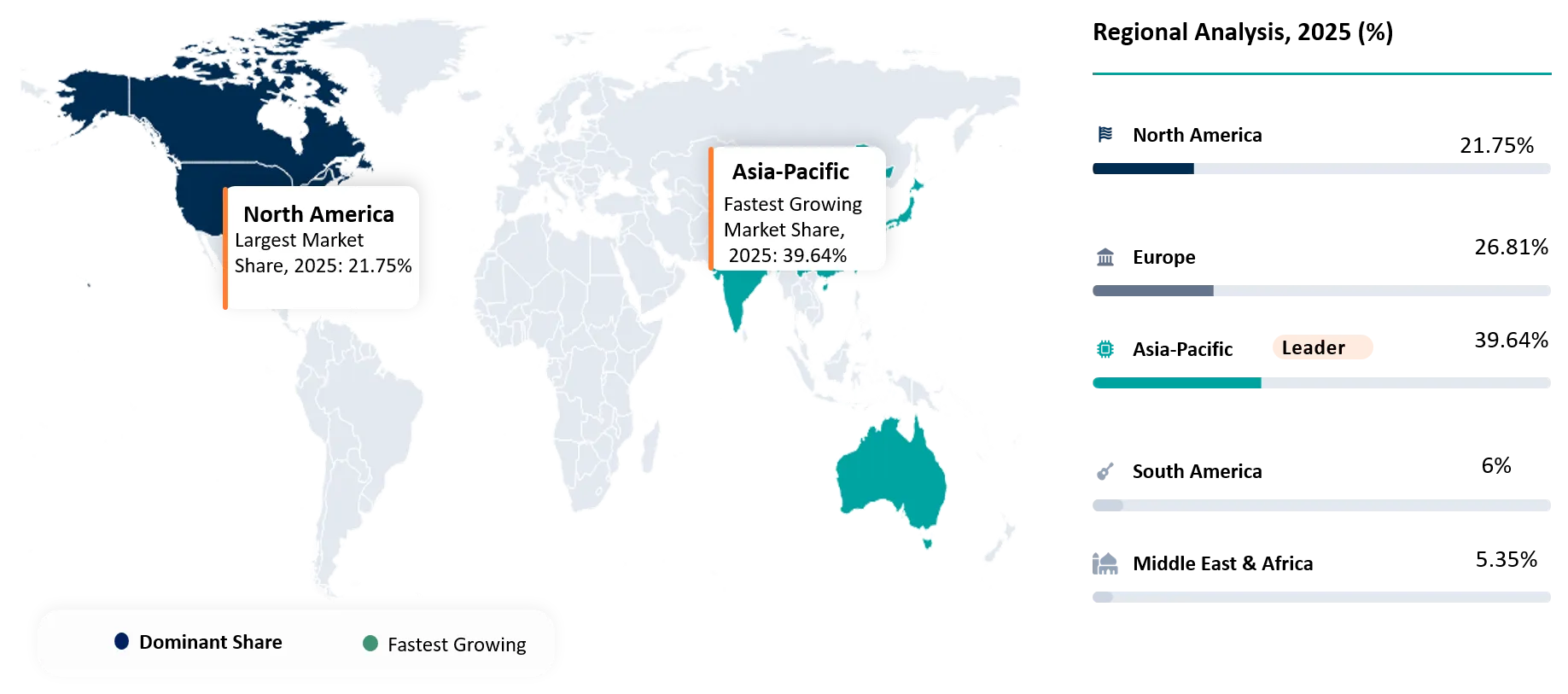
| Largest Market | North America | |
| Fastest Growing Market | Asia-Pacific | |
| By Color Configuration | Single-Color B1 Sheetfed Offset Press, Two-Color B1 Sheetfed Offset Press, Four-Color B1 Sheetfed Offset Press, Five-Color B1 Sheetfed Offset Press, Six-Color B1 Sheetfed Offset Press, Seven-Color B1 Sheetfed Offset Press, Eight-Color and Above B1 Sheetfed Offset Press and Others | |
| By Press type | Straight Press, Convertible Perfecting Press, Dedicated Perfecting Press, Non-Perfecting Press and Others | |
| By Printing and Curing Technology | Conventional Offset Press, UV Offset Press, LED-UV Offset Press, Hybrid Offset Press, IR and Hot Air Assisted Offset Press and Others | |
| By Automation Level | Standard Automation Press, Advanced Automation Press, Fully, Automated Press, Smart and Connected Press and Others | |
| By Material Handling System | Standard Feeder and Delivery Press, High-Pile Feeder and Delivery Press, Nonstop Feeder and Delivery Press, Logistics-Integrated Press and Others | |
| By Substrate | Coated Paper, Uncoated Paper, Folding Carton Board Solid Bleached Sulfate Board,, Solid Unbleached Sulfate Board, Recycled, Paperboard, Synthetic Paper, Plastic Film and Sheets, Metallized Paper and Board, Specialty Substrates and Others | |
| By Maximum Printing Speed | Up to 10,000 Sheets per Hour, 10,001 to 15,000 Sheets per Hour, 15,001 to 18,000 Sheets per Hour, 18,001 to 21,000 Sheets per Hour and Above 21,000 Sheets per Hour | |
| By Application | Commercial Printing, Folding Carton Printing, Label Printing, Publishing, Security Printing, Specialty Printing, Packaging Printing and Others | |
| By End-User | Commercial Printing Companies, Packaging Converters, Label, Manufacturers, Publishing Houses, Security Printing Facilities, Government Printing Facilities, In-House Printing Units, Printing, Service Providers and Others | |
| By Sales Channel | Direct Sales, Authorized Dealers and Distributors, Used Machinery, Dealers, Leasing and Financing Partners and Others | |
| By Installation type | New Installation, Replacement Installation, Capacity Expansion Installation, Used and Refurbished Press Installation and Others | |
| By Region | North America | U.S., Canada, Mexico |
| Europe | Germany, UK, France, Spain, Italy, Poland | |
| Asia-Pacific | China, India, Japan, Australia, South Korea, Indonesia, Malaysia, Singapore, Vietnam, Thailand, Philippines, Taiwan | |
| South America | Brazil, Argentina | |
| Middle East and Africa | UAE, Saudi Arabia, South Africa, Israel, Turkiye | |
| Report Insights Covered | Competitive Landscape Analysis, Company Profile Analysis, Market Size, Share, Growth | |
Why does this report matter in 2026?
Offset Sheetfed B1 printing companies head into 2026 expecting increased focus on automation, production efficiencies and sustainability, as print customers demand more sustainable, higher quality prints. Speed and print quality are not the only purchase drivers for commercial printers or packaging converters making press investments. Instead, it has become much more important to analyze makeready time, ink and paper waste, water usage, the capability for integration within a fully digital workflow, in-line print quality control and the availability of predictive maintenance services across a vast array of substrate types. Buyers will be seeking the optimum performance at lowest total cost of ownership, with added process agility and maximum operation efficiency from their investment.
The growth in premium packaging and folding cartons for the food, beverage, pharmaceutical and cosmetic sectors has added significant impetus to this trend.At the same time, there is a growing challenge from digital technologies that offer competitive solutions for short run, highly personalized volumes of both commercial printing and folding cartons. In an integrated analysis of the marketplace, the level of automation, B1 offset sheet fed configurations, end user segments and geographic areas that will experience increased demand must be analysed because, in comparison to commercial printing, demand for folding cartons has demonstrated greater resilience and higher growth prospects in many geographies.
White Space & Investment Opportunities
- Growth in emerging markets offers substantial possibilities as printing firms upgrade their production facilities to satisfy the increasing need for high-quality packaging and commercial printing.
- Investing in automation and AI-powered printing technologies provides significant opportunities to boost productivity, minimize waste and elevate print quality.
- Increasing demand for sustainable printing options is leading to opportunities for producers creating energy-efficient presses, LED-UV curing systems and environmentally friendly printing technologies.
- The growing adoption of digital workflow integration and Industry 4.0 creates chances for software vendors, automation firms and developers of smart manufacturing solutions.
- Increasing after-sales services, predictive maintenance and lifecycle support presents ongoing revenue prospects and reinforces enduring customer connections.
- Increasing demand for premium packaging solutions, such as folding cartons for food and beverage, pharmaceuticals, cosmetics and e-commerce, presents appealing investment prospects for machinery makers and packaging converters.
Future Market Transformation
Print companies looking to cut down costs and boost productivity by automating processes with digital connectivity, advanced technology and sustainable production are set to reshape the B1 Sheetfed Offset Press Market in the next few years. Manufacturers are set to invest more in integrating cutting-edge technologies into B1 Sheetfed Presses including AI-enabled quality inspection, rapid plate changing, predictive maintenance features, remotely monitored diagnosis, intelligent color controls and integrated cloud workflows to offer higher levels of production output and minimum downtime. Through these implementations, customers are guaranteed minimized setup duration times, reduced consumption of papers and inks, consistency of colors, operational costs along with flexibility in productions. With rapid changing customers preferences in delivery time, equipment producers aim at producing faster presses that can execute more printing works on a broader range of papers on any given surfaces with least manual intervention required.
The expansion of the packaging business worldwide coupled with environmentally friendly print solutions will play a big role in the market shift and will continue to remain. The increased demand on good quality, premium and environment- friendly foldable cartons from consumers that range from food & beverage industries, healthcare industries, cosmetics sectors, tech sectors, etc will stimulate the purchase and use of an advanced range of sheetfed offset presses. Producers are trying to innovate their offerings and present energy efficient innovations, LED-UV solutions and low-emission printing solutions that are eco friendly in the usage of papers and related resources. Modernization of old print houses, acceptance of 4.0 Industry standards, funding towards growing economies will reshape the competitive landscape, creating new opportunities for equipment manufacturers, printing service providers and packaging converters while supporting long-term market growth.
Buyer Decision-Making Criteria
Buyers of equipment for the B1 Sheetfed Offset Press Market look beyond merely printing capabilities in their buying choices. Beyond pure print quality and volume of sheets per hour, buyers base their purchasing decisions on factors such as makeready times, integration and availability of automation,energy efficiency, easiness of maintenance, interaction of digital workflows with the machines, the total cost of operation over their lifecycle as a purchasing criterion. Printers check what type of substrate it can print, its facility to be quick for new job printing, to assure colors are consistent and material is minimized due to increased market pressure on the reduced delivery cycles as well as demand in high graphic products for Packaging. In addition to technical functionalities, the supplier experience (after-sales, training, availability of spares and services, technical support) become major purchasing drivers.
With increasing demand for environmental friendly solutions the demand for press and equipment for printing solutions with UV technology and low-energy systems has also raised. Purchasing decisions are also shaped by return on investment (ROI), production scalability, financing options and the manufacturer's reputation for innovation and service. As the market becomes more competitive, buyers increasingly favor suppliers that offer integrated printing solutions, smart automation and long-term operational support rather than focusing solely on the initial purchase price.
Economic & Investment Analysis
Investments keep piling into the B1 Sheetfed Offset Press Market because printing companies continue upgrading production facilities to enhance efficiency and cut down on operational expenditures in line with mounting orders for high quality packaging and commercial printing. Despite high initial costs required, b1 sheetfed presses offer significant economic advantage due to their accelerated rate of producing work, lower per-unit printing costs, reduced material waste and the greater operational efficacy. An added increase can be foreseen for investment into the packaging section because of sustained and quick turning up times, high quantity production output and consistent impression quality remain critical competitive advantages.
The present trend of investment also entails presses incorporating energy saving features and being equipped with extensive automation, leading to improved profitability by lowering labor costs, having anticipatory maintenance and higher process consistency and integration with special emphasis on high capacity printing businesses. Emerging economies are witnessing increased investments in new printing facilities as demand for packaged consumer goods continues to rise, while mature markets are primarily investing in replacing aging equipment with advanced digital-ready presses. Furthermore, government schemes designed at a sustainable environment, use of 4.0 technologies at an increasing rate, together with the demand for eco friendly printing procedures, will encourage capital spending creating attractive opportunities for press manufacturers, technology providers and investors over the forecast period.
Investment Trends in the Market
- Printing firms are progressively allocating resources to highly automated B1 sheetfed offset presses to boost productivity, decrease operating expenses and improve print quality.
- Capital expenditure is transitioning towards printing equipment centered on packaging, influenced by increasing demand for folding cartons and high-quality packaging in the food & beverage, pharmaceutical and consumer goods sectors.
- Producers are boosting funding in R&D to create AI-driven quality assurance, digital workflow integration, foresight maintenance and energy-saving printing technologies.
- Investments in eco-friendly printing technologies like LED-UV curing systems, low-emission methods and recyclable substrate compatibility are growing rapidly to comply with environmental regulations.
- Increasing investments in emerging markets, especially throughout Asia-Pacific, are aiding the upgrading of printing facilities and the growth of production capacity.
- Firms are broadening their local service networks and post-sales support, emphasizing installation, upkeep, replacement parts and digital service platforms to enhance enduring customer connections.
Strategic Indicators For B1 Sheetfed Offset Press Market
High Regulation Impact
B1 sheetfed offset press market is characterized by Moderate to High Regulatory Impact due to increased prevalence of workplace safety, energy-efficiency regulatory landscape. Manufacturers and printing service providers are subjected to various regulatory standards with regard to VOC emissions control, waste management, chemical handling, machine safety as well as energy conservation measures. Policies which drive toward the use of environment-friendly ink, substrate and printing techniques for lower emission technologies further contribute to design of B1 Sheetfed Offset Presses.
Driven by burgeoning sustainability movement and increasing strict regulations on environment, predominant markets are witnessing inclination towards the uptake of B1 Sheetfed Offset Presses equipped with energy efficiency features such as LED-UV drying process, automated waste management function as well as digital workflow process. Manufacturers have to ensure compliance with quality standards to gain access into international markets. As regulatory expectations continue to evolve, companies investing in environmentally responsible and compliant printing technologies are expected to gain a stronger competitive advantage.
High Investment Activity
The B1 Sheetfed Offset Press Market has attracted substantial investment from printing companies that are seeking to enhance production efficiencies, curtail operating expenses and keep pace with increased demand for high-quality commercial and packaging applications. Printing firms have been actively making substantial investments in advanced B1 sheetfed offset presses that leverage technologies like automation, Artificial Intelligence-backed quality inspection, integration with digital workflows, predictive maintenance and enhanced energy efficiency. These upgrades help enhance productivity, reduce material waste and deliver faster turnaround times, making them attractive for commercial printers and packaging converters.
Equipment Manufacturers are continuously investing in research and development aimed at improving existing technology and rolling out more automated and sustainable presses that can handle a wider variety of substrates. In addition, the increasing demand for packaging across food and beverages, cosmetic, personal and healthcare and the pharmaceutical industry is encouraging capacity expansion and modernization of printing facilities, particularly in emerging markets. These investment trends are expected to strengthen market competitiveness and support long-term industry growth.
Supply Chain Disruption
The B1 Sheetfed Offset Press Market faces a moderate level of supply chain disruption due to its reliance on a globally distributed network of suppliers for precision machined components, electronic control systems, servo motors, sensors, semiconductor components, bearings, printing cylinders and automation systems. Fluctuations in the availability and pricing of steel, aluminum, electronic components and industrial parts, along with rising logistics and freight costs, can increase manufacturing expenses and extend equipment delivery timelines. As B1 sheetfed presses are highly customized and technologicalically advanced, delays in sourcing even a single critical component can disrupt production schedules and project installations.
In order to mitigate these issues, offset press manufacturers are broadening their base of component suppliers and regionalizing production while expanding inventories of key parts and investing in supply chain management software for greater visibility and demand prediction capabilities. Leading companies are also strengthening partnerships with component suppliers and expanding local service and spare parts networks to reduce downtime for customers.The long-term value of modern offset presses is becoming tied not just to their innovation and productivity, but also to the supplier chain’s efficiency.
Pricing Volatility
The global B1 Sheetfed Offset Press Market remains a subject to moderate price variations, as price ranges are affected by raw material costs, electric components, precisely engineered component prices and global logistics. Prices of steel, aluminum, semiconductors, electronic motors, automation machines and different sensors are responsible for determining cost of producing and delivering B1 sheetfed offset presses globally. Additionally, variations in energy prices, labor costs and foreign exchange rates can impact production expenses and equipment pricing, particularly for manufacturers operating across multiple regions.
Despite these fluctuations, pricing remains relatively stable due to the high-value and customized nature of B1 sheetfed offset presses, where purchasing decisions are driven more by performance, automation capabilities, productivity and total cost of ownership than by initial equipment price alone. Manufacturers increasingly offer flexible financing options, service contracts and technology upgrades to maintain competitiveness. Long-term supplier agreements, localized sourcing strategies and improved manufacturing efficiencies are also helping companies reduce the impact of cost fluctuations and provide greater pricing stability to customers.
Procurement Pressure
B1 Sheetfed Offset Press Market has moderate to high procurement pressure as buyers increasingly prioritize long-term operational value over initial purchase cost.Commercial printer and packaging converters evaluate presses based on production output, automation level, maintenance requirements and compatibility with digital workflows. Since B1 sheetfed offset presses represent significant capital investments, procurement decisions involve extensive technical evaluations, return on investment (ROI) analysis, supplier reliability and lifecycle operating costs. Buyers are also looking for equipment that can accommodate different substrate types, offer shorter setup times and accommodate future production needs ensuring long-term competitiveness in a rapidly evolving printing industry.
Procurement teams are also placing greater emphasis on supplier reputation, after-sales service, availability of spare parts, operator training and the availability of finance and technical assistance. Supply chain reliability and timely equipment delivery have become increasingly important due to global component shortages and logistics uncertainties. Environmental impact has a significant effect on purchasing decisions including energy-efficient technologies, LED-UV technology, minimized waste and other eco-friendly certifications. In an increasingly competitive market, manufacturers need to demonstrate flexibility, offer comprehensive solutions including installation, digital workflow integration, maintenance services and long-term customer support to strengthen their market presence.
New Technology Adoption
The B1 Sheetfed Offset Press Market is witnessing high adoption of new technologies as printing companies invest in advanced solutions to improve productivity, print quality and operational efficiency. Modern presses have equipped with features like automated plate changing, AI-controlled output, clever printing tone management, forecast upkeeps, monitoring by clouds to observe output, integrated digital workloads that bring downtime. In addition to that, these technologies help reduce setup times, minimize material waste, improve press utilization and ensure consistent print quality, enabling printers to meet growing demand for faster turnaround times and high-value print applications.
Sustainability and enhanced flexibility for production also plays a critical role in adoption of newer technology. Manufacturers are incorporating energy-efficient LED-UV curing systems, low-emission printing technologies and automation that reduces labor dependency and operating costs. Integration with Industry 4.0 platforms allows real-time data analysis, remote diagnostics and enhanced production planning, helping printing companies optimize performance and maximize return on investment. As competition intensifies and customer expectations continue to evolve, the adoption of smart, connected and environmentally responsible printing technologies is expected to remain a key factor driving the future growth of the B1 Sheetfed Offset Press Market.
Regional Expansion Opportunity
There are opportunities for strong regional growth, particularly in emerging economies where rapidly expanding industries, urbanization and increased consumption of packaged consumer goods are driving investments in modern printing infrastructure. Countries across Asia-Pacific, Latin America and the Middle East & Africa are witnessing growing demand for commercial printing and high-quality packaging, forcing printing companies to invest in modernizing their existing print facilities and adopting sophisticated B1 sheetfed offset presses. Increasing consumption of food & beverage, pharmaceutical, cosmetics and e-commerce packaging in these regions boost regional market growth.
Simultaneously, mature markets like North America and Europe still provide avenues for growth through upgrading from older technology, using sophisticated highly automated printing machines that are energy efficient and digitized. Companies are expanding their footprint with strengthened dealer network, service support facilities and technical expertise in the regions that ensure proximity and serve their customers. The rising trend for eco friendly printing methods together with expansion of industry 4.0 technologies, adoption of workflow automation, are also anticipated to ensure long term sustained growth.
Government Policy Support
Governments actively implement moderate policy support in the B1 Sheetfed Offset Press market to promote the advancement of industrial, manufacturing capabilities and the transformation to digital manufacturing and sustainable printing methods. This support is delivered in the form of tax breaks, investment subsidies, soft loans and funds to help local manufacturers and printers purchase advanced manufacturing equipment and technology. Many governments proviude incentives that promote domestic manufacturing industries, exports and develop industries such as food packaging.
Environmental regulations and sustainability policies are also influencing market development by encouraging the adoption of energy-efficient printing technologies, low-VOC inks, waste reduction practices and recyclable packaging materials. Green production measures, renewable energy consumption and eco-friendly printing processes have given a push to introduce sustainable technologies in the manufacturing process of Offset printing machines. Governmental investments in high-end industries, pharmaceutical sector, packaged food industry, packaging materials, education industry and consumer goods have been instrumental in driving the demand of high-quality print products, particularly commercial print and packaging applications.
Import Export and Pricing Intelligence
Germany and Japan dominate the international trade scenario in the B1 Sheetfed Offset Press Market through their exports of sophisticated sheetfed offset printing presses to their customers in the North America, Asia Pacific, Europe, South America and Middle East & Africa countries. In countries with dynamic printing markets, requirement for developing new ultra-modern facilities for their packaging and commercial printing applications drives the import market for sheetfed offset printing presses. Trade flows are influenced by factors such as import duties, exchange rate fluctuations, shipping costs and the availability of local distribution and service networks.
| HS Code | Reporter | Trade Flow | 2025 Trade Value | Interpretation |
| 8443 | Germany | Export | XXXXX | Germany remains a leading exporter of high-end B1 sheetfed offset presses, supported by strong manufacturing capabilities and global demand for premium printing equipment. |
| 8443 | Japan | Export | XXXXX | Japan continues to be a major supplier of technologically advanced B1 sheetfed offset presses, particularly for commercial printing and packaging applications. |
| 8443 | United States | Import | XXXXX | Imports reflect ongoing investments in replacing aging presses with highly automated and energy-efficient offset printing systems. |
| 8443 | India | Import | XXXXX | Rising imports are driven by expanding packaging, publishing and commercial printing industries, alongside modernization of domestic printing facilities. |
AI Impact Analysis
The adoption of AI in the B1 Sheetfed Offset Press market is steadily gaining momentum by driving advancements in production workflow, printing quality and equipment efficiency. Modern B1 Sheetfed offset machines are integrating AI-powered solutions for automated color management, inline print inspection, defect detection, predictive maintenance and real-time process optimization. These capabilities help printers reduce setup times, minimize material waste, improve print consistency and maximize machine uptime, resulting in higher productivity and lower operating costs. AI-driven workflow automation also enables faster job scheduling, intelligent resource allocation and improved decision-making throughout the printing process.
In addition to production enhancements, AI also increases business efficiencies such as demand forecast, off-site remote equipment surveillance, as well as predictive technical service. Machine builders utilize artificial intelligence to provide a higher degree of intelligence by examining equipment functions to develop better service strategies and scheduling of proactive technical assistance. For printing businesses focusing on adopting Industry 4.0 strategies and developing smart factories, AI provides opportunities for greater business flexibility, custom manufacturing as well as enhanced productivity, giving companies an edge in the future of the B1 Sheetfed Offset Press market.
Disruption Analysis
The B1 Sheetfed Offset Press Market is experiencing significant disruption from the pace of technological change, dynamic customer needs and increased uptake of digital printing technologies. Although B1 Sheetfed offset press technology remains dominant in medium and long-run production due to their superior print quality and cost efficiency, digital printing is gaining traction in short-run, personalized and on-demand applications. This is motivating suppliers to produce highly automated press with faster makeready times, intelligent workflow connectivity, more sophisticated quality controls to remain competitive in their markets. Furthermore the rise of the luxury print packaging and green printing is transforming the product innovation and investment plans throughout the industry.
Increased market uncertainty due to volatile supply chains and higher input costs, tight environmental legislation and changing dynamics on labour markets. As a reaction manufacturers are strengthening regional supply chains, expanding their portfolio of digitally-delivered services, investing in new energy efficient production technology and using AI to enhance operations in an efficient way to ensure robustness. Modern printing operations are transforming from traditional manufacturing processes to smart manufacturing as part of Industry 4.0 driven by cloud based production management and Predictive Maintenance solutions. Companies that innovate and remain agile to overcome technological changes and market volatility with sustainable products and customer centric approach are likely to gain a stronger competitive footing and long-term gains.
BCG Matrix: Company Evaluation
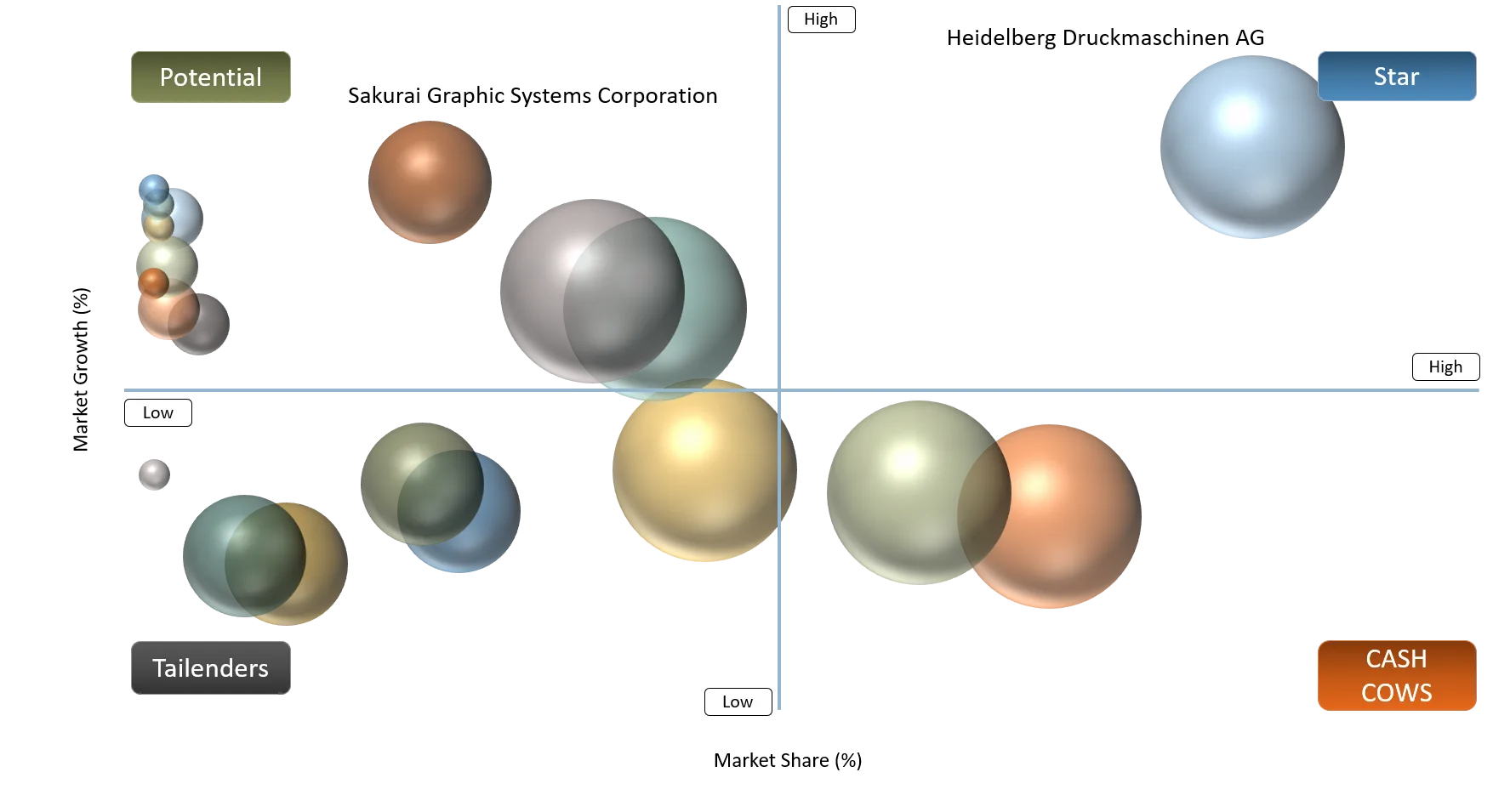
STAR
Heidelberg Druckmaschinen AG, Koenig & Bauer AG, Komori Corporation, RMGT (Ryobi MHI Graphic Technology Ltd.) and Manroland Sheetfed GmbH are major players and dominate the global B1 sheetfed offset press market. This can be attributed to their vast product offerings, integrated technology solutions and efficient global service network. Product and innovation strategies, strong R &D initiatives, automated production capabilities, significant investments in AI technology-driven solutions, integrated workflow capabilities, high-speed printing solutions and efficient energy management are core competencies for top players.
POTENTIAL
The list of potential participants and key players includes Sakurai Graphic Systems Corporation, Shinohara Machinery Co., Ltd., Akiyama International Co., Ltd., Zhejiang Weigang Machinery Co., Ltd., Weifang Donghang Graphic Technology Inc., Shanghai PrintYoung International Industry Co., Ltd. and Hans Gronhi Graphic Technology Co., Ltd. These key players are increasing their footprint in the market by adopting aggressive strategies, providing more cost effective solutions, enhancing automation options and strengthening distribution channels in regional markets. Growth is expected from opportunities, especially in new and emerging economies by the growing market for commercial printing and packaging sectors along with modernization of printing facilities is creating opportunities for new installations and equipment upgrades. Companies that continue investing in automation, sustainable printing technologies and localized technical support are expected to strengthen their competitive position over the coming years.
Market Dynamics
Driver Impact Analysis
| Driver | Market Growth Impact (%) | Demand Concentration | Impacted Use Case | Strategic Impact |
Rising demand for premium packaging and folding cartons | 32% | High | Packaging printing, folding cartons | Drives investments in high-speed, high-quality B1 sheetfed offset presses for packaging converters. |
Increasing adoption of automation and Industry 4.0 technologies | 27% | High | Commercial printing, packaging | Encourages adoption of AI-enabled, automated presses to improve productivity, reduce waste and lower operating costs. |
Growth in commercial printing and marketing materials | 22% | Medium to High | Brochures, catalogs, books, magazines, promotional materials | Supports replacement of aging presses with advanced equipment offering superior print quality and faster turnaround. |
Rising focus on sustainable and energy-efficient printing solutions | 19% | Medium | Eco-friendly packaging, commercial printing | Accelerates demand for LED-UV curing, energy-efficient presses and environmentally compliant printing technologies. |
Driver: Premium Packaging Is Creating the Strongest Demand Pull
The growing demand for premium packaging and folding cartons is the strongest driver of the B1 Sheetfed Offset Press Market, since brand owners are putting more emphasis on quality packaging to promote brand identity, elevate product appeal and enhance visibility. The food & beverage, pharmaceuticals, cosmetic and personal care, consumer electronics and e-commerce industries require high-quality printed packaging with excellent print clarity, color consistency, sharp graphics and luxury finish to make their products stand out. The B1 Sheetfed offset press are appropriate for such needs as it achieves high speed production with exceptional print accuracy, in combination with cost-effectiveness and optimized medium and long run.
Even in the face of the growing focus on sustainable purchasing criteria, packaging producers are continuing to invest in a new generation of presses that can print a greater range of recyclable substrates, using lower VOC inks and energy-efficient LED-UV curing systems while minimizing waste and operating costs. At the same time, growing demand for shorter delivery times, design innovation and greater flexibility for more efficient product launches is driving printers to invest in upgrading their old machines to fully-automated B1 sheetfed offset presses integrated with digital workflows, artificial intelligence for quality control and advanced predictive maintenance. The sustained drive to produce premium packaging with high-value creative designs is providing enduring high levels of demand for sophisticated B1 sheetfed offset technology.
Restraint Impact Analysis
| Restraint | Drag on Market Growth (%) | Primary Impact Area | Impacted Use Case | Strategic Impact |
| High capital investment and maintenance costs | 34% | Equipment procurement | Commercial printing, packaging | Delays new press installations and discourages investments by small and medium-sized printing companies. |
| Growing competition from digital printing technologies | 28% | Technology adoption | Short-run, on-demand and personalized printing | Reduces demand for offset presses in low-volume print jobs and accelerates the shift toward digital printing solutions. |
| Supply chain disruptions and rising component costs | 21% | Manufacturing & procurement | New press manufacturing and delivery | Increases production costs, extends equipment lead times and affects project execution schedules. |
| Skilled labor shortages and rising operational costs | 17% | Operations & workforce | Press operation and maintenance | Creates challenges in operating advanced automated presses and increases training and labor expenses. |
Restraint: High Capital Investment Is Moderately Restricting Market Growth
The high capital cost required for the acquisition and installation of B1 sheetfed offset presses forms one of the primary factors limiting the B1 Sheetfed Offset Press Market's growth, particularly in developing economies. Modern B1 sheetfed offset press technology is integrated with high-level automation, artificial intelligence (AI) driven quality management systems, digital workflow integration capabilities and energy efficient technologies, which involve significant upfront purchase price, in addition to expenses related to installation, operator training, maintenance and facility upgrades.
The high financial commitments associated with such hardware investments can hamper their equipment upgrades as well as discourage the adoption of more sophisticated printing hardware, particularly within developing and price sensitive regions. While productivity, wastage and reduced operational expenses eventually justify such expenditures, a few players are prolonging the operational lifespan of older equipment and procuring used printing presses, keeping their Capital Expenditure at bay. Hence, the higher upfront Capital Expenditure poses a moderate impediment towards an accelerated growth trajectory of the B1 Sheetfed Offset Press market.
Segmentation Analysis
The global B1 Sheetfed Offset Press market is segmented based on color configuration, press type, printing and curing technology, automation level, material handling system, substrate, maximum printing speed, application, end-user, sales channel, Installation type and region.
By Configuration
Four-Color Presses Dominate the Market
Four-color B1 sheetfed offset presses are currently the leading market share category based on configuration. Four-color B1 sheetfed offset presses are adopted widely in commercial printing as well as packaging applications due to the well-balanced combination of print quality, speed and price. Four-color B1 sheetfed offset presses are suitable for printing of brochures, catalogs, magazines, books, posters and folding cartons.
Accurate full color prints with correct registration are consistently being provided by four-color presses.
It is now the preferable press category for commercial printers and packaging converters. Furthermore, enhanced integration with automation, digital workflow, energy saving devices and new technology have fueled the demand for four-color presses. It is also expected that the demand for the same would continue to grow at the highest rate in the coming years.
By Application
Packaging Printing Emerges as the Fastest-Growing Application
During the forecast period, the packaging printing segment will emerge as the largest as the demand of food & beverages, pharmaceutical, cosmetics & personal care and consumer goods sectors continue to increase their need for folding cartons and high quality packaging. Brand owners are more focused to increase the visual appearance and improve packaging’s brand recognition through best-quality printing and innovative packaging formats. In response to brand owners demand for high quality, attractive packaging that promotes shelf differentiation, leading packaging printers are actively seeking advanced B1 sheet fed offset presses with extensive automation and digital features including LED UV Curing systems, AI powered Quality Assurance, integrated inline color controls, automation, smart technology & automated workflow management systems. The growth in the packaging printing segment will continue driven by rising online retail sale of packaging goods, growth in consumer’s spending on packaged products and increasing adoption of recyclable packaging materials.
Market Segmentation
By Color Configuration
- Single-Color B1 Sheetfed Offset Press
- Two-Color B1 Sheetfed Offset Press
- Four-Color B1 Sheetfed Offset Press
- Five-Color B1 Sheetfed Offset Press
- Six-Color B1 Sheetfed Offset Press
- Seven-Color B1 Sheetfed Offset Press
- Eight-Color and Above B1 Sheetfed Offset Press
- Others
By Press Type
- Straight Press
- Convertible Perfecting Press
- Dedicated Perfecting Press
- Non-Perfecting Press
- Others
By Printing and Curing Technology
- Conventional Offset Press
- UV Offset Press
- LED-UV Offset Press
- Hybrid Offset Press
- IR and Hot Air Assisted Offset Press
- Others
By Automation Level
- Standard Automation Press
- Advanced Automation Press
- Fully Automated Press
- Smart and Connected Press
- Others
By Material Handling System
- Standard Feeder and Delivery Press
- High-Pile Feeder and Delivery Press
- Nonstop Feeder and Delivery Press
- Logistics-Integrated Press
- Others
By Substrate
- Coated Paper
- Uncoated Paper
- Folding Carton Board
- Solid Bleached Sulfate Board
- Solid Unbleached Sulfate Board
- Recycled Paperboard
- Synthetic Paper
- Plastic Film and Sheets
- Metallized Paper and Board
- Specialty Substrates
- Others
By Maximum Printing Speed
- Up to 10,000 Sheets per Hour
- 10,001 to 15,000 Sheets per Hour
- 15,001 to 18,000 Sheets per Hour
- 18,001 to 21,000 Sheets per Hour
- Above 21,000 Sheets per Hour
By Application
- Commercial Printing
- Folding Carton Printing
- Label Printing
- Publishing
- Security Printing
- Specialty Printing
- Packaging Printing
- Others
By End-User
- Commercial Printing Companies
- Packaging Converters
- Label Manufacturers
- Publishing Houses
- Security Printing Facilities
- Government Printing Facilities
- In-House Printing Units
- Printing Service Providers
- Others
By Sales Channel
- Direct Sales
- Authorized Dealers and Distributors
- Used Machinery Dealers
- Leasing and Financing Partners
- Others
By Installation Type
- New Installation
- Replacement Installation
- Capacity Expansion Installation
- Used and Refurbished Press Installation
- Others
Geographical Penetration
U.S. B1 Sheetfed Offset Press Market Landscape
The U.S.B1 Sheetfed Offset Press market is one of the most sophisticated markets in the world, backed by increased demand in commercial, folding carton packaging and promotional printing. Print providers are continually investing in modern B1 sheetfed offset presses that promise enhanced productivity, cost reduction, meet customer expectations for faster turnaround times and superior print quality. As the demand from the packaging sector, especially from food & beverage, pharmaceuticals, cosmetics and consumer goods is consistently contributing as one of the highest revenue-generating opportunities as brand owners seek premium printed packaging with high color accuracy and attractive finishing. With the continuous upgrading of the old printing plants with most efficient technology, it will lead the replacement of conventional presses with more efficient systems supported by digitally integrated workflow and intelligence management.
Additionally, demand for advanced and environmental technology, including AI-driven quality inspection, predictive maintenance, automated plate changing, and energy-saving LED-UV technology, is also becoming prominent in the market, driven by rising environmental standards and demand from consumers for green packaging. Strong after-sales service networks, financing options and continuous technological innovation by leading manufacturers are expected to support stable market growth, making the U.S. a key market for advanced B1 sheetfed offset press installations.
Japan B1 Sheetfed Offset Press Market Outlook
Japan has significant influence in the overall global B1 sheet-fed offset press market. It is the country of some of the major offset press manufacturers, including Komori Corporation and RMGT, who are consistently innovating by investing in automated equipment. The industry leaders in Japan focus on intelligent color management, integration with the digital workflow, smart manufacturing and robotic automation systems.
Demand from various application segments like high-quality commercial printing, high-value packaging solutions, premium publications and industrial applications supports the growth of the offset presses in Japan.
A higher proportion of manufacturing in Japan is meant for export. Japanese manufacturers continue to innovate by leveraging the precision manufacturing practices and building robust and reliable equipment, thereby retaining their competitive position in the global market.
In line with other developed markets in the Asia Pacific and North America, Japan is witnessing growing investment in environmentally friendly and energy-efficient equipment for offset printing technologies such as LED-UV curing and fully automated waste management solutions. Most printing companies in Japan are currently in the process of replacing outdated machinery and equipment with high automated presses to increase the production efficiency. There is significant focus on innovation in the printing technologies in order to reduce dependency on labor costs and improve printing efficiency by adopting Industry 4.0 principles for smart printing facilities. High share of production from Japan is for export for developed regions of the Asia Pacific. Thus Japan will continue to remain one of the largest technology contributors to the global offset printing press market.
China B1 Sheetfed Offset Press Market Trends
Supported by rapid industrialization and growing manufacturing activities coupled with the rise in the demand for high quality packaging solutions, China has become one of the fastest-growing markets in B1 sheetfed offset presses. With growing demands from China’s vast food & beverage industry, pharmaceutical, cosmetics, and consumer electronics as well as the booming e-commerce industry, there have been paving ways for investments in modernized printing equipment. China’s printing businesses increasingly embrace automated B1 sheetfed offset presses that are designed to offer high-speed output, exquisite print quality and improved operational efficiency. The continued expansion of export-oriented manufacturing and consumer goods production is further strengthening demand for advanced offset printing equipment.
Modernization is an essential and pervasive trend in China’s print market, with leading local and global providers of high-performance solutions introducing intelligent printing machines incorporated with capabilities like AI-powered quality control, integrated digital workflow systems, predictive maintenance and efficient production processes, powered by advanced energy-efficient mechanisms. The Chinese government's focus on driving adoption of automated production and advanced manufacturing systems is pushing environmentally friendly production. Besides, local providers of industrial printing presses continue to enhance print quality and strengthen their automation functions to contend with top international brands. China's growth as an equipment supplier as well as future market prospect is indeed significant.
Competitive Landscape
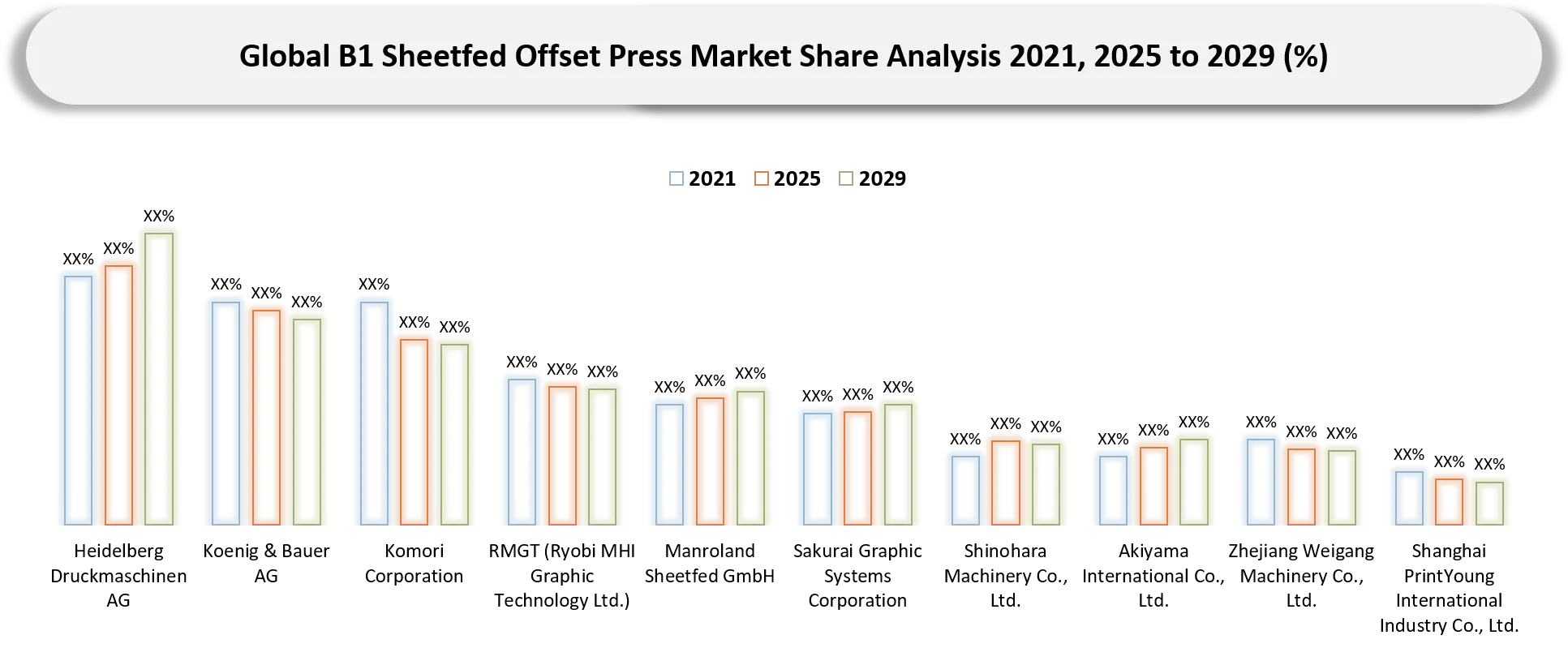
- The market is dominated by a set of established global players, namely Heidelberg Druckmaschinen AG, Koenig & Bauer AG, Komori Corporation, RMGT (Ryobi MHI Graphic Technology Ltd.), and Manroland Sheetfed GmbH, supported by strong global distribution networks and diverse technology portfolios.
- Market is witnessing technology-led competition, where major companies are leveraging technological innovation such as increased automation, AI in quality control, integration of digital workflows, high-speed printing and energy efficient technologies to improve productivity and print quality.
- Manufacturers are broadening their product portfolios catering to the ever increasing demand for packaging solutions like folding cartons, premium packaging as well as high quality commercial printing as they are anticipated to drive the market growth.
- Continuous investments in research & development capabilities of the key players are enabling the introduction of intelligent, faster and eco-friendly B1 sheetfed offset printing machines with higher operational efficiency.
- Factors like after sales service ranging from installation & maintenance services, operator training, spares availability, technical support play an integral part in fostering strong relationships between the manufacturers and their customers.
- Players are increasing their global footprint by consolidating their presence in emerging economies of Asia-Pacific, South America and the Middle East & Africa regions through partnerships, local sales and services support and affordable product offerings.
Company Coverage Preview
Heidelberg Druckmaschinen AG (HDM) leads the B1 Sheetfed Offset Press Market with its comprehensive range of high-automation sheetfed offset presses for commercial printing and packaging. The company has established itself with innovative AI quality control, digital workflow integration, intelligent press automation and energy-efficient printing. Its strong global service network, extensive installed base and focus on sustainable printing solutions make it one of the most influential players in the market.
Koenig & Bauer AG holds a significant market share across commercial, packaging and industrial printing segments. The company’s emphasis on high-performance offset presses, advanced automation and smart manufacturing solutions ensures enhanced productivity and lower operating expenses. Specialization in premium packaging and folding carton applications coupled with strategic investments in digitalization and sustainability strengthens its global market standing.
Komori Corporation is a prominent manufacturer, recognized for precision-engineered sheetfed offset press technology and integrated digital printing solutions. Its advanced press automation, intelligent color control systems and eco-friendly printing solutions have earned it preference among commercial printers and packaging converters. Komori’s substantial presence in the Asia-Pacific, Europe and North America markets solidifies its market dominance.
Key Companies
- Heidelberg Druckmaschinen AG
- Koenig & Bauer AG
- Komori Corporation
- RMGT (Ryobi MHI Graphic Technology Ltd.)
- Manroland Sheetfed GmbH
- Sakurai Graphic Systems Corporation
- Shinohara Machinery Co., Ltd.
- Akiyama International Co., Ltd.
- Zhejiang Weigang Machinery Co., Ltd.
- Weifang Donghang Graphic Technology Inc.
- Shanghai PrintYoung International Industry Co., Ltd.
- Hans Gronhi Graphic Technology Co., Ltd.
- JMD Printing Machines
- Prakash Offset Machinery Pvt. Ltd.
- Ronald Web Offset Pvt. Ltd.
Major Pain Points
- The high cost of acquiring, installing and maintaining such advanced B1 sheetfed offset presses makes it hard for smaller to medium-sized printers to upgrade their machines.
- Increasing competition from digital printing technologies, particularly for short-run, on-demand and personalized printing applications.
- Supply chain disruptions along with increasing prices for components lead to longer equipment lead times and higher manufacturing expenses.
- Lack of trained and skilled personnel capable of operating and maintaining the highly automated printing system.
- Stringent environmental regulations forcing businesses to invest in sustainable practices, such as environment friendly technologies, energy saving equipment, as well as a low emission printing technology to minimise the overall printing waste.
- Faster turnaround times and production flexibility is demanding businesses continue investing in automation and digitising workflow processes.
Recent Developments
- June 2026: Heidelberg Druckmaschinen AG acquired Manroland Sheetfed's entire service and spare parts business, including 35 country organizations and related intellectual property to bolster its lifecycle service portfolio and international customer service offering.
- June 2025: Heidelberg Druckmaschinen AG introduced the Cartonmaster CX 145, a very large format (VLF) sheetfed offset press for folding carton production, expanding its packaging portfolio through a technology partnership with Manroland Sheetfed.
- February 2026: Manroland Sheetfed India posted a high growth in 2025, by expanding beyond press sales into consumables and maintenance solutions. Furthermore, Manroland Sheetfed India expanded its presence with additional ROLAND 700 Evolution press installs and improved customer service digital engagement.
- March 2026: Manroland Sheetfed has initiated a comprehensive restructuring program with the aim of improving operational efficiency and long-term competitiveness in the global printing equipment market.
Analyst View / Opinion
- The B1 Sheetfed Offset Press market will gain traction in the coming years due to the increasing demand from end-user industries such as packaging, folding cartons and premium commercial printing.
- Automation & digitalization are key differentiating factors, with the integration of AI-based quality control systems, predictive maintenance and automated workflow integration into next-gen sheetfed presses will become a standard.
- In the future, packaging industry is expected to continue outperforming the conventional commercial printing, creating significant opportunities for manufacturers offering high-speed, energy-efficient and flexible printing solutions.
- Sustainability will be one of the deciding factors for buyers while investing in B1 sheetfed offset presses, as printing companies look for LED-UV curing, waste-minimizing production methods and compliance to sustainability norms.
- The key market players with robust R&D infrastructure, global service networks and efficient distribution networks will dominate the market whereas, the local manufacturers will focus on offering economic solutions and localized technical support.
Target Audience
| INDUSTRY | WHO SHOULD BUY THIS REPORT? | REASON TO BUY THIS REPORT |
| Printing Equipment Manufacturing | B1 sheetfed offset press manufacturers and OEMs | To identify market trends, technology advancements, competitive strategies and growth opportunities. |
| Commercial Printing | Commercial printing companies and print service providers | To evaluate equipment investments, automation trends and production optimization strategies. |
| Packaging | Packaging converters and folding carton manufacturers | To understand demand trends, technology developments and packaging-focused growth opportunities. |
| Investment & Finance | Investors, private equity firms and financial institutions | To assess market potential, investment opportunities and competitive positioning of key players. |
| Distribution & Sales | Printing equipment distributors, dealers and system integrators | To identify regional demand, customer preferences and expansion opportunities. |
| Raw Material & Component Suppliers | Suppliers of inks, printing plates, automation systems and machine components | To understand procurement trends, supply chain dynamics and future equipment demand. |
Why Choose DATAM?
- Data-Driven insights: Dive into detailed analyses with granular insights such as pricing, market shares and value chain evaluations, enriched by interviews with industry leaders and disruptors.
- Post-Purchase Support and Expert Analyst Consultations: As a valued client, gain direct access to our expert analysts for personalized advice and strategic guidance, tailored to your specific needs and challenges.
- White Papers and Case Studies: Benefit quarterly from our in-depth studies related to your purchased titles, tailored to refine your operational and marketing strategies for maximum impact.
- Annual Updates on Purchased Reports: As an existing customer, enjoy the privilege of annual updates to your reports, ensuring you stay abreast of the latest market insights and technological advancements. Terms and conditions apply.
- Specialized Focus on Emerging Markets: DataM differentiates itself by delivering in-depth, specialized insights specifically for emerging markets, rather than offering generalized geographic overviews. The approach equips our clients with a nuanced understanding and actionable intelligence that are essential for navigating and succeeding in high-growth regions.
- Value of DataM Reports: Our reports offer specialized insights tailored to the latest trends and specific business inquiries. The personalized approach provides a deeper, strategic perspective, ensuring you receive the precise information necessary to make informed decisions. The insights complement and go beyond what is typically available in generic databases.
What DATAM Uniquely Provides
- Comprehensive market intelligence coveringmarket size, growth forecast, market segmentation, market landscape, regional analysis for B1 Sheetfed Offset Press Market.
- In-depth insights into market trends & innovationS such as automation, AI powered printing, digital workflow integration, industry 4.0, sustainable printing etc.
- Detailed competitive benchmarking including leading manufacturers, product offerings, strategic developments, market positioning and business strategy.
- Procurement, pricing, supply chain & investment intelligence with actionable insights for business planning and strategic decision making.
- Futuristic outlook and opportunity assessment such as emerging market segments, future growth trends and regional opportunities for stakeholders in B1 Sheetfed Offset Press Market.


























































