


Automotive Zonal Architecture Market Size and Overview
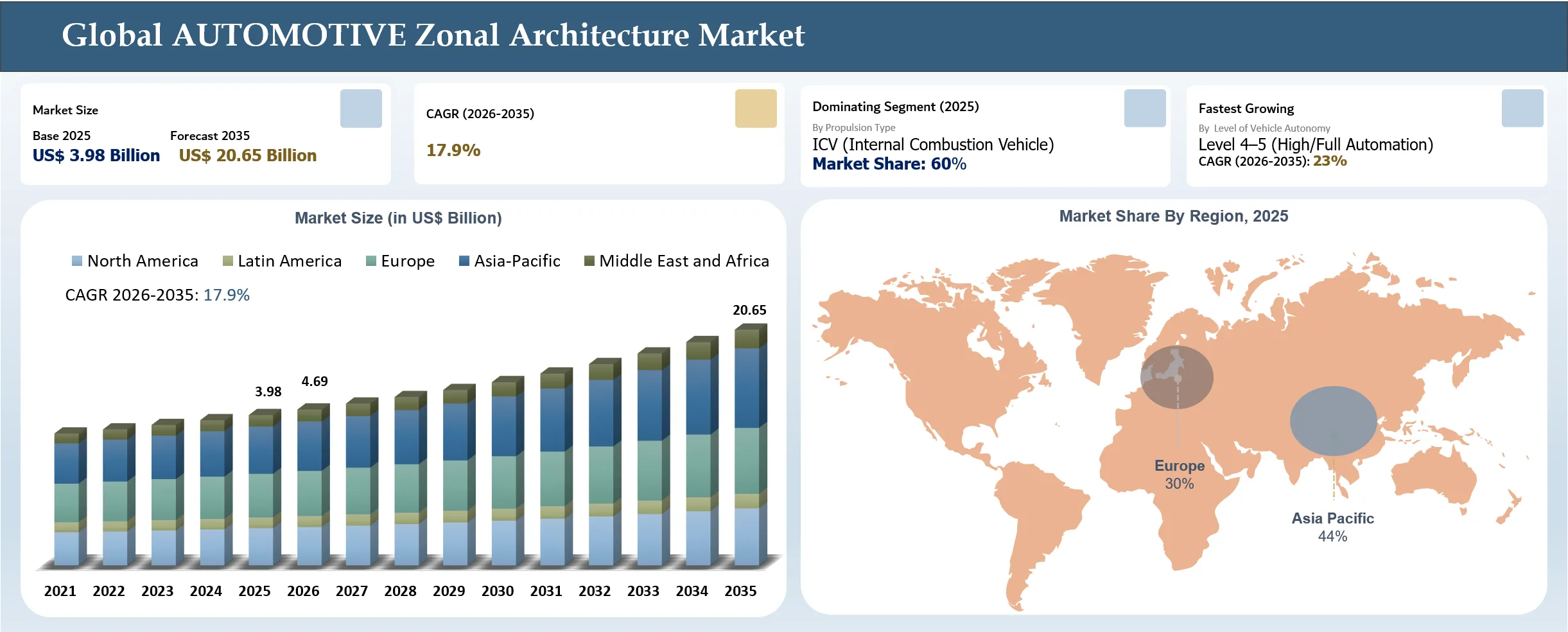
The global automotive zonal architecture market reached USD 3.98 billion in 2025 and is expected to reach USD 20.65 billion by 2035, growing with a CAGR of 17.9% during the forecast period 2026-2035. Market expansion is closely linked to the transition toward software-defined vehicles (SDVs) characterized by centralization of computing and E/E architectures through zone control in place of decentralized ECU control architecture. In its report, the International Energy Agency (IEA) states that adoption of SDVs has been accelerated by the proliferation of electric cars, allowing over-the-air (OTA) software updates, centralized computing in automobiles, and fast intra-automotive networks. In 2025, a Deloitte Global Automotive Executive Survey revealed that more than 90% of automobile manufacturers are aggressively pursuing the development of SDVs. As per the Deloitte Global SDV Readiness Study, OEMs are investing up to US$3 billion per firm for the transition to SDVs, which is equivalent to about one-third of their entire R&D spending. The companies, including Bosch, Aptiv, Continental, ZF, Qualcomm, NXP Semiconductors, Infineon Technologies, and Visteon, have been aggressively making investments in zone controllers, Automotive Ethernet, and centralized computing platforms.
The application of Volkswagen’s zone-based CEA platform in electric vehicles, hybrids, and ICE vehicles highlights the fact that centralized E/E architectures are increasingly becoming a standard framework of software-defined cars, contrary to only electric cars. In August 2025, according to the China Daily, Volkswagen Group China and XPENG have widened the use of the jointly developed China Electronic Architecture (CEA), which is a zonal electric/electronic architecture, for not only electric cars but also ICE and hybrid vehicles manufactured in China from 2027. The CEA includes central computing, AI-enabled smart cockpit capabilities, advanced driver assistance systems (ADAS), and OTA capabilities to reduce the number of electronic control units (ECUs). As a part of its "In China, For China" strategy, Volkswagen intends to launch 30 NEVs by 2027 and 30 all-electric vehicles by 2030 through its Volkswagen, Audi, and AUDI brand cars in China.
White-Space Opportunities Across the Automotive Zonal Architecture Value Chain
In July 2026, the UK Government expanded the scope of its £4 billion ($5.1 billion) Automotive Transformation Fund (ATF) to encompass Software-Defined Vehicles (SDV) technology developments, thereby expanding the range of investment areas beyond battery manufacturing and electric vehicle (EV) production. The largest share of the new investment is expected to be directed toward the development of software-defined vehicles platforms, which includes centralized/zonal E/E architecture; vehicle computing; Automotive operating systems; artificial intelligence (AI); over-the-air (OTA) software update capabilities; cybersecurity solutions; vehicle networking; advanced semiconductor integration, all of which will be crucial for future connected and autonomous vehicles (CAVs). The other areas of investment through expanded ATF remain unchanged and include battery cell/pack manufacturing; gigafactory; electric powertrain; electric drive unit (EDU); inverter; e-axle; power electronics; hydrogen fuel cell technology; lightweight materials; semiconductor fabrication; connected and autonomous vehicles (CAVs); advanced manufacturing capability; and Automotive supply chain localization.
Vehicle manufacturers, including Jaguar Land Rover (JLR), Nissan, Bentley Motors, Aston Martin, MINI, Toyota UK, and McLaren Automotive, are prepared to raise funds for future investment in SDV and electrification projects in the near future. It is estimated that tier-1 firms such as Bosch, ZF Friedrichshafen, Aptiv, Valeo, Continental, Magna International, Forvia (Faurecia), Denso, and Marelli will gain from the increasing demand for zonal control processes, central computing devices, x-by-wire devices, sensors, and enhanced vehicle electronics. Semiconductor and computing companies like Qualcomm Technologies, NVIDIA, NXP Semiconductors, Infineon Technologies, Arm, and STMicroelectronics will obtain considerable opportunities due to the breakdown of AI-based vehicle processors, Automotive SoCs, connectivity, cybersecurity, and high-performance computing systems. In addition, software provision and engineering service firms such as Capgemini Engineering, Tata Technologies, KPIT Technologies, AVL, Elektrobit, ETAS, and Siemens Digital Industries Software will experience a higher demand for software development, digital engineering, ensuring vehicles operate, validation, and securing their digitized twins.
Automotive Zonal Architecture Market Key Takeaways
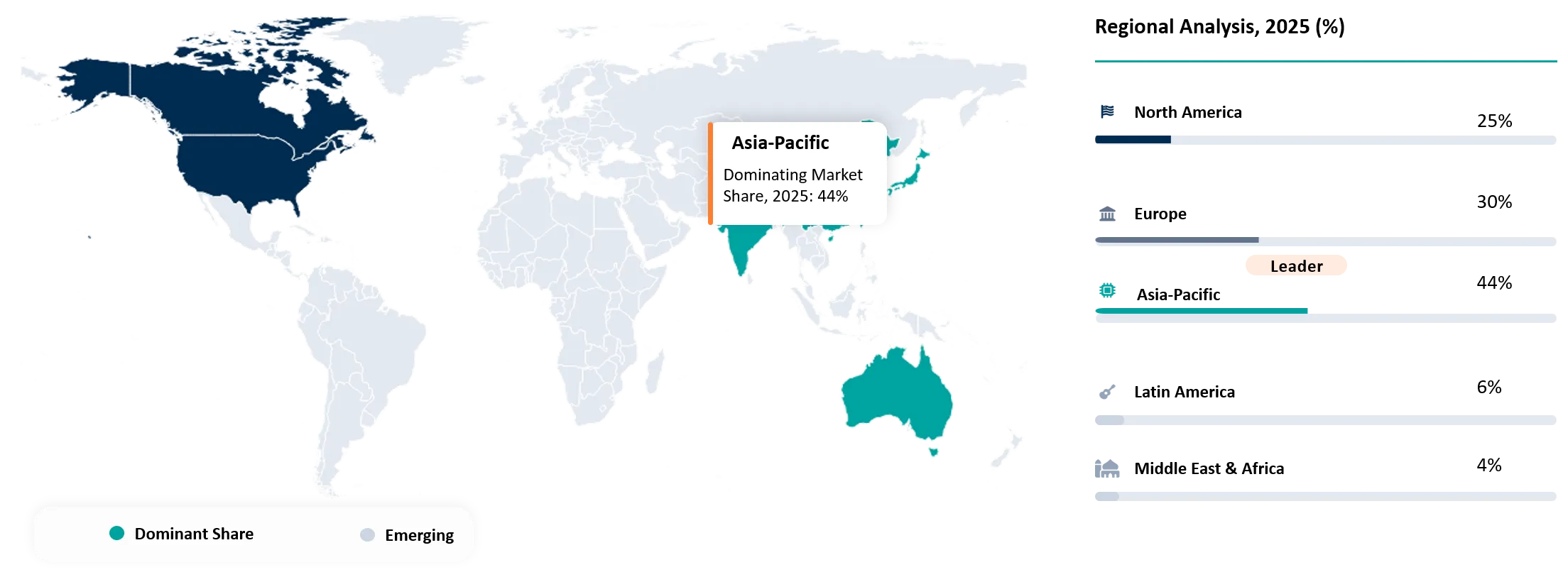
- The Asia-Pacific region dominated the global marketplace by commanding an approximate 44% market share in 2025. This leadership position is heavily anchored by China, which manufactured around 31.282 million vehicles and sold 12.81 million passenger NEVs in 2025.
- The Internal Combustion Vehicle (ICV) segment maintained the largest current platform footprint by capturing an estimated 60% share of the market in 2025. This dominance persists because legacy internal combustion platforms are actively being upgraded with centralized electronics to replace 100 to 150 legacy ECUs.
- The automotive zonal architecture and domain controller landscape features a highly concentrated competitive environment. The top leading Tier-1 suppliers and semiconductor providers collectively accounted for approximately 64.7% of the global market in 2025.
- Transitioning to software-defined vehicles requires massive financial backing, with individual vehicle manufacturers investing up to US$3 billion per firm. This heavy capital allocation represents approximately one-third of their entire research and development (R&D) spending.
Automotive Zonal Architecture Market Industry Trends and Strategic Insight
- Automotive OEMs are replacing distributed and domain-based E/E architectures with zonal architectures that consolidate sensing, actuation, and power distribution into physical vehicle zones connected to centralized high-performance computers (HPCs).
- Rather than deploying dozens of independent ECUs, OEMs are integrating multiple vehicle functions into centralized HPCs that manage ADAS, infotainment, powertrain, chassis, and connectivity simultaneously.
- The migration from CAN/LIN-dominated communication toward multi-gigabit Automotive Ethernet is accelerating as zonal architectures require deterministic, high-bandwidth communication between zonal controllers and vehicle computers.
- Competition is shifting beyond standalone automotive processors toward integrated hardware-software ecosystems. Semiconductor companies are introducing complete zonal controller reference systems combining processors, networking, safety software, middleware, and development tools, reducing OEM integration effort and shortening vehicle development cycles. NXP's CoreRide Z248 reference platform, introduced in 2026 reflects this industry direction.
- Automakers are increasingly adopting phased migration strategies rather than immediately replacing legacy electrical architectures. Recent SAE engineering research highlights mixed architectures that combine distributed ECUs, domain controllers, centralized computing, and zonal controllers during the transition period, minimizing engineering risk while preserving existing vehicle platforms.
Automotive Zonal Architecture Market Scope
| Metrics | Details | |
| 2025 Market Size | USD 3.98 Billion | |
| 2035 Projected Market Size | USD 20.65 Billion | |
| CAGR (2026-2035) | 17.9% | |
| Largest Market | Asia-Pacific | |
| Fastest Growing Market | Europe | |
| By Component | Hardware, Software, Services | |
| By Vehicle Type | Hatchback & Sedan, SUV (Sports Utility Vehicle), LCV (Light Commercial Vehicle), HCV (Heavy Commercial Vehicle) | |
| By Propulsion Type | ICV (Internal Combustion Vehicle), BEV (Battery Electric Vehicle), HV (Hybrid Vehicle) | |
| By Level of Vehicle Autonomy | Level 1 (Driver Assistance), Level 2 (Partial Automation), Level 3 (Conditional Automation), Level 4–5 (High/Full Automation) | |
| By Application | Powertrain & Chassis, Body Electronics, Infotainment & Connectivity, ADAS & Autonomous Driving (Advanced Driver Assistance Systems), Safety & Security Systems, Others | |
| By Region | North America | U.S., Canada, Mexico |
| Europe | Germany, UK, France, Spain, Italy, Poland | |
| Asia-Pacific | China, India, Japan, Australia, South Korea, Indonesia, Malaysia | |
| Latin America | Brazil, Argentina | |
| Middle East and Africa | UAE, Saudi Arabia, South Africa, Israel, Türkiye | |
| Report Insights Covered | Competitive Landscape Analysis, Company Profile Analysis, Market Size, Share, Growth | |
Automotive Zonal Architecture Market Disruption Analysis
Shift Toward Software-Defined Vehicles (SDVs) Reshaping Automotive Electronic Architecture
The disturbance in the Automotive Zonal Architecture market is primarily associated with the rapid adoption of Software Defined Vehicles (SDVs) that are changing the conventional vehicle architecture designs from hardware-based to software-based. According to the Deloitte Software-Defined Vehicle Global Manufacturer Readiness Study, about 69% of OEMs are using centralized approaches for developing SDVs, reflecting a huge shift towards centralized computing and zonal electrical/electronic (E/E) architecture. The trend has been further fueled by the significance of vehicle software, as noted by the International Energy Agency (IEA) in 2026, that vehicle architecture has shifted from the distributed Electronic Control Unit (ECU) based architecture to the domain and zonal architectures controlled by central computers.
In addition to this, Deloitte suggests that software-defined cars can add incremental value between US$400 and 600 billion by 2030 on account of digital services, connectivity, and software upgrades for vehicles. All of these advancements are impacting the legacy automobile value chain as value addition in this value chain is being moved away from mechanical hardware and ECUs to high-performance computing, semiconductor devices, operating systems, cybersecurity, and the software ecosystem. Some companies like Bosch, Continental, Aptiv, ZF, Qualcomm, NVIDIA, and NXP Semiconductors have increased their investments in zonal control units, Automotive Ethernet, and centralized computing systems for automobiles.
Automotive Zonal Architecture Market BCG Matrix: Company Evaluation
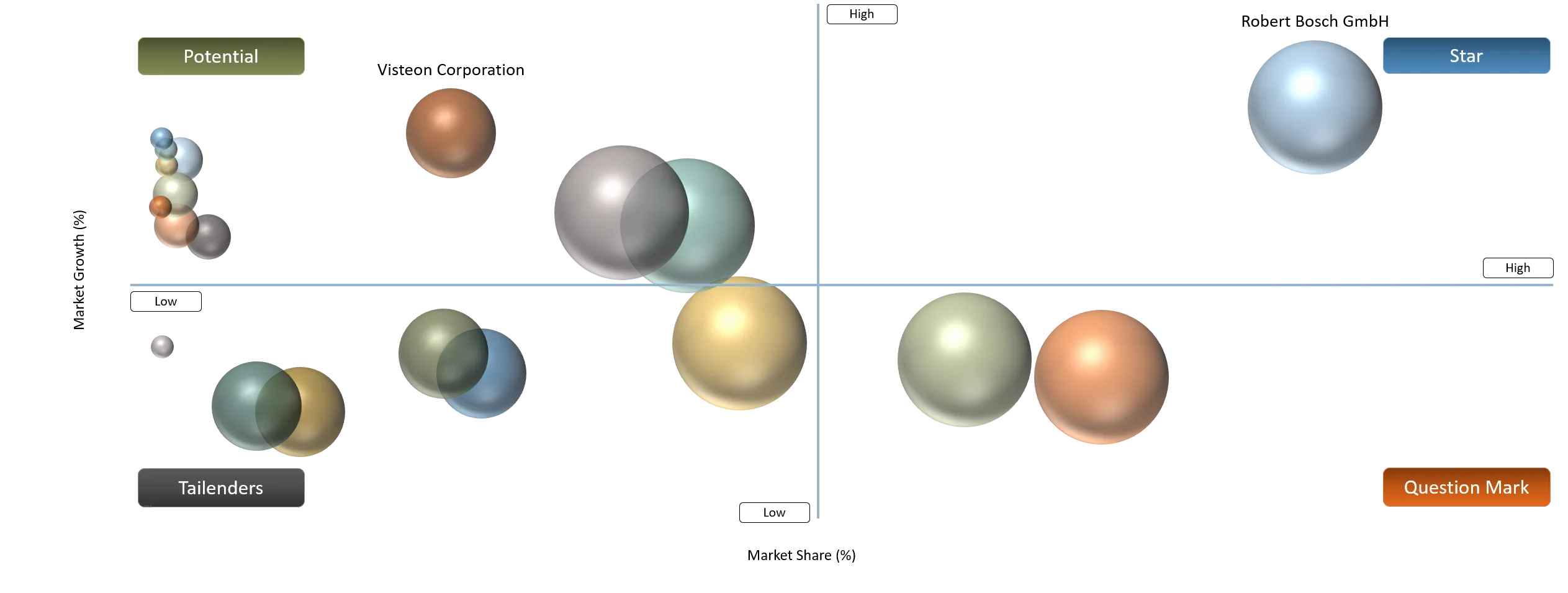
Stars include Robert Bosch GmbH, Aptiv PLC, Continental AG, NXP Semiconductors, and Qualcomm Technologies Inc. because these companies have strong market positioning, extensive Automotive electronics portfolios, and significant involvement in software-defined vehicle (SDV) architectures, zonal controllers, centralized computing platforms, and Automotive networking solutions. Question Marks includes NVIDIA Corporation, Infineon Technologies AG, and Valeo SA because these companies possess strong technological capabilities but are still expanding their influence within the Automotive zonal architecture ecosystem.
Potential includes Visteon Corporation, Texas Instruments Incorporated, and STMicroelectronics as these companies benefit from growing demand for vehicle computing, semiconductor components, Automotive processors, and connectivity solutions, but have more focused roles within the broader zonal architecture value chain. Tailenders include Panasonic Automotive Systems because its involvement in Automotive zonal architecture remains relatively specialized compared with leading Tier-1 suppliers and semiconductor companies.
Automotive Zonal Architecture Market Dynamics
Driver Impact Analysis
| Driver | Market Growth Impact (%) | Demand Concentration | Impacted Use Case | Strategic Impact |
Rising adoption of software-defined vehicles (SDVs) is accelerating demand for zonal E/E architectures that enable centralized computing, OTA updates, and scalable vehicle software platforms. | 35% | High demand concentration in premium passenger vehicles, EV platforms, and next-generation connected vehicles developed by OEMs in North America, Europe, China, Japan, and South Korea. | Centralized vehicle computing, OTA software updates, vehicle operating systems, digital cockpit, connected vehicle services, and lifecycle software management. | Accelerates the shift from hardware-centric ECU architectures toward software-driven vehicle platforms, increasing the importance of Automotive software, semiconductor processors, and zonal controller ecosystems. |
Increasing integration of ADAS and autonomous driving technologies is driving the need for high-performance computing platforms and high-speed in-vehicle communication networks. | 30% | Concentrated in Level 2+ to Level 5 autonomous vehicle programs, premium vehicles, robotaxis, and advanced EV models requiring real-time sensor data processing.
| ADAS domain integration, autonomous driving systems, sensor fusion, AI computing, camera/radar/LiDAR data processing, and safety-critical vehicle functions. | Strengthens demand for high-performance computing platforms, AI accelerators, Automotive Ethernet, and secure communication architectures while increasing collaboration between OEMs and semiconductor companies. |
Growing vehicle electrification and EV platform development are supporting the adoption of zonal architectures to simplify wiring systems, optimize power distribution, and improve electronic scalability. | 25% | High concentration in battery electric vehicles (BEVs), EV-native manufacturers, and large-scale EV production markets such as China, Europe, and North America. | EV power distribution, battery management systems (BMS), thermal management, vehicle control systems, and electrical system optimization. | Enables lighter vehicle designs, reduced wiring complexity, improved manufacturing efficiency, and scalable EV platforms, creating competitive advantages for automakers adopting zonal architectures early. |
Expansion of Automotive Ethernet and high-speed networking technologies is enabling the data bandwidth required for next-generation zonal vehicle architectures. | 20% | Concentrated among ADAS-equipped vehicles, connected vehicles, autonomous driving platforms, and high-end passenger vehicles requiring high-speed data communication. | In-vehicle networking, zonal controller communication, sensor connectivity, gateway systems, and real-time vehicle data transfer. | Accelerates replacement of traditional CAN/LIN-based networks with Ethernet-based architectures, increasing demand for Automotive networking chips, switches, and communication software solutions. |
Increasing integration of ADAS and autonomous driving technologies is driving the need for high-performance computing platforms and high-speed in-vehicle communication networks
The rapid development of advanced driver assistance systems (ADAS) and self-driving technologies is among the main catalysts behind the growing popularity of Automotive zonal architecture, since today's automobiles need more computing power and fast data networks. The use of various functions of the ADAS in 2025 included adaptive cruise control, automated emergency braking, lane assistance, and surround view in different passenger cars around the world. As stated by the European Automobile Manufacturers' Association (ACEA), the Automotive manufacturers all over the world are making more investments in automated and connected vehicles since software-based systems are becoming an integral part of future mobility systems. As a result, it is challenging for the traditional distributed architecture of ECUs to manage the increasing number of electronic systems, and there is a need for zonal controllers and HPC platforms.
With the development of autonomous systems based on AI technologies, there is an increasing need for high-performance computing architecture within automobiles that can process complex computations with minimal delay and maximum reliability. In May 2026, as per the IEEE Transactions on Computers proposed an ADS-Tile scheduling framework in order to optimize the efficiency of DNN-based autonomous driving systems. It is observed that Level-4+ autonomous driving systems would demand the execution of several DNNs in ≤100 milliseconds. Workloads of Level-4+ autonomous driving systems were found to vary from 1× to 3.3×. The ADS-Tile approach helped in reducing tiles by 32%, whereas processing waste was reduced from 17–44% to <1.2%.
Restraint Impact Analysis
| Restraint | Drag on Market Growth (%) | Primary Impact Area | Impacted Use Case | Strategic Impact |
High implementation complexity and integration challenges associated with replacing legacy ECU-based architectures with centralized zonal E/E platforms. | 30% | Vehicle E/E architecture redesign, software integration, validation processes, and OEM development cycles. | Zonal controller deployment, centralized computing platforms, wiring harness optimization, vehicle software migration, and SDV platform development. | Slows large-scale adoption by increasing engineering costs, extending development timelines, and requiring OEMs to invest heavily in new hardware-software integration capabilities. |
Cybersecurity risks and functional safety requirements create additional engineering challenges as centralized architectures increase dependence on software, connectivity, and vehicle data networks. | 25% | Vehicle cybersecurity, functional safety compliance, software validation, and connected vehicle protection. | Autonomous driving systems, ADAS platforms, OTA updates, vehicle communication networks, and connected mobility services. | Increases development complexity and compliance costs while driving demand for secure Automotive operating systems, encryption solutions, and cybersecurity-focused architecture designs. |
Limited standardization across Automotive zonal architecture platforms is creating interoperability issues between OEMs, Tier-1 suppliers, semiconductor providers, and software ecosystems. | 20% | Architecture compatibility, supplier integration, software interoperability, and technology standardization. | Zonal controllers, Automotive Ethernet networks, middleware platforms, AUTOSAR-based software systems, and cross-platform vehicle architectures. | Delays market scalability by creating fragmented technology ecosystems and increasing integration dependency between OEMs and technology suppliers. |
Dependence on advanced semiconductor components and Automotive-grade processors creates supply chain vulnerabilities for zonal controllers and centralized computing platforms. | 15% | Automotive semiconductor availability, processor supply, chip manufacturing capacity, and component sourcing. | High-performance computing units, AI processing platforms, Automotive Ethernet switches, microcontrollers, and power management systems. | Encourages OEMs and Tier-1 suppliers to diversify semiconductor sourcing, develop strategic chip partnerships, and increase investment in Automotive-grade semiconductor ecosystems. |
High implementation complexity and integration challenges associated with replacing legacy ECU-based architectures with centralized zonal E/E platforms
One of the major restraints limiting the adoption of Automotive Zonal Architecture includes the highly complex nature of the implementation of such an architectural change, which will involve a transition from the current ECU-based architectures to zonal E/E architectures. Modern automobiles are experiencing an increase in their electronic content, with premium automobiles using 100-150 ECUs and over a million lines of embedded code, thus leading to increased complexity in architecture migration, software integration, and validation. In July 2025, a study by McKinsey stated that software development efforts have become very important for automakers owing to the increased complexity of vehicle software.
The move towards SDV systems is hastening the shift towards zonal E/E architectures by allowing centralization of computing, software-enabled functions, and scalability of vehicles. In July 2025, as per the Automotive World Article, the transition from traditional vehicle architectures with hundreds of distributed ECUs to centralized computing and zonal E/E architecture is expected to facilitate the emergence of SDVs. This move will require car makers to consider many things, such as a high-performance computing platform, an OS for vehicles, a network, cybersecurity, and OTA, among others.
Automotive Zonal Architecture Market Segment Analysis
The global Automotive Zonal Architecture market is segmented based on component, vehicle type, propulsion type, level of vehicle autonomy, application, and region.
Internal Combustion Vehicles (ICVs) Maintaining Dominance Through Large Global Vehicle Fleet and E/E Architecture Upgrades
The Internal Combustion Vehicle (ICV) segment remains dominant within the Automotive Zonal Architecture Market in terms of market share in 2025, with an estimated share of around 60%. This is mainly attributed to the huge number of internal combustion vehicles available today, along with the modernization of internal combustion platforms through electronics. While the development of battery electric vehicles is expected to drive the growth in the application of zonal architecture in vehicles, many automobile manufacturers have started to incorporate central computing platforms, ADAS, connectivity solutions, and optimized electrical architectures in internal combustion vehicles to make the electronics more efficient.
Leading Automotive suppliers such as Bosch, Continental, Aptiv, ZF, and Valeo have adopted zonal architecture to enable advanced features for ICE platforms by using a more effective E/E architecture than the distributed network of ECUs used previously. In 2025, carmakers were looking to modernize their current ICE platform vehicles using the concept of software-defined vehicle technology that would allow for advanced features without changing the whole structure of the vehicle.
Automotive Zonal Architecture Market Geographical Penetration
Rapid Vehicle Electrification and Software-Defined Vehicle Development Driving Asia-Pacific Market Dominance
The Asia-Pacific region is dominating the Automotive Zonal Architecture Market, accounting for approximately 44% market share in 2025, supporting by its strong Automotive manufacturing ecosystem, rapid vehicle electrification, and increasing adoption of software-defined vehicle (SDV) technologies. Countries such as China, Japan, South Korea, and India are rapidly investing in advanced vehicle electronics, EV platforms, autonomous vehicles, and in-vehicle networks, thereby leading to a high demand for zonal controllers, central computers, Automotive Ethernet, and high-end semiconductors. The Asia Pacific region being the global leader in Automotive production and the fast growth in EV production, and connected vehicles is paving the way for adopting advanced E/E architecture.
The accomplishment indicates the increasing uptake of zonal architecture in China with automobile companies shifting towards centralized computing and software-defined vehicles. In July 2025, HIRAIN, a China-based Automotive electronics system supplier and intelligent driving technology provider, the company achieved a major milestone by producing its one-millionth Zonal Control Unit (ZCU), marking large-scale commercialization of zonal E/E architecture solutions in China. Developed the ZCU as a key component for next-generation vehicle architectures, integrating signal acquisition, load control, electronic fusing, and zonal gateway functions into a single module.
China Automotive Zonal Architecture Market Trends
China holds a dominant position in the Asia-Pacific Automotive Zonal Architecture Market owing to its large scale Automotive manufacturing network, wide-scale adoption of electric vehicles, and robust advancements in intelligent vehicles technologies. As per statistics provided by China Association of Automobile Manufacturers (CAAM), the country manufactured around 31.282 million vehicles in last year, thus, cementing its position as the world’s leading producer of automobiles, and hence, forming a solid demand foundation for zonal architecture, including the demand for zonal controllers, centralized computing, and high-speed vehicle communication systems. In addition to this, according to the statistics provided by China Passenger Car Association (CPCA), China has sold around 12.81 million passenger NEVs in 2025.
The mass production of the ZCU architecture highlights the rapid progress that China is making towards moving away from conventional ECU-based Automotive architectures to a centralized and zonal E/E architecture. In January 2026, Gasgoo, Geely Auto, a China-based Automotive original equipment manufacturer (OEM), and Jingwei Hirain Technologies, a China-based Automotive electronics and intelligent driving technology supplier, achieved mass production of the jointly developed Geely 3.0 Zonal Control Unit (ZCU) platform, marking a major milestone in China’s Automotive zonal architecture adoption.
India Automotive Zonal Architecture Market Outlook
India is emerging as one of the fastest-growing countries in the Asia-Pacific Automotive Zonal Architecture Market due to rapid vehicle electrification, increasing adoption of connected vehicle technologies, and expansion of Automotive electronics manufacturing capabilities. The growth of zonal architecture demand in India is primarily supported by rising EV penetration, development of software-defined vehicle platforms, and increasing integration of ADAS features in passenger and commercial vehicles.
The growth marks the increased significance of India as a development center for future automobile electronics and software-controlled cars. In November 2025, according to MotorIndia, Marelli, an Italy-based Automotive technology supplier and Tier-1 Automotive component manufacturer, expanded its engineering presence in India by opening a new technical R&D hub in Bengaluru to accelerate development of advanced Automotive technologies, including software-defined vehicles (SDVs), zonal architecture, EV propulsion systems, and vehicle electronics. The new facility is designed to accommodate 350 specialists, increasing Marelli’s total R&D workforce capacity in India to 1,200 engineers across Bengaluru and Gurugram centers.
Automotive Zonal Architecture Market Competitive Landscape
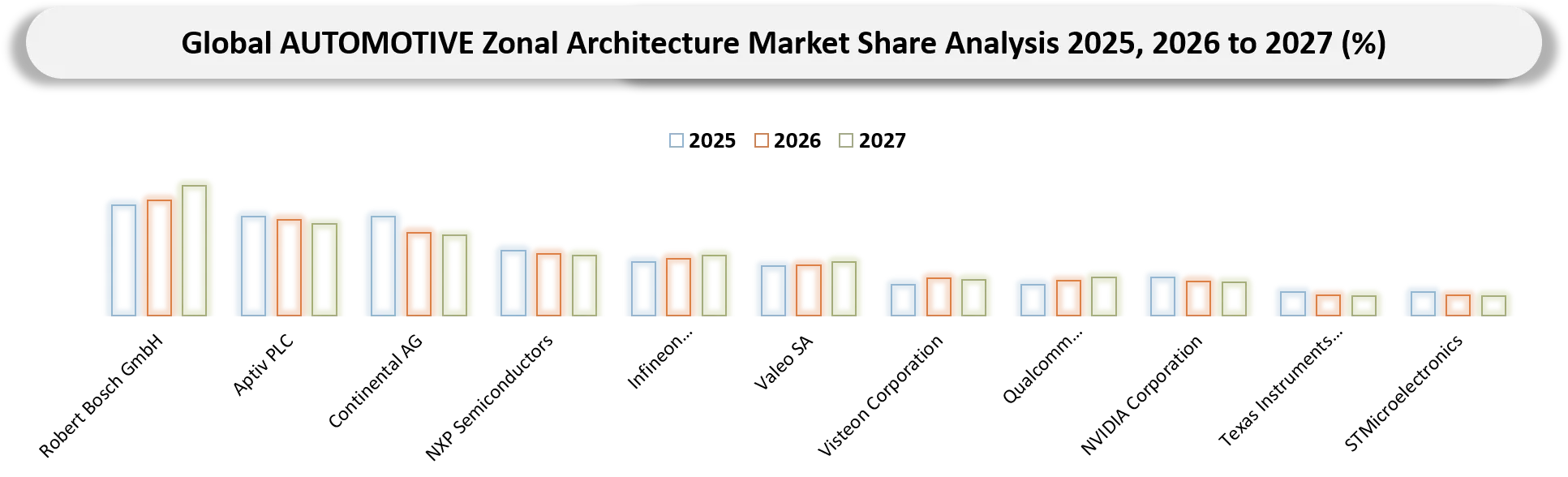
- The Automotive Zonal Architecture Market is characterized by three major participant groups: Automotive Tier-1 suppliers, semiconductor and computing platform providers, and Automotive software/networking technology companies. Leading Tier-1 suppliers such as Robert Bosch GmbH, Aptiv PLC, Continental AG, Valeo SA, Visteon Corporation, and Panasonic Automotive Systems focus on zonal controllers, vehicle computers, power distribution systems, and E/E architecture integration for software-defined vehicles. Semiconductor companies, including NXP Semiconductors, Infineon Technologies AG, Texas Instruments Incorporated, and STMicroelectronics, provide Automotive-grade processors, microcontrollers, Ethernet switches, power management ICs, and secure communication components required for zonal platforms. Meanwhile, Qualcomm Technologies Inc. and NVIDIA Corporation are strengthening their position through high-performance computing, AI processing, and autonomous driving platforms that support centralized vehicle architectures. According to Global Market Insights, leading companies, including Bosch, Aptiv, Continental, NXP, Valeo, Visteon, and ZF, collectively accounted for approximately 64.7% of the Automotive zonal architecture and domain controller market in 2025, indicating a concentrated competitive environment where OEM partnerships, semiconductor capabilities, software integration, and scalable computing platforms determine market leadership.
- Key players include Robert Bosch GmbH, Aptiv PLC, Continental AG, NXP Semiconductors, Infineon Technologies AG, Valeo SA, Visteon Corporation, Qualcomm Technologies Inc., NVIDIA Corporation, Texas Instruments Incorporated, STMicroelectronics, and Panasonic Automotive Systems.
Key Developments
- March 2026: Rivian, a U.S.-based electric vehicle manufacturer and software-defined vehicle technology company, unlocked an additional US$1 billion investment milestone from Volkswagen Group, a Germany-based global Automotive OEM, through their joint venture Rivian and Volkswagen Group Technologies (RV Tech) after achieving progress in the development of a next-generation zonal electrical/electronic (E/E) architecture.
- April 2026: Marelli, a Japan-based global Automotive technology supplier and Tier-1 Automotive component manufacturer, showcased its latest software-defined vehicle (SDV) cockpit and zonal architecture technologies at Auto China 2026 in Beijing.
- December 2025: Harman International, a U.S.-based Automotive electronics and connected vehicle technology supplier and a subsidiary of Samsung Electronics, agreed to acquire the Advanced Driver Assistance Systems (ADAS) business of ZF Group, a German-based Automotive Tier-1 supplier for €1.5 billion (approximately USD 1.7 billion).
- In May 2026: Inventec, a Taiwan-based high-performance computing, electronics manufacturing, and Automotive technology company, expanded its collaboration with NXP Semiconductors, a Netherlands-based semiconductor manufacturer and Automotive chip supplier, to advance zonal control architectures for electric vehicles (EVs) as part of the transition toward software-defined vehicles (SDVs).
Key Procurement Priorities and Buyer Evaluation Criteria
- Organizations investing in the Automotive Zonal Architecture Market are increasingly selecting suppliers based on their ability to deliver scalable zonal controllers, centralized high-performance computing (HPC) platforms, Automotive Ethernet solutions, and integrated E/E architecture systems that support software-defined vehicle (SDV) development.
- The procurement decision-making process is being influenced by the transition from traditional distributed ECU-based architectures toward centralized and zonal vehicle architectures, increasing demand for suppliers with capabilities in vehicle computing, middleware integration, OTA software management, cybersecurity, and real-time data communication.
- Buyers evaluate factors such as system reliability, functional safety compliance (ISO 26262), cybersecurity capabilities (ISO/SAE 21434), processing performance, communication bandwidth, power efficiency, and scalability when selecting Automotive zonal architecture technology providers.
Why Choose DataM?
- Technological Innovations: Explores advancements in Automotive electrical/electronic (E/E) architectures, including zonal controllers, centralized high-performance computing (HPC) platforms, Automotive Ethernet networks, middleware solutions, and software-defined vehicle (SDV) technologies, enabling reduced wiring complexity, improved computing efficiency, enhanced connectivity, and scalable vehicle architectures.
- Product Performance & Market Positioning: Evaluates how Automotive technology providers differentiate their solutions through processing capability, communication speed, cybersecurity, functional safety compliance, software integration, power efficiency, and compatibility with next-generation applications such as ADAS, autonomous driving, electric vehicles, and connected mobility platforms.
- Real-World Evidence: Highlights real-world adoption of zonal architecture solutions across passenger vehicles, electric vehicles, premium vehicles, and autonomous driving platforms, demonstrating benefits such as reduced wiring weight, improved data processing efficiency, simplified vehicle design, faster software deployment, and enhanced vehicle functionality.
- Market Updates & Industry Changes: Tracks key industry developments including OEM adoption of software-defined vehicle platforms, expansion of Automotive semiconductor capabilities, introduction of centralized computing systems, Automotive Ethernet deployment, and strategic collaborations between automakers, Tier-1 suppliers, and semiconductor companies across Asia-Pacific, North America, and Europe.
- Competitive Strategies: Analyzes how leading companies including Bosch, Aptiv, Continental, NXP Semiconductors, Qualcomm, NVIDIA, Infineon, and Valeo strengthen their market position through technology partnerships, semiconductor integration, software ecosystem development, OEM collaborations, and investments in next-generation vehicle architectures.
- Pricing & Market Access: Evaluates cost structures associated with zonal controllers, HPC platforms, Automotive networking components, software platforms, and integration services while analyzing procurement models involving OEMs, Tier-1 suppliers, semiconductor providers, and Automotive software companies.
- Market Entry & Expansion: Identifies growth opportunities driven by EV adoption, autonomous driving development, ADAS integration, connected vehicle expansion, and SDV transformation while outlining strategies such as regional manufacturing expansion, software capability development, semiconductor partnerships, and ecosystem collaboration to accelerate global adoption.
Target Audience 2026
- Automotive Original Equipment Manufacturers (OEMs)
- Tier-1 Automotive Suppliers
- Automotive Semiconductor Manufacturers
- Automotive Software & Platform Developers
- ADAS and Autonomous Driving Technology Providers
- Electric Vehicle Manufacturers and Battery Technology Companies
- Automotive Networking and Connectivity Solution Providers


























































