


Automotive Wet Friction Material Market Size and Overview
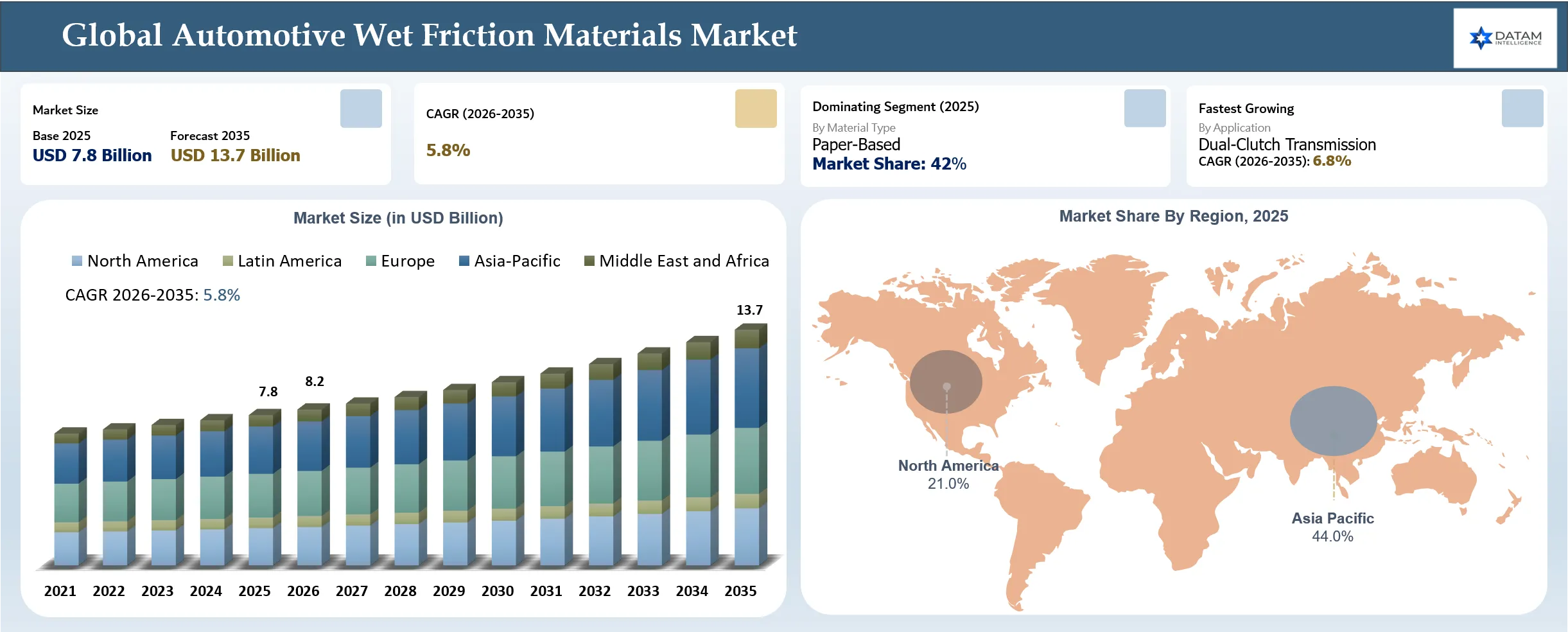
The global automotive wet friction material market was valued at US$7.8 billion in 2025 and is projected to reach US$13.7 billion by 2035, growing at a CAGR of 5.8% during 2026–2035. The global automotive wet friction materials market is driven by the rising adoption of automatic and dual-clutch transmissions, increasing hybrid vehicle production, growing demand for fuel-efficient and smooth-shifting powertrains, rising vehicle production in emerging economies, and increasing requirements for durable, and thermally stable friction materials.
Rising adoption of automatic transmissions is driving demand for automotive wet friction materials as automatic transmission systems increasingly replace manual transmissions across major vehicle markets. The shift is particularly visible in major European markets. In 2024, manual transmissions accounted for only 29% of new-car registrations across Germany, the UK, France, Italy, and Spain, compared with 91% in 2001. Mainstream-brand automatic penetration increased from 5% in 2001 to 63% in 2024.
Increasing investments in localized manufacturing and advanced wet-friction products are strengthening regional supply capabilities and supporting higher-performance applications. For instance, in September 2026, Carlisle Brake & Friction began construction of a new manufacturing facility in Chennai, India, to produce paper wet friction discs and steel separator plates for off-highway brake and transmission applications. Scheduled to open in 2027, the facility will expand Carlisle’s wet-friction manufacturing capacity in India and support OEM and aftermarket demand across India and Southeast Asia.
Automotive Wet Friction Material Market Key Takeaways
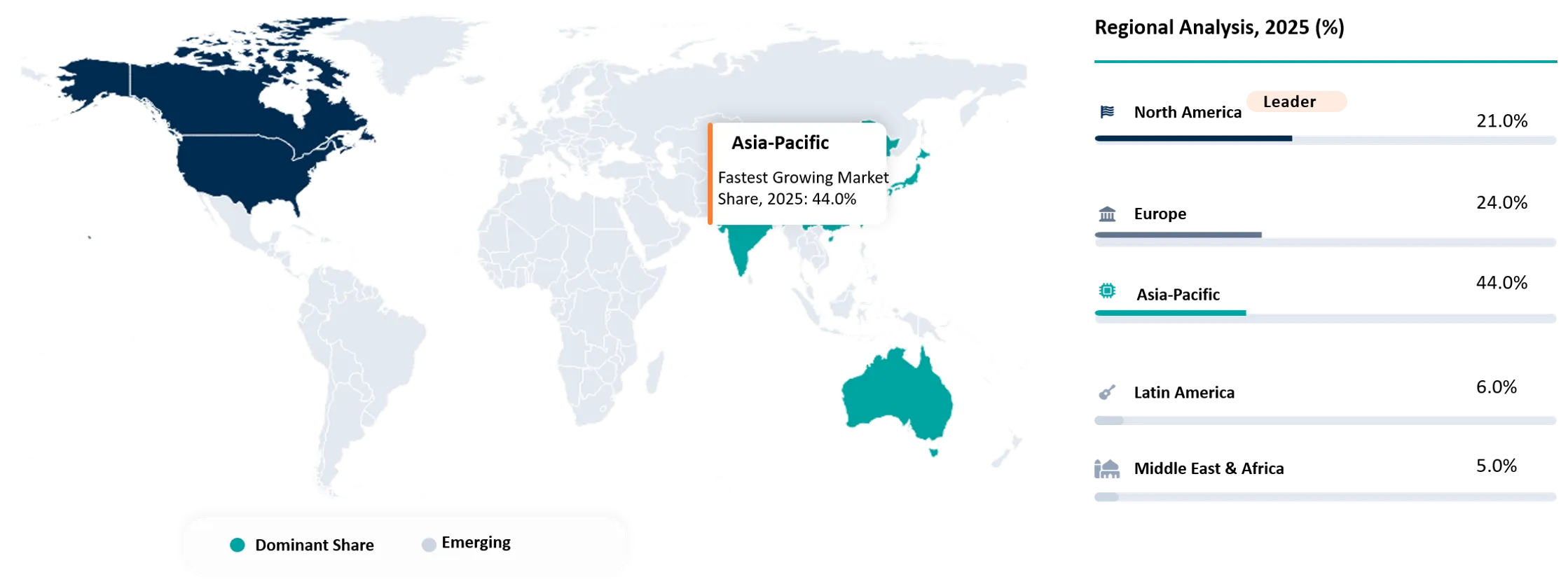
- Asia Pacific held the largest regional market share, accounting for approximately 44% of the global automotive wet friction Materials Market in 2025, supported by its large automotive manufacturing base, high adoption of automatic and advanced transmission systems, expanding hybrid-vehicle production, and strong presence of transmission and friction-material manufacturers.
- Paper-based materials accounted for approximately 42% of the global automotive wet friction materials market in 2025, supported by their extensive use in automatic transmissions, dual-clutch transmissions, torque converter clutches, transfer cases, AWD couplings, and other wet-friction applications. Their established manufacturing processes, friction stability, wear resistance, oil compatibility, and cost advantages support their widespread adoption.
- Dual-Clutch Transmission (DCT) is projected to be the fastest-growing application in the global automotive wet friction materials market, registering an estimated CAGR of 6.8% during 2026–2035. Growth is supported by increasing adoption of wet DCT systems in hybrid and high-performance vehicles, rising demand for faster and smoother gear shifting, and the increasing use of advanced transmission systems requiring durable and thermally stable wet friction materials.
Automotive Wet Friction Material Market Industry Trends and Strategic Insight
- Development of Advanced Wet Friction Materials: Demand for higher transmission efficiency, durability, and smoother shifting is encouraging manufacturers to develop friction materials with improved wear resistance, thermal stability, friction consistency, and oil compatibility. Manufacturers are advancing paper-based, carbon-based, sintered, and composite materials to support higher torque, temperature, and energy requirements in modern transmission systems.
- Growing Use Across Hybrid and Advanced Transmission Systems: Expansion of automatic transmissions, DCTs, CVTs, hybrid powertrains, and advanced AWD systems is increasing the application of wet friction materials across passenger cars, commercial vehicles, and off-highway equipment. Manufacturers are developing specialized friction plates and clutch materials to support frequent engagement cycles, engine-motor coupling, torque management, and improved transmission efficiency.
- Increasing Customization and Application-Specific Material Development: Transmission and clutch manufacturers are increasingly working with friction-material suppliers to develop application-specific formulations based on transmission design, torque capacity, operating temperature, lubricant characteristics, and shifting requirements. This is driving greater emphasis on material testing, friction characterization, durability validation, and customized friction performance for specific AT, DCT, hybrid, wet-brake, and transfer-case applications.
Automotive Wet Friction Material Market Scope
| Metrics | Details | |
| 2025 Market Size | USD 7.8 Billion | |
| 2035 Projected Market Size | USD 13.7 Billion | |
| CAGR (2026-2035) | 5.8% | |
| Largest Market | Asia-Pacific | |
| Fastest Growing Market | Asia-Pacific | |
| By Material Type | Paper-Based, Carbon-Based, Sintered, Fiber-Reinforced Composite, Molybdenum-Based, Others | |
| By Application | Automatic Transmission (AT), Dual-Clutch Transmission (DCT), Torque Converter Clutch (TCC), Transfer Case & AWD Coupling, Wet Brakes, Other Applications | |
| By Vehicle Type | Passenger Cars, Light Commercial Vehicles, Heavy Commercial Vehicles, Two-Wheelers, Off-Highway Vehicles, Other Vehicles | |
| By Sales Channel | OEM, Aftermarket | |
| By Region | North America | U.S., Canada, Mexico |
| Europe | Germany, United Kingdom, France, Italy, Spain, Netherlands, Switzerland, Sweden, Norway, Denmark, Belgium, Poland, Austria, Ireland, Portugal, Greece, Finland, and Rest of Europe. | |
| Asia-Pacific | China, Japan, India, South Korea, Australia, New Zealand, Singapore, Malaysia, Thailand, Indonesia, Vietnam, Philippines, Taiwan, and Rest of Asia Pacific. | |
| Latin America | Brazil, Argentina, Rest of Latin America | |
| Middle East and Africa | UAE, Saudi Arabia, South Africa, Israel, Türkiye, Rest of Middle East and Africa | |
| Report Insights Covered | Competitive Landscape Analysis, Company Profile Analysis, Market Size, Share, Growth | |
Automotive Wet Friction Material Market BCG Matrix: Company Evaluation
Automotive
DYNAX Corporation, NSK-Warner K.K., F.C.C. Co., Ltd., EXEDY Corporation, BorgWarner Inc., and Schaeffler AG are positioned as Stars, supported by broad wet-friction material portfolios, strong transmission and drivetrain exposure, advanced material-development capabilities, and established automotive OEM relationships. AISIN Chemical Co., Ltd. (AISIN Group), ZF Friedrichshafen AG, TREMEC, and Miba AG are positioned as Potential Stars, reflecting established friction-material and transmission capabilities, strong automotive customer bases, and growing exposure to advanced automatic, DCT, and hybrid transmission systems.
AvCarb Material Solutions and Carlisle Brake & Friction are positioned as Question Marks, supported by specialized wet-friction material technologies and established manufacturing capabilities, while their overall automotive market reach is narrower than the major global drivetrain manufacturers. While, Tribco Inc. is positioned as a Tailender, reflecting its specialized wet-friction material portfolio and focused presence in clutch and brake applications compared with larger diversified automotive transmission and friction-material manufacturers.
Automotive Wet Friction Material Market Dynamics
Driver Impact Analysis
| Driver | Market Growth Impact (%) | Demand Concentration | Impacted Areas | Strategic Impact |
Rising Adoption of Automatic Transmissions | 30% | Strong demand across North America, Europe, and Asia-Pacific, particularly in the U.S., China, Japan, South Korea, and Germany. | Automatic transmission friction plates, torque converter clutches, wet clutch packs, friction linings | Expands demand for wet friction materials as automatic transmissions gain penetration across passenger cars and commercial vehicles. |
Expansion of Hybrid Powertrains and Electrified Transmissions | 25% | Increasing demand across China, Japan, Europe, North America, and South Korea, supported by growing hybrid vehicle production. | Hybrid transmissions, wet clutches, multi-plate clutch systems, friction plates | Creates additional demand for wet friction materials used in engine, motor, and transmission coupling systems. |
Growing Adoption of Dual-Clutch and Advanced Transmission Systems | 20% | Strong demand across Europe, China, Japan, South Korea, and North America, where advanced transmission systems have broad application. | DCT friction plates, wet dual clutches, multi-plate clutch packs, friction linings | Increases demand for high-performance wet friction materials supporting rapid shifting, heat control, and durability. |
Rising Vehicle Production and Transmission Penetration in Emerging Markets | 15% | Increasing demand across China, Southeast Asia, Latin America, and other emerging automotive production centers. | Passenger vehicles, commercial vehicles, automatic transmissions, wet clutch systems | Expands the OEM customer base and increases demand for wet friction plates and clutch components. |
Demand for Higher Transmission Efficiency, Smooth Shifting, and Durability | 10% | Broad demand across North America, Europe, and Asia-Pacific, particularly in advanced passenger and commercial vehicle markets. | High-performance friction materials, AT, DCT, wet brakes, AWD couplings | Drives development and adoption of friction materials with improved wear resistance, thermal stability, and friction performance. |
Expansion of Hybrid Vehicles Drives Demand for Wet Friction Materials
The expansion of hybrid vehicles is driving demand for automotive wet friction materials as hybrid transmission systems increasingly use wet clutches and friction elements to engage, disengage, and manage power transfer between the internal-combustion engine, electric motor, and transmission. Global electric-car sales exceeded 17 million units in 2024, accounting for more than 20% of global new-car sales, while plug-in hybrid sales in China increased by about 80% during the year.
While in the European Union, hybrid-electric vehicles accounted for 34.5% of new car registrations in 2025, with 3.73 million hybrid vehicles registered, while plug-in hybrid registrations reached 1.02 million units. This growing hybrid vehicle base supports demand for wet friction plates, clutch packs, and disconnect-clutch materials used in hybrid transmission architectures.
Automotive Wet Friction Material Market Segment Analysis
The global automotive wet friction material market is segmented based on material type, application, vehicle type, sales channel and region.
Paper-Based Wet Friction Materials Dominate Across Automotive Transmission Applications
Paper-based wet friction materials dominate the automotive wet friction materials market due to their broad application across automatic transmissions, DCTs, hybrid transmissions, torque-converter lock-up clutches, transfer cases, and wet brakes. Major manufacturers such as DYNAX Corporation manufactures wet friction plates using paper-based materials for automatic transmissions (AT), continuously variable transmissions (CVT), dual-clutch transmissions (DCT), hybrid electric vehicles (HEV), transfer cases, and 4WD couplings.
Manufacturers are expanding in-house paper-based friction-material production to improve material performance, quality control, and supply reliability for automotive transmission applications. For instance, in July 2025, Raybestos Powertrain reported that its Crawfordsville, Indiana facility was producing its own friction material through an integrated paper mill. The company manufactures automatic-transmission friction clutch plates from this internally produced paper-based friction material, giving it controls over material consistency, performance, and quality.
Automotive Wet Friction Material Market Geographical Penetration
High Automatic Transmission Penetration and Electrified Vehicle Investments Drive North America Automotive Wet Friction Materials Market
North America is supported by a large automotive manufacturing base, high penetration of automatic and advanced transmissions, increasing hybrid-vehicle adoption, and continued investment in electrified vehicle production. The U.S. represents the largest demand base, while Canada adds demand through its established vehicle-production and emerging hybrid/EV manufacturing ecosystem.
Canada is also attracting large-scale investment in electrified vehicle manufacturing, strengthening the long-term automotive component ecosystem. For instance, in April 2024, Honda announced a US$11 billion investment in Ontario covering EV and battery production facilities, with planned annual capacity of 240,000 EVs and 36 GWh of battery production once the facilities are operational.
U.S. Automotive Wet Friction Material Market Trends
The U.S. automotive wet friction materials market is supported by the high penetration of automatic and advanced transmissions, continued production of hybrid vehicles, and demand for high-performance transmission and drivetrain systems. The high penetration of automatic and multi-speed transmissions in U.S. vehicles creates a substantial demand base for wet friction plates, clutch packs, and torque-converter lock-up friction materials. According to the U.S. EPA's 2025 Automotive Trends Report, 8-speed transmissions accounted for 33% of new-vehicle production in model year 2024, while CVTs and transmissions with nine or more speeds each represented more than 20% of new-vehicle production.
Additionally, the U.S. automotive wet friction materials market is also supported by collaborations focused on developing advanced friction materials for next-generation transmission systems. For instance, in March 2026, AvCarb Material Solutions announced support for Sonnax Transmission Company in advancing woven-carbon technology for wet-friction applications. The collaboration focuses on woven-carbon friction materials for automotive transmission systems, supporting higher performance and efficiency requirements.
Large Automotive Manufacturing Base and Advanced Powertrain Investments Drive Asia-Pacific Automotive Wet Friction Materials Market
The Asia-Pacific is supported by its large automotive manufacturing base, high adoption of automatic and advanced transmission systems, rapid growth of hybrid and new-energy vehicles, and strong presence of transmission and friction-material manufacturers. In 2025, the Asia-Pacific region produced approximately 59.2 million vehicles, accounting for more than 61% of global vehicle production, making it the largest regional automotive manufacturing base. China remained the largest contributor, producing 34.53 million vehicles, up 10.4% from 2024.
India Automotive Wet Friction Material Market Trends
India is supported by a large and expanding automotive manufacturing base, increasing adoption of automatic and advanced transmissions, rising hybrid and electrified vehicle production, and growing localization of transmission technologies. In FY2025–26, passenger-vehicle production reached 5.54 million units, up from 5.06 million in FY2024–25, while total automobile production increased from 31.04 million to 34.71 million units. This expanding production base supports demand for transmission friction plates, clutch systems, wet clutch components, and related friction materials.
India’s automotive wet friction materials market is supported by expanding automatic transmission production, rising localization of advanced powertrain technologies, and increasing investment in domestic manufacturing capacity. For instance, in February 2026, AISIN announced an investment of approximately US$202 million to expand its existing Rohtak plant and establish a new manufacturing facility in Sambhajinagar, Maharashtra. The investment will support local production of CVTs and automatic transmissions, with operations planned from 2029.
Japan Automotive Wet Friction Material Market Trends
Japan has a strong automotive wet friction materials market supported by its large installed vehicle base, high hybrid-vehicle penetration, advanced automatic and continuously variable transmission systems, and established domestic manufacturers of wet friction plates and clutch assemblies. In 2025, hybrid vehicles accounted for nearly 30% of vehicles owned by Japanese households, while Japan’s automotive industry reported 1.05 million hybrid passenger-car sales during January–June 2025, up 2.7% year over year.
Japan’s automotive wet friction materials market is supported by continued development of advanced clutch and transmission technologies for hybrid and next-generation vehicles. For instance, in May 2026, F.C.C. announced its participation in Automotive Engineering Exposition 2026 YOKOHAMA, where it showcased its four-wheel DCT clutch technology. The company specifically stated that its technologies are built on its core expertise in friction-material development, forming, and machining.
Automotive Wet Friction Material Market Competitive Landscape
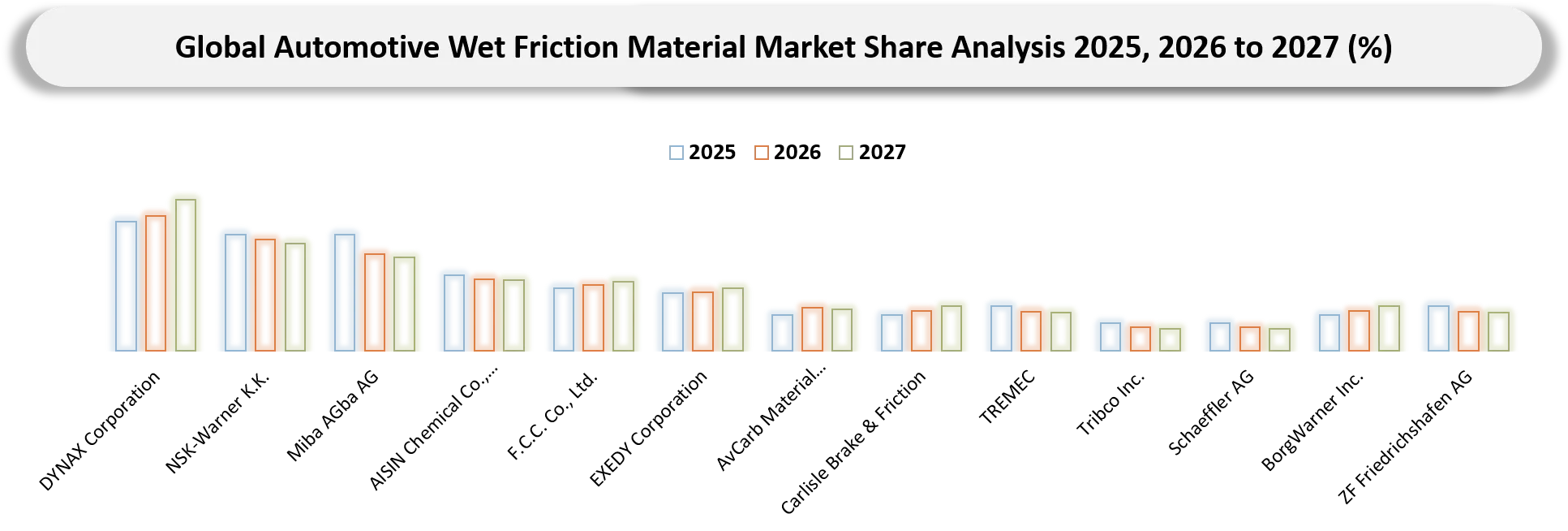
- The global automotive wet friction materials market comprises manufacturers specializing in wet friction plates, friction materials, clutch systems, transmission components, and advanced drivetrain applications. Key participants include DYNAX Corporation, NSK-Warner K.K., Miba AG, AISIN Chemical Co., Ltd. (AISIN Group), F.C.C. Co., Ltd., EXEDY Corporation, AvCarb Material Solutions, Carlisle Brake & Friction, TREMEC, Tribco Inc., Schaeffler AG, BorgWarner Inc., and ZF Friedrichshafen AG.
- DYNAX Corporation (Japan), NSK-Warner K.K. (Japan), Miba AG (Austria), AISIN Chemical Co., Ltd. (AISIN Group) (Thailand/Japan), F.C.C. Co., Ltd. (Japan), EXEDY Corporation (Japan), AvCarb Material Solutions (United States), Carlisle Brake & Friction (United States), TREMEC (United States), Tribco Inc. (United States), Schaeffler AG (Germany), BorgWarner Inc. (United States), and ZF Friedrichshafen AG (Germany) represent key participants across the global Automotive Wet Friction Materials Market.
Key Developments
- September 2026: Carlisle Brake & Friction began construction of a new manufacturing facility in Chennai, India, to produce paper wet friction discs and steel separator plates for off-highway brake and transmission applications. Scheduled to open in 2027, the facility will expand Carlisle’s wet-friction manufacturing capacity in India and support OEM and aftermarket demand across India and Southeast Asia.
- September 2025: AvCarb Material Solutions introduced a new High-Performance Wet Friction brochure covering its woven-carbon friction material portfolio for automotive and heavy-duty applications. The materials are used in torque-converter clutches, dual-clutch transmissions, multi-disc clutches, limited-slip differentials, and wet brakes.
- May 2026, BorgWarner secured a new program with a Chinese OEM for its latest-generation wet dual clutch for an SUV platform. The clutch uses high-performance wet friction materials and an optimized groove design to reduce drag torque, improve transmission efficiency, and support smoother launch and shifting, with production planned for the second half of 2026.
- March 2026: AvCarb Material Solutions supported Sonnax Transmission Company in advancing woven-carbon technology for wet-friction applications. The collaboration focuses on high-performance woven-carbon friction materials for automotive transmission systems, addressing requirements for durability, friction stability, and transmission efficiency.
- February 2026: AISIN announced an investment of approximately US$202 million to expand its existing Rohtak plant and establish a new manufacturing facility in Sambhajinagar, Maharashtra. The investment will support local production of CVTs and automatic transmissions, with operations planned from 2029.
Key Procurement Priorities and Buyer Evaluation Criteria
- Automotive wet friction material buyers prioritize materials that provide stable friction performance, smooth engagement, high wear resistance, thermal stability, oil compatibility, low noise and vibration, and reliable operation across automatic transmissions, DCTs, hybrid transmissions, torque-converter clutches, transfer cases, and wet brakes.
- Evaluation is based on criteria such as friction coefficient, friction stability, wear rate, thermal resistance, energy capacity, oil compatibility, durability, engagement characteristics, noise and vibration performance, material thickness consistency, surface characteristics, manufacturing precision, and compatibility with specific transmission fluids and clutch systems.
- OEMs, transmission manufacturers, clutch-system suppliers, and aftermarket companies consider factors including material cost, production scalability, customization requirements, tooling and processing requirements, supply reliability, lead times, quality consistency, testing requirements, and total cost of ownership. Compliance with applicable automotive quality and performance standards is also considered when selecting suppliers.
- Preference is given to manufacturers with proven wet friction material performance, established material-development capabilities, broad product portfolios, in-house testing and validation facilities, reliable manufacturing capacity, and the ability to supply paper-based, carbon-based, sintered, and other specialized friction materials for different transmission and drivetrain applications.
Automotive OEMs, transmission manufacturers, clutch suppliers, commercial-vehicle manufacturers, off-highway equipment producers, and aftermarket companies particularly prioritize suppliers that can provide consistent friction characteristics, long service life, high thermal and wear resistance, reliable oil compatibility, customized friction materials, and technologies that improve transmission efficiency, shifting quality, durability, and overall drivetrain performance.
Why Choose DataM?
- Material & Technology Innovation: Examines developments in paper-based, carbon-based, sintered, fiber-reinforced, molybdenum-based, and other wet friction materials, including improvements in friction stability, wear resistance, thermal performance, oil compatibility, energy capacity, and noise and vibration characteristics. The analysis evaluates how material innovations improve transmission efficiency, shifting performance, durability, and service life.
- Application-Level Analysis: Evaluates the use of wet friction materials across automatic transmissions, CVTs, DCTs, hybrid transmissions, torque-converter lock-up clutches, transfer cases, AWD couplings, wet brakes, and other drivetrain applications. The analysis identifies material requirements according to transmission design, torque levels, operating temperatures, and engagement conditions.
- Real-World Industry Evidence: Tracks manufacturer developments, vehicle and transmission production, new wet friction material technologies, clutch-system developments, manufacturing investments, capacity expansions, and technology collaborations across major automotive markets. The analysis incorporates developments from OEMs, transmission manufacturers, friction-material producers, and aftermarket suppliers.
- Competitive Landscape & Manufacturer Strategies: Analyzes how leading manufacturers strengthen their positions through new friction-material development, advanced clutch technologies, vertical integration, manufacturing capacity expansion, geographic expansion, OEM partnerships, technology collaborations, and development of customized materials for AT, DCT, hybrid, and off-highway applications.
- Pricing & Procurement Analysis: Evaluates wet friction material pricing based on material type, friction performance, thermal resistance, thickness, formulation, application, production volume, customization, processing requirements, and quality specifications. The analysis also considers procurement factors such as material consistency, supplier reliability, lead time, testing requirements, technical support, and total cost of ownership.
Market Entry & Growth Opportunities: Identifies opportunities arising from increasing automatic-transmission penetration, hybrid vehicle production, DCT adoption, advanced drivetrain development, vehicle production growth, transmission localization, aftermarket demand, and increasing requirements for high-performance and durable friction materials across passenger vehicles, commercial vehicles, and off-highway applications.
Target Audience 2026
- Automotive Wet Friction Material Manufacturers
- Friction Material and Clutch Component Manufacturers
- Automotive Transmission and Drivetrain Manufacturers
- Automatic Transmission, DCT, and CVT Manufacturers
- Automotive OEMs and Vehicle Manufacturers
- Hybrid and Electrified Powertrain Manufacturers
- Clutch and Transmission System Suppliers
- Commercial Vehicle and Off-Highway Equipment Manufacturers
- Automotive Aftermarket and Replacement-Part Suppliers





























































