


Australia Switchgear Market Size and Overview
The Australia Switchgear Market is valued at US$ 0.84 billion in 2025 and is forecast to reach US$ 1.07 billion in 2031, representing 4.28% annualized growth. The underlying quantitative series encompasses MV/HV Distribution & Switchgears. Product analysis addresses medium- and high-voltage air-insulated, gas-insulated, vacuum, modular and SF6-free switchgear used across the electrical system.
Australian demand is driven by Renewable Energy Zone substations, transmission interconnection, utility distribution renewal, high-reliability mining electrification and power supply to data centres. Procurement varies across New South Wales, Victoria, Queensland, Western Australia and South Australia, with material differences in approvals, voltage specifications and remote-service capability.
| 2025 MARKET SIZE | 2031 FORECAST | ANNUALIZED GROWTH (2025–2031) |
| US$ 0.84 Billion | US$ 1.07 Billion | 4.28% |
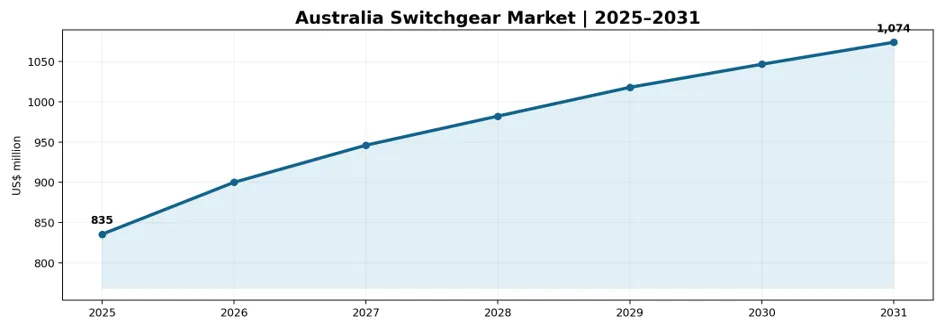
Australia Switchgear Key Takeaways
The MV/HV Distribution & Switchgears category expands from US$ 0.84 billion in 2025 to US$ 1.07 billion in 2031.
The category grows 4.28% annualized over 2025–2031, a six-year period.
ElectraNet awarded Hitachi Energy a March 2026 contract for its first SF6-free EconiQ high-voltage switchgear trial, including 145 kV and 72.5 kV breakers.
Schneider Electric committed A$2.5 million in September 2026 to double regional air- and moulded-case circuit-breaker assembly capacity in Adelaide.
Renewable Energy Zones, transmission interconnectors and utility replacement projects create demand for GIS, AIS and digitally monitored MV/HV bays.
Mining and data-centre clients require arc-flash protection, high uptime, short commissioning windows and robust lifecycle service.
Australia Switchgear Industry Trends and Strategic Insights
Utility transmission expansion and Renewable Energy Zone connections require new and refurbished substation switching equipment, protection relays and circuit breakers.
SF6-free technologies are advancing through early utility deployments as buyers assess lifecycle emissions and long-term equipment requirements.
Data centres, resource processing and mining electrification increase demand for MV equipment with remote condition monitoring and strong reliability records.
Domestic adaptation and assembly capacity can shorten configuration lead times, although high-voltage core equipment remains exposed to international supply chains.
Australia Switchgear Market Scope
| METRICS | DETAILS |
| 2025 Market Size | Australia Switchgear Market |
| 2031 Projected Market Size | Australia |
| CAGR (2026–2031) | US$ 0.84 billion |
| By Transformer Type | US$ 1.07 billion |
| By End-Use Industry | 4.28% |
| By Voltage Rating | 2025–2031 |
| By Cooling and Insulation | MV/HV Distribution & Switchgears |
| By Component | Medium and High Voltage |
| By Phase and Installation | Air-Insulated, Gas-Insulated, Vacuum and SF6-Free |
| By Installation Method | Indoor, Outdoor, Compact and Modular |
| Competitive Landscape | Utilities, Renewable Energy, Mining, Data Centres, Industrial and Commercial |
| Market Data Coverage | OEMs, EPCs, Utilities and Distributors |
Coverage: Australia. Quantified series: MV/HV Distribution & Switchgears (2025–2031). Included technology: AIS, GIS, vacuum and SF6-free switchgear, compact and modular systems, digital protection and utility/industrial installations. The workbook series is a combined distribution and switchgear category.
Australia Switchgear Market White Space & Investment Opportunities
SF6-free retrofit: introduce alternative-insulation circuit breakers and GIS for utility fleet-renewal and pilot procurements.
Renewable Energy Zone connection: provide repeatable medium- and high-voltage substation bays, protection schemes and energisation support.
Mining and data-centre power reliability: position arc-resilient switchgear, digital condition monitoring, spares and fast field-service contracts.
Strong growth opportunities are concentrated in technically qualified supply packages, retrofit-compatible designs and service delivery across dispersed substations. Project wins depend on grid connection timing, utility approval processes and demonstrated switchgear performance.
Driver Impact Analysis
Renewable Energy Zone programs and transmission interconnection increase requirements for substations, circuit breakers and switchgear. Distribution upgrades, electrification and planned data centre campuses add replacement and greenfield demand.
| DRIVER | AFFECTED PRODUCT / SIGNAL | 2026–2031 CAGR | STRATEGIC IMPACT |
| Transmission and REZ substations | MV/HV GIS and AIS | 4.28% | Prioritise grid connection packages and utility approvals |
| Mining and data centres | MV switchgear and arc protection | 4.28% | Offer rapid deployment and dependable field service |
| Utility replacement cycles | Breakers, relays and retrofits | 4.28% | Target asset-renewal tenders and outage planning |
| SF6-free technology adoption | Alternative-insulation HV apparatus | 4.28% | Pursue utility trials and specification alignment |
The shift to low-global-warming-potential insulation, digital protection and condition-based maintenance is changing preferred specifications. Australian service and engineering capabilities influence project selection and whole-of-life costs.
Restraint Impact Analysis
Utility projects face environmental approvals, land access delays and long delivery cycles for high-voltage equipment. OEM qualification and specialized interrupters can extend procurement timelines.
| RESTRAINT | PRIMARY EXPOSURE | RISK LEVEL | STRATEGIC IMPACT |
| Project approval and timing | Large substations and connections | High | Qualify project pipeline and delivery windows |
| Global component lead times | HV GIS, breakers and interrupters | High | Secure capacity and dual sourcing |
| Retrofit site outages | Live utility and industrial facilities | Medium | Use modular cutover and service planning |
| Remote site logistics | Mining and regional substations | Medium | Build Australian field support and spares |
Buyers must balance capital cost, maintenance access, SF6 handling requirements, retrofit outages and project-specific compliance. Remote installation conditions can add transport and commissioning complexity.
Australia Switchgear Market Competitive Landscape
The Australian switchgear market is served by international manufacturers and local assemblers, engineering contractors and service organizations. Leading suppliers include Schneider Electric, ABB, Siemens, Hitachi Energy, Eaton and NHP Electrical Engineering Products, with local delivery capability an important discriminator.
| COMPANY | AUSTRALIAN SWITCHGEAR POSITIONING |
| Schneider Electric Australia | Market leader in low-to-medium voltage switchgear with a heavy focus on EcoStruxure IoT-enabled smart systems, microgrid integration, and environmentally progressive SF₆-free dry-air technologies tailored for urban distribution networks like Ausgrid. |
| ABB Australia | Major player capturing high revenues through utility framework agreements. Specializes in highly reliable gas-insulated switchgear (GIS) and air-insulated switchgear (AIS), utility-scale protection, and digital monitoring solutions designed for severe conditions. |
| Siemens Australia | Tier-1 supplier dominating large-scale industrial automation and heavy utility transmission infrastructure. Positions itself around premium digital-twin integration, smart grid stability, and robust high-voltage circuit breakers. |
| Hitachi Energy Australia | Positioned heavily in major renewable integration and massive high-voltage grid infrastructure links. Strong footprint in high-fault node breakers, dead-tank breakers, and utility-scale transformers |
| Eaton Australia | Strongly positioned in both primary and secondary medium-voltage networks, offering highly modular solid-dielectric and gas-insulated pad-mounted switchgear. They target critical infrastructure, data centers, and compact commercial kiosk substations. |
| NHP Electrical Engineering Products | Premium local distributor and integrator focused on customized low-to-medium voltage modular boards with ultra-rapid delivery times. Strong focus on industrial buyers and arc-resistant safety configurations. |
| Lucy Electric Australia | Specialized leader in secondary power distribution networks, ring main units (RMUs), and distribution network automation (RTUs). Rapidly expanding its local market footprint with SF₆-free air Gas Insulated Switchgear (GIS) |
| S&C Electric Australia | Renowned niche expert in underground and pad-mounted distribution automation. Their premier offering is the Vista® submersible switchgear series, highly valued by utilities for flood-prone urban faults and green-grid alternatives. |
| G&W Electric Australia | Specializes in high-durability dead-front padmount and vault-mounted solid dielectric switchgear (Trident series). Highly positioned for underground automation and retrofitting legacy systems to eliminate oil-filled switches safely. |
| NOJA Power | An agile, highly competitive Australian manufacturer dominant in outdoor pole-mounted reclosers and indoor solid-dielectric gear. Frequently wins regional distribution utility tenders with smart grid protection automation. |
Competitive differentiation depends on voltage range, IEC/AS testing, local inventory and service, alternative-insulation readiness, digital integration and turnkey substation delivery.
Australia Switchgear Market Recent Developments
March 16, 2026 — Hitachi Energy announced a contract with ElectraNet for South Australia’s first utility trial of EconiQ SF6-free high-voltage switchgear, including three 145 kV and one 72.5 kV live-tank circuit breakers.
March 2026 — ElectraNet outlined plans to trial the SF6-free equipment as part of efforts to modernize South Australia’s transmission grid while reducing equipment emissions.
August 24, 2026 — Hitachi Energy introduced additional EconiQ high-voltage circuit-breaker and GIS ratings at CIGRE, extending a technology pathway relevant to Australian utility purchasing.
September 14, 2026 — Schneider Electric announced A$2.5 million investment in a smart circuit-breaker production line at Gepps Cross, Adelaide, designed to double local production capacity in the Pacific region.
September 14, 2026 — Schneider Electric stated its new Adelaide assembly line would support ComPacT NS and MasterPacT MTZ breaker ranges, with operation expected in the first quarter of 2027.
September 2026 — Schneider Electric specified more than 25 expected skilled manufacturing roles and approximately A$500,000 of testing equipment as part of its Gepps Cross electrical protection expansion.


























































