


Australia PFAS CRM Market Size and Overview
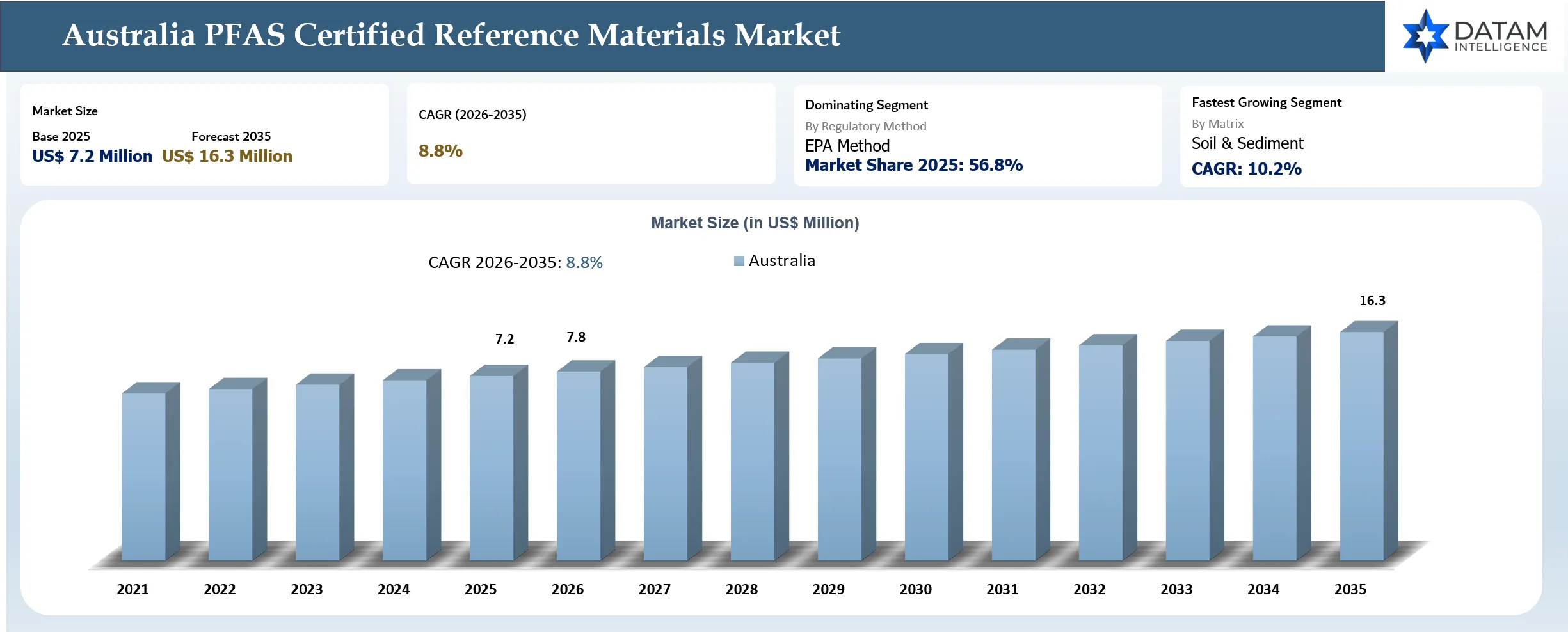
The Australia Per- and Polyfluoroalkyl Substances Certified Reference Materials (PFAS CRM) market is estimated at USD 7.2 million in 2025 and is projected to reach USD 16.3 million by 2035, growing at an assumed CAGR of 8.8% during 2026-2035. The Australia PFAS certified reference materials market is driven by stricter drinking-water PFAS guidelines, ongoing investigations of contaminated defence and industrial sites, increasing PFAS surveillance across soil and water matrices, and the need for compound-specific, traceable reference materials.
Australia’s PFAS testing landscape is expanding as laboratories broaden compound coverage and strengthen analytical capabilities across environmental and packaging matrices. For instance, in April 2026, SGS Australia expanded its accredited PFAS testing suite to 73 compounds across soil, water, cardboard, and plastic matrices. The expanded method covers emerging and less commonly tested PFAS, including polyfluoroalkyl phosphinates (PFPis), fluorotelomer carboxylic acids, and cationic and zwitterionic PFAS, with validation at trace and ultra-trace levels.
Australia PFAS CRM Market Key Takeaways
- EPA Method dominated the Australia PFAS Certified Reference Materials (CRM) market in 2025, accounting for 56.8% market share. Demand is supported by the widespread use of US EPA analytical procedures for PFAS testing, including drinking-water analysis and multi-matrix environmental monitoring. Laboratories require method-compatible reference standards for calibration, method validation, and analytical quality control.
- Soil & Sediment is projected to be the fastest-growing matrix in Australia’s PFAS CRM market, with a CAGR of 10.2%. Growth is supported by investigations of contaminated land, defence sites, and industrial locations, alongside continued monitoring of soil, sediment, and groundwater. These applications increase the need for matrix-matched reference materials to ensure reliable PFAS measurement across repeated sampling rounds.
- Australia’s expanding PFAS surveillance is increasing demand for specialised reference materials across environmental matrices. For instance, in March 2026, the NSW Environment Protection Authority began a statewide monitoring programme collecting water, sediment and fish samples at more than 200 sites to establish baseline PFAS concentrations and assess long-term environmental trends. The programme reinforces the need for reliable, matrix-appropriate reference materials to support analytical accuracy and quality control.
Australia PFAS CRM Market Scope
| Metrics | Details |
| 2025 Market Size | USD 7.2 Million |
| 2035 Projected Market Size | USD 16.3 Million |
| CAGR (2026-2035) | 8.8% |
| By Product Type | Native PFAS CRMs, Stable Isotope-Labeled (SIL) PFAS CRMs, Others |
| By PFAS Chemical Class | Perfluoroalkyl Carboxylic Acids (PFCAs), Perfluoroalkane Sulfonic Acids (PFSAs), Fluorotelomer Compounds (FTs), FOSAs & FOSEs, Others |
| By Matrix | Water, Soil & Sediment, Biological Samples, Food & Feed, Consumer Products & Packaging, Aqueous Film-Forming Foam (AFFF), Others |
| By Regulatory Method | EPA Methods, ASTM Methods, ISO Methods, DIN Methods, AOAC Methods, Others |
| By Analytical Technique | LC-MS/MS, LC-HRMS, GC-MS, Other Analytical Techniques |
| By End User | Environmental Testing Laboratories, Government & Regulatory Laboratories, Food & Consumer Product Testing Laboratories, Pharmaceutical & Biotechnology Laboratories, Industrial Manufacturing Laboratories, Academic & Research Institutes, Contract Research Organizations (CROs) |
| Report Insights Covered | Competitive Landscape Analysis, Company Profile Analysis, Market Size, Share, Growth |
Australia PFAS CRM Market Disruption Analysis
Shift Toward Long-Term, Multi-Matrix PFAS Monitoring Reshaping CRM Requirements
Australia’s PFAS monitoring landscape is shifting from isolated contamination assessments toward repeated sampling across groundwater, surface water, soil, and sediment. This changes laboratory requirements by increasing the need for consistent, matrix-specific reference materials that support comparable results across sampling rounds, distinguish genuine concentration changes from analytical variability, and validate methods across different environmental matrices. CRM suppliers must therefore address diverse matrix and compound requirements rather than relying solely on conventional water-based PFAS standards.
In February 2026, CS Energy completed its 17th quarterly technical monitoring round and sixth round of landholder sampling around Callide Power Station in Queensland. The programme has involved more than 2,000 water, soil, and sediment samples, alongside remediation activities. Continued sampling, even as PFAS concentrations generally decline, illustrates the need for repeatable analytical performance over extended monitoring periods. This shifts CRM requirements toward materials that support consistent measurements across environmental matrices and successive testing rounds.
Australia PFAS CRM Market BCG Matrix: Company Evaluation
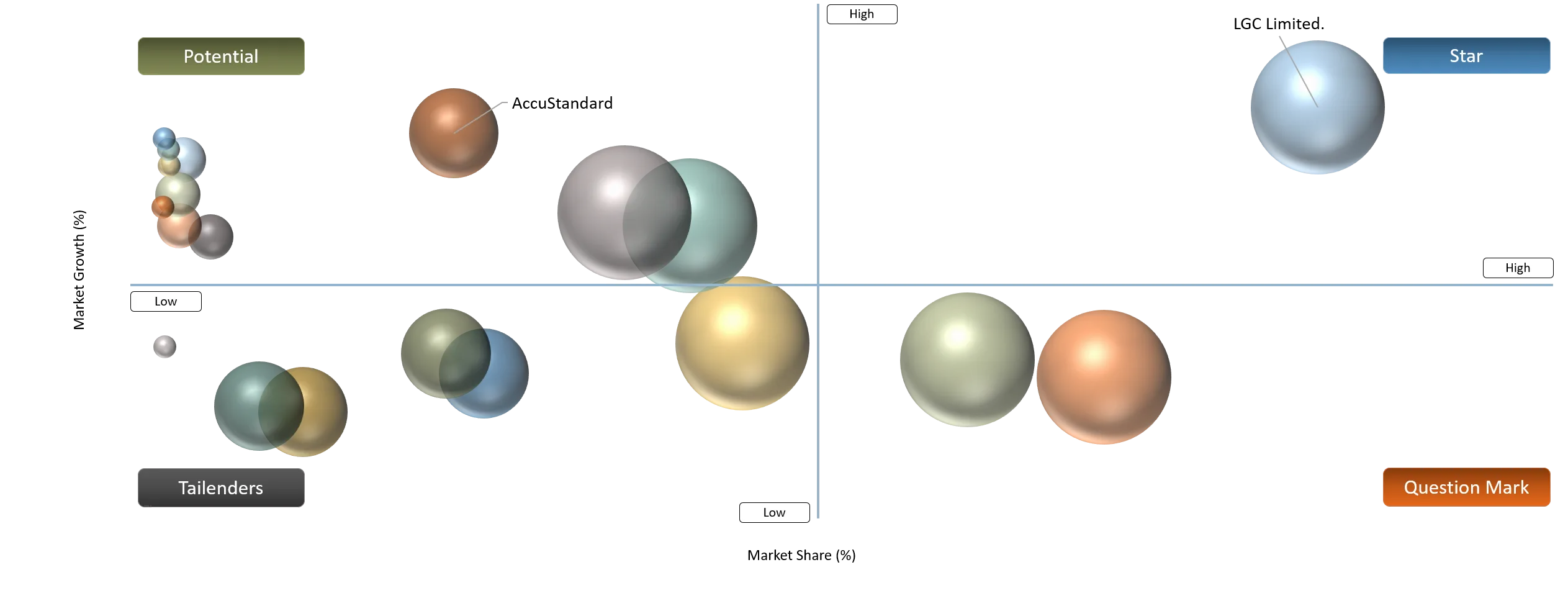
Waters Corporation and LGC Standards are suitable candidates for the Stars category in the Australia PFAS CRM market. Waters offers PFAS reference standards and certified reference materials, while LGC Standards supplies PFAS analytical standards and certified materials through its international portfolio serving Australian laboratories.
Wellington Laboratories, AccuStandard, Cambridge Isotope Laboratories, and Restek Corporation can be classified as Potential Stars, supported by their PFAS reference standards, certified mixtures, and isotope-labelled compounds for environmental analysis. Their positioning reflects specialised product portfolios and availability to Australian laboratories, rather than confirmed Australian manufacturing or verified market shares.
Australia PFAS CRM Market Segment Analysis
The Australia PFAS CRM market is segmented based on product type, PFAS chemical class, matrix, regulatory method, analytical technique, end-user industry, and region.
EPA Method Adoption and Regulatory Monitoring Strengthening Demand for PFAS CRMs in Australia
EPA methods hold the largest share of the Australia’s PFAS CRM market, as the national PFAS Environmental Management Plan identifies US EPA procedures as the most commonly used analytical methods in Australia and New Zealand. For instance, in October 2026, the NSW Environment Protection Authority commenced mandatory PFAS monitoring requirements for approximately 140 licensed landfills and 260 sewage treatment plants, requiring quarterly testing at specified locations using an aqueous PFAS LC-MS/MS method based on US EPA Method 1633A. The requirements cover PFOS, PFOA, PFHxS and PFBS, strengthening the need for method-compatible reference materials and quality-control standards for wastewater, leachate and groundwater analysis.
Australian laboratories including National Measurement Institute (NMI), SGS Australia, Eurofins Environment Testing Australia, and ALS Australia provide PFAS testing using US EPA methods. NMI offers testing based on EPA Method 537, while SGS and ALS cover EPA Method 1633-related applications. These services support demand for method-specific reference materials for calibration, trace-level quantification, and analytical quality control.
Australia PFAS CRM Market Competitive Landscape
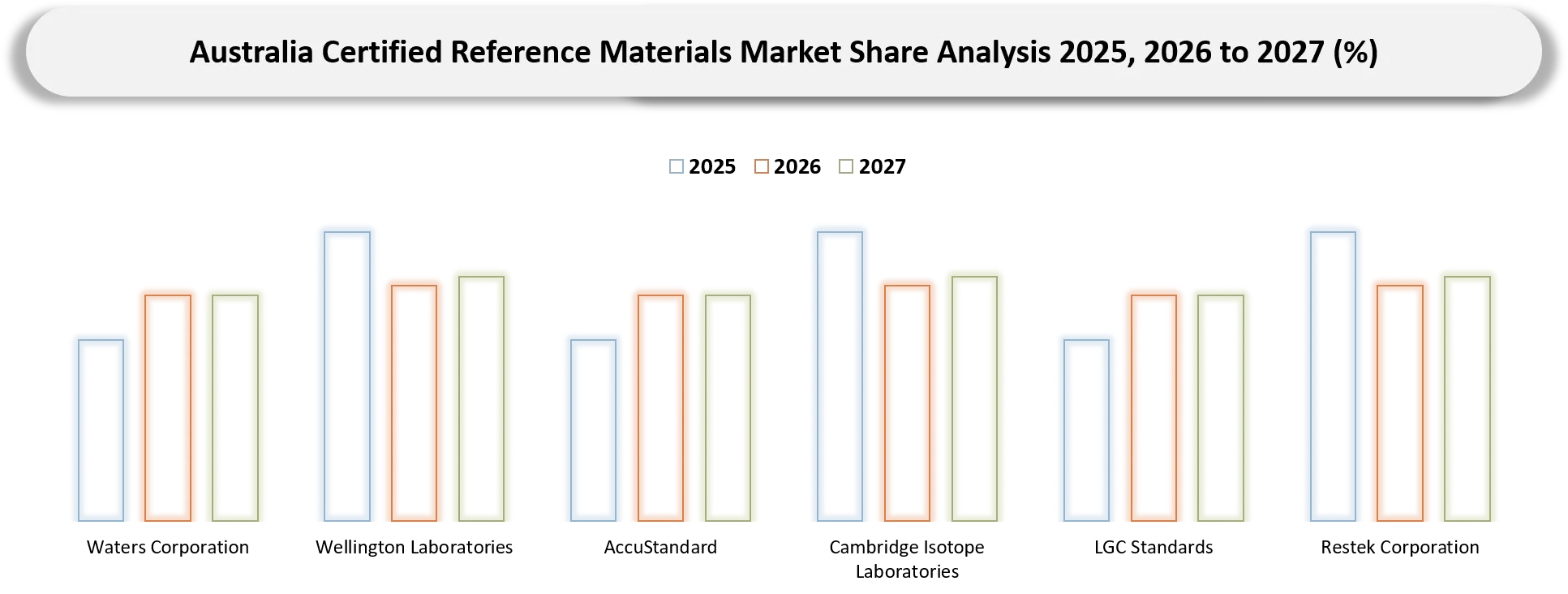
- PFAS CRM suppliers serving the Australian market include Waters Corporation, Wellington Laboratories Inc., AccuStandard, Cambridge Isotope Laboratories, Inc., LGC Standards, and Restek Corporation. Their portfolios include PFAS reference standards, certified multi-component mixtures, isotope-labelled compounds, and analytical standards used in environmental monitoring, drinking-water analysis, and laboratory quality control.
- Key players in the Australia PFAS CRM market include Waters Corporation, Wellington Laboratories Inc., AccuStandard, Cambridge Isotope Laboratories, Inc., LGC Standards, and Restek Corporation. These companies provide specialised PFAS analytical materials through international supply networks and Australian distribution channels. Their inclusion reflects market availability and supply presence, not confirmed PFAS CRM manufacturing within Australia.
Key Developments
- April 2026: SGS Australia expanded its accredited PFAS testing suite to 73 compounds across soil, water, cardboard, and plastic matrices. The expanded method covers emerging and less commonly tested PFAS, including polyfluoroalkyl phosphinates (PFPis), fluorotelomer carboxylic acids, and cationic and zwitterionic PFAS, with validation at trace and ultra-trace levels.
- September 2026: RMIT University and EPA Victoria researchers reported Australia’s first PFAS rainwater study, analyzing samples collected across Melbourne during 2024–2025 for 30 PFAS compounds. Eight compounds were detected at concentrations generally measured in nanograms per litre, while PFOS and PFOA remained below Australian drinking-water guideline values.
- October 2026: 3M outlined its planned defence against the Australian Government’s AUD 2 billion lawsuit over alleged PFAS contamination linked to firefighting foam used at 28 Defence Force bases nationwide. The Commonwealth alleges that 3M continued selling aqueous film-forming foam despite prior knowledge of potential PFAS-related risks to human health and the environment.
Why Choose DataM?
- Technological Innovations: Examines advancements in PFAS certified reference materials, including stable isotope-labeled standards, multi-component PFAS mixtures, matrix-specific reference materials, and standards for emerging PFAS compounds, supporting accurate quantification and reliable laboratory testing.
- Product Performance & Market Positioning: Evaluates how PFAS CRM manufacturers differentiate their products through certified concentrations, measurement uncertainty, traceability, purity, stability, and compatibility with EPA analytical methods, particularly Methods 533, 537.1, and 1633A.
- Real-World Applications: Highlights the use of PFAS CRMs by Australia laboratories in drinking-water compliance testing, contaminated-site investigations, groundwater monitoring, wastewater analysis, firefighting-foam contamination assessment, and food and biological sample testing.
- Market Updates & Industry Changes: Tracks developments during 2025-2026, including PFAS reference-standard launches, expanded compound coverage, new matrix-specific materials, supplier portfolio expansions, and changes in Australia PFAS monitoring and analytical requirements.
- Pricing & Market Access: Assesses PFAS CRM pricing based on compound composition, isotope labeling, concentration, certification level, mixture size, and packaging. It also examines supplier availability, distribution channels, procurement requirements, and access to specialized standards for Australia environmental, industrial, government, and research laboratories.
- Market Entry & Expansion: Identifies opportunities arising from drinking-water testing, environmental remediation, industrial contamination monitoring, and emerging PFAS analysis requirements. It evaluates strategies such as expanding isotope-labeled standard portfolios, developing matrix-specific CRMs, strengthening laboratory partnerships, and improving access to specialized reference materials across the United States.
Target Audience 2026
- PFAS Certified Reference Material Manufacturers and Producers
- Analytical and Environmental Testing Laboratories
- Government and Regulatory Agencies
- Pharmaceutical and Biotechnology Companies
- Food and Beverage Testing Organizations
- Environmental Monitoring and Water Quality Organizations
- Industrial Chemical and Manufacturing Companies
- Semiconductor and Electronics Manufacturers
- Wastewater Treatment and Remediation Companies
- Contract Research Organizations and Academic Research Institutes
- Reference Material Distributors and Laboratory Suppliers
- Mining, Metals and Critical Minerals Companies


























































