


Australia Data Center Cables & Wires Market Size and Overview
The Australia data center cables and wires market covers medium- and low-voltage site feeders, UPS and backup-generator cables, fiber-optic backbones, structured copper cabling, rack-level high-speed interconnects and fire-rated control wiring. Major demand hubs include Sydney and Melbourne, with additional colocation, enterprise and modular data center developments in Brisbane, Perth and Canberra.
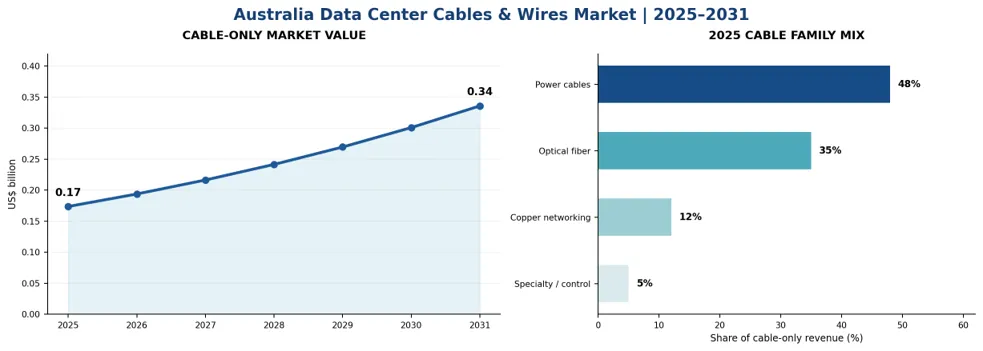
DataM estimates Australia data center cables and wires expenditure at US$ 0.17 billion in 2025, reaching US$ 0.34 billion by 2031, equivalent to 11.63% annualized growth over 2025–2031. The cable-only estimate allocates 12% of Australia data center electrical component expenditure to cables and wires in 2025 and 14% in 2031.
Australia Data Center Cables & Wires Market Key Takeaways
- Australia data-center cables and wires expenditure is estimated at US$ 0.17 billion in 2025, increasing to US$ 0.34 billion by 2031, equivalent to 11.63% annualized growth.
- Power cables represent an estimated 48% of 2025 cable-only expenditure, supporting site feeders, switchgear, transformers, UPS systems and backup-power connections.
- Optical fiber accounts for an estimated 35% of 2025 cabling expenditure, reflecting hyperscale connectivity, campus backbone links and higher bandwidth requirements for AI workloads.
- Structured copper networking and short-reach electrical interconnects account for approximately 12% of cabling value, connecting equipment within data halls and critical network spaces.
- Specialty and control cables account for approximately 5%, including life-safety circuits, grounding, monitoring and building-management wiring.
Australia Data Center Cables & Wires Industry Trends and Strategic Insights
Hyperscale, colocation and AI-capacity investments drive demand for fiber-dense backbones, higher-performance rack connectivity and resilient critical-power cabling.
Higher compute densities and redundancy requirements increase specification scrutiny for feeder cables, UPS connections, fiber-loss budgets and fire-performance materials.
Sydney and Melbourne remain major data-center demand centers, while Brisbane, Perth and Canberra create additional opportunities linked to regional enterprise, government and edge workloads.
Suppliers differentiate through Australian Standards compliance, delivery reliability, fire-safety certification, EPC relationships and preterminated fiber or modular power-cabling systems.
Australia Data Center Cables & Wires Market Scope
| METRICS | DETAILS |
| Base Year / Forecast | 2025 / 2026–2031 |
| Geographic Coverage | Australia |
| Market Size and Growth | US$ 0.17 billion (2025); US$ 0.34 billion (2031); 11.63% CAGR (2026–2031). Australia data-center cables and wires market. |
| By Cable Type | Power Cables & Wires (MV feeders, LV distribution, UPS / battery / generator cables, rack power whips); Datacom & Network Cables (SMF, MMF, copper Ethernet, DAC / AEC); Specialty (fire-rated / LSZH, control, grounding). |
| By Data Center Type | Hyperscale; Colocation; Enterprise / Private; Edge / Modular; AI / High-Density Compute. |
| By Cable Application | Site Power / Utility Interconnection; Electrical Distribution; UPS & Backup; Rack-Level Power; Structured Cabling; Campus Fiber; Controls / Fire Safety / BMS. |
| By Network / Transmission Medium | Copper Power Conductors; Copper Data Interconnects; Single-Mode Fiber; Multimode Fiber; Hybrid Copper-Fiber. |
| By Power Cable Voltage Rating | Low Voltage (up to 1 kV); Medium Voltage (above 1 kV to 35 kV); High Voltage (above 35 kV, utility / campus application). |
| By Cable Jacket / Fire Performance | Plenum / Riser; LSZH; Fire-Resistant / Circuit Integrity; XLPE / PVC / EPR and other materials. |
| By Deployment Location | Outside Plant / Campus; Electrical Rooms; Overhead Cable Tray; Underfloor / Conduit; Rack / Row Interconnect. |
| Competitive Landscape | 10 company profiles; product positioning; channel coverage; data-center partnerships and recent developments. |
| Market Insights | Cable-only market sizing, power / optical / networking product mix, installation demand, segment growth, market dynamics, capital opportunities and competition. |
Australia Data Center Cables & Wires Market White Space & Investment Opportunities
Fiber and AI networking: Higher-count optical fiber, preterminated trunks and low-loss connectors create opportunities in new data halls and network retrofits.
Critical-power cabling: Utility entries, redundant feeds, UPS, generator and distribution architectures require qualified LV / MV power cables and cable management.
Prefabricated deployment: Pretested fiber trunks, modular electrical connections and standardized cable kits can reduce on-site labor and speed commissioning.
Developer and EPC partnerships: Engagement with colocation operators, electrical contractors, cloud tenants and design consultants can help suppliers secure approved-vendor status.
Facility upgrades: Legacy colocation and enterprise sites accommodating denser racks may need replacement power feeders, optical backbones and specialized control cabling.
Australia Data Center Cables & Wires Market Dynamics
Australia data-center cabling purchases follow the progression from site power connection and electrical plant installation to network backbone fit-out, rack connectivity and commissioning. Cloud and colocation expansion supports demand for both power and datacom cables, while AI workloads change cable density, routing and performance requirements. Supplier opportunities depend on early specification engagement, approved-product status and reliable delivery against project milestones.
Driver Impact Analysis
| DRIVER | DEMAND EXPOSURE | IMPACTED CABLES | STRATEGIC IMPLICATION |
| Cloud and colocation expansion | Hyperscale, colocation and enterprise data centers | High | Qualify with EPCs and provide resilient power and fiber cable packages. |
| AI workload densification | Optical backbones, rack interconnects and critical-power wiring | High | Offer preterminated fiber and certified high-density connectivity. |
| Critical-power redundancy | Utility feeders, UPS, generators and building distribution | High | Provide qualified power products with full testing documentation. |
| Modular construction and upgrades | Prefabricated electrical and structured cable systems | Moderate–High | Build standardized cable kits and repeatable installation support. |
Investment in hyperscale facilities and high-density AI computing is expanding demand for fiber backbones, redundant power circuits and scalable internal connectivity. Electrical resilience requirements favor tested LV / MV feeders, UPS cabling and fire-performance products. Fiber solutions increasingly compete on installed loss, connector reliability, density and ease of future expansion. Modular deployments can create repeatable cable-package opportunities across phased campuses.
Market access depends on specification decisions by engineers, electrical EPC firms, network integrators and owners. Cable suppliers can strengthen their position through local inventory, installation support, proven certification documentation and packaged connectivity systems. Early engagement is particularly important where large developments are built in successive halls or where replacement cable routes become costly once facilities are operational.
Restraint Impact Analysis
| RESTRAINT | EXPOSURE AREA | IMPACTED USE CASE | STRATEGIC RESPONSE |
| Grid connection and approvals | Metropolitan data-center construction schedules | High | Track utility milestones and stage procurement to project readiness. |
| Metal and logistics cost changes | Power cable tenders, inventory and specialist imports | High | Use commodity-linked contracts and local stock buffers. |
| Specification and testing complexity | Fiber-loss, fire-safety and redundant power systems | Moderate–High | Invest in certification support and installer training. |
| Installation labor and retrofit access | Commissioning and live-site expansion | Moderate | Use pretested assemblies and coordinated contractor scheduling. |
Power availability, grid-connection schedules and planning approvals can shift project construction timetables and postpone cable purchase orders. Large metropolitan campuses may require extensive utility connection work before internal fit-out begins. Design revisions caused by changing rack densities, cooling architecture or backup-power configurations can also alter quantities and cable specifications after initial tendering.
Copper and aluminum cost fluctuations affect margins on power-cable contracts, while imported high-specification network components can create freight and lead-time exposure. Cabling systems must satisfy applicable electrical, fire and communications standards. High installation quality, traceable testing results, contractor training and dependable local stock availability are important for reducing commissioning risks.
Australia Data Center Cables & Wires Market Competitive Landscape
Australia data-center cabling competition includes domestic and multinational power-cable suppliers, specialist structured-cabling companies and optical-fiber equipment vendors. Power-cable manufacturers compete on standards compliance, availability and EPC relationships, while connectivity specialists compete on system certification, density, optical performance and integrated installation support.
| COMPANY | Australia DATA-CENTER POSITIONING |
| Prysmian Australia | Power and specialty cables for data-center feeders, distribution and critical infrastructure. |
| Nexans Australia | Building and power-distribution cabling for electrical contractor and infrastructure supply. |
| Bambach Wires and Cables | Australian industrial and specialty wire and cable production for demanding installations. |
| LAPP Australia | Flexible control cables and industrial connectivity solutions for technical infrastructure. |
| Eland Cables | LV, MV, control and specialist cable supply for engineered projects. |
| Leviton Network Solutions | Structured copper and fiber networking systems for enterprise and data-center applications. |
| Corning | Optical fiber and preterminated fiber connectivity for high-density data centers. |
| CommScope | Fiber and copper structured cabling systems for hyperscale and colocation installations. |
| Amphenol | High-speed copper, optical and electrical interconnects for network and rack systems. |
| Belden | Copper structured cabling, fiber and data-center connectivity systems. |
Hyperscale and colocation operators evaluate cable products based on fire performance, critical-power reliability, fiber-loss specifications, product traceability and installed cost. Differentiation increasingly comes from prequalification with consultants, supply availability across multiple construction phases and ability to support upgrades without disrupting live data-center operations.
Australia Data Center Cables & Wires Market Recent Developments
During 2026, continued investment in Australian cloud, colocation and AI capacity supported demand for fiber backbones and critical-power distribution cabling.
In 2026, utility-connection planning and resilient backup-power architecture remained key procurement considerations for new data-center campuses.
Throughout 2026, higher network bandwidth and compute-density requirements increased the importance of high-count fiber, preterminated trunks and rack-level connectivity.
In 2026, suppliers competed on Australian compliance, system testing, dependable local availability and installation support.
During 2026, grid capacity, project approvals and construction resource availability continued to influence cable procurement schedules.


























































