


Australia Certified Reference Materials (CRM) Market Size and Overview
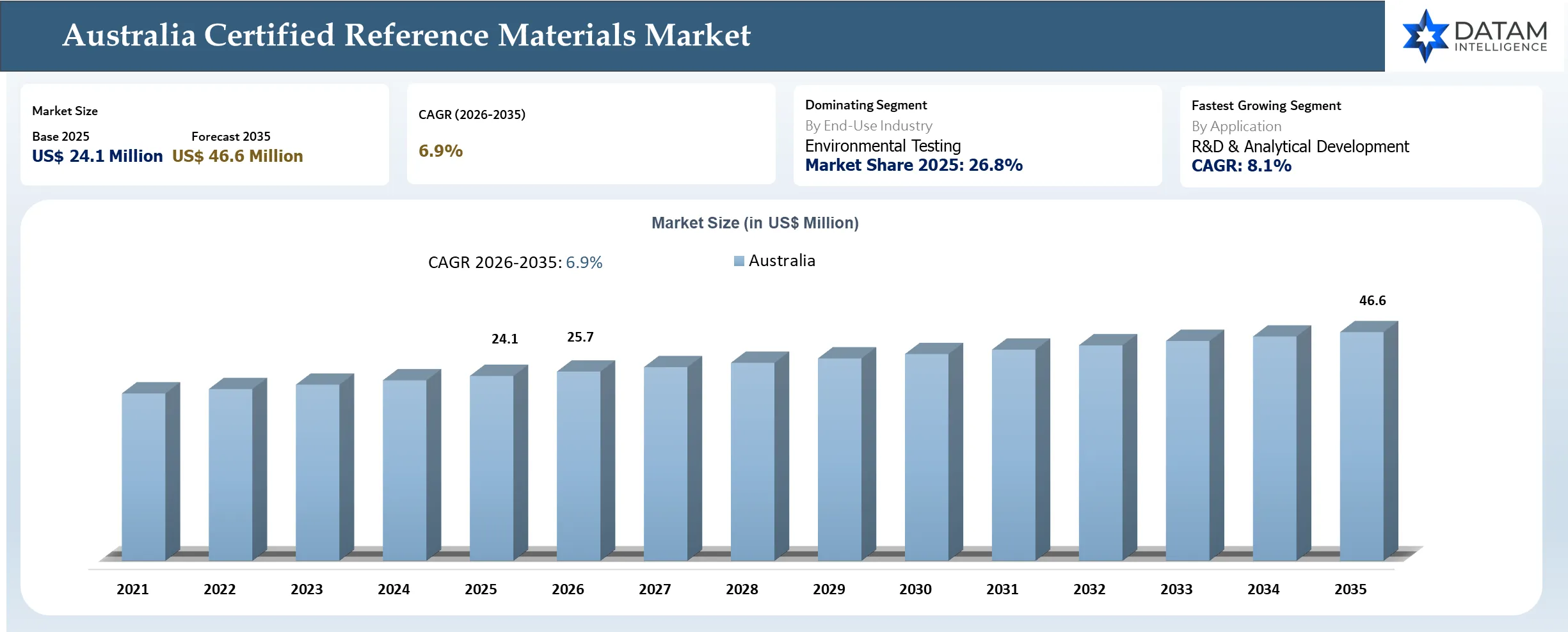
The Australia Certified Reference Materials (CRM) market reached USD 24.1 million in 2025 and is expected to reach USD 46.6 million by 2035, growing with a CAGR of 6.9% during the forecast period 2026-2035. The Australia certified reference materials market is driven by the expansion of accredited laboratory testing and quality assurance, stringent food safety and environmental monitoring requirements, strong mining and mineral exploration activity, increasing pharmaceutical and industrial analytical testing, and rising demand for contaminant detection and trace-level analysis.
Australia’s environmental monitoring programmes are increasing the need for PFAS testing in groundwater, surface water, soil, and sediment, supporting demand for reliable analytical methods and quality-control materials. For instance, in February 2026, CS Energy completed its 17th quarterly technical monitoring round and sixth round of landholder sampling around Callide Power Station in Queensland. The programme has included more than 2,000 water, soil, and sediment samples, alongside remediation activities. CS Energy reported an overall reduction in PFAS concentrations, with most increases remaining within historical levels.
Australia Certified Reference Materials (CRM) Market Key Takeaways
- Environmental testing dominated the Australia Certified Reference Materials (CRM) Market by end-use industry in 2025, accounting for 26.8% market share. Demand is driven by environmental monitoring and testing of soil, water and industrial contamination. Increasing analysis of PFAS, heavy metals, pesticides and hydrocarbons support the use of CRMs for instrument calibration, method validation and reliable contaminant measurement.
- R&D and analytical development is the fastest-growing application segment, with a projected CAGR of 8.1%. Growth is supported by increasing requirements for analytical method development, instrument calibration and measurement verification across research laboratories. CRMs provide traceable reference values that help researchers validate testing procedures and improve the accuracy and reproducibility of analytical results.
- Australia’s expanding PFAS testing capabilities are supporting demand for specialised analytical quality control. In April 2026, SGS Australia expanded its accredited PFAS testing suite to 73 compounds, covering soil, water and packaging matrices, including cardboard and plastic. The expansion reflects the need for more comprehensive contaminant analysis and reliable laboratory testing methods, supporting the role of reference materials in analytical quality assurance.
Australia Certified Reference Materials (CRM) Market Scope
| Metrics | Details |
| 2025 Market Size | USD 24.1 Million |
| 2035 Projected Market Size | USD 46.6 Million |
| CAGR (2026-2035) | 6.9% |
| By Product Type | Organic, Inorganic |
| By Application | Quality Control & Assurance, Method Validation, Regulatory Compliance Testing, R&D & Analytical Development, Calibration & Instrument Validation |
| By End-User Industry | Consumer Industry, Contract Testing, University / Non-Profit, Energy Industry, Environmental Testing, Health Care, Industrial / Manufacturing, Materials / Mining |
| Report Insights Covered | Competitive Landscape Analysis, Company Profile Analysis, Market Size, Share, Growth |
Australia Certified Reference Materials (CRM) Market Disruption Analysis
Evolving International Accreditation Standards Increasing Pressure on CRM Producers
Australia’s certified reference materials market faces a potential shift as international requirements for reference-material producers evolve. ISO 17034 provides the framework for assessing producer competence, including the consistent production of reference materials and the reliability of their assigned values. Changes to this framework could require producers to review technical procedures, quality-management systems and certification documentation, potentially increasing compliance costs and influencing supplier qualification.
In July 2026, the International Organization for Standardization advanced a new edition of ISO 17034 to the committee-draft stage, with the proposed revision intended to replace the 2016 edition. In Australia, the National Association of Testing Authorities (NATA) accredits reference-material producers against ISO 17034 requirements, making any eventual revision relevant to the country's accredited CRM supply base. The potential market disruption therefore lies in the possibility of future accreditation adjustments, additional compliance expenditure and changes in competitive positioning among CRM producers.
Australia Certified Reference Materials (CRM) Market BCG Matrix: Company Evaluation
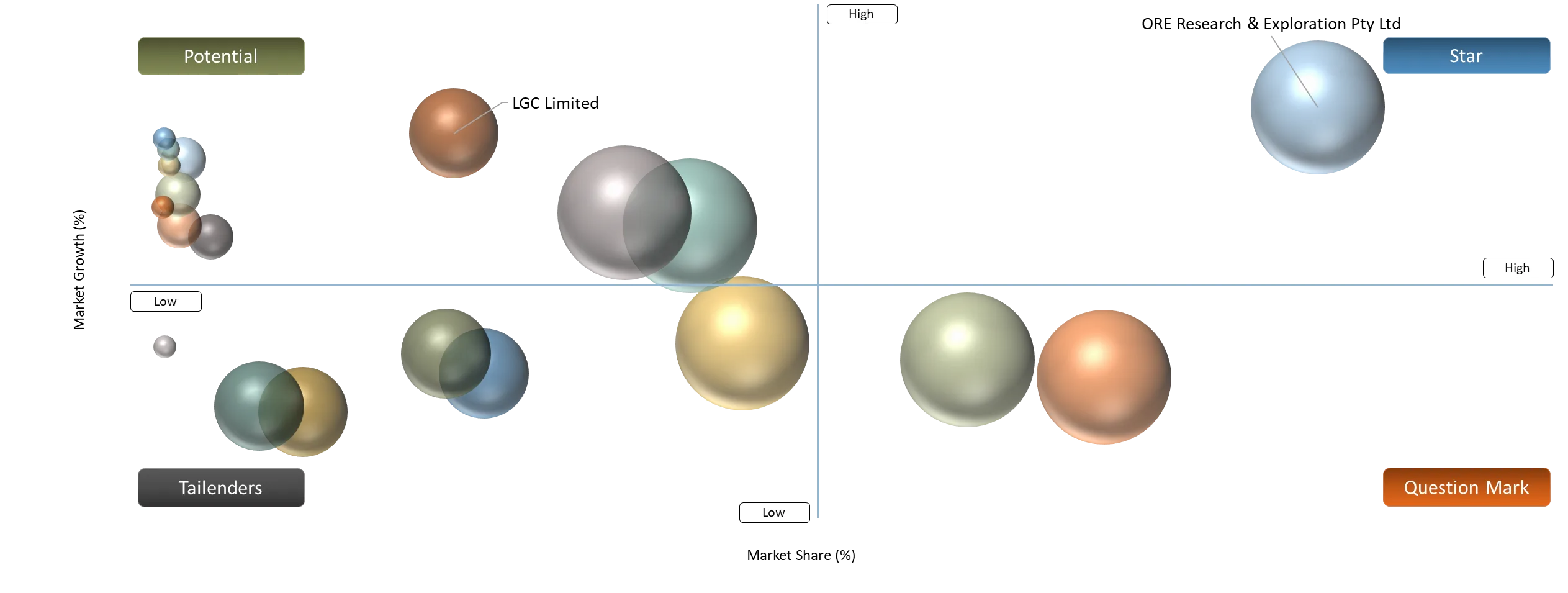
Klen International, ORE Research & Exploration Pty Ltd (OREAS), ACIRS, and Geostats Pty Ltd are positioned as Stars in the Australia Certified Reference Materials (CRM) Market due to their specialised CRM production capabilities and established applications in mineral exploration, mining, iron ore, and coal analysis. LGC Limited, Hach Lange GmbH, and Anton Paar GmbH are classified as Potential Stars, supported by their diversified reference-material portfolios and Australian sales presence across chemical, environmental, pharmaceutical, and analytical testing applications.
AccuStandard and Starna Scientific Limited are classified as Question Marks because of their specialised reference-material portfolios, covering analytical standards and optical or spectroscopy calibration materials, respectively, with opportunities to expand their Australian market presence. BioPoint Pty Ltd is positioned as a Tailender due to its specialised focus on microbiological reference materials compared with suppliers serving broader analytical testing applications.
Australia Certified Reference Materials (CRM) Market Segment Analysis
The Australia certified reference materials (CRM) market is segmented based on product type, application, end-user industry, and region.
Growing Consumer Demand for Food Safety Testing and Quality Assurance
The consumer industry supports CRM demand through food-safety testing, chemical-residue analysis and quality control. In Australia, the National Residue Survey collected and analysed 17,327 food samples in 2023–24, including 9,984 animal-product samples and 7,343 plant-product samples, for pesticide residues, contaminants and microorganisms. Its contracted laboratories must hold ISO/IEC 17025 accreditation, and proficiency testing helps verify their analytical performance.
Demand is further supported by ongoing chemical testing of food and packaged consumer products. In 2024–25, Australian dairy companies tested 1,687 samples for heavy metals, with 100% returning negative detections and also analysed 1,200 samples for aflatoxin M1. Separately, the Australian Total Diet Study collected approximately 2,000 food samples for analysis of more than 500 chemicals. These testing programmes create a need for reliable calibration and analytical quality assurance, including CRMs, although the published figures do not measure CRM consumption or market share directly.
Australia Certified Reference Materials (CRM) Market Competitive Landscape
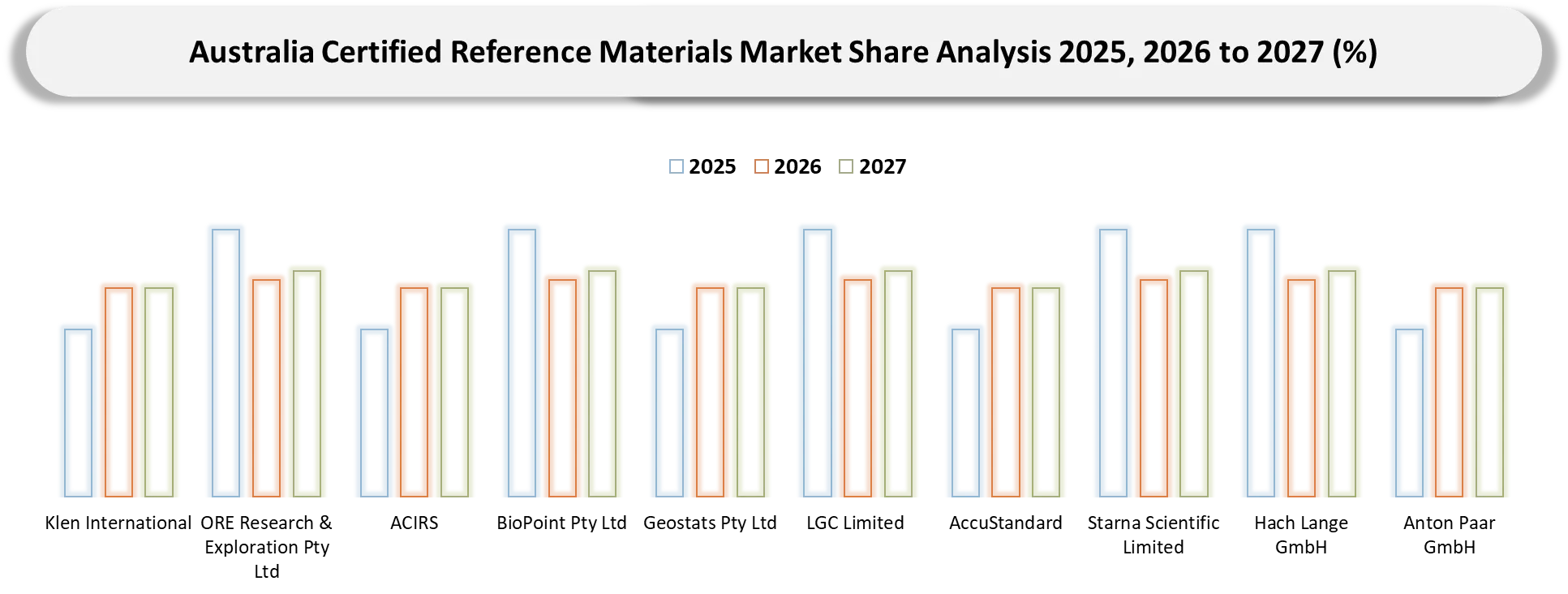
- Australian companies such as Klen International, ORE Research & Exploration Pty Ltd (OREAS), ACIRS, BioPoint Pty Ltd, and Geostats Pty Ltd supply certified reference materials for mineral exploration, mining, coal analysis, microbiological testing, and chemical and analytical quality control. International suppliers, including LGC Limited / LGC Standards, AccuStandard, Starna Scientific Limited, Hach Lange GmbH, and Anton Paar GmbH, extend the Australian market offering through pharmaceutical, environmental and chemical reference standards, spectroscopy reference materials, and certified calibration materials for laboratory testing.
- Key players in the Australia certified reference materials (CRM) market include Klen International (Australia), ORE Research & Exploration Pty Ltd (Australia), ACIRS (Australia), BioPoint Pty Ltd (Australia), Geostats Pty Ltd (Australia), LGC Limited / LGC Standards (United Kingdom, with Australian sales operations), AccuStandard (United States, with Australian distribution), Starna Scientific Limited (United Kingdom, with Australian sales presence), Hach Lange GmbH (Germany, with Australian operations), and Anton Paar GmbH (Austria, with Australian operations).
Key Developments
- July 2025: OREAS released five new certified reference materials (CRMs) developed from high-grade iron ore sourced from the Hawks Nest Magnetite Project in South Australia. The range includes OREAS 408, containing approximately 86% hematite and 3% magnetite, alongside OREAS 411, 412, 413 and 415. Prepared and certified in accordance with ISO 17034, the materials support iron ore exploration, grade control and resource evaluation.
- April 2026: SGS Australia expanded its accredited PFAS testing suite to cover 73 compounds across soil, water, and packaging matrices, including cardboard and plastic. The expanded method includes less commonly tested PFAS compounds, such as polyfluoroalkyl phosphinates and cationic and zwitterionic PFAS, supporting more comprehensive contamination detection at trace and ultra-trace levels.
- August 2026: OREAS released eight new CRMs for mining and geochemical laboratories, including materials for tungsten–molybdenum–bismuth–fluorine ores, nickel–cobalt sulphide ores and nickel–copper–platinum-group-element (PGE) ores. The release included OREAS 13c, containing approximately 0.2% nickel and 0.2% copper, to support analytical quality control and assay validation.
Why Choose DataM?
- Technological Innovations: Examines advancements in Certified Reference Materials (CRMs), including matrix-matched standards, high-purity elemental reference materials, quantitative nuclear magnetic resonance standards, and specialized materials for emerging analytical techniques, supporting improved measurement accuracy and laboratory reliability.
- Product Performance & Market Positioning: Evaluates how CRM manufacturers and suppliers differentiate their offerings through certified values, measurement uncertainty, metrological traceability, material homogeneity, certification quality, and suitability for environmental, pharmaceutical, food safety, mining, and industrial testing applications.
- Real-World Evidence: Highlights CRM applications in Canadian laboratories, including contaminant detection, elemental impurity analysis, water-quality monitoring, shellfish toxin testing, pharmaceutical quality control, and critical-mineral characterization, demonstrating their role in analytical validation and reliable measurement outcomes.
- Market Updates & Industry Changes: Tracks developments during 2025–2026, including new CRM introductions, specialized reference-material launches, product portfolio expansions, and changes in analytical testing requirements, helping identify evolving demand across Australia's environmental, food, healthcare, and industrial sectors.
- Pricing & Market Access: Assesses differences in CRM pricing based on material composition, certification complexity, concentration, packaging size, intended application, and production requirements. It also examines supplier availability, distribution channels, delivery lead times, and access to specialized reference materials for Canadian research institutions, industrial laboratories, and regulated testing facilities.
- Market Entry & Expansion: Identifies opportunities arising from environmental contaminant monitoring, food safety testing, pharmaceutical quality assurance, critical-mineral analysis, and emerging nanomaterial measurement requirements. It also evaluates strategies such as developing application-specific CRMs, strengthening laboratory partnerships, expanding distribution networks, and improving access to traceable reference materials across Australia.
Target Audience 2026
- CRM Manufacturers and Producers
- Analytical Testing Laboratories
- Government and Regulatory Agencies
- Pharmaceutical and Biotechnology Companies
- Food and Beverage Companies
- Environmental Monitoring and Water Testing Organizations
- Mining, Metals, and Critical Minerals Companies


























































