


Australia Cables & Wires Market Size & Overview
The Australia cables and wires market reached US$ 4.35 billion in 2025 and is projected to reach US$ 5.36 billion by 2031, representing 3.54% annualized growth over 2025–2031. Demand spans utility distribution and transmission, buildings, mining and industrial operations, renewables, telecommunications and transport infrastructure.
Australia’s cable requirements reflect an extensive transmission network, long interconnection distances and strong resource-sector investment. Grid reinforcement and renewable connection projects support medium- and high-voltage products, while commercial construction, housing and industrial maintenance underpin low-voltage wiring. Mining operations, offshore infrastructure and remote sites create sustained demand for rugged specialty cables.
| 2025 MARKET SIZE | 2031 FORECAST | CAGR (2026–2031) |
|---|---|---|
| US$ 4.35 Billion | US$ 5.36 Billion | 3.54% |
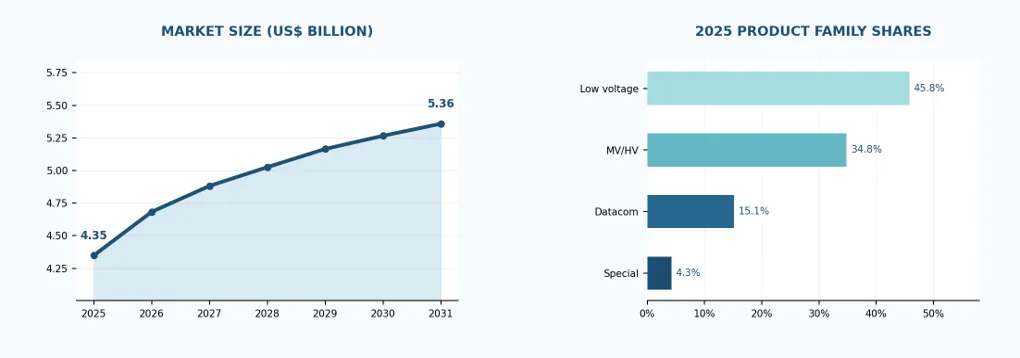
Australia cables and wires revenue increases from US$ 4.35 billion in 2025 to US$ 5.36 billion in 2031, an increase of US$ 1.01 billion.
The implied 3.54% annualized growth rate reflects sustained utility, industrial, building and connectivity expenditure.
Low-voltage cables account for 45.83% of 2025 demand, serving building wiring, industrial facilities and distribution networks.
Medium- and high-voltage cables account for 34.81% of 2025 demand, supported by grid reinforcement, renewable generation connections and major infrastructure.
Datacom cables represent 15.11% of 2025 demand, with opportunities in data centers, fiber connectivity and network upgrades.
Special cables represent 4.25% of 2025 demand, including mining, marine, photovoltaic and wind-power applications.
Australia Cables & Wires Industry Trends and Strategic Insights
Transmission investment and renewable integration underpin demand for long-life high-voltage cables and engineered connections across interregional networks and renewable corridors.
Mining, mineral processing and marine installations favor robust specialty cable systems built for mechanical stress, temperature extremes, water exposure and long replacement cycles.
Commercial construction, infrastructure refurbishment and industrial electrification support low-voltage power, fire-performance and flexible control cabling.
Fiber access, data-center growth and enterprise networking stimulate demand for optical-fiber and structured copper cabling, with emphasis on capacity, installation efficiency and resilience.
Australia Cables & Wires Market Scope
| METRICS | DETAILS |
| 2025 Market Size | US$ 4.35 Billion |
| 2031 Projected Market Size | US$ 5.36 Billion |
| CAGR (2026–2031) | 3.54% |
| Geographic Coverage | Australia (national market and major state industrial, infrastructure and utility demand centers) |
| By Cable Type | Datacom Cables (Communication & Data Cables, Fiber Optic Cables); Low-Voltage Cables (Fire Resistant Cables, Low Smoke & Halogen Free Cables, Low Voltage Cables & Wires); Medium- and High-Voltage Cables (Medium Voltage Cables, High Voltage Cables); Special Cables (Mining Oil & Gas Cables, Photovoltaic Cables, Ship & Harbour Cables, Windmill Cables) |
| By Industry | Industrial — Discrete (Aerospace & Defense, Automotive, Batteries, Electrical & Electronics, Machine Building, Semiconductor); Process (Chemicals, Energy/Oil & Gas, Metal Processing); Hybrid (Food & Beverage, Lifesciences, Mining & Quarrying, Other Manufacturing). Non Industrial — Transportation (Air, Land, Rail, Marine Services); Infrastructure & Services (Commercial Real Estate, Data Centers, Healthcare, Hospitality & Entertainment, Public Sector/Research/Education, Residentials, Water & Waste, Others). Power Utilities — Power Generation (Coal, Conventional Excl. Coal, Renewables); Power Distribution & Transmission. |
| By Conductor / Transmission Medium | Copper; Aluminum; Optical Fiber; Composite / Hybrid Construction |
| By Voltage Rating (Power Cables) | Low Voltage (up to 1 kV); Medium Voltage (above 1 to 35 kV); High Voltage (above 35 to 230 kV); Extra-High Voltage (above 230 kV) |
| By Insulation and Sheathing Material | Cross-Linked Polyethylene (XLPE); Polyvinyl Chloride (PVC); Ethylene Propylene Rubber (EPR/EPDM); Polyethylene (PE); Low Smoke Zero Halogen (LSZH); Other Materials |
| By Installation Method | Overhead; Underground / Buried; Submarine / Underwater; Indoor / Building; Outdoor / Industrial |
| Competitive Landscape | Competitive positioning, 10 company profiles, recent developments and partnerships |
| Market Data Coverage | Cable-type and cable-subtype market values, 2025–2031 (US$ million); industry, material, voltage and installation breakdowns within the defined report scope |
The study covers Australian cable and wire revenues by cable family and subtype, with multilevel segmentation across industrial, non-industrial and utility end markets. Additional breakouts address conductor, voltage, insulation and installation method. The forecast runs from 2026 through 2031 with 2025 as the base year.
Australia Cables & Wires Market White Space & Investment Opportunities
Renewable-energy connection networks: Expansion of solar, wind, storage and grid infrastructure creates demand for MV/HV, underground, fire-resistant and photovoltaic cable systems.
Mining and resource infrastructure: Remote operations and mineral-processing upgrades offer opportunities in abrasion-resistant, flexible, instrumentation and heavy-duty power cables.
Data and connectivity: Enterprise networking, fiber deployment and hyperscale data centers support optical fiber, structured copper and low-smoke indoor cabling.
Commercial opportunity varies by state and project type. New South Wales and Victoria are major demand centers for utilities and buildings, Queensland and Western Australia have significant mining and energy exposure, while South Australia and Tasmania offer specialized renewable and grid-connection opportunities.
Driver Impact Analysis
Australia’s transition toward greater renewable generation creates cable demand across new solar and wind farms, storage connections, distribution reinforcement and interregional transmission corridors. Long-route projects favor higher-voltage capacity, installation engineering and fault tolerance. Supplier qualification with transmission operators and EPC contractors is important for securing multi-year projects.
| DRIVER | AFFECTED PRODUCT / SIGNAL | IMPACT | STRATEGIC IMPACT |
| Transmission upgrades and grid renewal | MV/HV, overhead and underground cables | High | Prioritize utility qualification, local inventory and EPC partnerships. |
| Renewable energy integration | MV/HV, photovoltaic and wind cables | High | Build capacity to meet renewable project connection schedules. |
| Mining and industrial investment | Special, flexible and control cables | Moderate–High | Target mining contractors, OEMs and plant maintenance suppliers. |
| Buildings, fiber and digital networks | Low-voltage, optical fiber and structured copper | Moderate | Develop channel coverage for installers and data-center integrators. |
Construction and industrial capital spending provide a second demand stream. Residential, commercial and public infrastructure require compliant low-voltage wiring, while mining expansions and processing facilities consume heavy-duty power, control and instrumentation cables. Data centers and telecom upgrades add demand for reliable copper and optical-fiber connectivity, especially where high-density installations require low-smoke materials.
Restraint Impact Analysis
Copper and aluminum price volatility raises quotation risk, manufacturing working-capital needs and tender uncertainty. Import dependence for certain specialty products adds exposure to lead times, freight costs and exchange rates. Procurement terms that allow commodity-linked pricing and better inventory planning can protect supplier margins.
| RESTRAINT | PRIMARY EXPOSURE | RISK LEVEL | STRATEGIC IMPACT |
| Copper and aluminum price changes | Cable costs, tender margins and inventory | High | Apply price-adjustment clauses and supply planning. |
| Project approval and delivery delays | Transmission, renewable and mining installations | High | Track approval gates and project mobilization. |
| Product qualification and standards | Utility, industrial and fire-performance cables | Moderate–High | Invest in documentation, testing and technical support. |
| Imported specialty cable lead times | Submarine, EHV and niche industrial products | Moderate | Diversify sourcing and local stock positions. |
Grid and renewable projects are also vulnerable to permitting, easement approvals, skilled-labor availability and installation capacity constraints. Cable producers can face long utility qualification cycles while customers may defer projects when connection costs or construction budgets change. Reliability, technical testing and contractor support increasingly affect purchasing decisions.
Australia Cables & Wires Market Competitive Landscape
Australia’s competitive landscape includes local manufacturers, regional subsidiaries of global power-cable suppliers and specialist providers of industrial and communications cabling. Competition reflects local stocking, product certification, utility project experience and supply reliability as much as headline cable pricing.
| COMPANY | AUSTRALIA CABLES & WIRES POSITIONING |
| Prysmian Australia | Manufacture and supply of building, industrial, power and utility cables. |
| Nexans Australia | Power distribution, building and industrial cable supply, including Olex products. |
| Southwire | Power and building wire supply and international cable solutions. |
| Bambach Wires and Cables | Australian manufacturing of electrical and specialty cables. |
| LAPP Australia | Industrial connectivity, flexible control cables and automation cabling. |
| Belden | Industrial networking, structured copper and fiber connectivity. |
| CommScope | Structured cabling, fiber and enterprise connectivity systems. |
| Corning Optical Communications | Optical fiber cable and connectivity technology. |
| Prysmian Australia | Transmission, submarine and engineered power cable solutions. |
| Hengtong Group | Optical fiber, power cable and submarine cable technology. |
Prysmian and Nexans are important cable supply participants, alongside specialty industrial cable providers and international manufacturers serving Australia’s power and connectivity markets. Companies differentiate through technical support, product availability, capacity for large infrastructure orders and industrial distributor relationships.
Australia Cables & Wires Market Recent Developments
2026: Renewable generation and grid-connection development continues to shape demand for medium- and high-voltage power cables.
2026: Energy transmission planning reinforces demand for high-reliability underground, overhead and engineered interconnection cable systems.
2026: Resource-sector investment and remote site electrification support specialty mining, industrial power and control cables.
2026: Fiber-network modernization and data-center buildouts support optical-fiber and structured copper cable product lines.
2026: Cable suppliers emphasize fire performance, compliance, long product life and qualification for critical infrastructure purchasing.
2026: Copper price fluctuations, logistics and project approvals remain important factors influencing Australian cable procurement.


























































