


Ashwagandha Beverages Market Size
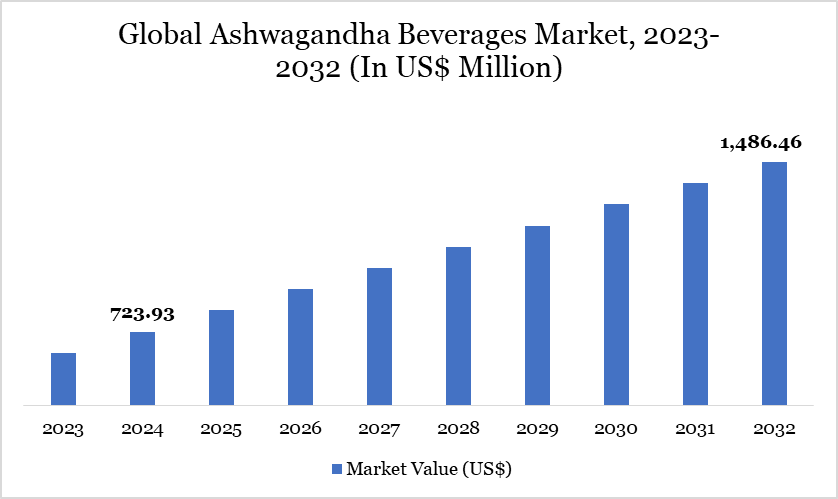
Global Ashwagandha Beverages Market reached US$ 723.93 million in 2024 and is expected to reach US$ 1,486.46 million by 2032, growing with a CAGR of 9.41% during the forecast period 2025-2032.
The global ashwagandha beverages market is witnessing significant growth driven by increasing consumer demand for natural adaptogens and stress-relief solutions. With rising awareness around holistic wellness, especially post-COVID, beverages infused with Ashwagandha are gaining popularity for their functional benefits such as stress reduction, improved focus, and enhanced immunity.
For instance, REBBL Inc. in the US offers adaptogenic drinks like Reishi Chocolate and Ashwagandha-infused elixirs, targeting health-conscious millennials. As mental health awareness and functional beverage trends converge, the Ashwagandha beverage market is set to expand rapidly across North America, Europe, and Asia-Pacific.
Key Takeaways
The market is still emerging, but it has strong cultural and commercial momentum within functional beverages. Within the ashwagandha beverages market, that signal should shape product strategy, pricing discipline, and investment priorities.
Mainstream retail placement and non-alcoholic wellness trends are giving the category broader visibility than pure supplement channels alone. Competitive advantage in the ashwagandha beverages market will increasingly go to companies that operationalize the insight better than peers.
Brand storytelling around stress support, clean ingredients and ritualized consumption remains central to premium pricing. Capital allocation, partnerships, and go-to-market execution in the ashwagandha beverages market are likely to follow the same logic over the forecast period.
Market estimates vary because some publishers size the ingredient market while others size the beverage format subset. Longer-term winners in the ashwagandha beverages market usually turn that takeaway into repeatable execution rather than one-off launches.
Key Growth Factors
- Non-alcoholic wellness shift: consumers are replacing part of alcohol and conventional energy-drink spend with mood-supporting functional beverages.
- Adaptogen acceptance: ashwagandha has become one of the most recognized adaptogens, helping reduce trial barriers.
- Channel expansion: grocery, club, DTC and specialty wellness retail are all widening the route-to-market.
Global Ashwagandha Beverages Market Trends
There is a growing preference for clean-label beverages made with recognizable, natural ingredients and without artificial additives. Ashwagandha fits perfectly into this category due to its Ayurvedic origins and natural therapeutic properties. Organic India and Vahdam Teas have capitalized on this trend by Distribution Channel certified organic Ashwagandha teas, appealing to health-conscious and eco-aware consumers in both domestic and export markets.
The global popularity of Ayurveda is driving demand for ancient herbal ingredients like Ashwagandha. This has opened doors for Indian Ayurvedic companies like Himalaya Wellness and Upakarma Ayurveda to enter international markets with traditional drinks and juices formulated with Ashwagandha.
For more details on this report, Request for Sample
Market Scope
| Metrics | Details |
| By Product Type | Ashwagandha Tea, Ashwagandha Juice, Ashwagandha Smoothies, Ashwagandha-infused Water, Ashwagandha-based Energy Drinks, Others |
| By Packaging Type | Bottles (Glass or PET), Cans, Cartons, Tetra Packs, Others |
| By Application | Stress and Anxiety Relief, Energy & Stamina Enhancement, Cognitive Support, Immunity Boosting, Hormonal & Sexual Wellness, Others |
| By Distribution Channel | Supermarkets/Hypermarkets, Health Food Stores, Convenience Stores, Online Retail, Others |
| By Region | North America, South America, Europe, Asia-Pacific, Middle East and Africa |
| Report Insights Covered | Competitive Landscape Analysis, Company Profile Analysis, Market Size, Share, Growth |
Market Dynamics
Drivers: Functional-wellness demand
Functional-wellness demand remains the strongest growth driver in the ashwagandha beverages market because consumers are shifting toward beverages that promise mood, stress and cognitive support without heavy sugar or synthetic positioning. Demand expands fastest when buyers can tie that catalyst to measurable gains in speed, compliance, operating efficiency, or customer experience.
Channel strategy also benefits when the leading catalyst solves a visible problem for end users rather than adding a marginal feature. Buyers tend to favor vendors that can document the operational gain in plain commercial terms.
Strategic momentum broadens further when functional-wellness demand is supported by format expansion and retail readiness. Companies that package the main catalyst with reliable execution and proof of performance are more likely to capture market share during the forecast period.
Restraint: Claims and compliance
Claims and compliance remains the most material restraint in the ashwagandha beverages market because brands must stay careful around structure-function claims, dosage communication and cross-border labeling rules. Adoption slows when the issue raises qualification risk, lengthens decision cycles, or weakens confidence in long-term economics.
Margin pressure can intensify even in a healthy market outlook when remediation costs are high. Procurement teams usually favor suppliers that can show tighter controls, steadier quality, and better risk visibility.
Secondary friction from ingredient quality variation and consumer education can magnify the problem by adding more cost and complexity. Vendors that solve the primary restraint faster than peers usually protect pricing and strengthen enterprise trust.
How Ai Impacted
Formulation optimization is influencing the ashwagandha beverages market in a material way. AI is being used to balance flavor, sweetness, botanical stacks and ingredient stability in functional beverages which reduces trial-and-error cost and shortens development or engineering cycles.
Consumer insight mining is influencing the ashwagandha beverages market in a material way. Brands use AI to track wellness language, repeat-purchase drivers and channel-specific demand patterns while helping companies lower waste, improve inventory turns, and react faster to demand volatility.
Demand forecasting is influencing the ashwagandha beverages market in a material way. AI helps brands manage smaller-batch innovation, retail velocity analysis and launch sequencing while helping companies lower waste, improve inventory turns, and react faster to demand volatility.
Unmet Needs
Mainstream RTD winners are among the clearest unmet needs in the ashwagandha beverages market. The market still needs more scaled brands that can balance efficacy, taste, shelf stability and retail economics and suppliers that address the gap convincingly are more likely to expand category usage and customer loyalty.
Clear dosage communication remains one of the clearest unmet needs in the ashwagandha beverages market. Many products under-explain extract quality, standardization and intended use cases and vendors that close the gap well should improve conversion, retention, and market trust.
Broader channel trust remains one of the clearest unmet needs in the ashwagandha beverages market. Clinical storytelling and better category education are still needed for broader household penetration and companies that solve the need early can widen adoption and defend margins more effectively.
Disruption Analysis
Ashwagandha beverages are disrupting both traditional herbal supplements and premium soft drinks by turning wellness into a daily consumption ritual. In the ashwagandha beverages market, the shift changes how buyers define value, which lets premium segments outgrow commodity tiers as buyers reward visible differentiation, and leadership in the ashwagandha beverages market will increasingly depend on how well companies operationalize the shift rather than merely describe it.
The category is being reshaped by non-alcoholic functional beverages that emphasize calmer mood support rather than just stimulation. In the ashwagandha beverages market, the shift changes how buyers define value, which pushes competition toward vendors that combine product performance with services, data, and execution quality, and suppliers that adapt early can capture share while slower competitors remain tied to legacy pricing and delivery models in the ashwagandha beverages market.
Ingredient-branding and extract standardization are becoming important differentiators as more entrants crowd the market. In the ashwagandha beverages market, the shift changes how buyers define value, which pushes competition toward vendors that combine product performance with services, data, and execution quality, and strategic winners usually emerge when management teams translate disruption into product redesign, channel change, and faster capital allocation in the ashwagandha beverages market.
Market Segment Analysis
The global ashwagandha beverages market is segmented based on product type, packaging type, application, distribution channel, and region.
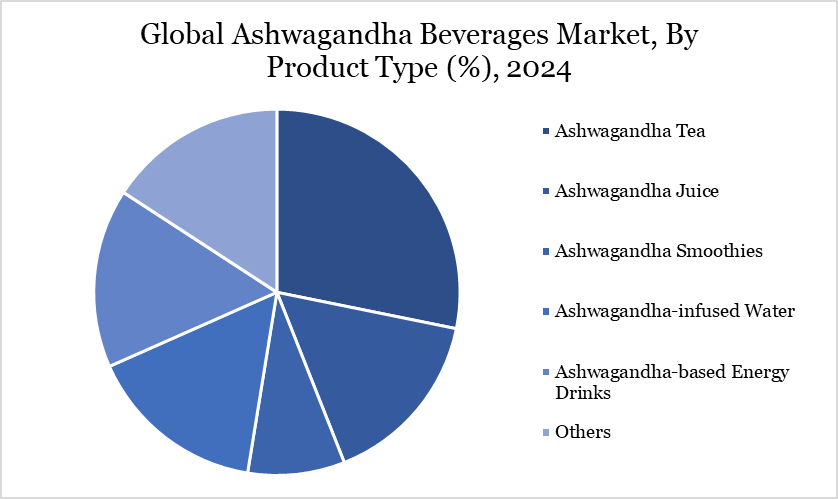
Dominance of Ashwagandha Tea in the Evolving Adaptogenic Beverage Landscape
The Ashwagandha Tea segment dominates the market growth within the Ashwagandha beverages category due to its wide consumer appeal, ease of consumption, and strong alignment with the global herbal tea trend. Consumers seeking stress relief, improved sleep, and overall wellness are increasingly turning to functional teas, where Ashwagandha is blended with other calming herbs like chamomile, tulsi, or lavender.
For instance, Yogi Tea offers “Sweet Clementine Stress Support” and “Ashwagandha Stress Relief” herbal blends in Western markets, gaining popularity among urban wellness consumers. This combination of traditional acceptance and modern wellness positioning makes Ashwagandha tea the leading growth driver in the overall Ashwagandha beverage market.
Market Geographical Share
Asia-Pacific Emerges as the Global Leader in Ashwagandha Beverages Market
The Asia-Pacific region dominates the global Ashwagandha beverages market due to its deep-rooted cultural connection with Ayurveda, growing health consciousness, and a rapidly expanding wellness industry. Countries like India, where Ashwagandha has been used for centuries in traditional medicine, are central to both the production and consumption of Ashwagandha-based drinks.
Indian companies such as Organic India, Himalaya Wellness, and Upakarma Ayurveda have capitalized on local demand for immunity-boosting and stress-relieving herbal products by offering Ashwagandha teas, juices, and tonics across urban and rural markets. The combination of indigenous knowledge, a large consumer base, government support for traditional medicine, and cost-effective manufacturing gives the Asia-Pacific region a distinct advantage, allowing it to lead both in domestic consumption and the international distribution of Ashwagandha beverages.
Sustainability Analysis
Sustainability is becoming a critical factor in shaping the future of the Ashwagandha beverages market, with increasing emphasis on ethical sourcing, organic farming, eco-friendly packaging, and transparent supply chains. Ashwagandha, as a plant-based adaptogen, already aligns well with the global shift toward natural and environmentally friendly wellness products.
Many manufacturers are sourcing Ashwagandha through sustainable and regenerative farming practices to protect soil health and biodiversity, especially in India where the herb is predominantly cultivated. For instance, companies like Organic India and Banyan Botanicals are known for working closely with smallholder farmers, ensuring fair trade wages and organic certification, thereby promoting both environmental and social sustainability.
Top 10 Key players for Ashwagandha Beverages
- VAHDAM
- Hiyo
- REBBL
- Sunwink
- Rasa
- Moon Juice
- Peak and Valley
- Four Sigmatic
- Naturedge / Shunya
- Remedy Organics
Key Developments
- Mar 2026: VAHDAM launched Ashwagandha Coffee into about 1,000 Target stores in the United States.
- Feb 2025: Constellation Brands took a minority stake in Hiyo, a fast-growing functional non-alcoholic beverage brand that uses adaptogenic ingredients including ashwagandha.
- Aug 2025: Reliance Consumer Products deepened its partnership with Naturedge Beverages around wellness drinks under the Shunya platform.
Merges and Acquisitions
- Feb 2025: Constellation Brands made a minority investment in Hiyo.
- Aug 2025: Reliance Consumer Products entered a majority-led strategic arrangement with Naturedge Beverages for wellness beverages.
- Mar 2026: Constellation Brands agreed to acquire the remaining stake in Hop WTR, reinforcing large-beverage interest in adaptogenic adjacencies.
Advanced Technologies
- Standardized high-potency extracts such as root-only formats designed for beverage compatibility and taste management.
- RTD and instant-mix formats that combine ashwagandha with coffee, tea, nootropics or hydration benefits.
- Data-driven flavor and formulation development to improve repeat purchase in wellness beverages.
What’s Trending
- Coffee and tea adjacencies are accelerating because they give consumers familiar rituals with functional benefits.
- Retailers are leaning into premium functional beverages that bridge wellness, calmer energy and alcohol alternatives.
- Ingredient-brand transparency is becoming more important as consumers compare efficacy claims across brands.
Geopolitical Impact
Botanical supply chains, trade policy and labeling rules matter heavily here. Ashwagandha sourcing is concentrated in India and nearby supply ecosystems, so weather, agricultural policy, export controls, packaging costs and cross-border wellness-claims standards can materially influence margins and launch timing in global beverage markets.
Why Choose DataM?
- Data-Driven Insights: Dive into detailed analyses with granular insights such as pricing, market shares and value chain evaluations, enriched by interviews with industry leaders and disruptors.
- Post-Purchase Support and Expert Analyst Consultations: As a valued client, gain direct access to our expert analysts for personalized advice and strategic guidance, tailored to your specific needs and challenges.
- White Papers and Case Studies: Benefit quarterly from our in-depth studies related to your purchased titles, tailored to refine your operational and marketing strategies for maximum impact.
- Annual Updates on Purchased Reports: As an existing customer, enjoy the privilege of annual updates to your reports, ensuring you stay abreast of the latest market insights and technological advancements. Terms and conditions apply.
- Specialized Focus on Emerging Markets: DataM differentiates itself by delivering in-depth, specialized insights specifically for emerging markets, rather than Distribution Channel generalized geographic overviews. This approach equips our clients with a nuanced understanding and actionable intelligence that are essential for navigating and succeeding in high-growth regions.
- Value of DataM Reports: Our reports offer specialized insights tailored to the latest trends and specific business inquiries. This personalized approach provides a deeper, strategic perspective, ensuring you receive the precise information necessary to make informed decisions. These insights complement and go beyond what is typically available in generic databases.
Target Audience 2024
- Manufacturers/ Buyers
- Industry Investors/Investment Bankers
- Research Professionals
- Emerging Companies



























































