


Global Ambient Intelligence Market Overview
Growth is driven by rising demand for smart environments across healthcare, retail, and urban infrastructure. Key drivers include AI integration, IoT expansion, and personalized user experiences. Sustainability goals and energy-efficient systems further accelerate adoption.
Asia-Pacific leads the ambient intelligence market due to rapid urbanization and strong government backing for smart cities. Countries like China, Japan, and India are investing heavily in AI, sensors, and digital infrastructure. A large population base and growing middle class fuel demand for intelligent systems. Manufacturing hubs also embed smart tech into logistics and production, boosting regional growth.
Global Ambient Intelligence Market Size and Future Outlook
- 2025 Market Size: US$ 36.10 billion
- 2033 Projected Market Size: 229.54 billion
- CAGR (2025–2032): 26.02%
- Largest Market: Asia-Pacific
- Fastest Market: North America
Key Takeaways
- The rapid integration of artificial intelligence (AI), Internet of Things (IoT), machine learning, and context-aware computing technologies is emerging as a key industry trend, with organizations focusing on creating intelligent environments that can autonomously adapt to user behavior, preferences, and real-time conditions.
- Asia-Pacific maintains a leading position in the ambient intelligence market due to rapid urbanization, strong government support for smart city initiatives, expanding digital infrastructure, large-scale investments in AI and sensor technologies, and growing adoption of intelligent systems across healthcare, transportation, education, and industrial sectors.
- North America is projected to record significant growth as advanced IoT infrastructure, high technology adoption rates, increasing investments in smart healthcare and smart building solutions, and strong research and development activities continue to accelerate the deployment of ambient intelligence platforms.
- The growing demand for personalized, context-aware, and automated user experiences across residential, commercial, and industrial environments is becoming a major factor driving the adoption of ambient intelligence solutions worldwide.
- Increasing implementation of ambient intelligence in smart homes, healthcare monitoring systems, industrial automation, retail environments, and intelligent transportation networks is expanding market opportunities for technology providers and solution developers.
- Industry participants are increasingly evaluating investments based on AI capabilities, interoperability with connected ecosystems, edge computing integration, cybersecurity readiness, and the ability to deliver seamless real-time user experiences rather than relying solely on standalone automation technologies.
- Rising investments in smart cities, connected infrastructure, edge AI, 5G networks, intelligent healthcare systems, and next-generation digital transformation initiatives are creating significant growth opportunities for ambient intelligence technology providers and ecosystem partners globally.
Ambient Intelligence Market Scope
| Metrics | Details |
| By Component | Hardware, Software, Services |
| By Connectivity | Wired, Wireless |
| By Technology | Machine Learning, Natural Language Processing, Computer Vision, IoT (Internet of Things), Context-Aware Computing, Others. |
| By End-User | Residential, Commercial, Industrial, Government |
| By Region | North America, South America, Europe, Asia-Pacific, Middle East and Africa |
| Report Insights Covered | Competitive Landscape Analysis, Company Profile Analysis, Market Size, Share, Growth |
For More Detail Information, Request for Sample
Ambient Intelligence Market Dynamics
Healthcare Digitization Accelerates Ambient Intelligence Adoption in Patient Monitoring
Healthcare digitization is a key driver of ambient intelligence, as medical environments increasingly rely on real-time data and automated systems to improve patient care. Hospitals and clinics are adopting sensor-based technologies that monitor vital signs, detect anomalies, and support clinical decision-making without direct human intervention. This shift is especially important for managing chronic illnesses and elderly care, where continuous, unobtrusive monitoring enhances safety and responsiveness.
For instance, in 2025, Smart Meter launched iAmbientHealth, a radar-based sensor designed for contactless patient monitoring without relying on wearables or cameras. By tracking vital signs and movement discreetly, it enhances ambient intelligence in healthcare settings, offering continuous oversight while preserving patient privacy.
Privacy Concerns and Integration Costs Restrain Ambient Intelligence Adoption
As ambient intelligence systems rely on continuous monitoring through sensors and real-time data collection, users often express concern about how their personal information is stored, shared, and protected. This issue is particularly sensitive in healthcare and residential environments, where data privacy is paramount. Moreover, integrating ambient technologies into legacy infrastructure poses technical challenges, and the high upfront investment required for deployment can discourage smaller organizations from embracing these solutions ultimately slowing market expansion.
Ambient Intelligence Market Segmentation Analysis
The global ambient intelligence market is segmented based on component, connectivity, technology, end-user and region
Commercial Sector Leads Ambient Intelligence Adoption with Scalable Smart Integration
The commercial sector currently leads in adoption and revenue contribution. This dominance is driven by widespread integration of smart technologies in offices, retail spaces, and hospitality environments, where energy efficiency, occupant comfort, and security automation are top priorities. Commercial buildings benefit from scalable deployment of sensor networks and AI-driven systems that optimize lighting, HVAC, and access control, making them ideal testbeds for ambient solutions
As per instance, in 2025, Meta’s $14.3 billion investment in Scale AI boosts the ambient intelligence market by improving real-time data labeling and autonomous system training, essential for smarter, context-aware environments.
Residential Segment Emerges as Fastest-Growing Frontier in Ambient Intelligence
This growth is fueled by rising consumer demand for smart home technologies that enhance convenience, energy efficiency, and security. Devices like voice-activated assistants, motion-sensitive lighting, and adaptive climate control systems are becoming more accessible and affordable, driving adoption across urban and semi-urban households. Additionally, increased awareness of home automation and integration with IoT platforms has positioned residential spaces as a key frontier for ambient intelligence expansion.
For instance, in 2025, LG’s launch of Bon Voyage expanded the ambient intelligence market by bringing AI-powered smart home features to mobile and off-grid living. Its adaptive systems for climate, entertainment, and security showcased how ambient technologies can function beyond fixed residences, opening new opportunities for responsive environments in diverse housing formats.
Ambient Intelligence Market Regional Analysis
Asia-Pacific Leads the Rise of Ambient Intelligence
Asia-Pacific leads the ambient intelligence market due to its rapid urbanization, strong government backing, and aggressive investment in smart infrastructure. Countries across the region are embedding AI, IoT, and sensor networks into public services, healthcare, transportation, and education to enhance efficiency and responsiveness. The region benefits from a large, digitally literate population and a thriving tech ecosystem, which accelerates adoption and innovation.
China Ambient Intelligence Market Growth
China’s dominance in ambient intelligence is fueled by its aggressive investment in AI, automation, and urban surveillance technologies. The country has integrated ambient systems into smart transportation, energy grids, and public safety platforms, supported by strong industrial policy and centralized planning. Massive deployments of facial recognition, predictive analytics, and sensor-rich environments in cities like Shenzhen and Hangzhou reflect China’s commitment to intelligent infrastructure. With leading domestic tech firms and robust manufacturing capabilities, China is not only a major adopter but also a global supplier of ambient intelligence solutions.
As per the instance, in August 2025, China’s Mazu AI weather system was launched globally, boosting ambient intelligence by enabling real-time environmental sensing, automated alerts, and smarter disaster response across public infrastructure.
India Ambient Intelligence Market Growth
India’s leadership in the ambient intelligence market stems from its rapid digital transformation, government-backed smart city programs, and a booming tech ecosystem. With initiatives like Digital India and Smart Cities Mission, the country is embedding sensor networks, AI-driven analytics, and IoT infrastructure into urban planning, healthcare, and public services. The rise of affordable smartphones, expanding internet penetration, and a vibrant startup culture further accelerate adoption. India’s demographic advantage a young, tech-savvy population creates fertile ground for ambient intelligence applications in education, retail, and mobility.
For instance, in September 2025, Airtel Business announced a partnership with Swift Navigation to launch India's first AI/ML-powered, cloud-based location service. This service aims to improve location accuracy for uses that are critical to ambient technology
North America Sets the Standard for Ambient Intelligence
North America North America remains a leading force in the ambient intelligence market due to its advanced digital infrastructure, strong enterprise adoption, and robust investment in AI and IoT technologies. The region benefits from a mature tech ecosystem, widespread cloud integration, and a high concentration of innovation hubs. Ambient intelligence is being embedded across sectors such as healthcare, retail, and smart manufacturing, driven by demand for predictive analytics, automation, and personalized user experiences.
U.S Ambient Intelligence Market Growth
The United States drives ambient intelligence growth through its leadership in AI research, sensor innovation, and smart system integration. Major cities are deploying ambient technologies in traffic management, energy optimization, and public safety, supported by federal and state-level initiatives. The presence of top-tier universities, tech giants, and venture capital accelerates commercialization across industries. In healthcare, ambient systems are transforming patient monitoring and hospital operations, while retail and hospitality sectors use them to enhance customer engagement and operational efficiency.
As per instance, in 2025, the U.S. government committed $100 million to AI research and development, aiming to strengthen national capabilities in safe and scalable AI systems. Around the same time, OpenAI secured a record $40 billion in venture capital, signaling strong private sector momentum. Together, these investments are accelerating ambient intelligence by supporting real-time sensing, ethical automation, and integration of AI into everyday environments like healthcare, infrastructure, and smart cities.
Canada Ambient Intelligence Market Growth
Canada’s contribution to the ambient intelligence market is shaped by its focus on ethical AI, smart city development, and inclusive digital transformation. Cities like Toronto, Vancouver, and Montreal are piloting ambient systems in public transit, urban planning, and environmental monitoring. The country’s emphasis on privacy, sustainability, and community-driven innovation makes it a model for responsible deployment. With strong academic research, government funding, and collaboration between public and private sectors, Canada is cultivating intelligent environments that balance technological advancement with social impact.
Canada established the Canadian Artificial Intelligence Safety Institute (CAISI) with a $50 million commitment, aiming to tackle emerging risks in AI. As part of a larger $2.4 billion federal strategy, the initiative also supports programs that advance ambient intelligence particularly in smart infrastructure, healthcare automation, and ethical AI deployment positioning Canada as a proactive player in shaping intelligent, responsive environments.
Ambient Intelligence Market Sustainability Analysis
Ambient Intelligence Is advancing sustainability by enabling energy-efficient automation, real-time resource monitoring, and low-impact living across sectors. Smart systems in homes and hospitals reduce waste, optimize power use, and support remote care, while edge computing enhances privacy and lowers emissions making intelligent environments both responsive and environmentally responsible.
Ambient Intelligence Market Competitive Landscape
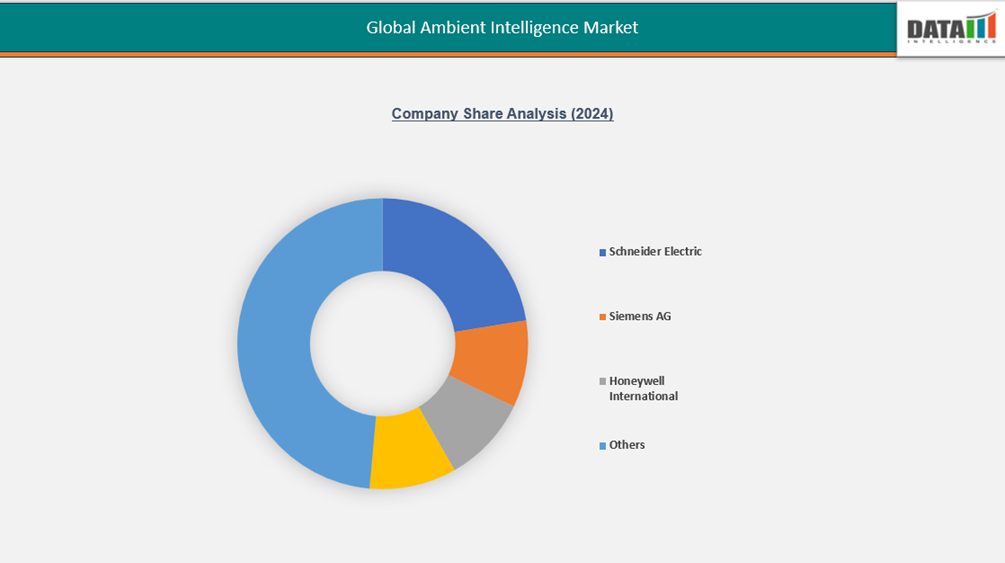
- The global ambient intelligence market is highly competitive, driven by a mix of global and regional players striving for technological efficiency and cost leadership. Key players include,Schneider Electric, Siemens AG, Honeywell International, ABB Ltd., Johnson Controls, Amazon.com Inc., Google (Alphabet Inc.), Microsoft Corp., Apple Inc., NXP Semiconductors
Key Developments of the Ambient Intelligence Market
- May 2026: Samsung Electronics highlighted the next evolution of ambient intelligence through its open Home AI ecosystem at CES 2026, focusing on context-aware interactions across appliances, energy systems, and connected devices. The company emphasized interoperable AI that can proactively understand user routines and seamlessly coordinate experiences across the smart home environment.
- March 2026: Samsung Electronics advanced its Agentic Galaxy AI vision at MWC 2026, expanding ambient intelligence capabilities across smartphones, wearables, and connected devices. The latest ecosystem enhancements leverage contextual awareness and cross-device AI collaboration to deliver personalized, always-available assistance in everyday scenarios.
- January 2026: Lenovo unveiled Qira, its new Personal Ambient Intelligence System, designed to create a unified AI layer across Lenovo PCs, tablets, Motorola smartphones, and future wearable devices. The platform uses contextual understanding and continuous cross-device interaction to provide proactive assistance and seamless digital experiences, marking a significant step in ambient intelligence innovation.
Why Choose DataM?
- Data-Driven Insights: Dive into detailed analyses with granular insights such as pricing, market shares and value chain evaluations, enriched by interviews with industry leaders and disruptors.
- Post-Purchase Support and Expert Analyst Consultations: As a valued client, you gain direct access to our expert analysts for personalized advice and strategic guidance, tailored to your specific needs and challenges.
- White Papers and Case Studies: Benefit quarterly from our in-depth studies related to your purchased titles, tailored to refine your operational and marketing strategies for maximum impact.
- Annual Updates on Purchased Reports: As an existing customer, enjoy the privilege of annual updates to your reports, ensuring you stay abreast of the latest market insights and technological advancements. Terms and conditions apply.
- Specialized Focus on Emerging Markets: DataM differentiates itself by delivering in-depth, specialized insights specifically for emerging markets, rather than offering generalized geographic overviews. This approach equips our clients with a nuanced understanding and actionable intelligence that are essential for navigating and succeeding in high-growth regions.
- Value of DataM Reports: Our reports offer specialized insights tailored to the latest trends and specific business inquiries. This personalized approach provides a deeper, strategic perspective, ensuring you receive the precise information necessary to make informed decisions. These insights complement and go beyond what is typically available in generic databases.
Target Audience
- Manufacturers/ Buyers
- Industry Investors/Investment Bankers
- Research Professionals
- Emerging Companies


























































