


Aluminum Packaging Market Overview
The global aluminum packaging market reached US$ 66.48 billion in 2025 and is expected to reach US$ 92.18 Billion by 2033, growing at a CAGR of 4.31 % during the forecast period 2025-2033.
The aluminum packaging market is primarily driven by the growing demand for sustainable and recyclable packaging solutions across industries such as food & beverages, pharmaceuticals, and personal care. Aluminum’s lightweight, durable, and corrosion-resistant properties make it ideal for cans, foils, and containers, while consumer preference for ready-to-eat and convenience products is boosting adoption. According to Metal Packaging Europe (MPE), the global demand for aluminum beverage cans is projected to rise from 420 billion units in 2020 to 630 billion by 2030, reflecting this growing market need.
The market is witnessing steady growth, with recycling initiatives playing a key role in its expansion. Recycling all cans by 2030 could save 60 million tonnes of greenhouse gas emissions annually, highlighting aluminum’s environmental advantages. Industry and governments are being urged to increase recycling rates to at least 80% by 2030 and strive for nearly 100% by 2050, reinforcing the market’s sustainability focus. Technological advancements in aluminum packaging design and production further enhance product appeal, enabling the market to grow both in volume and value while addressing environmental concerns.
Aluminum Packaging Market Trends
The aluminum packaging market is increasingly shaped by the demand for sustainable and recyclable solutions, as manufacturers and consumers prioritize eco-friendly materials. Growing consumer preference for convenience foods and beverages is driving innovation in can and foil designs, while technological advancements are enhancing both functionality and aesthetic appeal. Additionally, global initiatives to increase recycling rates and reduce greenhouse gas emissions are reinforcing aluminum’s position as a preferred packaging material across industries.
Aluminum Packaging Market Scope
Metrics | Details |
By Product | Cans, Foil, Sheets, Others |
By Type | Rigid Packaging, Flexible Packaging |
By End-User | Food & Beverage, Pharmaceuticals, Cosmetics, Consumer Goods, Others |
By Region | North America, South America, Europe, Asia-Pacific, Middle East and Africa |
Report Insights Covered | Competitive Landscape Analysis, Company Profile Analysis, Market Size, Share, Growth |
Explore the Future of the Aluminum Packaging Market
Get a comprehensive sample report covering Aluminum Packaging Market trends, technological advancements, competitive landscape, application insights, and growth opportunities. Request your sample today to understand the factors shaping the next generation of sustainable and high-performance packaging solutions. Request Sample Report Today!
Aluminum Packaging Market Dynamics
Sustainability and Recycling Driving the Aluminum Packaging Market
Aluminum’s infinite recyclability without quality loss makes it a highly preferred material for sustainable packaging solutions. Companies are increasingly using recycled aluminum to reduce energy consumption and carbon footprint, supporting global sustainability goals. Rising consumer demand for eco-friendly products is encouraging brands across the food, beverage, and personal care sectors to expand aluminum packaging usage.
In August 2025, Ball Corp., a leading global producer of beverage cans, reported a 4.1% year-on-year increase in aluminum packaging shipments for Q2, highlighting the growing adoption of sustainable aluminum solutions. The company’s net earnings rose 34% to US$212 million, and sales reached $3.34 billion, reflecting strong market demand. CEO Daniel W. Fisher emphasized that sustainability initiatives, coupled with effective management of aluminum price volatility, are driving both financial performance and broader industry growth.
Energy-Intensive Production Process
The energy-intensive production process of aluminum significantly restrains the aluminum packaging market. Manufacturing aluminum requires large amounts of electricity, often derived from non-renewable sources, leading to high production costs and a substantial carbon footprint. These environmental concerns have prompted stricter regulations and sustainability requirements, which can increase operational expenses for manufacturers. Additionally, regions with limited access to affordable, clean energy face challenges in producing aluminum competitively, slowing market expansion. As a result, the high energy demand acts as a barrier to faster growth in the aluminum packaging industry.
Aluminum Packaging Market Segmentation Analysis
The global aluminum packaging market is segmented based on product, type, application and region
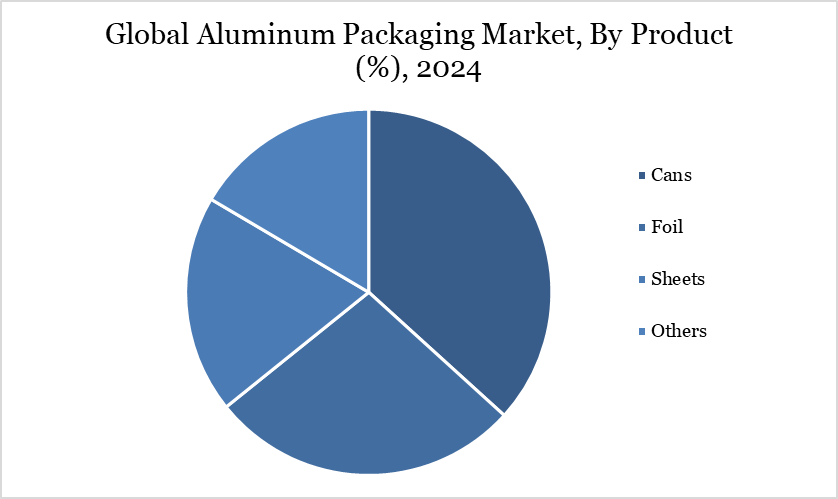
Aluminum Cans Dominate the Packaging Market Due to Durability, Recycling, and Rising RTD Beverage Demand
Aluminum cans maintain a significant share in the global aluminum packaging market due to their durability, lightweight nature, and recyclability, which appeal to both manufacturers and environmentally conscious consumers. They provide excellent product protection and extend shelf life, making them ideal for beverages and other liquid products. The growing demand for ready-to-drink (RTD) beverages, soft drinks, and alcoholic drinks further reinforces their market dominance.
In August 2025, Ball Corporation partnered with CavinKare to launch retort aluminium cans for milkshakes in India, tapping into the country’s expanding RTD beverage market. This move highlights the versatility of aluminum cans in adapting to diverse product types and flavors. With innovations enhancing convenience, sustainability, and aesthetic appeal, aluminum cans continue to strengthen their position as a preferred packaging solution worldwide.
Aluminum Packaging Market Geographical Penetration
Asia-Pacific Leads Global Aluminum Packaging Market Due to Rapid Industrialization, Rising Consumer Demand, and Strong Manufacturing Capabilities
The Asia-Pacific region accounts for a major share of the global aluminum packaging market, fueled by rapid industrialization, urbanization, and growing demand for packaged food and beverages. Countries like China, Japan, and India are key contributors, supported by strong manufacturing capabilities and cost-effective production.
According to the Packaging Industry Association of India (PIAI), the Indian packaging market is projected to reach USD 204.81 billion by 2025, growing at a CAGR of 26.7% from 2020 to 2025. As one of India’s high-growth industries, expanding at 22–25% annually, it reinforces the region’s dominance in aluminum packaging. The sector’s steady growth and potential for further expansion, especially in exports, further strengthen Asia-Pacific’s leading position in the market.
Sustainability Analysis
The global aluminum packaging market is increasingly focusing on sustainability due to its high recyclability and lower carbon footprint compared to other packaging materials. Manufacturers are adopting recycled aluminum in production, reducing energy consumption and minimizing greenhouse gas emissions. Innovations in lightweighting and eco-friendly coatings further enhance the environmental performance of aluminum packaging.
Regulatory pressures and consumer demand for sustainable packaging are driving companies to adopt circular economy practices, such as collection and reuse programs. Partnerships between beverage and food brands with recycling initiatives are growing globally. Overall, aluminum’s closed-loop recycling potential positions it as a key material for sustainable packaging solutions.
Aluminum Packaging Market Competitive Landscape
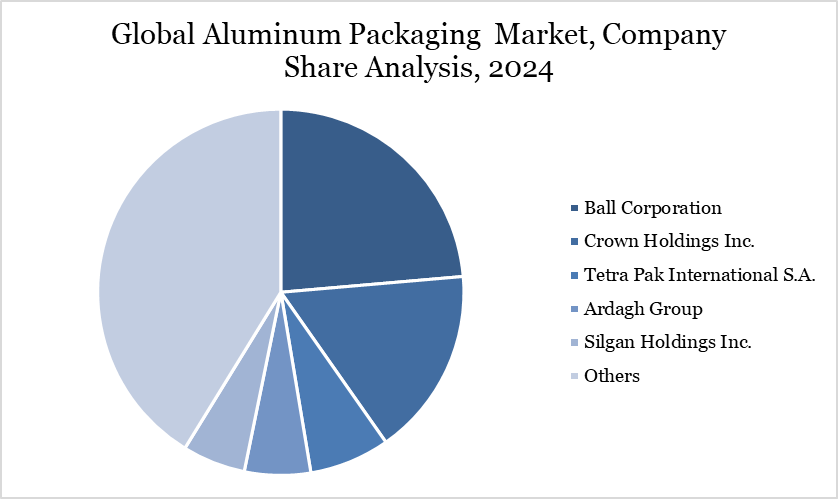
The major global players in the market include Ball Corporation, Crown Holdings, Tetra Pak International S.A, Ardagh Group, Silgan Holdings, Can-Pack S.A, UACJ Corporation, Novelis, Reynolds Consumer Products, Amcor
Key Developments in Aluminum Packaging Market
July 2026: Ball Corporation & Del Valle launched a new 290 ml aluminum-can lemonade line in Brazil, expanding aluminum packaging beyond traditional carbonated beverages into new consumption occasions. The packaging emphasizes portability, product protection and convenience for on-the-go consumption.
- April 2026: Crown Holdings announced a state-of-the-art beverage-can facility in Northern India, designed with advanced manufacturing technologies and sustainability standards. The two-line plant is expected to produce approximately 2.2 billion aluminum cans annually at full capacity.
- March 2026: Ball Corporation & Grupo Mariza launched Nutrinéctar, Brazil’s first canned juice using aluminum certified under the Aluminium Stewardship Initiative (ASI). The innovation introduces certified responsible aluminum sourcing and greater material traceability into the juice-packaging segment.
- March 2026: Ball Corporation advanced circular aluminum packaging through its MEADOW KAPSUL™ refill system and ELYSIS™ technology, demonstrating a scalable refillable aluminum format while progressing toward carbon-free primary aluminum for aerosol packaging.
Why Choose DataM?
Technological Innovations: Explores advancements in aluminum packaging technologies, including lightweight aluminum cans, high-barrier aluminum foil, rigid containers, flexible packaging formats, easy-open and resealable closures, advanced printing and coating technologies, and designs that improve material efficiency and recyclability. Aluminum’s barrier properties help protect products from light, oxygen, moisture, and other contaminants, supporting applications across food, beverages, pharmaceuticals, and consumer products.
Product Performance & Market Positioning: Evaluates aluminum packaging products based on critical performance parameters such as barrier protection, strength, weight, formability, thermal resistance, shelf-life protection, recyclability, printability, and compatibility with different filling and processing systems. The analysis highlights how cans, foil, sheets, trays, containers, and other aluminum packaging formats are positioned according to application requirements across food & beverage, pharmaceutical, cosmetics, and consumer goods industries.
Real-World Evidence: Highlights the adoption of aluminum packaging across beverage cans, food containers, foil packaging, pharmaceutical blister packs, and other applications where product protection, convenience, durability, and recycling potential are important. Aluminum beverage cans have demonstrated strong circularity, with global recycling reaching 75% in 2023, while aluminum foil is widely used for food and pharmaceutical packaging because of its high barrier performance.
Market Updates & Industry Changes: Tracks key developments across aluminum packaging, including increasing demand for recyclable packaging, lightweighting initiatives, recycling infrastructure improvements, packaging regulations, innovations in flexible and rigid formats, and investments supporting circular aluminum supply chains. European regulatory developments are particularly relevant, with the EU’s Packaging and Packaging Waste Regulation targeting recyclable packaging and stronger collection systems.
Competitive Strategies: Analyzes how leading aluminum packaging companies compete through lightweight product design, manufacturing efficiency, recycled-content integration, portfolio expansion, technology upgrades, sustainability initiatives, strategic partnerships, and investments in recycling and circular-economy capabilities. Competitive positioning is assessed across beverage cans, foil products, containers, pharmaceutical packaging, and other aluminum-based formats.
Pricing & Market Access: Explains pricing variations based on aluminum raw-material costs, recycled versus primary aluminum content, product thickness, packaging format, production volumes, printing and coating requirements, conversion processes, and application-specific specifications. It also evaluates market access through packaging manufacturers, converters, can producers, foil manufacturers, distributors, and integrated packaging suppliers. Volatility in aluminum prices remains an important consideration for packaging manufacturers and converters.
Market Entry & Expansion: Identifies growth opportunities created by the shift toward recyclable and lightweight packaging, increasing consumption of packaged food and beverages, pharmaceutical packaging requirements, convenience-oriented food formats, and the expansion of circular-economy systems. The analysis evaluates strategies including regional manufacturing expansion, recycled aluminum sourcing, product innovation, capacity development, sustainability-focused differentiation, and partnerships across the packaging and recycling value chain. India, for example, is experiencing growing aluminum-can demand alongside expanding beverage consumption and interest in recyclable packaging.
Target Audience
- Aluminum Packaging Manufacturers & Converters
- Aluminum Can Manufacturers
- Aluminum Foil & Flexible Packaging Producers
- Food & Beverage Packaging Companies
- Pharmaceutical Packaging Manufacturers
- Cosmetics & Personal Care Packaging Companies
- Aluminum Producers & Recyclers




























































