


AI Silicon Market Size and Overview
The global AI Silicon market was valued at approximately US$ 77.59 billion in 2025 and is projected to reach about US$ 361.14 billion by 2035, expanding at a CAGR of approximately 16.64% during 2026-2035. Growth is being driven by hyperscale AI training, rapidly expanding inference, custom cloud accelerators, on-device AI and automotive intelligence. Value is shifting toward workload-specific architectures, advanced packaging and memory-rich modules that maximize useful AI throughput per watt.
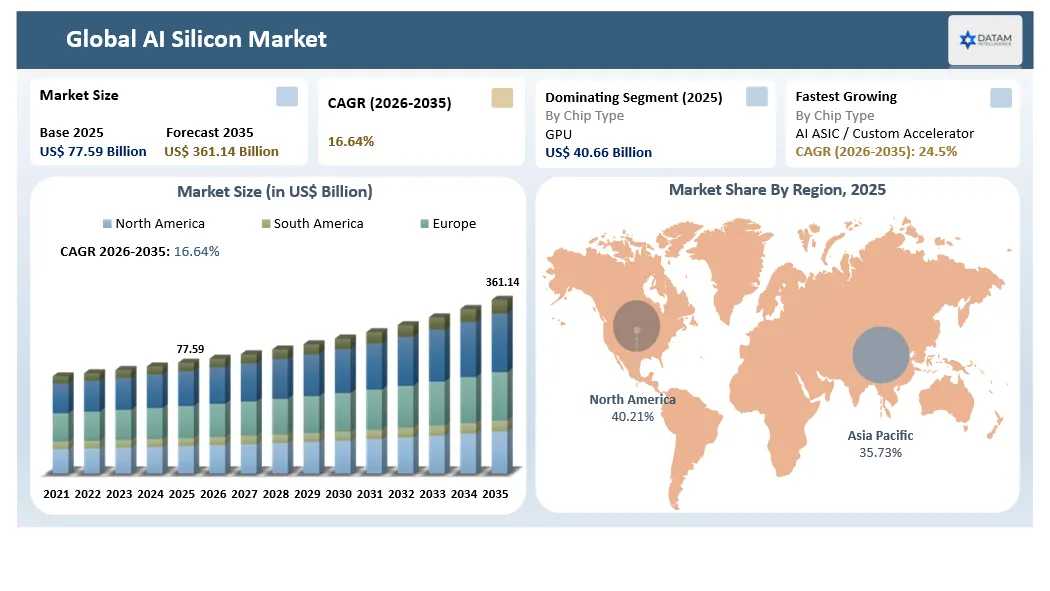
The market entered 2026 with exceptional momentum. NVIDIA reported Q1 FY2027 revenue of US$81.6 billion, including US$75.2 billion from Data Center. AMD reported Q1 2026 Data Center revenue of US$5.8 billion, up 57% year over year. Broadcom reported Q2 FY2026 AI semiconductor revenue of US$10.8 billion, up 143%, highlighting the simultaneous expansion of merchant GPUs and custom accelerators.
| Metric | Details |
| 2025 Market Size | US$ 77.59 Billion |
| 2035 Projected Market Size | US$ 361.14 Billion |
| CAGR (2026-2035) | 16.64% |
| Largest Market | North America |
| Fastest Growing Market | Asia-Pacific |
| Dominating Chip Type | GPU |
| Fastest Growing Area | Custom AI ASICs & Inference Silicon |
| Primary Growth Engine | Generative AI, inference and custom hyperscale accelerators |
AI Silicon Market Key Takeaways
- GPUs remain the largest value pool in data-center AI, but custom ASICs and XPUs are taking a larger role as hyperscalers optimize cost, power and workload specificity.
- Inference is becoming the broadest volume opportunity, spanning cloud, enterprise, automotive, robotics, smartphones, PCs and industrial edge systems.
- Advanced packaging and HBM availability are strategic constraints because AI performance increasingly depends on memory bandwidth, chiplet integration and package-level power delivery.
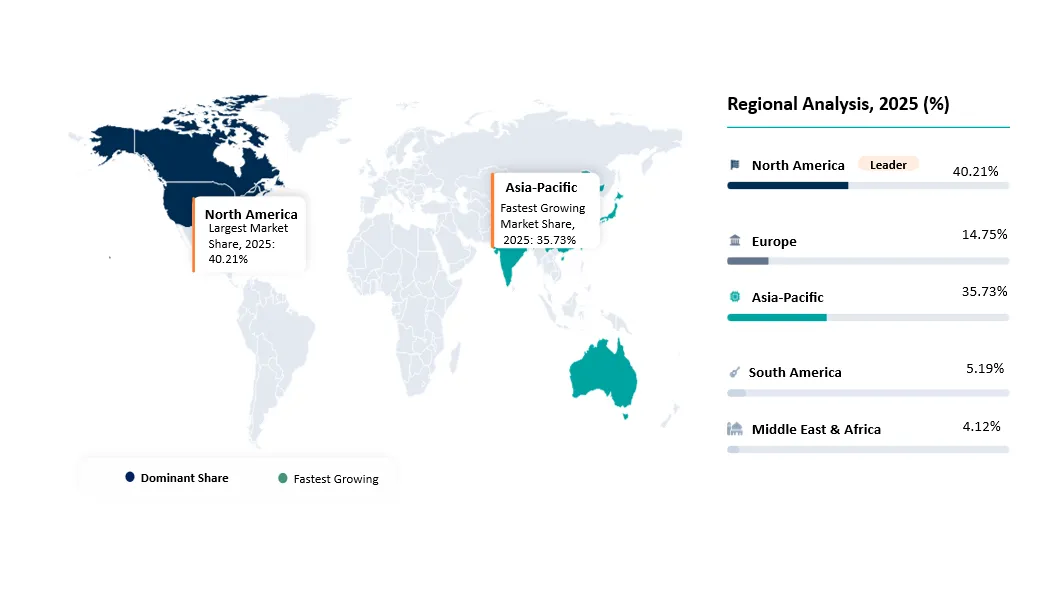
- North America leads market value through NVIDIA, AMD, Broadcom, cloud custom-silicon programs and hyperscale AI investment, while Asia-Pacific dominates manufacturing and advanced packaging capacity.
- Chiplets, 2nm-class process nodes, HBM4, co-packaged optics and scale-up fabrics are reshaping accelerator roadmaps and economics.
- Export controls and sovereign semiconductor policies are fragmenting product configurations and accelerating regional AI silicon ecosystems.
- Buyer decisions increasingly emphasize total cost per token, performance per watt, software portability, memory capacity and supply assurance rather than peak compute alone.
- The market ecosystem is tightly coupled across chip design, EDA/IP, foundries, advanced packaging, HBM, substrate suppliers, cloud customers and software frameworks.
AI Silicon Industry Trends and Strategic Insights
- AI compute procurement is shifting from general-purpose processors toward heterogeneous architectures combining GPUs, CPUs, custom ASICs, NPUs and high-speed interconnects. Platform value increasingly depends on software and memory-system design as much as transistor count.
- NVIDIA remains the leading merchant AI accelerator platform, AMD is scaling Instinct deployments, Broadcom and Marvell are expanding custom XPU programs, and hyperscalers continue to increase internally designed silicon.
- Custom silicon is gaining share where workload scale justifies non-recurring engineering expense and where power efficiency or supply diversification creates strategic value.
- Edge and endpoint AI are expanding through NPUs integrated into smartphones, PCs, cameras, robots and vehicles, creating a high-volume market distinct from data-center accelerators.
- Supply-chain advantage increasingly depends on access to leading-edge wafers, CoWoS-class advanced packaging, HBM, substrates and high-speed SerDes/IP.
- Sovereign AI and semiconductor industrial policy are broadening investment in domestic design, packaging and manufacturing capabilities.
AI Silicon Market Scope
| Metrics | Details |
| By Chip Type | GPU; AI ASIC / Custom Accelerator; NPU / AI Processor; FPGA; AI-Enabled CPU & Other |
| By Processing Type | Training; Inference; Hybrid Training & Inference; Edge / Real-Time Processing |
| By Deployment Environment | Data Center / Cloud; Edge Infrastructure; On-Device / Endpoint; Automotive & Embedded |
| By Integration / Form Factor | Discrete Accelerators & Cards; Integrated SoCs & NPUs; Chiplet / Multi-Die Modules; Custom XPU Modules |
| By Application | Generative AI / Foundation Models; AI Inference & Agents; Computer Vision & Perception; Recommendation, Search & Data Analytics; Robotics & Autonomous Systems; Others |
| By End Use Industry | Cloud Service Providers; IT & Telecom; BFSI; Healthcare; Automotive; Manufacturing & Robotics; Consumer Electronics; Government & Defense; Others |
| By Business Model | Merchant Silicon; Custom Silicon / ASIC Programs; IP Licensing & Architecture; Foundry / Co-Design Partnerships; Captive / Vertically Integrated Silicon |
| By Technology Node | 3nm and below; 5nm-7nm; 10nm-16nm; Above 16nm |
| By Region | North America; Europe; Asia-Pacific; South America; Middle East & Africa |
Why does this report matter in 2026?
The year 2026 marks a transition from a GPU-only narrative toward a broader AI silicon race involving merchant accelerators, hyperscaler custom chips, inference ASICs, edge NPUs and AI-enabled CPUs. Architecture decisions are increasingly shaped by power, memory bandwidth, software ecosystem, advanced packaging and total deployment economics.
The report matters because competitive advantage in AI silicon can move quickly between architecture generations. The study therefore evaluates not only chip vendors, but also foundries, HBM suppliers, IP licensors, cloud custom-silicon programs and packaging bottlenecks that determine market availability and cost.
AI Silicon Market White Space & Investment Opportunities
- Inference-optimized accelerators targeting lower cost per token and higher performance per watt.
- Custom AI ASIC platforms for hyperscalers, sovereign clouds and large enterprises.
- Edge AI NPUs and low-power accelerators for robotics, industrial vision and intelligent devices.
- Advanced packaging, chiplet interconnect and HBM integration capacity.
- AI silicon software portability, compilers and orchestration layers that reduce dependence on a single architecture.
- Optical I/O, CXL memory expansion and silicon photonics for next-generation AI systems.
AI Silicon Future Market Transformation
By 2035, AI silicon is expected to evolve toward highly heterogeneous platforms combining compute chiplets, HBM, networking, security and domain-specific acceleration in tightly integrated packages. Training remains important, but the volume center of gravity will increasingly shift toward inference across data centers and edge devices.
Business models will diversify. Merchant silicon will coexist with custom cloud ASICs, licensed CPU/NPU architectures and vertically integrated silicon. Vendors able to combine architecture, software, packaging and guaranteed manufacturing capacity will capture disproportionate value.
AI Silicon Market Buyer Decision-Making Criteria
Buyers prioritize performance per watt, total cost per token, memory bandwidth and capacity, software compatibility, process-node maturity, packaging availability, interconnect bandwidth, supply assurance and roadmap continuity. Hyperscalers additionally evaluate custom-design economics and control over platform architecture.
AI Silicon Market Economic & Investment Analysis
AI silicon economics are dominated by R&D, leading-edge wafer cost, advanced packaging, HBM content and software investment. The largest accelerators command very high value, while custom ASIC economics improve when enormous workload volumes amortize design cost. Packaging and memory can be as strategically important as logic die supply.
Investment is spreading across fabs, advanced packaging, HBM, EDA, silicon IP, chiplet interconnect, photonics and custom accelerator design. Bottleneck assets and reusable IP platforms can capture strong returns as AI compute architectures become more complex.
AI Silicon Investment Trends in the Market
- Foundries and OSATs are expanding leading-edge and advanced-packaging capacity for AI accelerators.
- Cloud providers are increasing internal silicon teams and multi-year custom ASIC programs.
- HBM suppliers are expanding capacity and moving toward higher stacks and next-generation memory interfaces.
- Venture investment remains active in inference accelerators, edge AI, RISC-V AI processors and optical interconnect.
- Strategic partnerships increasingly link chip designers, foundries, cloud customers and software ecosystems.
Strategic Indicators for AI Silicon Market
High Regulation Impact
Export controls, semiconductor industrial policy, AI governance and technology-transfer restrictions materially influence where leading-edge accelerators can be sold, designed and manufactured.
High Investment Activity
AI silicon is attracting record capital across accelerator R&D, custom chips, foundries, HBM, packaging and silicon photonics.
Supply Chain Disruption
Concentration in leading-edge foundry, advanced packaging and HBM capacity creates systemic supply risk and favors buyers with long-term capacity agreements.
Pricing Volatility
Accelerator pricing varies with generation, memory content, package complexity and supply scarcity. Custom silicon shifts economics toward NRE plus high-volume wafer commitments.
Procurement Pressure
Buyers face pressure to secure leading-edge capacity while avoiding architectural lock-in and rapid obsolescence. Multi-sourcing and software portability are becoming strategic procurement goals.
New Technology Adoption
2nm-class nodes, gate-all-around transistors, HBM4, chiplets, UCIe, CXL, optical I/O and domain-specific accelerators are changing silicon design.
Regional Expansion Opportunity
Asia-Pacific remains the manufacturing center, while North America leads design and cloud demand and Europe, Middle East and Asia are expanding sovereign AI programs.
Government Policy Support
CHIPS-style incentives, national AI strategies and domestic semiconductor programs support local fab, packaging and design investment.
Pricing Intelligence
The market is shifting from chip ASP comparisons to cost per useful AI output, incorporating power, memory, software and utilization.
Disruption Analysis of AI Silicon Market
The market is being disrupted by custom accelerators, chiplets, advanced packaging, on-device AI and the rapid shift from training-only demand toward continuous inference. These shifts redistribute value among GPU vendors, ASIC designers, foundries, HBM suppliers and software ecosystems.
AI Silicon Market BCG Matrix: Company Evaluation
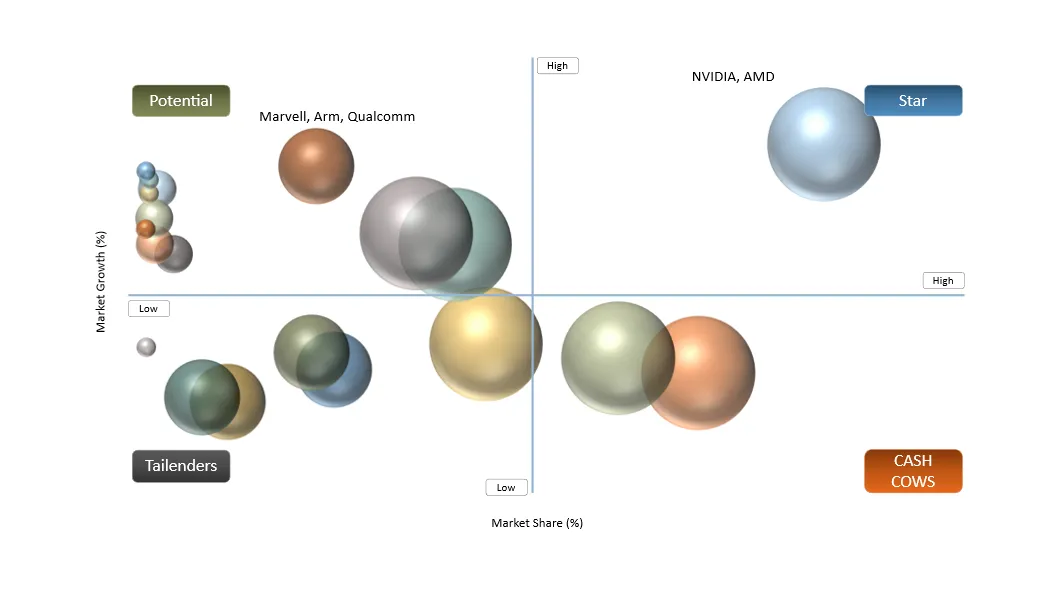
STAR
NVIDIA, AMD and Broadcom occupy the Star category because they combine high exposure to AI compute growth with large-scale silicon platforms, major customer relationships and strong software or custom-design capabilities.
POTENTIAL
Marvell, Arm, Qualcomm, MediaTek and emerging AI accelerator vendors remain high-potential participants. Their growth depends on custom XPU wins, edge AI adoption, IP licensing, software support and access to advanced manufacturing.
AI Silicon Market Dynamics
Driver Impact Analysis
| Driver | Market Growth Impact | Demand Concentration | Impacted Use Case | Strategic Impact |
| Generative AI and agentic inference | Very High | Hyperscalers and AI platforms | Training and inference accelerators | Accelerates demand for GPUs, ASICs and memory-rich silicon |
| Hyperscaler custom silicon | Very High | North America and global cloud | Custom XPU/ASIC programs | Expands co-design and merchant-plus-custom silicon models |
| On-device and edge AI | High | Consumer, automotive and industrial | NPUs and low-power accelerators | Broadens unit volumes beyond data centers |
| Sovereign semiconductor investment | High | U.S., Europe, Asia and Middle East | Domestic AI compute ecosystems | Supports regional design, packaging and manufacturing investment |
Driver: Rapid Growth in Generative AI, Inference and Specialized Compute
The primary driver is the expansion of AI from model training into always-on inference and agentic workloads. Hyperscalers are deploying larger accelerator fleets, while enterprises and device makers require lower-power inference silicon. The result is simultaneous growth in GPUs, custom ASICs, NPUs and AI-enabled CPUs.
Restraint Impact Analysis
| Restraint | Drag on Growth | Primary Impact Area | Impacted Use Case | Strategic Impact |
| Advanced packaging and HBM constraints | Very High | Leading AI accelerators | High-end training/inference chips | Creates allocation risk and favors scaled buyers |
| Leading-edge foundry concentration | High | Manufacturing supply | 3nm/2nm-class products | Raises geopolitical and capacity risk |
| Export controls and regional restrictions | High | Cross-border sales | Advanced accelerators | Fragments product roadmaps and addressable markets |
| High design and mask cost | Medium-High | Custom silicon economics | New ASIC/SoC programs | Raises break-even volumes and favors large customers |
Restraint: Advanced Packaging, HBM Supply and Leading-Edge Design Economics
AI accelerators require expensive leading-edge process nodes, advanced packaging and large HBM allocations. Capacity concentration and long design cycles can delay launches, while rapid architecture transitions increase inventory and obsolescence risk.
AI Silicon Market Segment Analysis
The global AI Silicon market is segmented based on Chip Type, Processing Type, Deployment Environment, integration/form factor, Application, end-use industry, Business Model, technology node, and region.
By Chip Type
GPU Will Continue to Lead Market Value
GPUs remain the largest AI silicon segment because they offer mature software ecosystems and broad programmability for training and inference. Custom AI ASICs are growing faster as hyperscalers optimize cost and power at scale, while NPUs dominate many edge and endpoint designs.
By Processing Type
Inference Silicon Will Record the Fastest Volume Growth
Training requires the highest-value accelerator clusters, but inference expands across many more workloads and devices. This creates demand for optimized precision, memory efficiency and lower-power architectures.
By Deployment Environment
Data Center / Cloud Will Remain the Largest Segment
Cloud and hyperscale deployments remain the largest value pool due to frontier-model training and large inference fleets. Edge and endpoint silicon grows faster in unit terms as AI becomes embedded in devices and machines.
By Integration / Form Factor
Chiplet and Multi-Die Modules Will Gain Share Rapidly
AI compute is moving toward multi-die packages that combine logic, HBM and high-speed interconnect. Chiplets improve scalability and yield while enabling specialized functions to be integrated at package level.
By Application
AI Inference & Agents Will Gain Share Rapidly
Inference broadens demand across copilots, agents, recommendations, search, industrial vision and robotics. Continuous production workloads favor cost-efficient silicon optimized for throughput and power.
By End Use Industry
Cloud Service Providers & AI Platforms Will Continue to Dominate
Hyperscalers remain the largest buyers and developers of AI silicon. Automotive, consumer electronics, telecom and industrial automation broaden demand as intelligence moves toward the edge.
AI Silicon Market Geographical Penetration
U.S. AI Silicon Market Landscape
The U.S. is the largest market by design and demand, led by NVIDIA, AMD, Broadcom, Marvell, hyperscaler custom silicon and massive AI infrastructure spending. Export policy and domestic manufacturing incentives materially shape strategy.
China AI Silicon Market Trends
China is accelerating domestic GPU, NPU and accelerator development in response to export controls, while maintaining major demand from cloud, telecom, consumer electronics and industrial AI. Access to leading-edge manufacturing remains a critical constraint.
Japan AI Silicon Market Outlook
Japan is strengthening semiconductor manufacturing, advanced materials and AI infrastructure through public-private investment. Automotive, robotics and industrial automation create important edge AI opportunities.
Germany AI Silicon Market Outlook
Germany combines automotive, industrial automation and research demand with European semiconductor policy. Edge AI, autonomous systems and energy-efficient compute are key opportunities.
Middle East AI Silicon Market Outlook
Saudi Arabia and the UAE are expanding sovereign AI infrastructure and semiconductor ambitions through state-backed investment and global technology partnerships, creating demand for advanced accelerators and local AI ecosystems.
AI Silicon Market Competitive Landscape
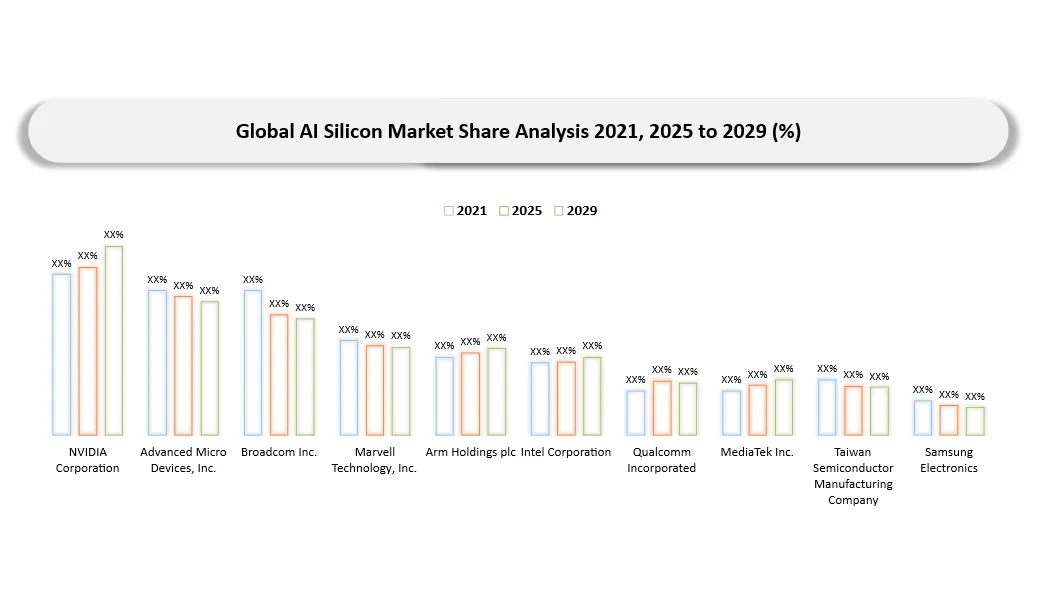
- Competition is structured around architecture performance, software ecosystems, custom-silicon capability, process-node access, advanced packaging capacity and hyperscaler design wins.
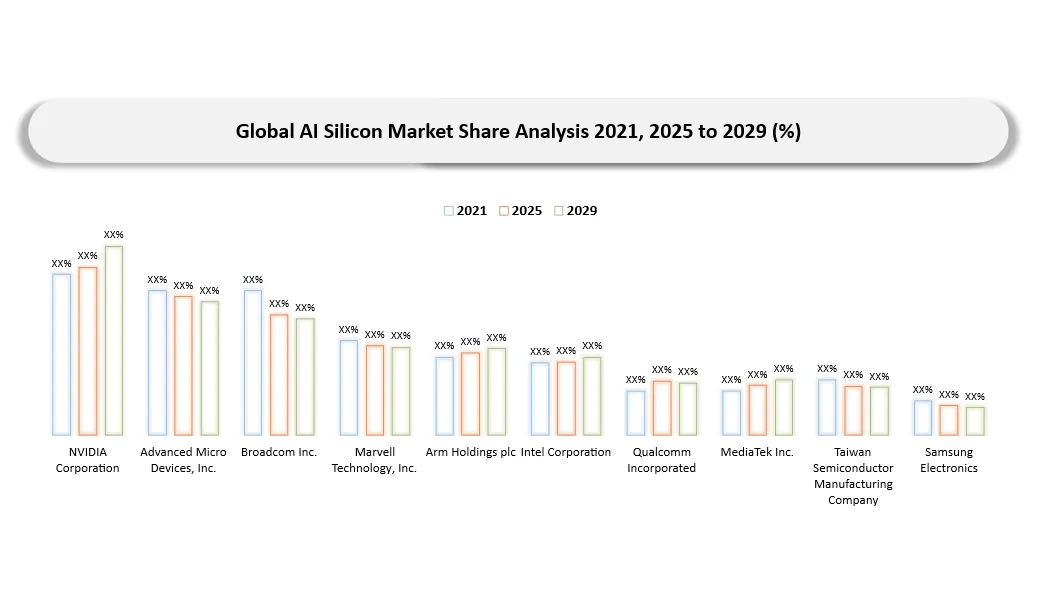
- NVIDIA leads merchant AI accelerators, AMD is scaling Instinct platforms, while Broadcom and Marvell compete strongly in custom AI silicon and connectivity.
- Arm, Qualcomm and MediaTek expand AI silicon at the edge through CPU/NPU architectures, while Intel pursues accelerators, CPUs and foundry-enabled opportunities.
- Market share can shift rapidly between product generations because large hyperscaler design wins and custom ASIC ramps materially affect revenue.
- Differentiation increasingly depends on performance per watt, software, memory architecture, packaging, supply assurance and customer co-design rather than transistor specifications alone.
Market Ecosystem Table
| Value Chain Sector | Representative Companies | Role in AI Silicon Market |
| EDA & Semiconductor IP | Synopsys, Cadence, Arm, Rambus, Alphawave Semi | Design tools, CPU/NPU IP, interfaces and SerDes |
| Merchant AI Accelerators | NVIDIA, AMD, Intel, Qualcomm, MediaTek | GPU, NPU and accelerator platforms |
| Custom AI Silicon / ASIC | Broadcom, Marvell, Google, AWS, Microsoft, Meta | Custom XPUs and workload-specific accelerators |
| Foundries | TSMC, Samsung Foundry, Intel Foundry | Leading-edge wafer fabrication |
| Advanced Packaging / OSAT | TSMC, ASE, Amkor, JCET, Samsung | 2.5D/3D packaging, chiplets and HBM integration |
| HBM & Memory | SK hynix, Samsung Electronics, Micron | High-bandwidth and accelerator memory |
| Substrates & Materials | Ibiden, Unimicron, Shinko, Ajinomoto, Entegris | Advanced substrates, films and semiconductor materials |
| Cloud & AI Platforms | Microsoft, Amazon, Google, Meta, Oracle | Largest AI silicon buyers and custom-chip sponsors |
| Edge / Automotive Systems | Qualcomm, NVIDIA, Mobileye, NXP, Renesas | On-device, robotics and automotive AI compute |
| Software & Frameworks | NVIDIA CUDA, ROCm, PyTorch, TensorFlow, OpenXLA | Developer ecosystems, compilers and runtime portability |
| Standards & Interconnects | UCIe, CXL Consortium, PCI-SIG, UALink, Ethernet Alliance | Chiplet, memory and accelerator interconnect standards |
Public Company Q1-Q2 2026 Performance Comparison
| Public Company | Reporting Period | Q1-Q2 2026 Performance | Growth Indicator | Factors Driving AI Silicon Growth |
| NVIDIA Corporation | Q1 FY2027 ended Apr. 26, 2026 | US$81.6B total revenue; US$75.2B Data Center revenue | Total revenue +85% YoY; Data Center +92% YoY | Blackwell/Blackwell Ultra GPUs, CUDA, NVLink/NVSwitch, networking and rack-scale AI platforms |
| Advanced Micro Devices | Q1 2026 ended Mar. 28, 2026 | US$10.25B total revenue; US$5.8B Data Center revenue | Total revenue +38% YoY; Data Center +57% YoY | Instinct GPU ramp, EPYC CPUs, MI450/Helios roadmap and hyperscaler partnerships |
| Broadcom Inc. | Q2 FY2026 ended May 3, 2026 | US$22.19B total revenue; US$10.8B AI semiconductor revenue | Total +48% YoY; AI semiconductor +143% YoY | Custom AI accelerators, AI networking, hyperscaler ASIC programs and scale-up/scale-out connectivity |
| Marvell Technology | Q1 FY2027 ended May 2, 2026 | US$2.418B revenue | Revenue +28% YoY; exceptional AI-related bookings | Custom XPU programs, 800G/1.6T optics, Ethernet switching, XPU attach and Celestial AI/XConn integration |
| Arm Holdings | Q1 FYE27 ended Jun. 30, 2026 | US$1.289B revenue; US$715M royalty revenue | Total +22% YoY; royalty +22% YoY | Armv9, Compute Subsystems, data-center CPU adoption, edge AI and licensing demand |
Key Companies
- NVIDIA Corporation
- Advanced Micro Devices, Inc.
- Broadcom Inc.
- Marvell Technology, Inc.
- Arm Holdings plc
- Intel Corporation
- Qualcomm Incorporated
- MediaTek Inc.
- Taiwan Semiconductor Manufacturing Company
- Samsung Electronics
- Micron Technology
- SK hynix
- Alphabet / Google
- Amazon Web Services
- Tenstorrent and other private AI silicon vendors
Company Profiles
NVIDIA Corporation
NVIDIA is the leading merchant AI accelerator supplier, combining high-performance GPUs, CUDA software, NVLink/NVSwitch scale-up fabrics and networking. Its Blackwell and Rubin roadmaps shape data-center AI architecture, while its automotive and edge platforms extend AI silicon into physical systems.
Advanced Micro Devices, Inc.
AMD is scaling its AI silicon position through Instinct accelerators, EPYC CPUs, ROCm software and package-scale Helios platforms. The company is expanding hyperscaler deployments and positions its open software strategy as an alternative to proprietary accelerator ecosystems.
Broadcom Inc.
Broadcom is a major custom AI silicon and networking supplier. Its hyperscaler ASIC programs, Ethernet switching, SerDes and connectivity portfolio give it exposure to both AI compute and the scale-up/scale-out fabrics required to connect accelerators.
Marvell Technology, Inc.
Marvell provides custom XPU silicon, high-speed connectivity, optics, switching and data-center infrastructure semiconductors. Its AI growth strategy centers on hyperscaler custom accelerators, XPU attach, 800G/1.6T optical interconnect and emerging scale-up architectures.
Arm Holdings plc
Arm supplies CPU architecture and compute subsystem IP used across cloud, edge and endpoint AI. Armv9, Neoverse and Compute Subsystems increase royalty value per chip and enable partners to build custom CPUs, NPUs and AI SoCs with power-efficient architectures.
Intel Corporation
Intel participates through Xeon CPUs with AI acceleration, Gaudi accelerators, client NPUs and foundry ambitions. Its opportunity is strongest where customers value x86 software compatibility, integrated CPU acceleration and diversified leading-edge manufacturing options.
Qualcomm Incorporated
Qualcomm is a leading-edge AI silicon supplier through Snapdragon platforms and integrated NPUs spanning smartphones, PCs, automotive and IoT. Its differentiation centers on low-power inference, heterogeneous compute and software that brings generative AI onto devices.
MediaTek Inc.
MediaTek supplies AI-enabled SoCs for smartphones, consumer devices, connectivity and edge applications. Integrated NPUs and high-volume device platforms position the company to benefit as generative AI and computer vision move into mass-market endpoints.
Taiwan Semiconductor Manufacturing Company
TSMC is the critical leading-edge foundry and advanced-packaging partner for the AI silicon ecosystem. Its process-node leadership and CoWoS-class packaging capacity directly influence accelerator supply, chiplet integration and time-to-volume for major AI chip designers.
Samsung Electronics
Samsung participates through foundry services, HBM and advanced memory as well as integrated device silicon. Its strategic opportunity is to combine leading-edge logic manufacturing, packaging and memory to capture a larger share of AI accelerator value.
AI Silicon Market Major Pain Points
- Concentration of leading-edge foundry capacity creates geopolitical and allocation risk.
- HBM and advanced-packaging capacity can constrain accelerator shipments even when logic wafers are available.
- Rapid architecture transitions can shorten product life cycles and increase inventory obsolescence risk.
- Leading-edge design, masks, verification and software ecosystems require very high upfront investment.
- Memory bandwidth and interconnect bottlenecks can limit realized AI performance despite higher compute density.
- Custom ASIC programs require large customer volumes to justify non-recurring engineering and manufacturing commitments.
- Export controls and technology-transfer restrictions fragment product roadmaps by geography.
- Software lock-in and portability challenges complicate adoption of alternative accelerators and custom silicon.
AI Silicon Market Recent Developments
- June 2026: Broadcom reported Q2 FY2026 AI semiconductor revenue of US$10.8 billion, up 143% year over year, driven by custom AI accelerators and AI networking.
- May 2026: NVIDIA reported Q1 FY2027 revenue of US$81.6 billion and Data Center revenue of US$75.2 billion, up 92% year over year.
- May 2026: AMD reported Q1 2026 Data Center revenue of US$5.8 billion, up 57% year over year, driven by EPYC processors and continued ramp of Instinct GPUs.
- May 2026: Marvell reported record Q1 FY2027 revenue of US$2.418 billion, up 28% year over year, citing exceptional AI-related bookings and strength in custom XPU and connectivity solutions.
- July 2026: Arm reported Q1 FYE27 revenue of US$1.289 billion, up 22% year over year, with royalty revenue also up 22% as Armv9, Compute Subsystems and data-center deployments expanded.
- 2026: Semiconductor suppliers continued to increase investment in leading-edge process nodes, HBM, advanced packaging, chiplets and custom AI silicon to support next-generation training and inference platforms.
Analyst View/Opinion on AI Silicon Market
- AI silicon is evolving from a discrete accelerator category into the central architectural layer of the AI economy, spanning cloud training, continuous inference, edge intelligence and autonomous systems.
- Near-term leadership will be determined by accelerator performance, HBM and packaging access, while long-term leadership will depend on software ecosystems, custom-silicon capability, power efficiency and roadmap execution.
- Inference will become the principal source of broad-based volume growth because AI applications increasingly run continuously across cloud, enterprise and endpoint environments.
- Chiplets, advanced packaging and memory-system design will become as important as transistor scaling in determining usable AI performance.
- Hyperscalers will continue to increase custom silicon because workload scale can justify design cost and improve economics, but merchant accelerators will remain essential for flexibility and ecosystem breadth.
- Suppliers with strong positions in EDA/IP, foundry, HBM, advanced packaging and high-speed interconnect can capture value even as accelerator market share diversifies.
AI Silicon Market Target Audience
| INDUSTRY | WHO SHOULD BUY THIS REPORT? | REASON TO BUY THIS REPORT |
| AI Semiconductor Vendors | Strategy, product, sales and roadmap teams | Benchmark architecture trends, demand growth, custom-silicon competition and market positioning. |
| Foundries & OSATs | Capacity planning, business development and investment teams | Assess leading-edge wafer, packaging and chiplet demand. |
| Memory & Component Suppliers | HBM, substrate, interconnect and materials suppliers | Quantify AI accelerator attach opportunities and bottlenecks. |
| Cloud & Data Centers | Hyperscalers, neoclouds and infrastructure teams | Evaluate silicon roadmaps, custom-chip economics and supply strategy. |
| Automotive & Edge OEMs | Platform architects and procurement teams | Assess NPU, SoC and low-power AI silicon opportunities. |
| Investors & Consulting | PE, VC, institutional investors and strategy teams | Assess growth, competitive positioning, supply bottlenecks and investment white spaces. |
Why Choose DATAM?
- Data-driven insights combining vendor disclosures, shipment modeling, semiconductor economics and country-level AI demand analysis.
- Post-purchase analyst consultations for market entry, competitive benchmarking, silicon roadmap positioning and customer targeting.
- Annual report updates covering accelerator launches, custom ASIC programs, process-node transitions, packaging expansion and market-share shifts.
- Specialized focus on emerging markets and sovereign AI/semiconductor initiatives rather than generalized regional summaries.
- Actionable analysis connecting AI chip demand with foundry, HBM, packaging, software and export-control constraints.
What DATAM Uniquely Provides
- Ten-year forecasts across chip type, processing type, deployment environment, integration, application, end use, business model and technology node.
- Architecture-level analysis linking compute, memory bandwidth, packaging, interconnect and performance-per-watt requirements.
- Competitive benchmarking of merchant accelerators, custom ASIC suppliers, IP licensors, foundries and hyperscaler silicon ecosystems.
- Public-company 2026 performance comparison tied directly to AI silicon growth drivers.
- Market ecosystem mapping from EDA/IP and foundries through HBM, advanced packaging, cloud customers and edge-device OEMs.


























































