


AI in Telehealth Market Overview
The global AI in telehealth market reached US$ 5.58 billion in 2025 and is expected to reach US$ 59.78 billion by 2035, growing at a CAGR of 26.8% during 2026 to 2035. Demand is shifting from simple video consultation tools toward virtual care systems that can support triage, risk scoring, clinical documentation, remote monitoring alerts, patient engagement and guided care navigation. Healthcare providers now want platforms that reduce avoidable visits, prepare clinicians before the consultation and help patients move to the right care setting with less confusion. Provider shortages and rising chronic disease burden are changing the economics of virtual care. Hospitals and health systems are using AI-enabled intake, RPM alert prioritization, virtual assistants and workflow automation to manage demand before it reaches already stretched clinical teams. Payers and employers are also paying closer attention because better digital triage can reduce unnecessary urgent care visits and help high-risk members receive earlier intervention.
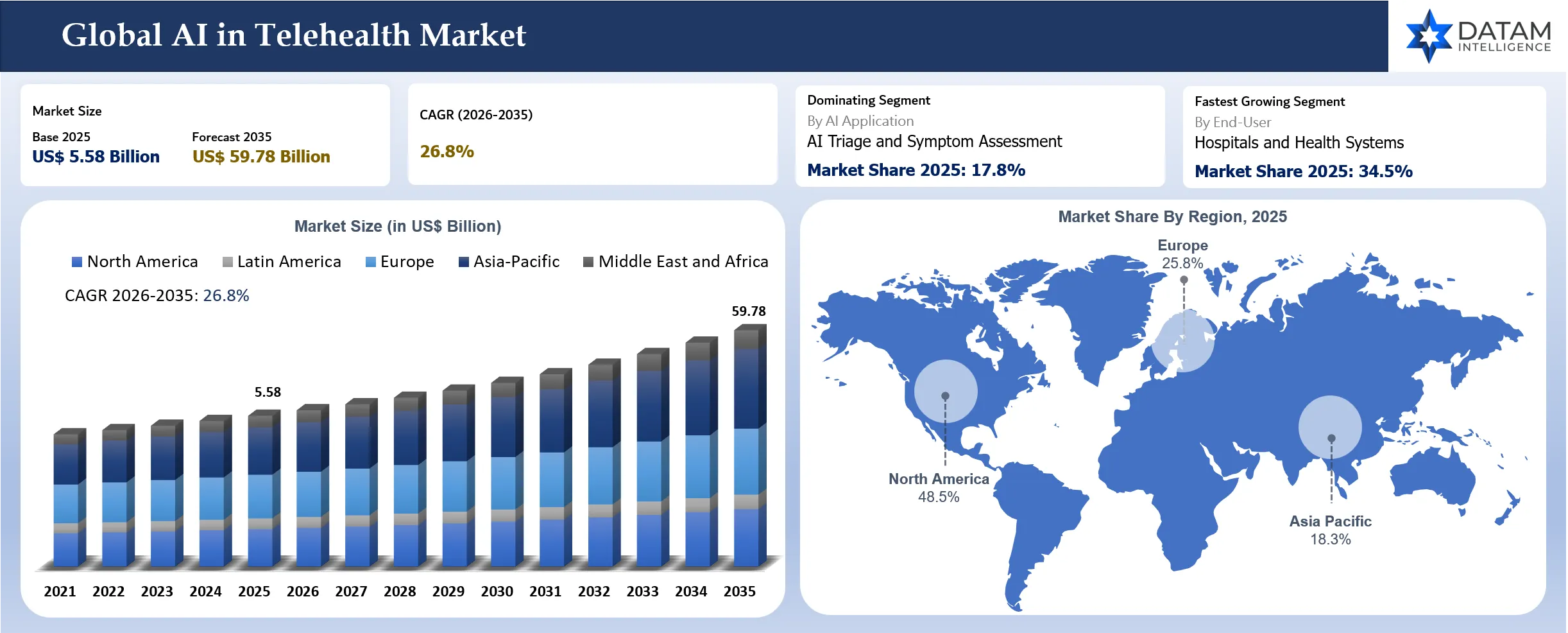
North America remains the largest regional base because the U.S. has mature telehealth adoption, strong reimbursement pathways, large health system buyers, active AI healthcare companies, and a deeper enterprise software ecosystem. The Middle East and Africa are also expected to grow fastest because Gulf healthcare systems are building national digital health infrastructure and virtual care capacity on a scale. Saudi Arabia stands out because Sehhaty, Seha Virtual Hospital and formal telehealth rules create a practical foundation for AI assisted triage, specialist routing, remote care and documentation support.
Commercial Activity in AI Enabled Virtual Care
- Teladoc Health added workplace safety capability to its AI enabled Clarity monitoring solution in October 2025, expanding hospital use cases beyond observation into faster response workflows for care teams.
- Amwell integrated Suki’s AI Assistant into the Converge platform in March 2024, giving virtual care providers access to clinical documentation support inside a telehealth workflow used by major health plans.
- Huma Therapeutics launched Huma Intelligence Scribe in March 2026 with NVIDIA AI technology, supporting real time consultation transcription and actionable summaries for providers and patients.
- TytoCare received U.S. FDA De Novo classification in April 2026 for Tyto Insights For ENT Suite, creating a regulated AI diagnostic aid route for eardrum analysis from home based virtual care.
- AliveCor received U.S. FDA clearance in January 2026 for expanded KAI 12L cardiac determinations on the Kardia 12L ECG System, strengthening the AI diagnostic support layer around remote cardiac assessment.
AI in Telehealth Market Scope
| Metrics | Details | |
| Market Size In 2025 | US$ 5.58 Billion | |
| Market Size By 2035 | US$ 59.78 Billion | |
| CAGR During 2026 To 2035 | 26.8% | |
| Largest Region In 2025 | North America, 48.5% market share in 2025 | |
| Fastest Growing Region | Middle East and Africa, 21.4% CAGR between 2026 and 2035 | |
| Key Regional Shift | Middle East and Africa is expected to increase from 7.8% market share in 2025 to 9.5% market share by 2035 | |
| Leading AI Application | AI Triage and Symptom Assessment | |
| Fastest Growing AI Application | AI Enabled Documentation and Workflow Automation | |
| Leading Offering | Software | |
| Fastest Growing Offering | Services | |
| Leading Care Delivery Model | Synchronous Telehealth | |
| Fastest Growing Care Delivery Model | AI Enabled RPM (Remote Patient Monitoring) | |
| Leading Deployment Model | Cloud Based | |
| Fastest Growing Deployment Model | Hybrid | |
| Leading End-User | Hospitals and Health Systems | |
| Fastest Growing End-User | Government Healthcare Programs | |
| Market Maturity | Early Growth Stage | |
| By AI Application | AI Triage and Symptom Assessment, Predictive Analytics and Risk Stratification, Automated Diagnostic Support, CDS (Clinical Decision Support), Virtual Assistants and Patient Navigation, AI Enabled RPM Alert Prioritization, AI Enabled Care Recommendation, AI Enabled Documentation and Workflow Automation, AI Enabled Patient Engagement, Others | |
| By Offering | Software, Services, Hardware Enabled Solution Components | |
| By Care Delivery Model | Synchronous Telehealth, Asynchronous Telehealth, AI Enabled RPM (Remote Patient Monitoring), Mobile Health Based Virtual Care, Hybrid Virtual Care, Others | |
| By Deployment Model | Cloud Based, On Premise, Hybrid | |
| By End-User | Hospitals and Health Systems, Clinics and Physician Practices, Telehealth Service Providers, Home Healthcare Providers, Government Healthcare Programs, Payers and Insurance Providers, Employers, Patients and Direct Consumers, Others | |
| By Business Model | Subscription, Per Consultation Fee, Per Patient Monitoring Fee, Per User License, Per Provider License, Enterprise Platform Contract, Managed Service Contract, Outcome Linked Contracting, Others | |
| By Region | North America | U.S., Canada, Mexico |
| Europe | Germany, UK, France, Spain, Italy, Poland | |
| Asia-Pacific | China, India, Japan, Australia, South Korea, Indonesia, Malaysia | |
| South America | Brazil, Argentina | |
| Middle East and Africa | UAE, Saudi Arabia, South Africa, Israel, Turkiye | |
| Report Insights Covered | Competitive Landscape Analysis, Company Profile Analysis, Market Size, Share, Growth | |
AI in Telehealth Market Key Takeaways
- AI in telehealth is moving from chatbots and video visit support toward clinically relevant workflows such as symptom assessment, risk stratification, documentation, clinical decision support and RPM escalation.
- Software remains the most commercially important offering because most intelligence is delivered through platforms, APIs, workflow modules, model services and enterprise subscription contracts.
- Services are growing fastest because hospitals need implementation, model localization, integration, training, governance support and ongoing managed monitoring to make AI safe inside care delivery.
- AI triage and symptom assessment lead adoption because they sit at the digital front door and directly influence patient routing, appointment demand and clinician workload.
- AI enabled documentation and workflow automation is expanding quickly as virtual care programs increase note volume, follow up tasks and payer documentation requirements.
- Hospitals and health systems remain the most important buyers because they control large virtual care programs, EHR integration requirements, clinical governance and post consultation follow up workflows.
- Saudi Arabia is a strong growth market because national virtual care infrastructure, 99% internet penetration and formal telehealth rules create a credible pathway for AI enabled care navigation.
Strategic Indicators For AI in Telehealth
High Regulation Impact
Regulation impact is high because AI in telehealth often touches clinical decision making, patient routing and sensitive health data. Tools used only for scheduling or administrative tasks can move faster, while AI systems that diagnose, recommend treatment or escalate clinical alerts face stronger scrutiny. FDA rules for software as a medical device, clinical decision support guidance, HIPAA requirements and local privacy laws shape adoption across major markets.
Healthcare buyers want clear intended use, visible clinical basis and human review pathways. A symptom checker that sends a low risk patient to self care must still recognize red flags and support escalation. An AI RPM system that prioritizes alerts must show why a reading is urgent and how the clinician can validate the recommendation.
Saudi Arabia, Canada, the U.S. and Europe illustrate the direction of travel. Each market has its own rules, but the practical requirement is similar: vendors need consent controls, data protection, clinical safety evidence, audit logs and a model lifecycle plan. Companies that can document performance across populations and language groups will win trust faster.
High Investment Activity
Investment activity is strong because AI enabled virtual care addresses a direct operating problem for health systems. Hospitals are short on clinical staff and virtual care programs can generate high administrative load. Capital is therefore moving into AI scribes, clinical triage, remote monitoring analytics, care navigation and regulated digital health infrastructure rather than only consumer wellness apps.
Product activity also shows a shift toward embedded AI. Teladoc Health, Amwell, Huma, TytoCare, AliveCor, K Health, Infermedica and iRhythm are building AI around existing care workflows. Buyer interest is strongest where technology can reduce clinician time, improve patient routing or support earlier detection in a measurable way.
Funding discipline is also more visible than during the pandemic telehealth boom. Investors are less interested in standalone virtual visit volume and more interested in enterprise platforms with clinical evidence, reimbursement fit, regulatory readiness and integration depth. The best positioned companies combine AI capability with healthcare distribution.
Supply Chain Disruption
Supply chain disruption in AI enabled telehealth is less about finished goods inventory and more about cloud infrastructure, model access, medical device components, wearable sensors and integration capacity. RPM programs depend on connected devices, Bluetooth gateways, diagnostic peripherals and secure data pipelines that must work reliably in home environments.
Hardware enabled solution components can face delays when device suppliers, logistics partners or connectivity providers cannot support large deployments. Remote diagnostic kits and connected monitoring devices also need calibration, replacement planning, patient onboarding and technical support. Weak execution can lower patient adherence even when the AI software is strong.
Cloud and compute availability create another layer of risk. AI scribes, virtual assistants and predictive models need secure processing capacity and resilient uptime. Healthcare providers will favor vendors with multi-cloud readiness, local hosting options and contingency plans for outages, cyber incidents and cross border data restrictions.
Pricing Volatility
Pricing volatility comes from the mix of software licenses, per visit charges, monitoring fees, device bundles, integration work and managed services. A low subscription price can become expensive when EHR integration, model configuration, training and clinical governance support are added. Buyers increasingly evaluate total cost per avoided visit or total cost per monitored patient.
AI documentation tools usually price around clinician usage, consultation volume or platform contracts. RPM tools often price per enrolled patient or per monitoring period. AI triage platforms may use enterprise subscription, usage based or member access models. Each structure creates different budget exposure for payers, employers and health systems.
Vendors with measurable economic proof can defend pricing better. Avoided unnecessary visits, faster documentation, reduced alert fatigue and earlier detection of deterioration provide a clearer value story than generic AI productivity claims. Outcome linked contracting will become more visible where buyers can track clinical and cost results.
Procurement Pressure
Procurement pressure is rising because health systems want innovation but cannot add risky or poorly integrated tools to clinical workflows. AI telehealth solutions must pass reviews from clinical leadership, compliance, IT, cybersecurity, procurement and finance. Sales cycles can stretch when evidence, data handling and EHR integration are unclear.
Hospitals increasingly ask for AI governance documents before deployment. They want to know who reviews model output, how errors are handled, whether the system was validated for local populations and how updates are controlled. Buyer scrutiny is especially high for symptom assessment, diagnostic support and care recommendation tools.
Procurement teams will favor vendors that arrive with integration playbooks, clinician training materials, safety monitoring dashboards and clear service level commitments. Companies that sell AI as a black box will face more resistance than suppliers that help providers manage operational change.
New Technology Adoption
New technology adoption is strongest in AI triage, documentation automation, RPM alert prioritization, care navigation and clinical decision support. Generative AI is entering virtual care mainly through scribes, patient summaries, after visit instructions and internal workflow assistants. Medical reasoning tools are being combined with controlled knowledge bases to reduce the risk of unsupported answers.
RPM is moving from passive dashboards to smarter escalation. Wearables, ECG monitors, connected blood pressure cuffs, glucometers and respiratory devices create large data volumes. AI can prioritize alerts and detect patterns earlier, but providers need rules for accountability and escalation ownership.
Multimodal AI is likely to shape the next phase. Virtual care increasingly combines patient reported symptoms, vitals, images, audio, device data and EHR history. Platforms that can interpret these inputs safely and present concise evidence to clinicians will create stronger differentiation.
Regional Expansion Opportunity
Regional expansion opportunity is strongest in North America, Europe, Saudi Arabia and selected Asia-Pacific markets. North America offers enterprise buyers, reimbursement experience and AI healthcare suppliers. Europe offers demand for safe AI, cross border governance and digital health infrastructure. Asia-Pacific provides scale through mobile first access and large chronic disease populations.
Saudi Arabia is a high interest market because national virtual care platforms are already operating at scale. Sehhaty facilitated more than 51 million instant and virtual consultation appointments in 2024, while Seha Virtual Hospital reported more than 16 million appointments and consultations in 2025. AI triage, navigation and specialist prioritization fit that operating base.
Vendors entering the Gulf need Arabic language capability, localization, data residency planning and alignment with national health information rules. A standard U.S. workflow may not translate directly because family centered care, public sector delivery models and national platform integration matter more in the region.
Government Policy Support
Government policy support is strong where virtual care is linked to access, prevention and system efficiency. Public health agencies are using digital platforms to connect patients with providers, manage chronic disease and extend specialist access outside major cities. AI can support these goals when governance and clinical responsibility are clear.
Saudi Arabia’s Health Sector Transformation Program highlights access, quality, prevention and digital services. Seha Virtual Hospital shows how a national virtual care model can provide specialist support remotely. AI enabled telehealth suppliers can build on such infrastructure when they align with licensing, provider privilege and data rules.
Policy support will not remove buyer caution. Governments are likely to encourage AI adoption while demanding evidence, privacy protection and local accountability. Vendors that invest early in regulatory alignment and public sector integration will be better positioned for national programs.
New Product Launches
- April 2026: TytoCare secured U.S. FDA De Novo classification for Tyto Insights For ENT Suite, creating a regulated AI powered eardrum analysis pathway for virtual primary and urgent care.
- March 2026: Huma Therapeutics launched Huma Intelligence Scribe powered by NVIDIA AI technology to transcribe consultations and generate actionable summaries for patients and providers.
- January 2026: AliveCor received U.S. FDA clearance for expanded KAI 12L cardiac determinations on the Kardia 12L ECG System, strengthening AI supported remote cardiac assessment.
- October 2025: Teladoc Health added workplace safety capability to its AI enabled Clarity monitoring solution for hospitals and health systems.
- October 2025: TytoCare unveiled Smart Clinic Companion as an AI guided solution built on its Home Smart Clinic platform and multimodal clinical dataset.
- April 2025: Infermedica launched Conversational Triage by combining LLM based interaction with Bayesian medical reasoning to improve virtual triage and patient navigation.
- May 2025: AliveCor launched KardiaMobile 6L Max and KardiaAlert to expand AI enabled personal ECG monitoring and alerting capabilities.
AI Impact Analysis
AI impact in telehealth starts before the visit. Symptom assessment, digital intake and triage tools collect structured information from patients and route them toward self care, primary care, urgent care, specialist care or emergency escalation. A strong system does not replace the clinician. It prepares the encounter and reduces the time spent gathering basic information. AI also changes what happens during the visit. Clinical decision support tools can surface risk factors, medication history, prior symptoms and guideline relevant prompts while the clinician speaks with the patient. Documentation assistants can capture visit context and draft notes. Virtual assistants can support after visit instructions and patient reminders. Each workflow saves minutes that matter when providers manage high patient volume.
RPM creates the most data intensive impact layer. Connected devices produce continuous readings that cannot be reviewed manually at scale. AI can prioritize alerts, detect deterioration patterns and reduce noise for nursing teams. The strongest products will explain why an alert matters and allow clinicians to adjust thresholds based on patient condition. AI also improves access when combined with localized language support and care navigation. Arabic language assistants, multilingual symptom assessment and culturally adapted patient guidance can support adoption in Gulf markets and other diverse regions. Clinical safety will depend on localization, medical validation and clear escalation rules.
Disruption Analysis
The biggest disruption is the move from visit centric telehealth to care pathway telehealth. A video consultation is only one touchpoint. AI can manage the full flow from symptom entry to risk scoring, provider selection, documentation, follow up and remote monitoring. Vendors that control more steps in the pathway will create stronger customer lock in. A second disruption comes from ambient and generative documentation. Clinicians often view documentation burden as one of the least satisfying parts of digital care. AI scribes can reduce administrative work and make telehealth more scalable. Adoption will grow fastest where systems generate structured notes that fit local EHR templates and coding needs.
A third disruption is the rise of regulated home diagnostics. TytoCare, AliveCor, DexCom, iRhythm and other device linked companies are showing how virtual care can include data beyond patient conversation. When AI evaluates ECG signals, ear images, glucose patterns or respiratory readings, telehealth becomes more clinically actionable. The market will shift from remote access to remote evidence generation. Patient trust remains a disruptive risk. People may accept AI for navigation or reminders but become cautious when software appears to decide clinical action. Winning platforms will keep the clinician visible, explain how AI supports the process and allow patients to understand when human review is involved.
BCG Matrix: Company Evaluation
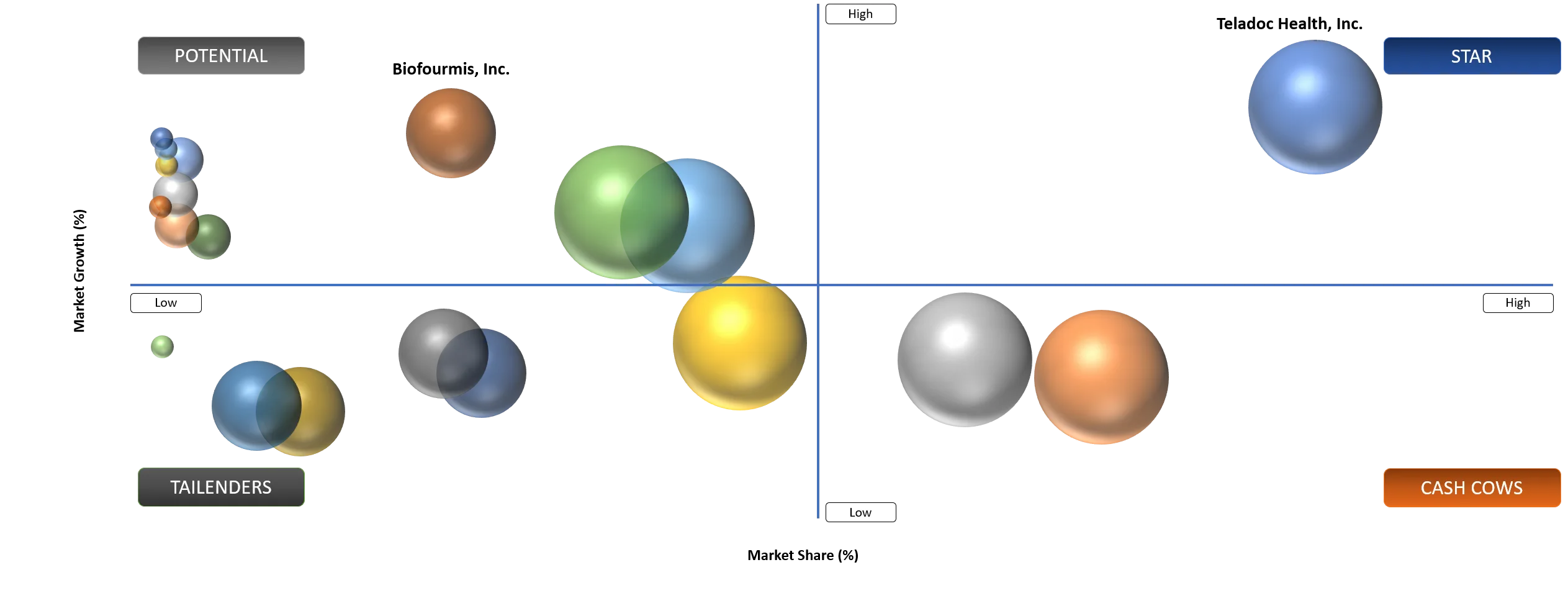
Star
Star players include Teladoc Health, Inc., American Well Corporation, Koninklijke Philips N.V., GE HealthCare Technologies Inc., Medtronic plc, Abbott Laboratories, DexCom, Inc., ResMed Inc., Huma Therapeutics Limited and TytoCare Ltd. Strength come from enterprise customer access, virtual care platforms, connected device ecosystems, AI enabled monitoring, clinical workflow integration and regulatory experience. Buyers view these companies as credible because they can connect AI capability with care delivery infrastructure, provider workflows or remote diagnostic data.
Potential
Potential companies include Biofourmis, Inc., AliveCor, Inc., Ada Health GmbH, Infermedica Sp. z o.o., K Health, Inc., Masimo Corporation, iRhythm Technologies, Inc., OMRON Healthcare Co., Ltd., Boston Scientific Corporation and Best Buy Health, Inc. Growth depends on converting specialized AI capability into repeatable provider, payer or consumer programs. Symptom assessment, personal ECG monitoring, predictive analytics, care navigation and at home monitoring create strong upside when vendors can prove safety, reimbursement fit, integration readiness and patient engagement.
AI in Telehealth Market Dynamics
Driver Impact Analysis
| Driver | Market Growth Impact | Demand Concentration | Impacted Use Case | Strategic Impact |
AI Triage Is Becoming The Digital Front Door For Virtual Care | High | North America, Europe and Gulf Markets | Digital Intake and Patient Routing | Reduces avoidable visits and improves access management |
Provider Shortages Are Pushing AI Into Pre Consultation Workflows | High | Global Health Systems | Documentation and Clinical Preparation | Supports clinician productivity and lower administrative burden |
AI Enabled RPM Is Moving From Passive Monitoring To Clinical Escalation | Medium To High | North America, Japan, Saudi Arabia and Europe | RPM Alert Prioritization | Turns device readings into actionable care workflows |
Driver: AI Triage Is Becoming The Digital Front Door For Virtual Care
AI triage is becoming a central growth driver because patients often do not know whether they need self care, virtual primary care, urgent care, emergency care or a specialist. Health systems lose capacity when patients enter the wrong door. A clinically governed digital front door can collect symptoms, flag red risks and route patients before the consultation begins. Provider shortages make this driver more practical. Triage tools can reduce avoidable visits and prepare clinicians with structured histories. The value is highest when the platform connects directly with scheduling, eligibility, EHR records and follow up pathways instead of operating as a standalone questionnaire.
Companies such as Ada Health, Infermedica and K Health show how medical reasoning tools can move into real patient navigation. Adoption will depend on clinical validation, language support and governance. Health systems need to know how the AI handles uncertainty and when it escalates to human review. Commercial impact is strong because triage can affect both access and cost. Payers can use it to reduce avoidable high cost visits. Providers can use it to improve routing and reduce call center load. Government programs can use it to extend access in underserved areas while keeping clinical oversight.
Restraint Impact Analysis
| Restraint | Drag On Market Growth | Primary Impact Area | Impacted Use Case | Strategic Impact |
Clinical Validation Gaps Slow Provider Trust In AI Recommendations | High | Evidence and Governance | Triage, CDS and Diagnostic Support | Extends sales cycles and raises proof requirements |
Data Localization and Privacy Rules Limit Cross Border AI Deployment | Medium To High | Cloud Hosting and Model Operations | Telehealth Platforms and RPM | Requires local deployment options and strict consent controls |
Restraint: Clinical Validation Gaps Slow Provider Trust In AI Recommendations
Clinical validation remains a major restraint because virtual care decisions can affect patient safety. A model that works well in a demo may perform differently across age groups, languages, chronic conditions or local care pathways. Providers need evidence that the tool is safe for the population they serve. Validation gaps are especially important for automated diagnostic support, CDS and risk stratification. A clinician must understand why a recommendation was generated and whether the basis can be independently reviewed. Opaque recommendations create legal and clinical concerns even when the interface looks polished.
Health systems also need post deployment monitoring. Model performance can drift when patient behavior changes, new care pathways are introduced or data quality declines. Vendors that provide audit trails, performance dashboards and update controls will reduce buyer hesitation. Commercial impact appears through longer pilots, narrower initial deployment and more service work. Companies with clinical evidence, regulatory expertise and strong governance support will move faster than vendors that rely mainly on AI claims.
AI in Telehealth Market Segmentation Analysis
By Offering: Software Leads AI Driven Telehealth Through Platform Intelligence and Clinical Workflow Integration
Software is the most commercially important offering because the main value of AI in telehealth sits inside platforms, algorithms, data connectors, workflow engines and clinician facing interfaces. Hardware supports RPM and remote diagnostics, but the intelligence layer is usually delivered through software modules or cloud based services. AI enabled telehealth platforms are growing because providers want one environment for patient intake, consultation, documentation and follow up. A platform that connects symptom capture, appointment routing, video visits, clinical notes and patient engagement can create more enterprise value than a single point solution.
AI triage and symptom assessment software is especially important at the start of the care journey. Tools such as Ada Health and Infermedica demonstrate how clinical reasoning can be embedded into websites, mobile apps, portals and digital front doors. Strong products keep escalation pathways visible and avoid overpromising diagnosis. Clinical decision support software is gaining importance because virtual consultations often happen with limited physical examination and time pressure. AI can summarize patient history, surface risk flags and suggest guideline relevant next steps. Provider adoption depends on whether clinicians can review the basis of the recommendation.
Documentation and workflow automation software is expanding quickly because telehealth creates its own administrative load. AI scribes and workflow assistants can draft notes, summarize visits, prepare after visit instructions and reduce time spent inside EHR screens. Such tools have immediate appeal because they solve a daily pain point for clinicians. Data integration remains the hidden growth layer. AI telehealth tools need access to EHR records, scheduling data, patient reported outcomes, device readings and care pathway rules. Vendors with interoperability strength will have an advantage because providers do not want new AI tools that create new data silos.
By AI Application: AI Triage and Symptom Assessment Software
AI triage and symptom assessment software helps patients describe symptoms in a structured way before they reach a clinician. A well designed tool can ask follow up questions, identify red flag symptoms and recommend the next care setting based on local rules. The business case is strongest where health systems face high call volumes and avoidable urgent care demand. The category requires a careful balance between automation and safety. Patients need clear language and easy navigation, while clinicians need a transparent view of the information collected. A system that simply produces a recommendation without rationale will be harder to approve inside hospital governance.
Language localization creates a major opportunity. Arabic, Spanish, German, Japanese and other language capabilities can widen access when medical terminology is handled safely. Saudi Arabia and Gulf markets are especially attractive because national digital health platforms can use localized triage tools to manage large patient populations. Future competition will focus on clinical validation and integration depth. A triage tool connected to scheduling, EHR data and care pathways creates more value than a chatbot that only gives general guidance. Vendors that support real time escalation and clinician review will be better positioned.
AI Enabled RPM Alert Prioritization
AI enabled RPM alert prioritization is becoming important because connected devices create more readings than clinical teams can manually review. Blood pressure, glucose, ECG, oxygen saturation, weight and respiratory signals can all generate alerts. Without prioritization, virtual monitoring teams risk alert fatigue and missed deterioration. AI can rank alerts by clinical risk, patient history and trend direction. A single abnormal reading may be less important than a pattern of change across several days. Predictive analytics can help care teams intervene earlier and avoid emergency escalation when the model is reliable and explainable.
Hardware enabled solution components make this area different from pure telehealth software. Connected monitoring kits, remote diagnostic devices and wearables must be easy for patients to use at home. Device logistics, data quality and patient adherence directly affect AI performance. Providers will favor RPM solutions that combine reliable devices, clear escalation workflows and integration into care team operations. A dashboard alone is not enough. The commercial winners will reduce noise and help clinicians decide which patient needs attention first.
AI in Telehealth Market Geographical Penetration
North America AI in Telehealth Market Trends
North America led the market with 48.5% share in 2025 because the U.S. combines mature telehealth adoption, large payer networks, strong provider technology budgets and active AI healthcare suppliers. Enterprise buyers already understand virtual care economics and are now looking for AI that can improve workflow efficiency. U.S. demand is strongest across AI triage, documentation automation, RPM alert prioritization and virtual care navigation. Large health systems want tools that reduce clinician burden and integrate with EHR platforms. Payers want member routing that reduces avoidable urgent care and emergency department use. Canada has a strong opportunity around rural care, public health access and virtual specialist support. Health Canada guidance on machine learning enabled medical devices creates a clearer regulatory pathway for AI tools that cross into diagnosis or clinical decision support.
Mexico remains more selective but has growth potential in employer health, private telehealth networks and chronic disease management. Vendors need mobile first design, affordable pricing and Spanish language clinical content to scale beyond premium private care.
U.S. AI in Telehealth Market Landscape
The U.S. is the decisive demand center because virtual care platforms, EHR vendors, AI health companies and remote monitoring providers compete inside a large commercial insurance and provider market. AI adoption is strongest where it improves measurable operational outcomes. Teladoc Health, Amwell, Huma, AliveCor, TytoCare, iRhythm, DexCom and other vendors show the breadth of U.S. opportunity. Use cases range from virtual hospital monitoring to home diagnostics, cardiac analytics, diabetes monitoring, AI scribes and clinical navigation.
Regulation shapes the adoption path. FDA oversight, HIPAA privacy rules and state level medical practice expectations influence product design. A virtual assistant used for patient engagement faces a different risk profile than AI diagnostic support or autonomous care recommendations. Provider procurement will remain evidence driven. U.S. buyers want clinical validation, integration readiness, cybersecurity maturity and a clear economic case. Vendors that reduce documentation time or avoid unnecessary visits can defend premium pricing.
Europe AI in Telehealth Market Outlook
Europe is a high value market because health systems are digitizing care pathways while keeping strong expectations around privacy, safety and equity. AI in telehealth must fit GDPR requirements, medical device software rules and national digital health frameworks. The UK, Germany, France, Italy and Spain offer opportunities across digital front doors, remote monitoring and AI documentation. Public health systems and private providers both need tools that reduce waiting times and support chronic care management.
European buyers often require local evidence and language support. A symptom assessment tool must work across local pathways, reimbursement structures and clinical terminology. Vendors with multilingual clinical content and configurable pathways will have an advantage. Procurement cycles can be slower than in the U.S. but contracts may be sticky once platforms are approved. Trust, interoperability and data residency will matter as much as model performance.
Asia-Pacific AI in Telehealth Market Analysis
Asia-Pacific demand is shaped by mobile health adoption, large patient populations, physician distribution gaps and rising chronic disease burden. China, India, Japan, Australia and South Korea are the most important markets, but supplier access differs widely by country. India is a high potential market because digital health infrastructure, large private hospital networks and demand for affordable access create room for AI triage and virtual care navigation. Local language coverage and low cost delivery models will be essential.
Japan deserves separate attention because aging population pressure and high expectations for reliability create demand for AI enabled RPM, chronic care monitoring and remote specialist support. Japanese providers will prioritize evidence, safety and integration with established clinical workflows. Australia and South Korea offer opportunities in rural access, hospital at home programs, connected devices and secure virtual care. Vendors should expect strong scrutiny around privacy and clinical accountability.
Saudi Arabia AI in Telehealth Market Growth
Saudi Arabia is becoming a strong demand environment because virtual care is part of national healthcare transformation rather than a temporary access channel. Health Sector Transformation Program priorities around access, quality, prevention and digital services align directly with AI triage, virtual care routing and remote specialist support. Sehhaty facilitated more than 51 million instant and virtual consultation appointments in 2024. Seha Virtual Hospital reported more than 16 million appointments and consultations in 2025. Such scale creates a practical base for AI assisted triage, appointment prioritization, specialist routing and RPM alert management.
Digital readiness is high. Saudi Arabia reported 99% internet penetration in 2024, and mobile internet use is deeply embedded in daily life. AI enabled telehealth can therefore reach patients through apps, portals and virtual hospital networks when language localization and usability are strong. Regulatory clarity is also improving. Ministry of Health telehealth regulations and National Health Information Center rules shape licensing, practitioner responsibility, approved practice and insurance coordination. Vendors need data residency planning, Arabic language capability, cybersecurity and alignment with national health information infrastructure.
Middle East and Africa AI in Telehealth Market Outlook
Middle East and Africa is also fastest-growing region because several Gulf countries are investing in digital health infrastructure while African markets need affordable access models. UAE and Saudi Arabia lead in digital health maturity, while South Africa has selective growth around private healthcare and remote monitoring. Gulf demand is strongest across virtual hospitals, AI triage, remote specialty care, patient navigation and chronic disease programs. Public sector buyers may prefer enterprise platforms that support national access and data governance requirements.
Africa will grow more selectively because connectivity, affordability and provider capacity differ significantly by country. Mobile based virtual care, symptom assessment and remote monitoring for chronic disease can still create value when solutions are lightweight and affordable. Vendors need different market entry strategies across the region. Gulf markets need localization, government engagement and integration with national platforms. African markets need low bandwidth design, partnership with providers and flexible pricing.
AI in Telehealth Market Competitive Landscape
- Competition is split between telehealth platform companies, medical device firms, RPM specialists, AI symptom assessment vendors, virtual care infrastructure companies and consumer health technology providers.
- Teladoc Health and Amwell compete through enterprise virtual care platforms and provider access, while Philips, GE HealthCare, Medtronic, Abbott, DexCom, ResMed, Masimo and iRhythm connect AI telehealth value to monitoring and diagnostic data.
- Ada Health, Infermedica and K Health compete around symptom assessment, medical reasoning and virtual care navigation. Huma and Biofourmis are stronger around regulated digital health infrastructure and remote care management.
- Competitive benchmarking should track clinical evidence, EHR integration, privacy architecture, AI governance, language localization, device ecosystem depth, pricing model flexibility and provider workflow fit.
- Partnerships will remain central because few companies can deliver patient access, devices, AI models, clinical pathways, EHR integration and managed services alone.
Key Companies
- Teladoc Health, Inc.
- American Well Corporation
- Koninklijke Philips N.V.
- GE HealthCare Technologies Inc.
- Medtronic plc
- Abbott Laboratories
- Boston Scientific Corporation
- OMRON Healthcare Co., Ltd.
- Masimo Corporation
- iRhythm Technologies, Inc.
- DexCom, Inc.
- ResMed Inc.
- Huma Therapeutics Limited
- Biofourmis, Inc.
- TytoCare Ltd.
- AliveCor, Inc.
- Ada Health GmbH
- Infermedica Sp. z o.o.
- K Health, Inc.
- Best Buy Health, Inc.
Company Coverage Preview
Teladoc Health, Inc. is the most visible virtual care platform company in the AI in telehealth market because it combines large scale digital care delivery, enterprise customer relationships and a growing portfolio of AI enabled workflow capabilities. Its relevance comes from the ability to serve health systems, employers, payers and patients across multiple virtual care settings.
The company reached a leading position by building broad virtual care access and then expanding into more structured care capabilities. The market is no longer rewarding simple visit volume alone, so Teladoc Health’s strategy increasingly depends on using technology to improve safety, efficiency, chronic care management and provider workflow. AI enabled Clarity shows how virtual care infrastructure can move into hospital monitoring and operational response.
Teladoc Health’s USP is its combination of brand recognition, enterprise relationships, care delivery experience and platform scale. Competitive pressure remains high because AI native companies can move quickly in documentation, triage and care navigation. The company’s advantage will depend on how effectively it embeds AI into measurable workflows without adding complexity for clinicians.
AI in Telehealth Market Recent Developments
In July 2026, Teladoc Health, Inc. expanded its AI-enabled telehealth capabilities with advanced virtual care and clinical decision-support tools. The development focuses on personalized care delivery and improved provider workflows. This supports the growing adoption of AI-powered remote healthcare.
- In June 2026, Microsoft Corporation strengthened its AI healthcare ecosystem with intelligent tools designed to support virtual consultations, clinical documentation, and patient engagement. The development improves healthcare workflow efficiency. This supports broader AI adoption in telehealth services.
- In May 2026, Amazon Web Services, Inc. expanded its healthcare AI capabilities with cloud-based solutions supporting remote patient monitoring, clinical analytics, and virtual care applications. The development enhances scalability and data-driven decision-making. This benefits telehealth providers.
- In April 2026, Philips advanced its AI-enabled virtual care solutions with technologies for remote patient monitoring and connected healthcare workflows. The development focuses on earlier identification of patient risks and continuous care. This supports remote chronic disease management.
- In March 2026, Amwell (American Well Corporation) strengthened its digital health platform with AI-powered capabilities for virtual care delivery and clinical workflows. The innovation focuses on improving care coordination and operational efficiency. This supports healthcare organizations expanding telehealth services.
Analyst View and Opinion
- The strongest growth will come from AI tools that solve workflow problems before, during and after a virtual consultation.
- AI triage will remain central because it affects patient routing, appointment demand and care access economics.
- Documentation automation will grow quickly because clinician burnout and administrative burden are easy pain points for buyers to understand.
- RPM alert prioritization will become a major value area as connected devices generate more data than clinical teams can manually review.
- Clinical validation and transparency will separate credible healthcare AI suppliers from general chatbot vendors.
- Saudi Arabia and the Gulf will attract more vendor attention because national digital health infrastructure creates scale pathways.
- Companies with devices and data streams will have an advantage where telehealth needs clinical evidence beyond patient reported symptoms.
- Enterprise buyers will increasingly ask for AI governance tools and post deployment monitoring before full scale rollout.
- Outcome linked contracting will grow where vendors can avoid avoided visits, reduced clinician time or earlier intervention.
What DataM Uniquely Provides
- DataM separates AI in telehealth demand by AI application, offering, care delivery model, deployment model, end user, business model and region.
- DataM maps clinically meaningful use cases such as triage, RPM alert prioritization, documentation, decision support and care navigation instead of treating AI as one broad software category.
- DataM benchmarks platform vendors, device companies, AI symptom assessment suppliers and remote care infrastructure companies in one competitive framework.
- DataM evaluates regulatory and procurement friction including clinical validation, privacy, data localization, model governance and EHR integration.
- DataM connects regional demand to ground realities such as Saudi virtual care infrastructure, U.S. enterprise telehealth adoption and European privacy requirements.
- DataM supports pricing discussions by separating software subscriptions, per consultation fees, per patient monitoring fees, managed service contracts and outcome linked models.
- DataM tracks recent launches, partnerships, acquisitions and regulated AI milestones that influence near term buyer confidence.
- DataM provides a practical view for providers, payers, technology vendors and investors seeking market sizing feasibility and commercial positioning
Target Audience
| Industry | Who Should Buy This Report? | Reason To Buy This Report |
| Hospitals and Health Systems | Digital Health Leaders, CMIOs, Virtual Care Teams, Procurement Teams | Evaluate AI enabled triage, RPM, documentation and clinical workflow opportunities |
| Telehealth Service Providers | Product Leaders, Strategy Teams, Partnership Teams | Benchmark AI roadmap options and vendor positioning across virtual care models |
| Payers and Insurance Providers | Population Health Teams, Innovation Teams, Network Strategy Leaders | Assess AI triage and virtual care routing models that can reduce avoidable utilization |
| Government Healthcare Programs | Digital Health Authorities, Public Health Planners, Transformation Offices | Plan AI enabled access expansion, telehealth governance and national virtual care programs |
| Medical Device Companies | RPM Leaders, Connected Care Teams, Business Development Teams | Understand how device data can support AI enabled telehealth and remote escalation |
| AI Health Startups | Founders, Product Teams, Clinical Strategy Teams | Identify procurement barriers, validation needs and buyer pain points |
| Investors | Venture Capital, Growth Equity, Healthcare Funds | Track AI telehealth funding themes, commercialization barriers and scalable use cases |
| Consulting Firms | Healthcare Strategy Teams, Market Entry Teams | Support client works around digital health, AI governance, partner mapping and regional opportunity |



























































