


Agricultural Swarm Robotics Market Size and Overview
The global agricultural swarm robotics market was valued at approximately USD 420.5 million in 2025 and is projected to reach around USD 3,672.7 million by 2035, expanding at a CAGR of approximately 24.2% during 2025–2035. The agricultural swarm robotics market is experiencing significant growth driven by increasing agricultural labor shortages and labor costs, growing demand for precision and autonomous farming, the need to improve farm productivity and field coverage, and continued advancements in artificial intelligence, sensing, autonomous navigation, and multi-robot coordination technologies. In the U.S., H-2A positions certified increased more than sevenfold, from approximately 48,000 in FY2005 to around 385,000 in FY2024, reflecting the agricultural sector's growing reliance on temporary foreign labor. Meanwhile, nonsupervisory farm workers earned an average hourly wage of $18.12 in 2024, while inflation-adjusted farm wages increased at an average annual rate of 1.9% between 2014 and 2024. Increases in labor costs and the challenges associated with obtaining agricultural laborers have resulted in an increased economic need for farmers to implement autonomous robots that can execute labor-intensive activities. Furthermore, advancements in technologies such as artificial intelligence, computer vision, sensing technologies, autonomous navigation, and wireless communications have been making agricultural robots more independent in complex farming environments. Improvements in multi-robot cooperation, data sharing, task allocation, and swarm intelligence have helped make possible for multiple robots to function cooperatively.
Government Investments Accelerating Agricultural Swarm Robotics Development
Funding from government agencies is enabling the progress of autonomous and multi-robot agricultural technology through investment in research and development efforts, field trials, and commercialization strategies. Government-funded initiatives are increasingly providing support for the development of technologies involving AI, autonomy, robotics, sensing, and cooperative multi-robots due to issues within agriculture. For instance, in June 2025, the European Commission signed the grant agreement for the A-FORWARD (Autonomous Full Farming for Optimised Regenerative and Wholesome Agriculture with Robotics and Deep-Learning) project, which officially started on May 2025, and will continue until April 2027. The project is sponsored by the European Innovation Council (EIC). Nature Robots GmbH receives a total contribution from the EU of around USD $2.67 million. The project is concerned with the development of a completely automated agriculture system that employs artificial intelligence (AI), deep learning, autonomous navigation, crop and weed recognition, and modular farm robots. Such funds are leading to the rapid evolution of advanced agricultural robotic systems that are able to perform several agricultural tasks automatically.
Agricultural Swarm Robotics Market Key Takeaways
- North America held the leading regional market share, accounting for approximately 34.2% of the global agricultural swarm robotics market in 2025, supported by the increasing adoption of autonomous agricultural equipment, labor shortages, large-scale commercial farming operations, and the presence of established agricultural robotics and drone manufacturers. Europe accounted for around 27.8% of the market share in 2025, supported by the adoption of precision agriculture technologies, government support for farm automation, stringent requirements for efficient agricultural production, and the presence of agricultural robotics developers and manufacturers.
- Advancements in autonomous navigation, swarm intelligence, and multi-robot coordination technologies are becoming key strategic focus areas in the global agricultural swarm robotics market. Companies are increasingly investing in AI-based navigation, machine vision, RTK/GPS positioning, fleet management, wireless communication, task allocation, and autonomous decision-making technologies to improve field coverage, reduce labor requirements, and enable multiple agricultural robots or drones to operate simultaneously.
- Commercialization initiatives and expansion of multi-robot agricultural systems are accelerating market development, as companies are moving from individual autonomous machines toward coordinated fleets capable of performing agricultural tasks at larger scales. For instance, Fendt has developed the Xaver system, in which multiple small field robots operate as a swarm for precision seeding. XAG provides swarm operation for agricultural drones, allowing multiple drones to be controlled simultaneously, while Hylio has developed swarm-enabled agricultural drone systems for coordinated spraying operations.
Agricultural Swarm Robotics Market Industry Trends and Strategic Insight
- Agricultural robotics companies are increasingly investing in swarm intelligence and multi-robot coordination technologies to improve field coverage, operational efficiency, and autonomous task execution. Companies are adopting advancements in AI-based navigation, machine vision, RTK/GPS positioning, fleet management, wireless communication, and autonomous decision-making to enable multiple robots or drones to operate simultaneously across agricultural environments.
- Demand for application-specific swarm robotic systems is becoming a major market trend as farmers and agricultural operators seek coordinated robotic solutions for specific field activities. Different applications require specific capabilities such as precision navigation, obstacle detection, task allocation, payload capacity, field coverage, and crop-level sensing. As a result, companies are developing coordinated robot and drone fleets for applications including crop monitoring, weed control, precision spraying, planting, harvesting, soil monitoring, and pest and disease management.
- Commercialization of multi-robot agricultural systems is accelerating the development of next-generation farm automation solutions. Increasing investment in autonomous agricultural equipment, agricultural drones, AI, and precision farming technologies is encouraging companies to expand from individual robotic machines toward coordinated fleets capable of performing multiple tasks simultaneously. The development of swarm-enabled agricultural drones, autonomous field-robot fleets, collaborative tractor-robot systems, and fleet-management platforms, along with field deployments, manufacturing expansions, and partnerships, is further supporting the adoption of agricultural swarm robotics globally.
Agricultural Swarm Robotics Market Scope
| Metrics | Details | |
| 2025 Market Size | USD 420.5 Million | |
| 2035 Projected Market Size | USD 3,672.7 Million | |
| CAGR (2026-2035) | 24.2% | |
| Largest Market | North America | |
| Fastest Growing Market | Asia-Pacific | |
| By Robot Type | Ground Robots, Aerial Drones, Hybrid Air-Ground Swarms, Autonomous Agricultural Vehicles, Other | |
| By Swarm Configuration | Homogeneous Swarms, Heterogeneous Swarms | |
| By Application | Crop Monitoring & Scouting, Weed Detection & Control, Precision Spraying & Crop Protection, Planting & Seeding, Crop Harvesting, Soil Monitoring & Analysis, Irrigation & Water Management, Pest & Disease Detection & Management, Mowing & Slashing, Other Applications | |
| By Technology | Artificial Intelligence & Machine Learning, Computer Vision, GNSS & RTK Navigation, IoT & Wireless Connectivity, Swarm Intelligence & Multi-Robot Coordination, Sensor Fusion, LiDAR & 3D Perception, Autonomous Navigation | |
| By Component | Hardware, Software, Services | |
| Farm Type | Open-Field Agriculture, Orchards & Vineyards, Greenhouses, Indoor Farms, Other Farm Types | |
| By Region | North America | U.S., Canada, Mexico |
| Europe | Germany, UK, France, Spain, Italy, Poland, Russia, Rest of Europe | |
| Asia-Pacific | China, India, Japan, Australia, South Korea, Indonesia, Malaysia, Rest of Asia-Pacific | |
| Latin America | Brazil, Argentina, Rest of Latin America | |
| Middle East and Africa | UAE, Saudi Arabia, South Africa, Israel, Türkiye, Rest of Middle East and Africa | |
| Report Insights Covered | Competitive Landscape Analysis, Company Profile Analysis, Market Size, Share, Growth | |
Agricultural Swarm Robotics Market Disruption Analysis
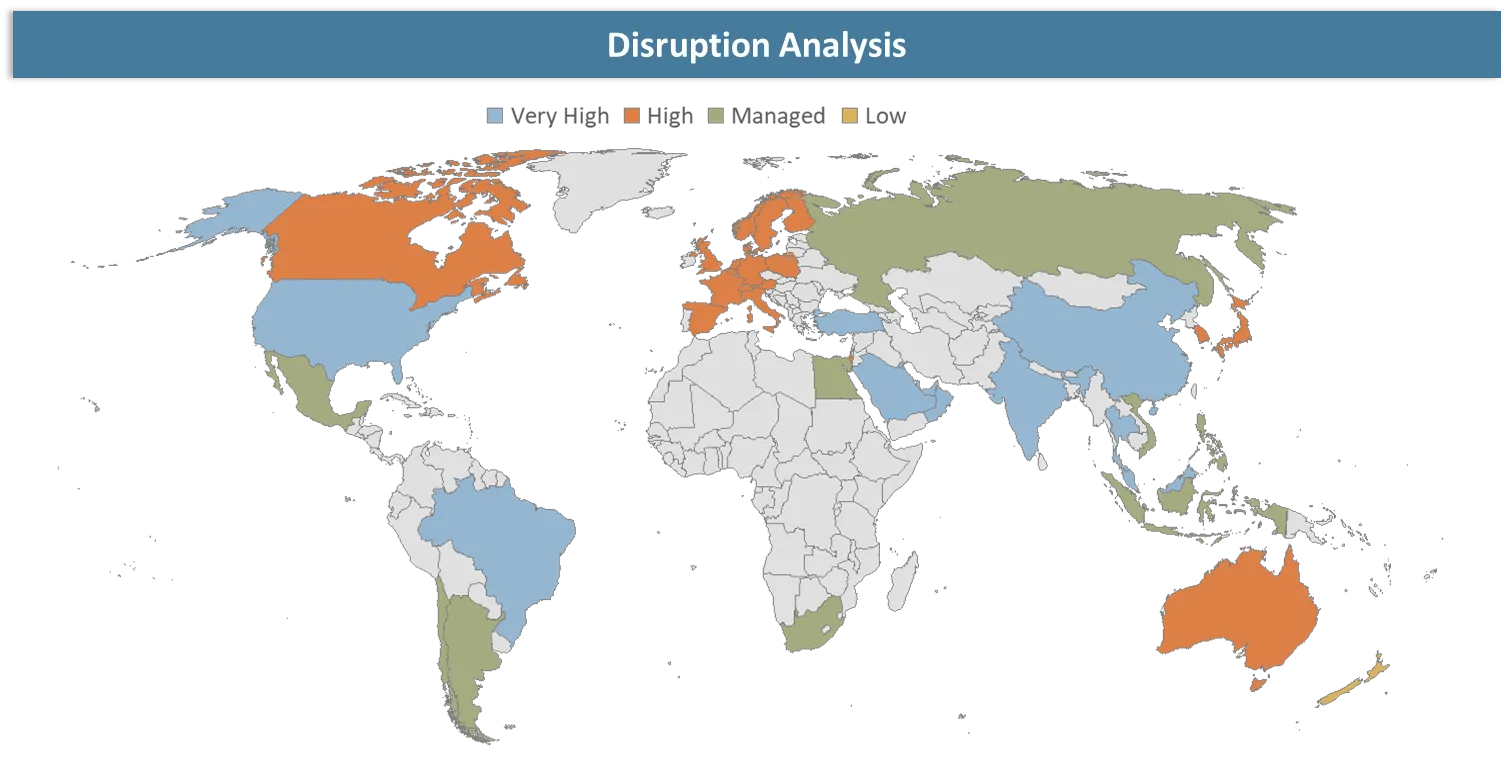
Shift Toward Intelligent, Decentralized, and Scalable Multi-Robot Coordination Systems
The global agricultural swarm robotics market is being transformed by advancements in decentralized control, artificial intelligence, real-time communication, and distributed decision-making technologies that enable multiple agricultural robots to operate collectively with reduced dependence on centralized control systems. Conventional multi-robot operations often rely on predefined task allocation and centralized fleet management, whereas swarm-based approaches enable robots to dynamically coordinate movements, allocate tasks, share field data, and adapt their behavior based on changing agricultural and environmental conditions. This technological shift is driving the development of swarm intelligence, autonomous task allocation, machine-to-machine communication, edge computing, and collaborative navigation capabilities. Companies and research organizations developing agricultural swarm systems are focusing on scalable coordination architectures capable of supporting larger robot populations and collaborative applications such as crop monitoring, precision weeding, targeted spraying, seeding, and coordinated aerial-ground operations, expanding the scope of distributed and intelligent agricultural automation.
Agricultural Swarm Robotics Market BCG Matrix: Company Evaluation
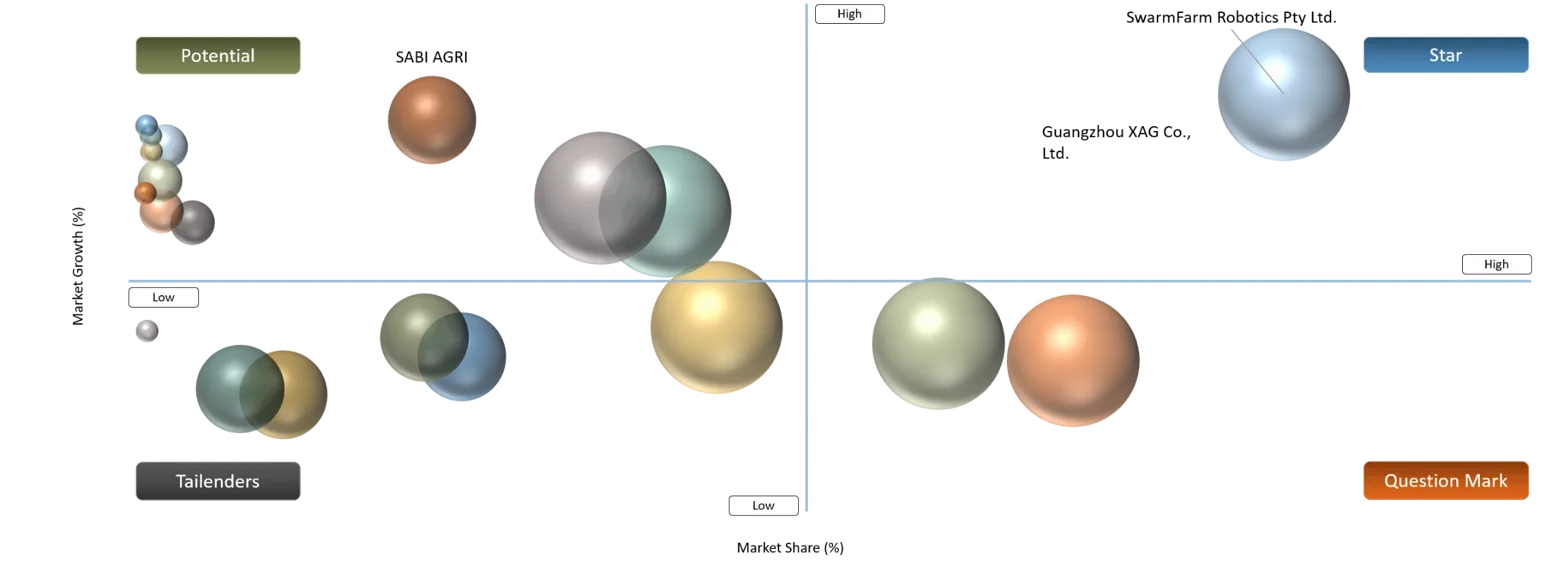
SwarmFarm Robotics Pty Ltd., AGCO Corporation (Fendt), Guangzhou XAG Co., Ltd., and Hylio, Inc. are classified as Star competitors due to their established agricultural robotics and drone platforms, demonstrated swarm or multi-robot operation capabilities, commercial deployments, and applications across precision spraying, seeding, crop protection, and autonomous field operations. SABI AGRI, Greenfield Robotics, Inc., and MSOEN are categorized as high-growth players, supported by collaborative agricultural fleets, autonomous ground-robot and agricultural drone development, expanding commercial applications, and increasing capabilities for coordinated multi-robot operations. Aigen, Inc., FarmDroid ApS, and tmsuk Co., Ltd. represent established/specialized competitors, driven by autonomous agricultural robot platforms, specialized applications in weed control and seeding, and development of coordinated or group-based robotic operations.
Agricultural Swarm Robotics Market Dynamics
Driver Impact Analysis
| Driver | Market Growth Impact (%) | Demand Concentration | Impacted Use Case | Strategic Impact |
Agricultural Labor Shortages and Rising Labor Costs | 30% | Strong demand concentration in North America and Europe, particularly in labor-intensive agriculture, with increasing relevance across Asia-Pacific as agricultural labor availability declines. | Precision weeding, crop monitoring, planting, spraying, harvesting assistance, and other labor-intensive field operations. | Increases the economic incentive for farms to deploy multiple coordinated robots capable of performing agricultural tasks simultaneously while reducing dependence on manual and seasonal labor. |
Growing Adoption of Precision Agriculture and Autonomous Farming | 25% | High adoption in North America and Europe, supported by established precision agriculture infrastructure, with expanding deployment across large commercial farms in Asia-Pacific and Latin America. | Crop scouting, field mapping, precision spraying, variable-rate application, soil monitoring, and targeted weed control. | Creates demand for coordinated robotic systems that can collect, share, and act on field-level data across multiple locations simultaneously. |
Advancements in AI, Autonomous Navigation, and Multi-Robot Coordination Technologies | 20% | Strong technology development activity in Europe, North America, and Asia-Pacific, supported by investments in AI, robotics, sensors, computer vision, and autonomous systems. | Swarm coordination, collaborative navigation, autonomous task allocation, machine-to-machine communication, and real-time field monitoring. | Expands the technical capabilities of agricultural swarm systems by improving robot coordination, navigation accuracy, distributed decision-making, and operational scalability. |
Growing Demand for Higher Farm Productivity and Operational Efficiency | 15% | Strongest demand across large-scale commercial farming regions in North America, Europe, Australia, and parts of Latin America. | Large-area crop monitoring, planting, weeding, spraying, and simultaneous multi-zone agricultural operations. | Supports the deployment of multiple coordinated robots that can divide agricultural tasks and operate concurrently, increasing field coverage and reducing operational time. |
Increasing Focus on Resource-Efficient and Sustainable Agriculture | 10% | Strong demand concentration in Europe and North America, supported by sustainability policies, water constraints, input-reduction requirements, and precision farming initiatives. | Targeted spraying, precision irrigation monitoring, weed detection, crop health monitoring, and reduced-input farming. | Supports the adoption of distributed robotic systems capable of performing localized interventions and reducing unnecessary use of water, fertilizers, pesticides, and fuel. |
Advances in Autonomous Navigation and Swarm Control Accelerate Agricultural Swarm Robotics Market
Advancements in autonomous navigation, artificial intelligence, and multi-robot coordination are supporting the development of agricultural swarm robotics across global markets. Agricultural equipment manufacturers are increasingly integrating swarm-control capabilities into autonomous platforms, enabling multiple robots or drones to coordinate tasks and operate simultaneously. For instance, In November 2024, XAG announced its product lineup at its annual conference in Guangzhou, including the P150 and P60 agricultural drones, APC2 AutoPilot Console, and Smart Fertigation System. The P150 supports fully autonomous operations through the XAG One App, including swarm control, intelligent route planning, and prescription-map operations. The lineup expands XAG’s smart farming ecosystem across crop protection, precision field operations, and automated farm management. These developments are expanding the use of swarm robotics across precision spraying, crop monitoring, field mapping, weeding, and other agricultural operations.
Restraint Impact Analysis
| Restraint | Drag on Market Growth (%) | Primary Impact Area | Impacted Use Case | Strategic Impact |
High Initial Costs of Multi-Robot Deployment | 30% | Autonomous robots, sensors, cameras, GNSS/RTK systems, onboard computing, communication infrastructure, charging stations, and fleet-management platforms. | Multi-robot deployment for crop monitoring, spraying, weeding, seeding, and harvesting. | Increases upfront investment requirements, particularly for small and medium-sized farms, which can delay adoption and limit deployment of large robotic fleets. |
Limited Multi-Robot Coordination and Interoperability | 25% | Communication protocols, fleet coordination, task allocation, navigation, data sharing, and integration between robots from different manufacturers. | Coordinated ground-robot fleets, drone swarms, and heterogeneous aerial-ground operations. | Technical incompatibility and coordination challenges can reduce system efficiency and increase integration requirements, limiting large-scale deployment of heterogeneous robotic fleets. |
Complex Farm Environments and Navigation Challenges | 20% | Uneven terrain, mud, dust, variable crop conditions, obstacles, changing weather, GPS signal limitations, and unstructured field environments. | Autonomous navigation, precision weeding, crop monitoring, spraying, and harvesting. | Increases the technical requirements for reliable autonomous operation and can reduce robot performance, operational consistency, and deployment reliability under difficult field conditions. |
Regulatory and Safety Constraints | 15% | Drone flight regulations, autonomous vehicle requirements, operating-zone restrictions, safety standards, data regulations, and approval requirements. | Agricultural drone swarms, autonomous tractors, aerial-ground coordination, and unmanned field operations. | Regulatory restrictions can limit operating areas, swarm sizes, and autonomous functions, increasing compliance requirements and extending deployment timelines. |
Limited Technical Expertise and Farm-Level Infrastructure | 10% | Availability of skilled operators, connectivity, charging infrastructure, maintenance capabilities, digital farm infrastructure, and technical support. | Fleet management, autonomous field operations, remote monitoring, and robot maintenance. | Requires additional training and infrastructure investment and can restrict adoption in farms that lack adequate connectivity, technical skills, or service support. |
Multi-Robot Coordination and Interoperability Challenges Restrain Swarm Deployment
One of the significant limitations is the technical challenge of managing the coordination of several autonomous robots in the same farm ecosystem. Coordination in swarms involves the constant exchange of information about position, condition of the farm, state of the task, route, and obstacles without overlapping of activities and interference among each other. Interoperability can be challenging owing to differences in communication technology, navigation methods, software, and hardware across robots manufactured by different companies. Such difficulties may be especially pertinent when heterogeneous swarms are concerned, which involve a variety of robots ranging from drones and ground-based vehicles to autonomous tractors and utility robots, whose integration and synchronization needs may lead to increased system complexity and decrease in operational efficiency of multi-robot systems, thus hampering their widespread use.
Agricultural Swarm Robotics Market Segment Analysis
The global agricultural swarm robotics market is segmented based on robot type, swarm configuration, application, technology, component, farm type and region.
Precision Spraying and Crop Protection Lead Agricultural Swarm Robotics Applications
Precision spraying and crop protection is expected to remain the dominant application in agricultural swarm robotics because spraying is well suited to coordinated multi-drone operation. Multiple autonomous drones can divide a field into separate operating areas and conduct pesticide, herbicide, fertilizer, or biological-input applications simultaneously. This allows larger areas to be treated within limited spraying windows while reducing the time required for field operations. For instance, in November 2025, XAG unveiled the P150 Max Agricultural Drone at Agritechnica 2025. The design of the new drone is based on autonomous operations for spraying, spreading, field surveying, and logistics with payload capacity of 80 kg, 80-liter liquid container, and 32 liters/minute spray rate that goes up to 46 liters/minute with four nozzles configuration. More specifically, regarding swarm robotics, the P150 Max uses swarm mode that provides autonomous control of two drones from one control station.
Agricultural Swarm Robotics Market Geographical Penetration
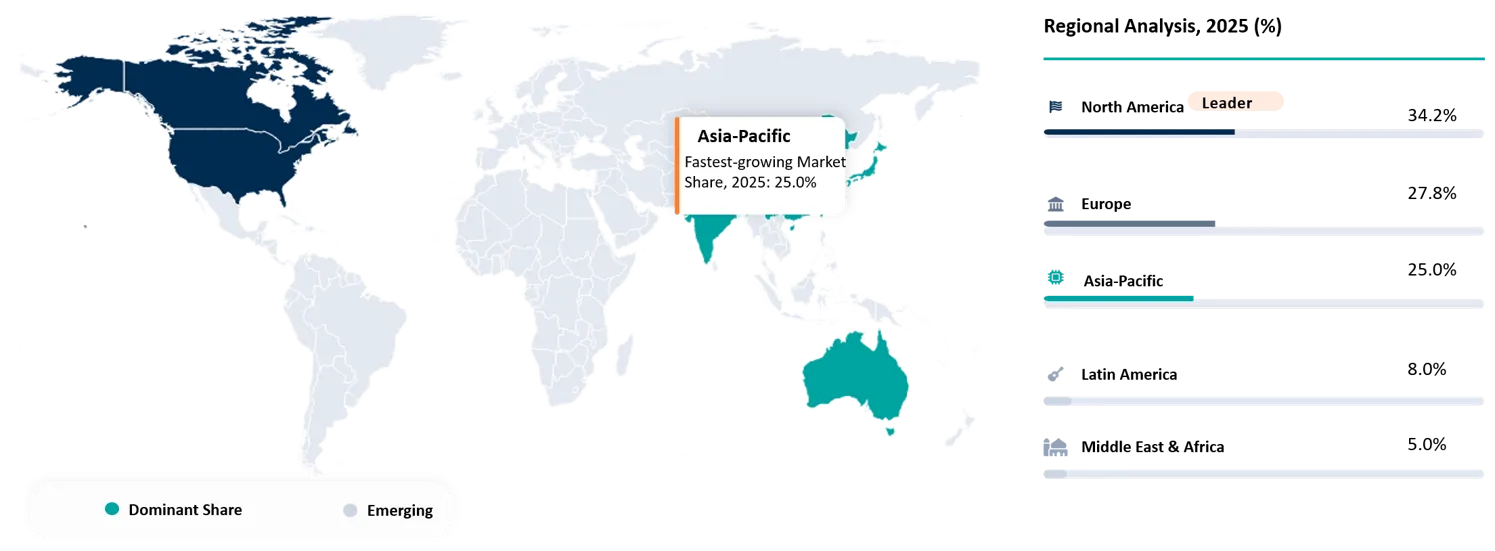
North America Dominates Through Large-Scale Farming and Early Commercial Swarm Robotics Deployment
North America is a major market for agricultural swarm robotics, supported by large-scale commercial farming, high agricultural labor costs, widespread adoption of precision-agriculture technologies, and the development of autonomous agricultural equipment. The United States and Canada have established agricultural technology ecosystems involving artificial intelligence, autonomous navigation, drones, sensors, and farm-management systems. Commercial deployment of swarm-enabled agricultural robots is also expanding in North America, as robotics companies move from technology development and field trials toward commercial farm applications. For instance, in April 2024, SwarmFarm Robotics delivered its first commercial SwarmBot autonomous agricultural robot in the U.S. to Beck’s Hybrids in Indiana. The deployment marked the company’s expansion of its autonomous robotics platform into North America. SwarmFarm is also developing applications for non-chemical weed control and weather-responsive crop protection.
High Labor Costs and Regulatory Advances Drive U.S. Swarm Robotics Adoption
The US represents a significant market for agricultural swarm robotics, supported by large-scale commercial farming, high agricultural labor costs, widespread adoption of precision-agriculture technologies, and increasing use of autonomous equipment. The nation has an advanced system for agriculture technology consisting of robotics, AI, drones, GPS guidance, computer vision, and farm management software. Labor-intensive specialty-crop production provides a strong use case for swarm robotics in the U.S. In 2024, USDA reported that labor accounted for approximately 40% of total cash expenses on U.S. specialty-crop farms, compared with about 15% across all U.S. farms, creating a stronger economic incentive to automate repetitive agricultural activities.
Recent regulatory advances have been aiding in the use of agricultural swarm robotics in the U.S. through providing clear operating frameworks for the use of agricultural drones in an autonomous manner. The regulatory approvals that enable operation of more than one drone at once by a single operator can cut down the cost involved in operations. For instance, in March 2024, Hylio became the first company to receive FAA approval for swarm operations involving agricultural drones weighing more than 55 pounds with a single operator, allowing one pilot to simultaneously operate up to three drones without a visual observer, including at night. This regulatory development can improve the scalability and economics of agricultural drone swarms by allowing multiple machines to perform crop spraying and other field operations concurrently.
High Horticultural Labor Costs and Large-Scale Farming Supporting Multi-Robot Deployment
The adoption of agricultural swarm robotics in Canada is supported by labor shortages, high labor requirements, large farming operations and the increasing use of automation across farming operations. In 2024, Canada’s primary agriculture sector comprised approximately 189,874 farms, covering 62.2 million hectares, while the largest 10% of farms generated more than two-thirds of farm revenues. These large-scale operations, together with labor-intensive horticultural production, create opportunities for coordinated fleets of agricultural robots and drones to perform monitoring, weeding, spraying, and other repetitive activities across larger areas.
Labor costs and workforce shortages are key factors supporting adoption of agricultural robotics in Canada. In 2024, Canadian greenhouse vegetable producers spent US $434.5 million on gross payroll, representing 29.5% of total operating expenses of US $1.47 billion. In addition, 38% of Canadian agricultural producers reported experiencing labor-market challenges, increasing to 61% among farms with annual income of US $720,000 million or more. These conditions can increase demand for agricultural swarm robotics, as multiple coordinated robots can perform tasks simultaneously and reduce the amount of manual labor required for repetitive agricultural activities.
Rising Protein Demand and Source Diversification Strengthen Mycoprotein Opportunities Across Asia-Pacific
Asia-Pacific is emerging as a promising market for agricultural swarm robotics, supported by growing consumer interest in alternative proteins, expanding food innovation, and established fermentation capabilities across countries such as China, Japan, South Korea, and India. The region’s large consumer base and increasing focus on protein diversification and sustainable food production are encouraging food manufacturers and startups to explore fungal-based protein ingredients. Furthermore in countries like India growing demand for protein-rich foods, alongside supply and price pressures affecting conventional protein ingredients, is encouraging manufacturers to diversify protein sources. In May 2026, whey protein prices in India were reported to have increased nearly fourfold amid a global supply shortage, prompting food manufacturers to consider alternatives such as soy, pea and other plant-based proteins. This environment could create additional opportunities for emerging protein ingredients such as mycoprotein. In addition, regulatory progress and partnerships between mycoprotein developers and established food companies are also helping move the technology toward commercial applications.
China’s Smart Agriculture Policies and Integrated Robotics Accelerate Multi-Machine Farm Automation
China is a leading market for agricultural robotics, supported by large-scale agricultural production, labor-force changes, government support for smart agriculture, and rapid development of AI, robotics, drones, and autonomous equipment. Government policies are also supporting the deployment of intelligent agricultural technologies. In October 2024, China’s Ministry of Agriculture and Rural Affairs issued guidelines for the wider application of IoT, big data, artificial intelligence, robots, and intelligent agricultural equipment throughout agricultural production, with emphasis on intelligent perception, decision-making, and precision operations.
Furthermore, commercial deployment of integrated agricultural robotic systems is expanding in China as farms adopt autonomous technologies for crop protection and field management. The integration of aerial drones with autonomous ground robots and automated support equipment is extending agricultural robotics toward coordinated multi-machine operations, covering multiple farming activities within a single workflow. For intsance, in July 2026, XAG launched its X Series agricultural robot system and RM80 unmanned mower in Guangzhou. The X Series combines an autonomous drone with the XA1 docking station and LM1 chemical mixing and refilling unit to automate spraying, charging, refilling, and chemical preparation. The RM80 adds autonomous ground operations for mowing, surveying, crop protection, and logistics, expanding XAG’s platform toward coordinated aerial and ground robotics.
Government Support and Compact Multi-Robot Platforms Expand Japan’s Agricultural Swarm Robotics
Japan’s agricultural sector is adopting robotic and smart-farming technologies to address declining agricultural labor availability and improve farm productivity. The country’s core agricultural workforce has declined substantially, while the proportion of older farmers remains high, increasing the need for labor-saving technologies. The market is supported by government initiatives promoting robots, AI, IoT, autonomous machinery, and precision farming. Japan’s Ministry of Agriculture, Forestry and Fisheries (MAFF) is also supporting technologies that automate labor-intensive activities, including crop monitoring, spraying, harvesting, transportation, and weeding.
Furthermore, the development of compact multi-robot systems is supporting the expansion of agricultural swarm robotics in Japan, particularly for farms where field size and shape limit the use of conventional large machinery. Robotics companies in Japan are developing coordinated autonomous platforms that can perform labor-intensive crop production tasks with multiple robots operating simultaneously. For instance, in April 2024, Japan-based Temsac Co., Ltd. introduced the Raicho No. 1, an autonomous agricultural robot designed for automated rice seeding and weed control. The robot can operate in groups of multiple units, using AI and high-precision positioning to identify unsown areas and complete seeding across fields. Its compact design enables coordinated use on small and irregularly shaped farmland, making it a relevant development in agricultural swarm robotics.
Agricultural Swarm Robotics Market Competitive Landscape
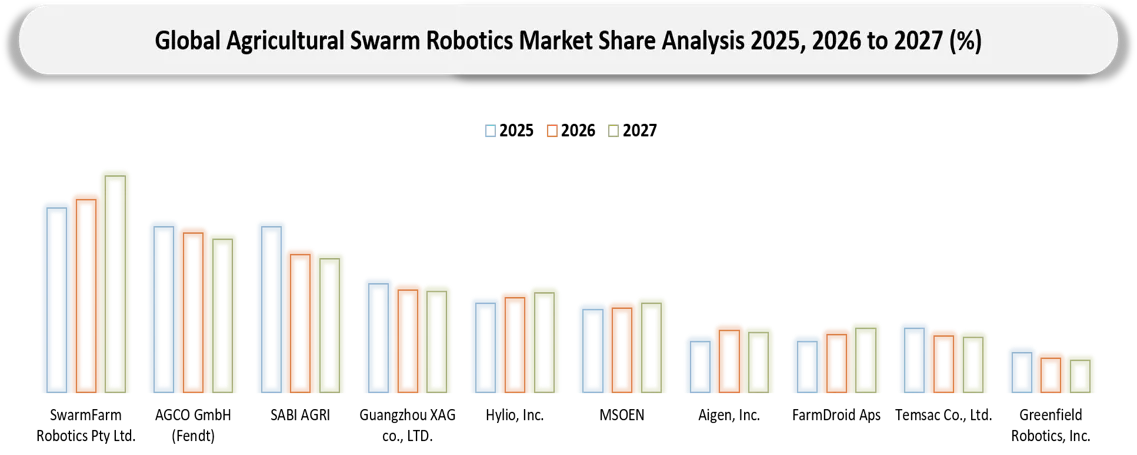
- The global agricultural swarm robotics market is characterized by the presence of agricultural robot manufacturers, autonomous agricultural drone manufacturers, and robotics companies developing coordinated multi-robot systems for crop production, crop protection, weed control, seeding, monitoring, and other field operations. SwarmFarm Robotics Pty Ltd., AGCO GmbH (Fendt), SABI AGRI, Guangzhou XAG Co., Ltd., Hylio, Inc., MSOEN, Aigen, Inc., FarmDroid ApS, tmsuk Co., Ltd., and Greenfield Robotics, Inc. are among the notable players due to their development of autonomous agricultural robots and drones with swarm, collaborative, or coordinated multi-robot capabilities. SwarmFarm Robotics maintains a strong position through its SwarmBot platform, which can operate independently or cooperatively as a swarm across agricultural fields. AGCO's Fendt Xaver system uses multiple small field robots operating as a swarm for autonomous seeding, while SABI AGRI has developed collaborative agricultural fleets in which robotic vehicles work alongside its electric tractors. Guangzhou XAG and Hylio contribute through agricultural drones with explicit swarm-operation capabilities for crop spraying and other precision applications. Meanwhile, MSOEN, Aigen, FarmDroid, tmsuk, and Greenfield Robotics participate through agricultural drone and ground-robot platforms supporting coordinated fleet operations, group deployment, autonomous field management, seeding, and chemical-free weed control.
- SwarmFarm Robotics Pty Ltd. (Australia), AGCO GmbH (Fendt) (Germany), SABI AGRI (France), Guangzhou XAG Co., Ltd. (China), Hylio, Inc. (United States), MSOEN (China), Aigen, Inc. (United States), FarmDroid ApS (Denmark), tmsuk Co., Ltd. (Japan), and Greenfield Robotics, Inc. (United States) are among the notable players operating in the global agricultural swarm robotics market.
Key Developments
- July 2026, XAG launched its X Series agricultural robot system and RM80 unmanned mower in Guangzhou. The X Series combines an autonomous drone with the XA1 docking station and LM1 chemical mixing and refilling unit to automate spraying, charging, refilling, and chemical preparation. The RM80 adds autonomous ground operations for mowing, surveying, crop protection, and logistics, expanding XAG’s platform toward coordinated aerial and ground robotics.
- April 2024: SwarmFarm Robotics delivered its first commercial SwarmBot autonomous agricultural robot in the U.S. to Beck’s Hybrids in Indiana. The deployment marked the company’s expansion of its autonomous robotics platform into North America. SwarmFarm is also developing applications for non-chemical weed control and weather-responsive crop protection.
- March 2024: Hylio became the first company to receive FAA approval for swarm operations involving agricultural drones weighing more than 55 pounds with a single operator, allowing one pilot to simultaneously operate up to three drones without a visual observer, including at night. This regulatory development can improve the scalability and economics of agricultural drone swarms by allowing multiple machines to perform crop spraying and other field operations concurrently.
- April 2024: Japan-based Temsac Co., Ltd. introduced the Raicho No. 1, an autonomous agricultural robot designed for automated rice seeding and weed control. The robot can operate in groups of multiple units, using AI and high-precision positioning to identify unsown areas and complete seeding across fields. Its compact design enables coordinated use on small and irregularly shaped farmland, making it a relevant development in agricultural swarm robotics.
Key Procurement Priorities and Buyer Evaluation Criteria
- Buyers prioritize agricultural swarm robotics solutions with proven probiotic viability, stability, and controlled release performance to ensure effectiveness across demanding applications
- Buyers prioritize agricultural swarm robotics solutions with proven autonomous operation, multi-robot coordination, navigation accuracy, and reliable task execution to ensure effective performance across applications such as crop monitoring, weed control, precision spraying, planting, harvesting, soil monitoring, and irrigation.
- Buyers prioritize swarm robotics systems with high operational reliability, accurate positioning, obstacle detection, efficient route planning, and coordinated task allocation to enable multiple robots to operate simultaneously without collisions, redundant activities, or interference.
- Evaluation is based on criteria such as robot navigation accuracy, autonomous operating capability, swarm coordination, communication range and reliability, sensor performance, obstacle detection, task allocation, path-planning efficiency, field coverage, battery capacity, operating time, payload capacity, mobility, terrain adaptability, and agricultural task performance.
- Buyers consider factors including batch-to-batch or unit-to-unit consistency, robot durability, software reliability, fleet management capabilities, communication stability, charging and refueling requirements, maintenance needs, spare-parts availability, cybersecurity, interoperability, scalability, and compatibility with existing farm machinery and farm-management systems.
- Preference is given to suppliers with expertise in autonomous agricultural robotics, multi-robot coordination, swarm intelligence, machine vision, precision navigation, GPS/RTK positioning, sensor integration, fleet management, wireless communication, and agricultural automation, supported by proven field deployments and appropriate safety and regulatory compliance.
- Farmers, agricultural contractors, cooperatives, and large commercial farms particularly prioritize suppliers with proven commercial-scale deployment, reliable multi-robot operation, technical support, fleet monitoring capabilities, operator training, maintenance infrastructure, software updates, and the ability to scale the number of robots according to farm size and operational requirements.
- Buyers also evaluate the total cost of ownership, including robot acquisition cost, software and fleet-management fees, charging infrastructure, maintenance, replacement components, labor savings, operating efficiency, and expected return on investment. Solutions that can demonstrate lower labor requirements, higher field coverage, reduced input use, and reliable long-term operation are generally preferred.
Why Choose DataM?
- Technological Innovations: Explores advancements in agricultural swarm robotics technologies, including autonomous navigation, swarm intelligence, multi-robot coordination, machine vision, sensor integration, RTK/GPS positioning, fleet-management systems, wireless communication, AI-based decision-making, task allocation, and collaborative robot control that improve field coverage, operational efficiency, navigation accuracy, and autonomous task execution.
- Product Performance & Market Positioning: Evaluates how agricultural swarm robotics manufacturers differentiate their solutions based on autonomous operating capabilities, robot mobility, navigation accuracy, payload capacity, battery endurance, field coverage, obstacle detection, precision application capabilities, fleet-management functionality, scalability, and suitability across applications such as crop monitoring, weed control, precision spraying, planting, harvesting, soil monitoring, irrigation, and pest and disease management.
- Real-World Evidence: Highlights commercial and field deployments of agricultural swarm and coordinated robotic systems across crop production, demonstrating benefits such as reduced labor requirements, increased field coverage, improved operational precision, optimized agricultural input use, continuous monitoring, and the ability to perform multiple tasks simultaneously through coordinated robotic fleets.
- Market Updates & Industry Changes: Tracks key developments including new robot launches, swarm-operation capabilities, autonomous farming deployments, regulatory approvals, manufacturing facility expansions, strategic partnerships, technology collaborations, pilot projects, and investments in agricultural robotics across major markets such as North America, Europe, and Asia-Pacific.
- Competitive Strategies: Analyzes how leading companies expand through development of autonomous and swarm-capable robots, expansion of robot portfolios, improvements in fleet-management software, partnerships with farmers and agricultural equipment companies, integration of AI and sensing technologies, manufacturing capacity expansion, application-specific robotic solutions, and geographic market expansion.
- Pricing & Market Access: Explains pricing variations based on factors such as robot type, number of robots deployed, payload capacity, sensor and navigation technologies, autonomous capabilities, fleet-management software, charging infrastructure, agricultural implements, customization requirements, maintenance services, and subscription or software fees. It also evaluates procurement models such as direct purchase, leasing, robotics-as-a-service, and technology partnerships.
- Market Entry & Expansion: Identifies growth opportunities driven by agricultural labor shortages, rising demand for farm automation, increasing adoption of precision agriculture, demand for autonomous field operations, advances in AI and robotics, and the need for scalable agricultural production, while outlining strategies such as regional manufacturing, partnerships with agricultural equipment providers, distributor networks, pilot deployments, robotics-as-a-service models, and application-specific solutions.
Target Audience
- Agricultural Robotics Manufacturers, Swarm Robotics Companies, and Autonomous Agricultural Equipment Providers
- Large Commercial Farms, Agricultural Producers, Cooperatives, and Farm Operators
- Precision Agriculture, Farm Automation, and Digital Farming Technology Companies
- Agricultural Equipment Manufacturers, OEMs, Distributors, Dealers, and System Integrators
- Agricultural Contractors and Robotics-as-a-Service Providers
- Research Institutions, Universities, and Government Organizations focused on agricultural robotics, automation, and precision agriculture
- Investors, Venture Capital Firms, Private Equity Firms, and Strategic Partners evaluating agricultural robotics and autonomous farming technologies


























































