


Agentic Payments Market Size and Overview
The global agentic payments market reached USD 18 million in 2025 and is expected to reach USD 3,98,989 million by 2035, growing with a CAGR of 172% during the forecast period 2026-2035. The market is advancing as AI agents move from being helpful to customers in finding products and comparing them to completing consumer and enterprise transactions themselves. In December 2025, according to FinTech Magazine, Visa and its partners were able to perform hundreds of secure transactions using AI. In addition, Visa was collaborating with over 100 partners all around the world, 30 of which were building within the Visa Intelligent Commerce environment, and more than 20 agents and agent enablers were integrating into the system.
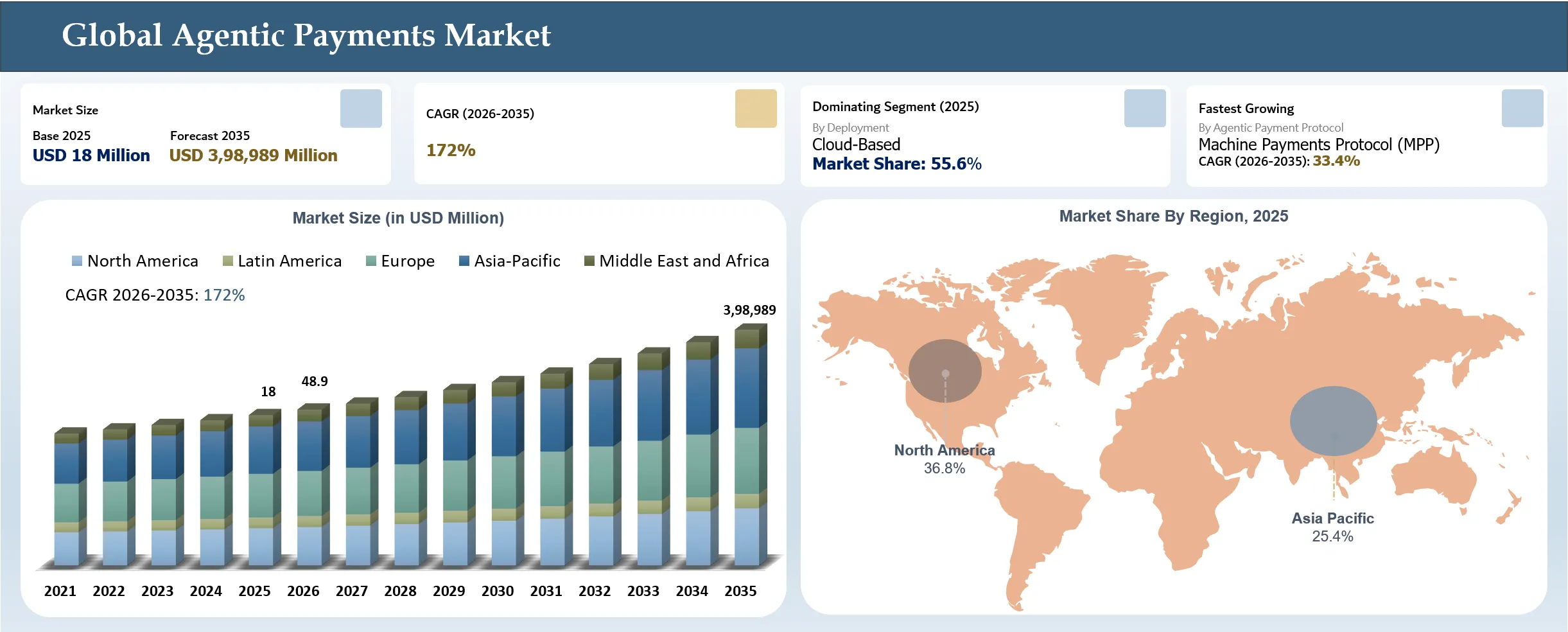
In addition, agentic payments commercialization is being boosted by the increasing engagement of customers in AI-powered commerce and the creation of specialized payment infrastructure. According to FinTech Magazine, almost half of U.S. shoppers already use some form of AI technology to shop; citing Salesforce, the publication also noted that 48% of consumers currently using AI to shop would be okay with an AI agent making purchases for them. Additionally, Visa spent USD 3 billion developing AI and data infrastructure over the previous decade, mostly for anti-fraud purposes, and its systems can scan more than 500 data points per second in up to 83,000 transactions.
White-Space Opportunities for Agentic AI–Enabled Payment Security and Autonomous Transaction Infrastructure
In May 2026, the U.S. federal government is creating a potential opportunity for the Agentic Payments Market through direct procurement of agentic AI capabilities and AI systems supporting financial fraud detection and transaction-related government services. The most directly relevant investment is the USD 800 million Joint Artificial Intelligence contract awarded by the Pentagon's Chief Digital and AI Office to xAI, OpenAI, Google, and Anthropic, making it the first federal contract specifically structured around agentic capabilities and frontier-lab access.
In parallel, the U.S. Department of Health and Human Services (HHS) allocated approximately USD 2.4 billion for AI, including CMS fraud detection, while the U.S. Department of the Treasury allocated approximately USD 1.6 billion for AI, including IRS fraud detection and taxpayer services. These programs are relevant to agentic payments because fraud detection, autonomous decision-making, taxpayer services, and agentic AI capabilities are important building blocks for secure autonomous financial transactions and payment authorization.
The investment creates opportunities primarily for companies developing agentic AI, autonomous decision-making, fraud detection, financial-service automation, and AI infrastructure that can eventually support agent-initiated transactions. xAI, OpenAI, Google, and Anthropic are the direct beneficiaries of the USD 800 million agentic-AI contract, providing advanced AI models and agentic capabilities that can underpin autonomous commercial and financial workflows.
Agentic Payments Market Key Takeaways
- North America led the agentic payments market in 2025 with an estimated 36.8% market share. The Asia-Pacific region recorded a 25.4% market share in 2025 as the fastest-growing market.
- Cloud-based infrastructure dominated the global agentic payments market in 2025, capturing a 55.6% market share. This dominance is driven by the need for scalable, API-based infrastructure supporting machine-native operations.
- AI-driven traffic to U.S. retail websites surged by more than 4,700% year-over-year in October 2025. Furthermore, 85% of shoppers using AI reported that it improved their overall shopping experience.
- The U.S. CDAO awarded a USD 800 million Joint Artificial Intelligence contract to xAI, OpenAI, Google, and Anthropic. This contract marks the first federal agreement specifically structured around agentic capabilities and frontier-lab access.
Agentic Payments Market Industry Trends and Strategic Insight
- Payment initiation is shifting from user-led checkout to delegated transaction execution, with AI agents increasingly capable of interpreting purchase intent, selecting payment methods, and completing transactions within predefined authorization boundaries.
- Agent identity and payment authorization are becoming core infrastructure layers, as payment networks move toward mechanisms that verify whether an agent is legitimate, what authority it has received, and whether a transaction falls within the user's permitted conditions. The September 2026 Visa–Mastercard–Ant International initiative reinforces the industry's movement toward common agent identification and verification standards.
- Machine-to-machine payments are creating a new transaction architecture, in which agents can purchase computing resources, data, APIs, and digital services without a conventional checkout interaction. Mastercard's Agent Pay for Machines specifically targets continuous, programmatic transactions between machines, including very small-value payments.
- The strategic value of agentic payments is shifting toward trust infrastructure rather than payment execution alone, meaning competitive differentiation will increasingly depend on verified agent identity, permission management, transaction controls, auditability, and dispute resolution rather than simply providing another payment method.
- Payment economics could change materially as machine-generated transactions scale, because autonomous agents can create transaction flows with much higher frequency and lower individual values than conventional commerce. Providers therefore need pricing, routing, and settlement models capable of supporting continuous machine activity economically.
Agentic Payments Market Scope
| Metrics | Details | |
| 2025 Market Size | USD 18 Million | |
| 2035 Projected Market Size | USD 3,98,989 Million | |
| CAGR (2026-2035) | 172% | |
| Largest Market | North America | |
| Fastest Growing Market | Asia-Pacific | |
| By Transaction Type | Consumer-to-Business (C2B) Payments, Business-to-Business (B2B) Payments, Machine-to-Machine (M2M) Payments, Agent-to-Agent (A2A) Payments | |
| By Payment Infrastructure | Card-Based Payments, Real-Time Account-to-Account Payments, Digital Wallets, Bank Account Payments, Stablecoin or Crypto-Based Payments, Others | |
| By Agentic Payment Protocol | Agentic Commerce Protocol (ACP), Agent Payments Protocol (AP2), Universal Commerce Protocol (UCP), x402, Machine Payments Protocol (MPP) | |
| By Transaction Mode | Agent-Initiated Payments, Human-Authorized Agent Payments, Fully Autonomous Payments | |
| By Deployment | Cloud-Based, On-Premises, Hybrid | |
| By Region | North America | U.S., Canada, Mexico |
| Europe | Germany, UK, France, Spain, Italy, Poland, Netherlands, Switzerland | |
| Asia-Pacific | China, India, Japan, Australia, South Korea, Indonesia, Malaysia | |
| Latin America | Brazil, Argentina | |
| Middle East and Africa | UAE, Saudi Arabia, South Africa, Israel, Türkiye | |
| Report Insights Covered | Competitive Landscape Analysis, Company Profile Analysis, Market Size, Share, Growth | |
Agentic Payments Market Disruption Analysis
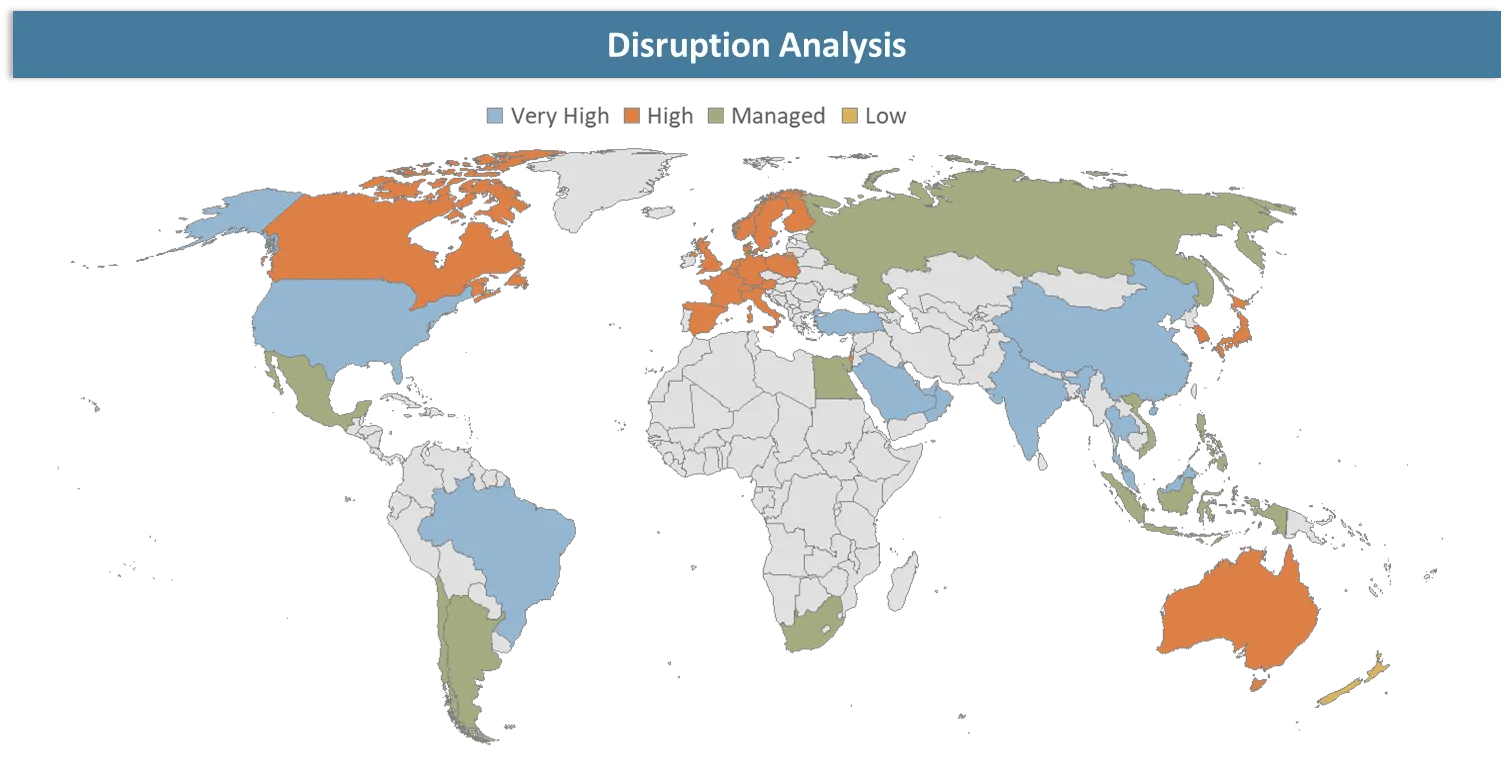
Human Checkout - Agent-Mediated Checkout Reshaping the Payments Landscape
The disruption in the agentic payments market is primarily associated with the rapid shift from human-led checkout to an AI agent-mediated purchase and transaction process. AI agents have started progressing from discovery and suggestion into an autonomous process wherein they will discover, compare, choose, and then execute transactions for consumers and businesses on their behalf, within certain permissions. In December 2025, according to Visa, there were several transactions that were made securely through agents within the ecosystem. Visa also said that AI agents would go from assisting to making the purchase by the year 2026.
The market is gaining momentum as AI agents are moving from helping out in commercial activities to independently performing transactions based on predefined authority. In September 2026, as per Reuters, India has plans to introduce the Unified Agent Protocol that would help AI agents perform micro-digital payments using UPI without having to approve each transaction. The existing size of the payment infrastructure in India gives an excellent starting point for agentic payments, with the total number of transactions via UPI being 24.51 billion transactions valued at INR 29.82 trillion (USD 314.21 billion) in August 2026.
Agentic Payments Market BCG Matrix: Company Evaluation

Stars include Visa, Mastercard, and Google because they have strong positions in global payment infrastructure and are rapidly integrating agentic commerce capabilities into their ecosystems. Question Marks include Stripe, PayPal, Adyen, and Checkout.com, which have strong digital-payment and merchant-acquiring capabilities but are still expanding their positions in the emerging agentic payments ecosystem.
The Potential category includes Razorpay, Worldpay, American Express, and Pine Labs, which benefit from established merchant, card, acquiring, and digital-payment ecosystems but have comparatively narrower exposure to the rapidly developing agentic-payment infrastructure. Cloudflare belongs to the Tailenders category because its primary strength is in cloud, connectivity, security, and internet infrastructure rather than conventional payment processing.
Agentic Payments Market Dynamics
Driver Impact Analysis
| Driver | Market Growth Impact (%) | Demand Concentration | Impacted Use Case | Strategic Impact |
Rapid adoption of AI agents for autonomous purchasing is driving demand for payment systems that can execute transactions on behalf of users. | 32% | High – Consumer commerce, travel, retail and digital services | Autonomous shopping, travel booking, subscription purchases, personalized purchasing | Shifts payments from human-initiated checkout toward delegated and autonomous transaction execution, increasing demand for agent identity, tokenization, authorization and spending controls. |
Growing deployment of agentic commerce protocols and payment standards is accelerating interoperability between AI agents, merchants, and payment networks. | 26% | High – Payment networks, merchants, AI platforms and fintechs | Agent authentication, checkout orchestration, cross-platform transactions, delegated payments | Creates demand for interoperable payment protocols and common trust standards. |
Expansion of autonomous B2B transactions and machine-to-machine payments is creating demand for always-on, programmable payment infrastructure. | 24% | Very High – B2B procurement, cloud/compute, IoT and machine services | AI compute payments, API/data access, automated procurement, inventory replenishment, M2M micropayments | Expands the market beyond consumer checkout toward high-frequency, low-value machine transactions. |
Increasing demand for frictionless and personalized checkout experiences is encouraging merchants to integrate AI-driven payment execution. | 18% | Medium-to-High – E-commerce, travel, financial and digital-service merchants | One-click/zero-click checkout, personalized offers, automated reordering, autonomous bookings | Moves merchant strategy from optimizing conventional checkout pages toward AI-readable commerce infrastructure, structured product information and payment experiences designed for agent-mediated transactions. |
Rapid adoption of AI agents for autonomous purchasing is driving demand for payment systems that can execute transactions on behalf of users
Rapid adoption of AI shopping agents for autonomous purchases has led to growing demand for payment methods that are able to conduct transactions with minimal human participation. MasterCard's Agentic Commerce 2025 has developed technology that allows the use of certified AI shopping agents to conduct transactions on behalf of customers and organizations. It has illustrated the shift from AI-assisted shopping to AI shopping agents executing transactions. This shift is also creating demand for payment infrastructure that can handle agent identities, authorization delegation, payment credentials, and transaction controls.
In parallel, the rapid growth of AI-driven commerce is pushing payment providers to develop infrastructure specifically designed for autonomous purchasing. In October 2025, according to Visa, AI-driven traffic to U.S. retail websites had surged by more than 4,700% over the previous year, while 85% of shoppers who had used AI for shopping said it improved their shopping experience. In April 2026, Visa further reported that nearly 40% of Americans had made a purchase they normally would not have considered because of an AI agent or tool, while 53% of surveyed U.S. businesses were willing to allow AI agents to negotiate prices or terms with other AI agents. Consequently, payment providers are investing in tokenized credentials, delegated spending controls, authentication and agent-verification protocols to enable secure autonomous purchasing at scale.
Restraint Impact Analysis
| Restraint | Drag on Market Growth (%) | Primary Impact Area | Impacted Use Case | Strategic Impact |
Growing fraud and scam risks are restraining agentic payment adoption as AI agents can be exploited to initiate unauthorized or manipulated transactions. | 30% | Fraud prevention, cybersecurity and transaction trust | Autonomous purchases, digital commerce, automated payments, agent-to-agent transactions | Increases the need for agent authentication, transaction monitoring, spending limits and verifiable intent, raising security requirements before autonomous payments can scale. |
Lack of standardized agent identity and consumer-intent verification is limiting trust in autonomous payment transactions. | 27% | Identity, authentication and authorization | Agent-initiated checkout, delegated payments, recurring purchases and cross-platform transactions | Creates demand for common agent identity and intent standards. Visa, Mastercard and Ant International announced a 2026 initiative to establish common standards for identifying and verifying AI agents. |
Unclear liability for incorrect or unauthorized transactions is creating barriers to widespread adoption of agentic payments. | 23% | Regulatory compliance, dispute resolution and financial liability | Autonomous purchasing, B2B procurement, agent-to-agent payments and high-value transactions | Payment providers, merchants and AI platforms must determine who is responsible when an agent makes an unauthorized or incorrect transaction, encouraging audit trails, explicit authorization and liability frameworks. |
Limited merchant readiness and the need to adapt legacy payment infrastructure for agent-driven transactions are increasing integration barriers. | 20% | Merchant technology, payment integration and infrastructure | Agentic checkout, e-commerce, automated reordering and AI-driven procurement | Merchants must make payment systems agent-readable and compatible with new authentication and authorization mechanisms. |
Growing fraud and scam risks are restraining agentic payment adoption, as AI agents can be exploited to initiate unauthorized or manipulated transactions
One of the major restraints affecting the agentic payments market is the increasing chances of fraudulent activities and scams as AI agents become capable of performing payments on behalf of their customers or businesses. As payment decision-making becomes increasingly automated, malicious actors can exploit compromised agents, manipulated instructions, fake identities, or social-engineering techniques to influence legitimate payment flows.
Fraud and security risks are also becoming an important consideration as AI agents gain greater authority to initiate financial transactions. In April 2026, according to VitalLaw, citing the FBI's 2025 Internet Crime Report, the FBI received 22,364 complaints involving artificial intelligence in 2025, resulting in nearly USD 893 million in reported losses. The scale of AI-related cybercrime highlights the potential vulnerability of autonomous payment systems to manipulation, impersonation, and unauthorized transaction activity, increasing demand for stronger agent authentication, transaction monitoring, and permission-based controls.
Agentic Payments Market Segment Analysis
The global agentic payments market is segmented based on transaction type, payment infrastructure, agentic payment protocol, transaction mode, deployment, and region.
Cloud-Based Infrastructure Driving High-Volume Agentic Payment Processing
The cloud-based segment dominates the agentic payments market, with a market share of 55.6% in 2025, driven by the requirement for scalable and API-based infrastructure, which enables integration of AI agents with payment systems, merchants, and financial services. The need for scalable infrastructure has become increasingly important considering machine-native payment operations.
The innovations introduced by Visa reflect the fast growth of payment processing through machines. In July 2026, according to Visa, the x402 protocol handled an estimated volume of USD 15 million from 109.6 million transactions, while the Machine Payments Protocol (MPP) handled approximately USD 25,000 from 115,000 transactions in its early weeks of operation. With each transaction amounting to less than a penny, these facts underscore the need for a cloud-based platform capable of processing extremely high transaction volumes efficiently and supporting agent identity, authorization, monitoring, and settlement at scale.
Agentic Payments Market Geographical Penetration
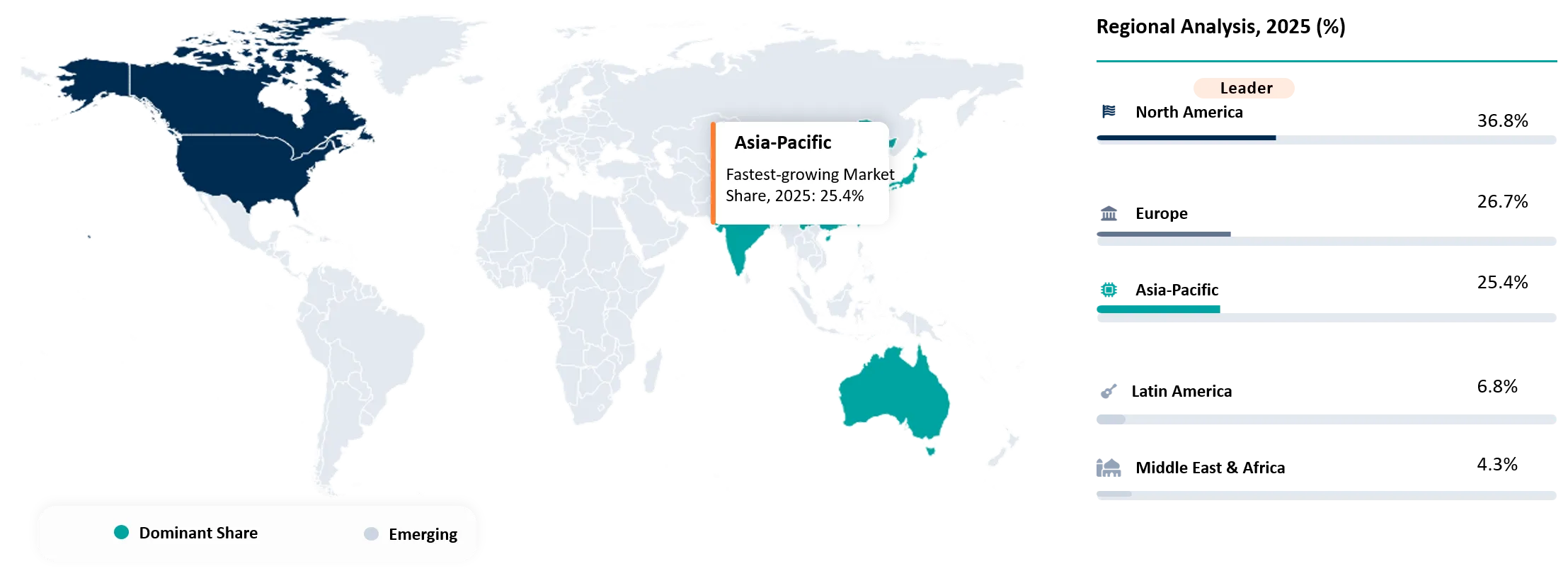
North America Leading Agentic Payments Adoption and Infrastructure Development
The North American region dominates the agentic payments market, accounting for an estimated 36.8% market share in 2025, supported by its concentration of global payment networks, AI technology companies, fintech platforms, and cloud infrastructure providers. The region has become a major testing ground for agent-mediated commerce as payment companies move from pilot programs toward live transactions.
The development strengthens the market’s ability to support secure, scalable, and programmable transactions initiated independently by AI agents. In June 2026, Mastercard, a U.S.-based global payments technology company, launched Agent Pay for Machines (AP4M) to enable AI agents and machines to conduct high-frequency, low-value payments across cards, accounts, and stablecoins. The platform provides credentialing, permissioning, transaction execution, and multi-rail settlement, with transactions potentially occurring at machine speed and at values below one cent.
U.S. Agentic Payments Market Trends
The U.S. holds a dominant position in the North American agentic payments market due to its concentration of global payment networks, AI companies, fintech platforms, and technology infrastructure providers. The country has become an important early market for the commercialization of AI-agent transactions, supported by strong collaboration between payment networks and AI developers.
The development strengthens the foundation for autonomous, stablecoin-based transactions and cross-border agentic commerce. In May 2026, OwlTing Group (OBOOK Holdings Inc.), a Taiwan-based blockchain technology and global fintech company, launched OwlPay Agent Wallet, a self-custody digital wallet designed for AI agents to send, receive, and manage stablecoins on behalf of users. The wallet enables autonomous payments and cross-border transfers within user-defined authorization and supports transactions across the Ethereum ecosystem, Stellar, and Solana. As of the launch, OwlTing had obtained Money Transmitter Licenses or equivalent approvals in 40 U.S. states.
Canada Agentic Payments Market Outlook
Canada is emerging as an important country in the North American agentic payments market, supported by its established digital-payments infrastructure, strong banking ecosystem, and growing integration of artificial intelligence into commerce. The country is increasingly becoming a focus for global payment networks as AI agents move beyond assisting users toward searching, deciding, and completing transactions on their behalf.
The platform expands the foundation for secure, programmable, and cross-border agentic payment transactions. In December 2025, Chimoney, a Canada-based fintech and payment-infrastructure company, launched an integrated Digital Passport and Payment Infrastructure for AI agents and humans, combining programmable wallets, verifiable AI-agent identities, and policy controls. The platform supports payments across 130+ countries, 20+ stablecoins, and 5 blockchains, with 99.9% uptime and sub-200-millisecond policy verification for transactions.
Rapid Commercialization and Expansion of Agentic Payment Infrastructure in Asia-Pacific Region
The Asia-Pacific is the fastest-growing region in the agentic payments market, accounting for an estimated 25.4% market share in 2025. The region is benefiting from rapid digital-payment adoption, strong fintech ecosystems, mobile-first consumers, and increasing investments by global payment networks in AI-enabled commerce. The combination of banks, payment networks, technology providers, and AI platforms is creating the infrastructure required for AI agents to search, select, authenticate, and complete transactions on behalf of consumers and businesses.
The development creates a foundation for scalable, autonomous payment execution across diverse financial services. In November 2025, Omise Co., Ltd., a Thailand-based online payment solutions and fintech company, launched Omise MCP, an AI-agent payment infrastructure based on the Model Context Protocol (MCP). The platform provides AI agents with access to more than 60 payment tools covering payment acceptance, transaction management, subscriptions, transfers, monitoring, refunds, reconciliation, and supplier payouts, enabling autonomous execution of financial tasks.
Japan Agentic Payments Market Trends
Japan is one of the major countries in the Asia-Pacific agentic payments market, supported by its advanced digital-payment infrastructure, large banking ecosystem, technology-oriented economy, and rapid integration of AI into consumer and mobility services. The country is moving agentic payments from experimentation toward real-world commercialization, with payment networks, banks, AI developers, and merchants collaborating to enable AI agents to execute transactions securely.
The development strengthens the foundation for autonomous, programmable, and AI-driven transaction execution. In July 2026, HashPort Inc., a Japan-based blockchain and Web3 technology company, announced plans to launch HashPort Wallet MCP in September 2026, enabling AI agents such as Claude and ChatGPT to control wallets through the Model Context Protocol (MCP). The planned infrastructure will allow agents to perform wallet-related functions, including checking balances and preparing digital-asset transactions, while HashPort Wallet already supports more than 500 tokens, including JPYC and USDC, across multiple blockchain networks.
Agentic Payments Market Competitive Landscape
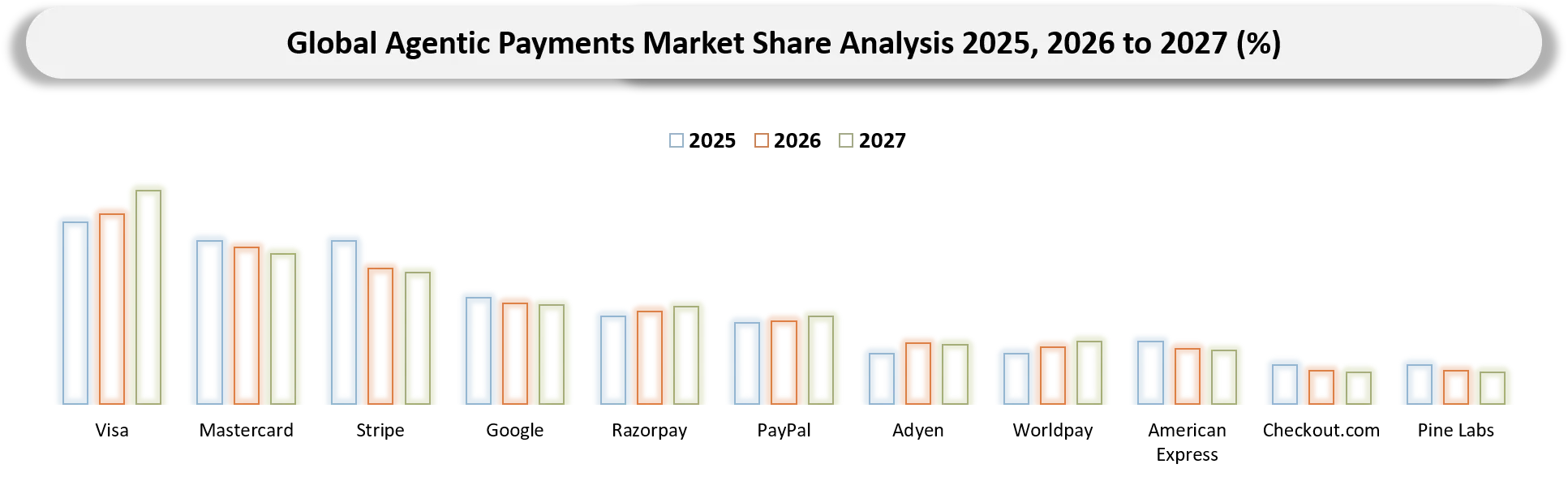
- The Agentic Payments Market is characterized by three key participant groups: global payment networks, AI-powered payment and commerce infrastructure providers, and merchant-focused payment technology companies. Visa and Mastercard lead the network layer through agentic-payment infrastructure, tokenization, authentication, and transaction authorization; Stripe, PayPal, Adyen, Worldpay, and Checkout.com focus on payment orchestration, merchant acceptance, and integration of agentic commerce into existing checkout environments. Google contributes AI, commerce, and digital-wallet capabilities, while Razorpay and Pine Labs strengthen agentic payment adoption through AI-enabled payment and UPI infrastructure. American Express focuses on secure agent-based commerce and authentication, whereas Cloudflare supports the emerging agent identity and security layer. This creates an ecosystem-driven competitive landscape where payment-network reach, AI-agent integration, authentication, tokenization, merchant connectivity, security, and interoperability define competitiveness.
- Key players include Visa (United States), Mastercard (United States), Stripe (United States), Google (United States), Razorpay (India), PayPal (United States), Adyen (Netherlands), Worldpay (United States), American Express (United States), Checkout.com (United Kingdom), Pine Labs (India), and Cloudflare (United States).
Key Developments
- September 2026: Visa, a U.S.-based global digital payments technology company, Mastercard, a U.S.-based global payments technology company, and Ant International, a Singapore-based global digital payments and financial technology provider, launched an initiative to develop common standards for identifying and verifying AI agents that make purchases on behalf of users.
- November 2025: Mastercard, a U.S.-based global payments technology company, launched Mastercard Agent Pay in the UAE in collaboration with Majid Al Futtaim, a UAE-based diversified lifestyle and retail conglomerate, and Dataiera, a UAE-based fintech company.
- October 2025: Mastercard, a U.S.-based global payments technology company, and PayPal, a U.S.-based digital payments and financial technology company, expanded their partnership to accelerate secure agentic commerce globally.
- June 2026: Mastercard, a U.S.-based global payments technology company, launched Agent Pay for Machines (AP4M) to enable AI agents and machines to conduct high-frequency, low-value, and continuous payments at machine speed.
- October 2025: Cloudflare, a U.S.-based connectivity cloud and Internet security company, collaborated with Visa, a U.S.-based global payments technology company, Mastercard, a U.S.-based global payments technology company, and American Express, a U.S.-based financial services and payments company, to establish an authentication layer for agentic commerce.
- November 2025: LazAI, a Canada-based Web3-native AI infrastructure protocol, launched GMPayer, a multi-currency, multi-chain payment hub built on the x402 protocol specifically for AI agents.
Key Procurement Priorities and Buyer Evaluation Criteria
- Organizations investing in the Agentic Payments Market are increasingly selecting technology and payment partners based on their ability to provide secure, scalable, and interoperable agentic payment infrastructure that enables AI agents to initiate, authorize, and complete transactions with minimal human intervention.
- The decision-making process for procurement is increasingly influenced by the growth of AI-driven commerce, autonomous purchasing, machine-to-machine transactions, digital wallets, real-time account-to-account payments, and agentic payment protocols, requiring buyers to evaluate whether solutions can integrate effectively with existing payment, banking, merchant, and AI-agent ecosystems.
- Buyers consider factors such as agent authentication, tokenization, transaction security, fraud prevention, authorization controls, consumer consent, identity verification, transaction monitoring, and auditability when selecting an agentic payments technology partner. The ability to establish clear boundaries for autonomous spending and prevent unauthorized agent activity is becoming a critical procurement requirement.
Why Choose DataM?
- Technological Innovations: Explores advancements in agentic payment infrastructure, including AI-agent authentication, tokenization, delegated authorization, agentic payment protocols, real-time payment connectivity, and machine-to-machine payment capabilities, enabling secure and autonomous transaction execution across digital commerce and financial ecosystems.
- Product Performance & Market Positioning: Evaluates how different players deliver agentic payment solutions based on transaction security, scalability, interoperability, authorization controls, integration capabilities, and payment-network reach, highlighting how leading companies differentiate through agent identity, programmable payment controls, and seamless AI-agent integration.
- Real-World Evidence: Highlights the adoption of agentic payments across autonomous shopping, travel and ticket bookings, subscriptions, AI-driven procurement, digital services, API access, cloud-compute payments, and machine-to-machine transactions, demonstrating the transition from conventional human-led checkout toward AI-mediated transaction execution.
- Market Updates & Industry Changes: Tracks key developments such as new agentic payment protocols, AI-commerce partnerships, authenticated agent transactions, payment-network expansions, merchant integrations, and regulatory and security initiatives across North America, Europe, Asia-Pacific, and other emerging markets.
- Competitive Strategies: Analyzes how leading companies expand through agentic-payment platforms, strategic partnerships, AI integration, tokenization, authentication technologies, protocol development, and merchant-network expansion to establish positions in the evolving agentic commerce ecosystem.
- Pricing & Market Access: Examines differences in transaction economics, payment-processing models, micropayment structures, platform fees, and infrastructure requirements, along with market access through payment networks, banks, digital wallets, fintech platforms, merchant-acquiring systems, and AI-commerce platforms.
- Market Entry & Expansion: Identifies growth opportunities driven by autonomous commerce, AI assistants, real-time payments, B2B procurement, machine-to-machine transactions, and digital services, while outlining strategies such as ecosystem partnerships, protocol interoperability, secure agent authentication, merchant integration, and regional expansion to scale agentic payment solutions globally.
Target Audience
- Payment Networks & Processors
- Banks & Financial Institutions
- Fintech & Payment Technology Companies
- AI & Technology Companies
- E-commerce & Merchant Platforms
- Payment Acquirers & Merchant Service Providers
- Technology & Cybersecurity Providers


























































