


Market Size
Global Acquired Ichthyosis Treatment Market reached US$ 91.6 million in 2025 and is expected to reach US$ 128.3 million by 2033, growing at a CAGR of 4.3% during the forecast period 2026-2033.
Aquired ichthyosis (AI) is an uncommon condition that appears in adulthood and is often secondary to an underlying disease. It is, clinically at least, similar to ichthyosis vulgaris, a harmless hereditary condition that appears in childhood.Aquired ichthyosis may accompany various underlying diseases or drug treatments such as oncological, infectious, inflammatory, and metabolic conditions. The most frequent malignancy associated with this condition is Hodgkin's disease. Aquired ichthyosisis prevalent in cases of human immunodeficiency virus (HIV) infection, which is usually associated with a low CD4+ count and is not necessarily malignant. Cases of known AI have also been reported in the presence of active tuberculosis infection.
Executive Summary
For more details on this report – Request for Sample
Market Dynamics: Drivers & Restraints
Rising Prevalence of Acquired ichthyosis
The global treatment market for acquired ichthyosis is mainly impacted by the increasing cases of acquired ichthyosis, which translates into a rise in the need to effectively diagnose and manage the patients. Despite its low incidence, Acquired ichthyosis tends to appear as a secondary condition to other diseases: autoimmune disorders, some types of cancer, and metabolic syndromes, which are all on the rise in the world. Given the increase in the conditions that are related, coupled with the awareness and the ability to diagnose, more and more cases of acquired ichthyosis are being diagnosed and treated. Therefore, the options of treatment for this condition, for example emollients and keratolytics, and advanced treatment options such as phototherapy, are in high demand.
In addition, with the increase in the number of cases diagnosed, health care providers and researchers are further encouraged to look for new treatment and targeted therapy options, thus widening the market. The well-being of patients is greatly affected by acquired ichthyosis thereby creating a need for long term control measures which is positively impacting the market and improving the available care measures across the globe.
For instance, according to article published in NCBI IV is the most common ichthyosis, with an estimated prevalence of 1 in 100 to 250. The mode of inheritance is autosomal semi-dominant with a milder phenotype in heterozygous individuals. The overall penetrance is 80%-95%. The age of onset is in infancy, with the majority of patients having clearly characteristic manifestations by 5 years of age. Sex or ethnic predilection has not been observed.
Complications Associated With The Drugs
Ichthyosis is a condition where skin cells scale off, causing skin infections, dehydration, blocked sweat glands, slow hair growth, and increased calorie burn. The condition can also cause emotional issues, as the scales can affect self-esteem. Children with ichthyosis are more likely to develop eczema, asthma, hay fever, and hives. Men with ichthyosis are at a higher risk of testicular cancer, undescended testicles, and low sperm count. Other complications include vision loss, hearing loss, and brain and nervous system problems. Overall, ichthyosis can lead to various health issues and complications.
Market Segment Analysis
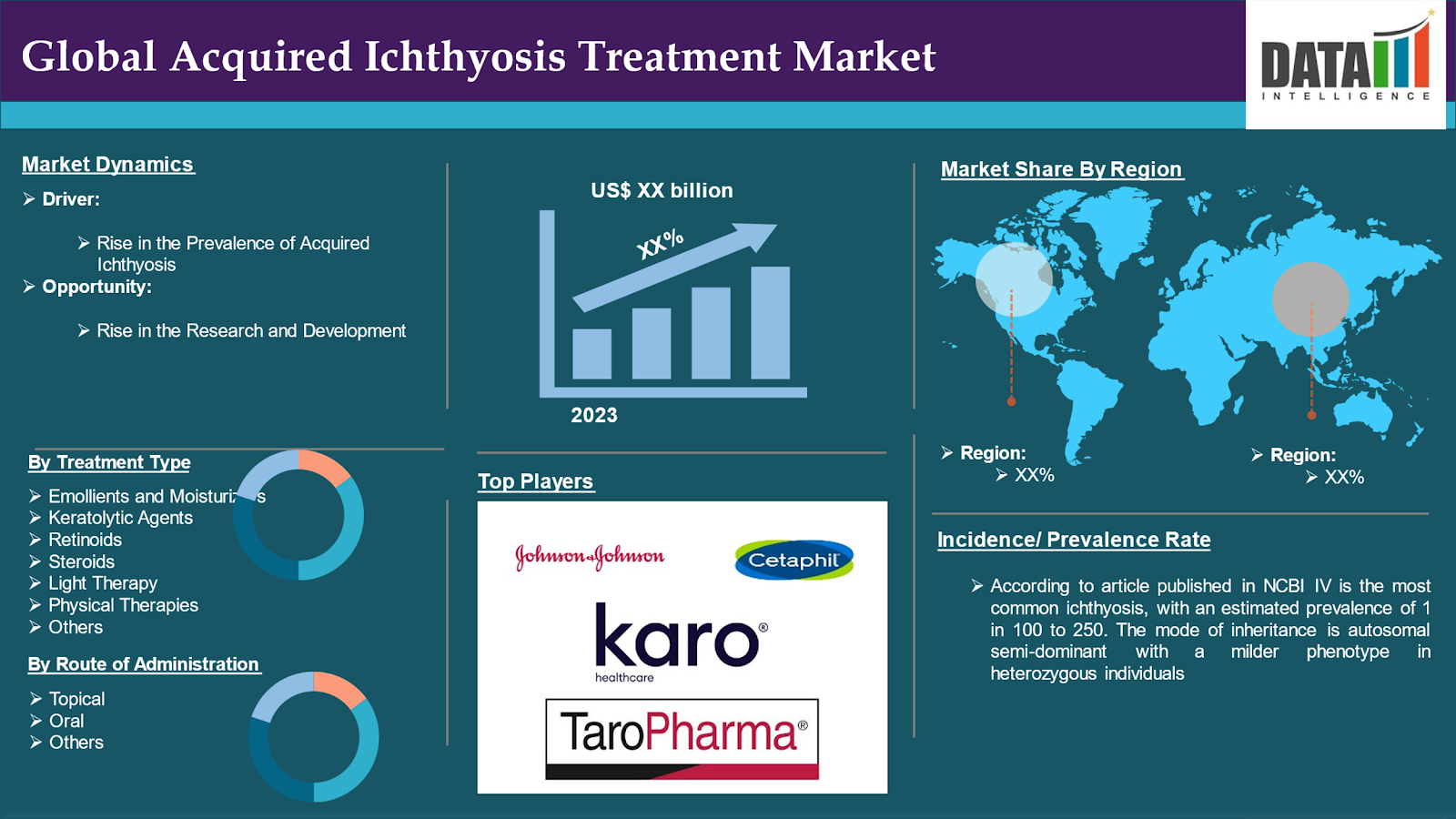
The global acquired ichthyosis treatment market is segmented based on treatment type, route of administration, distribution channel, and region.
Treatment Type:
Emollients and Moisturizers segment is expected to dominate the acquired ichthyosis treatment market share
The emollients and moisturizers segment holds a major portion of the acquired ichthyosis treatment market share and is expected to continue to hold a significant portion of the acquired ichthyosis treatment market share during the forecast period.
Moisturizers and emollients are key components of the global market of therapeutics for acquired ichthyosis, since they are the primary elements in treating rubbery dry skin that is often experienced in this condition. These products work by creating a film over the skin which helps in preventing loss of water by the skin, retaining moisture, and smoothing the dry and hard patches, which are features of ichthyosis, on the skin.
Emollients especially those containing urea, below, glycerin etc. lactic acids, are useful in the elasticity of the skin and relieving discomfort, itching and scaling. They play a significant role in decreasing skin irritation and allow patients to experience a better quality of life by controlling some bothersome symptoms through maintaining skin moisture and also reducing further loss.
Emollients and moisturisers are easy to find, mostly sold in chemists without a prescription, and can comfortably be used for extended periods more so by patients hence making them appealing to both patients and healthcare providers. The treatment's affordability and versatility contribute to a majority of its healthcare market presence considering that this is the first treatment option in most cases and its continuous use is a requisite for people suffering from such a long-lasting skin disorder.
The product which is branded as Laglo Soft Lotion is indicated for management of erythrodermic skin diseases and their complications. It is also known to work in cases of Xerosis, Ichthyosis, Atopic Dermatitis, Psoriasis, Skin Ageing and in treatment involving Corticosteroids.
Keratolytic agents segment is the fastest-growing segment in the acquired ichthyosis treatment market share
The keratolytic agents segment is the fastest-growing segment in the acquired ichthyosis treatment market share and is expected to hold the market share over the forecast period.
Keratolytics play an important role in the global market for acquired ichthyosis skin disorder treatment due to their ability to combat the scaling and thickening of skin associated with the condition. They do so by softening and breaking the uppermost rigid layer of dead keratinized skin so that the skin appears healthier. Salicylic acid, urea and lactic and alpha hydroxy acids are some of the most commonly used keratolytics that help reduce scales and increase flexibility of skin hence are of great help in ichthyosis.
Keratolytics also assist in the absorption of hydrating elements such as emollients and moisturizers by reducing the surface layer of the skin, which helps in reducing the dry skin and skin disorders in general. The application of topical keratolytic agents on the skin as required may bring about drastic changes regarding the skin’s appearance and feeling which makes them of great importance to patients suffering from moderate and severe symptoms. These treatments can be very effective but should be applied judiciously especially in delicate areas because their strength can result in discomfort or dryness when used too liberally.
Route of Administration:
Topical route of administration segment is expected to dominate the acquired ichthyosis treatment market share
The topical route of administration segment holds a major portion of the acquired ichthyosis treatment market share and is expected to continue to hold a significant portion of the Acquired ichthyosis Treatment market share during the forecast period.
As primary treatment for the symptoms of this disease characterized by dry, scaly, and often thickened skin, topical treatments are paramount in the acquired ichthyosis treatment market particularly in the management of global acquired ichthyosis. In topical preparations, skin emollients, moisturisers and scaling agents are the most commonly available topically active ingredients which assist in preventing dry skin, correcting scaling and refining skin.
These products are essential in preventing loss of moisture from the skin, in making the skin supple and in the process of exfoliation by aiding in the shedding of dead skin. Topical corticosteroids come in handy to control inflammation and pruritus, most especially for patients who have pruritus from skin that is dry, irritated and adjacent to lesions.
Oral segment is the fastest-growing segment in the acquired ichthyosis treatment market share
The oral segment is the fastest-growing segment in the acquired ichthyosis treatment market share and is expected to hold the market share over the forecast period.
One of the treatments that can be given orally is usually given for more severe cases of acquired ichthyosis or when topical treatments only are not enough. Systemic therapies like oral retinoids (for example, acitretin) are an essential part of treatment as they act upon the pathophysiology of the disease, eliminating the symptoms of skin scaling and thickening.
Oral retinoids achieve this by modulating the rate of mitotic activity and preventing the abnormal proliferation of epithelial cells within the skin. Although these preparations are effective, they are rarely issued without restriction due to the liver toxicity, drying effect, and potential birth defects that can occur as side effects, requiring strict adherence to the monitoring. Immunosuppressants or systemic steroids are other classes of oral medications that may be prescribed in the treatment of acquired ichthyosis with autoimmune etiology, as they treat the underlying condition.
Market Geographical Share
North America is expected to hold a significant position in the acquired ichthyosis treatment market share
North America holds a substantial position in the acquired ichthyosis treatment market and is expected to hold most of the market share due to the rising number of cases for the conditions related to acquired ichthyosis such as autoimmune diseases, metabolic disorders, and cancers. Moreover, there is a growing concern among the physicians and patients with acquired ichthyosis regarding the management of acquired ichthyosis and its symptoms. As a result, there has been growing use of topical preparations such as emollients, keratolytic agents, and advanced therapies such as phototherapy.
Also, the pharmaceutical industry is on the innovation stage in the North American continent due to the presence of great companies that develops treatments giving the growth of the market. Furthermore, the region's existing healthcare systems, coupled with extensive health insurance coverage and reimbursement policies, promote the adoption of both existing and new treatment modalities, thereby contributing to the growth of the market.
Europe is growing at the fastest pace in the acquired ichthyosis treatment market
Europe holds the fastest pace in the acquired ichthyosis treatment market and is expected to hold most of the market share.
In European region, factors such as increasing healthcare awareness and rising funding towards dermatologicals’ research and investment for treatment are responsible for the expansion of the global acquired ichthyosis treatment market. There exist advanced health care facilities within the region which enables the diagnosis and treatment of acquired ichthyosis at the right time. Apart from that, the rise in cases of acquired ichthyosis has been overflowing towards the rising number of autoimmune disorders, malignancies and certain other infections which contribute to the various risk factors of the disorder. Countries in Europe have a high sense of dermatological life hence such treatments such as keratolytic agents, emollient and phototherapy are in stock.
Moreover, the region growth is also boosted by the increase in the use of advanced therapies in dermatology clinics and hospitals. Also, the pharmaceutical market in Europe is quite large with quite a number of countries involved in the production of innovative agents targeted for the treatment of skin diseases with low prevalence. Therefore, factors such as healthcare policies seeking to provide the patients with the necessary treatments, increasing patient education, and thus treatment seeking behaviors make sure that Europe is a key market for the acquired ichthyosis treatment analysis and strategies.
Key Industry Developments
March 2026: UBC‑affiliated researchers demonstrated a first‑in‑class topical CRISPR‑based gene‑editing therapy for keratinization disorders in human‑skin models, showing restoration of up to around 30% of normal skin barrier function and positioning it as a potential long‑term corrective option rather than a symptomatic treatment for ichthyosis‑spectrum conditions.
January 2026: Timber Pharmaceuticals advanced its TMB‑001 program (topical isotretinoin via IPEG™ delivery) into late‑stage planning for moderate‑to‑severe inherited ichthyoses, building on prior FDA Breakthrough Therapy designation and expanding its pipeline footprint in barrier‑repair and keratin‑modulating therapies for rare skin disorders.
May 2025: Novartis announced a strategic collaboration with Dermira (now part of Eli Lilly) to co‑develop next‑generation topical agents for rare dermatoses, including lamellar and other severe ichthyosis subtypes, with an emphasis on high‑penetration formulations and improved tolerability over conventional emollients and keratolytics.
Market Competitive Landscape
The major global players in the Acquired ichthyosis Treatment market include Johnson & Johnson, Dexeryl, Cetaphil, Taro Pharmaceutical Industries, Avogel, Advantice Health, Karo Healthcare AB among others.
Metrics | Details | |
CAGR | 4.3% | |
Market Size Available for Years | 2023-2033 | |
Estimation Forecast Period | 2026-2033 | |
Revenue Units | Value (US$ Mn) | |
Segments Covered | Treatment Type | Emollients and Moisturizers, Keratolytic Agents , Retinoids, Steroids, Light Therapy, Physical Therapies, Others |
Route of Administration | Topical, Oral, Others | |
Distribution Channel | Hospital Pharmacies, Retail Pharmacies, Online Pharmacies | |
Regions Covered | North America, Europe, Asia-Pacific, South America, and Middle East & Africa | |
Why Purchase the Report?
- To visualize the global acquired ichthyosis treatment market segmentation based on treatment type, route of administration, distribution channel, and region and understand key commercial assets and players.
- Identify commercial opportunities by analyzing trends and co-development.
- Excel data sheet with numerous data points of the acquired ichthyosis treatment market with all segments.
- PDF report consists of a comprehensive analysis after exhaustive qualitative interviews and an in-depth study.
- Product mapping is available in excel consisting of key products of all the major players.
The global acquired ichthyosis treatment market report would provide approximately 70 tables, 65 figures, and 184 pages.
Target Audience 2026
- Manufacturers/ Buyers
- Industry Investors/Investment Bankers
- Research Professionals
- Emerging Companies



























































