


Acesulfame Potassium Market Size and Overview
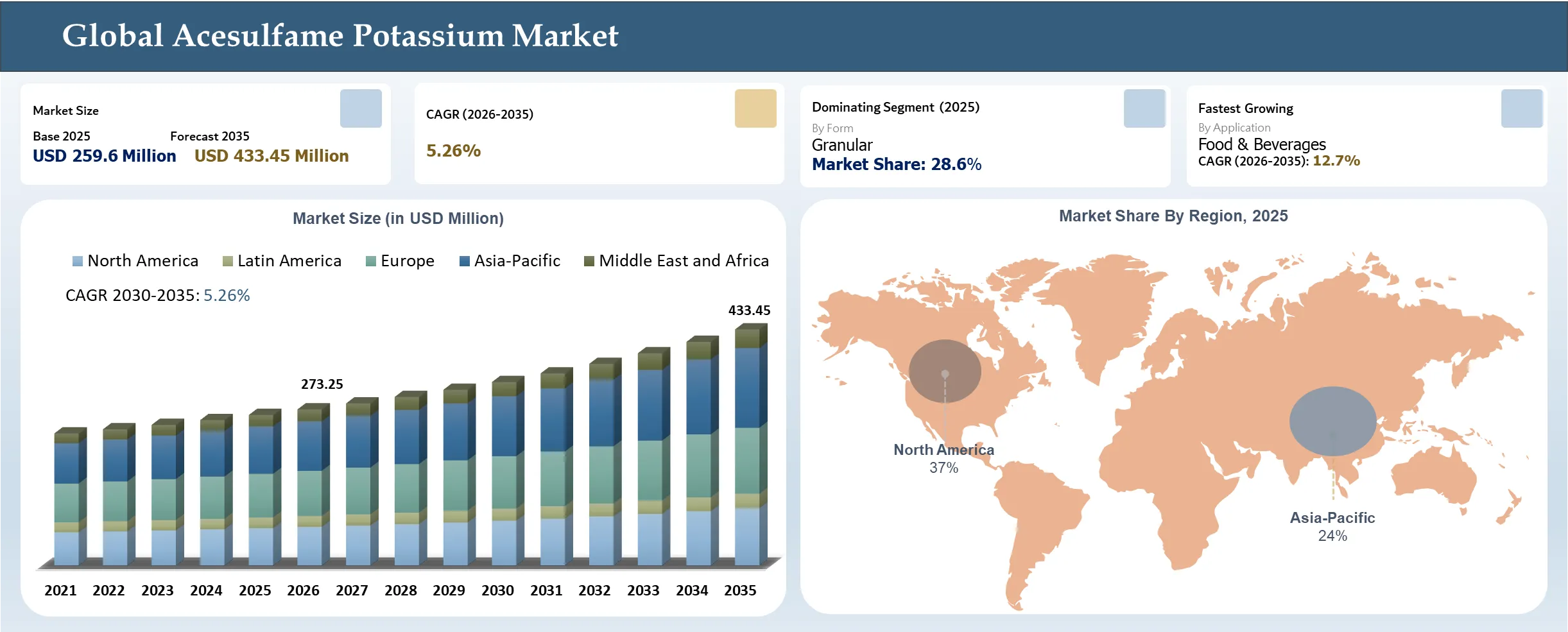
The global acesulfame potassium market reached USD 259.6 million in 2025 and is expected to reach USD 433.45 million by 2035, growing with a CAGR of 5.26% during the forecast period 2026-2035. The market growth is supported by demand for low-sugar and sugar-free beverages, confectionery, and processed foods, where acesulfame potassium provides sweetness without adding calories. The stability of acesulfame potassium and its combination with other sweeteners makes it appropriate for use in many foods and drinks. In April 2025, the European Food Safety Authority (EFSA) revised the acceptable daily intake (ADI) of acesulfame potassium from 9 mg to 15 mg/kg of body weight/day after stating that exposure will be below the new level in all populations in the European Union.
EFSA also emphasised stricter limits for certain impurities, e.g., 5-chloro-acesulfame (max 0.1 mg/kg) and acetylacetamide (max 1 mg/kg). In September 2026, Mitsui & Co. announced plans to acquire an additional 19% stake in Nutrinova Netherlands B.V., increasing its ownership to 89%, while integrating upstream intermediate production at VP4 Frankfurt GmbH into Nutrinova's operations. The consolidation should improve supply security, competitiveness, and quality control for acesulfame potassium and other preservatives.
Acesulfame Potassium Market Key Takeaways
- North America represented the largest regional market in 2025, accounting for a dominant 37% share of global revenues. Growth in this region is anchored by high consumer demand for zero-sugar and sugar-reduced food and beverage products.
- The granular form dominated the acesulfame potassium market by holding a leading 28.6% market share in 2025. Granular product is preferred in large-scale manufacturing due to its efficient bulk handling, stability, and reduced dusting compared to fine powders.
- Formulating acesulfame potassium into blended sweetener systems with sucralose and aspartame carries a 20% driver impact. These combination blends allow manufacturers to optimise sweetness profiles while mitigating unwanted aftertastes.
- In September 2026, Mitsui & Co. agreed to buy an additional 19% stake in Nutrinova Netherlands B.V. for approximately USD 152 million. The transaction raises Mitsui's total ownership stake to 89% while reducing Celanese's holding to 11%.
Acesulfame Potassium Market Industry Trends and Strategic Insight
- Manufacturers are incorporating acesulfame potassium into reduced-sugar and sugar-free carbonated drinks, energy drinks, nutritional beverages, chewing gum, and confectionery to maintain sweetness while lowering sugar content. Its role is particularly relevant in products where manufacturers need consistent sweetness without adding calories.
- Growing Reliance on Blended Sweetener Systems. Food and beverage developers are increasingly treating acesulfame potassium as one component of a broader sweetening system rather than a standalone sugar replacement.
- The EFSA re-evaluation published in 2025 reinforces the importance of impurity controls, analytical testing, and alignment with food-additive specifications. Suppliers may need to strengthen quality assurance, validate manufacturing processes, and maintain documentation that supports compliance across target markets, particularly where regulatory requirements differ.
- Stevia-derived sweeteners and monk fruit ingredients are competing with synthetic high-intensity sweeteners as manufacturers respond to consumer interest in ingredient origin and clean-label positioning. Acesulfame potassium suppliers therefore need to demonstrate its functional advantages while supporting customers in developing formulations that balance taste, cost, regulatory compliance, and consumer expectations.
- Ingredient suppliers have an opportunity to move beyond commodity-style sales by offering formulation guidance, regulatory assistance, application testing, and tailored sweetener combinations. The approach can help beverage, food, and pharmaceutical customers shorten reformulation cycles and address product-specific taste and processing requirements.
Acesulfame Potassium Market Scope
| Metrics | Details | |
| 2025 Market Size | USD 259.6 Million | |
| 2035 Projected Market Size | USD 433.45 Million | |
| CAGR (2026-2035) | 5.26% | |
| Largest Market | North America | |
| Fastest Growing Market | Asia-Pacific | |
| By Form | Powder, Granular, Liquid | |
| By Grade | Food Grade, Pharmaceutical Grade | |
| By Application | Food & Beverages, Personal Care Products, Dietary Supplements, Others | |
| By Region | North America | U.S., Canada, Mexico |
| Europe | Germany, UK, France, Spain, Italy, Poland, Netherlands, Switzerland | |
| Asia-Pacific | China, India, Japan, Australia, South Korea, Indonesia, Malaysia | |
| Latin America | Brazil, Argentina | |
| Middle East and Africa | UAE, Saudi Arabia, South Africa, Israel, Türkiye | |
| Report Insights Covered | Competitive Landscape Analysis, Company Profile Analysis, Market Size, Share, Growth | |
Acesulfame Potassium Market Disruption Analysis
Regulatory Changes and Impurity Control Reshaping the Acesulfame Potassium Market
The disruptions in the acesulfame potassium market are driven by increasing requirements for ingredient traceability, impurity management, and consistent product quality. Manufacturers must strengthen production and analysis controls in order to ensure that their products adhere to the standards required for food additives. The challenges will cost companies more and make it hard for small players.
The disruption is also linked to evolving regulatory requirements for data in the food additive industry. In March 2026, the European Food Safety Authority (EFSA) issued an open call covering 15 priority groups of food additives in which analytical data and use levels will be required, and the deadline for submission is 30 June 2026, while the validation of the data is set for 31 August 2026. Among those priorities are cyclamates (E 952), polyols, and other additives, but not acesulfame potassium. However, this initiative indicates the rising significance of ingredient use records and analytical data in the regulatory decision-making process, motivating sweeteners manufacturers to improve their data collection and management systems.
Acesulfame Potassium Market BCG Matrix: Company Evaluation
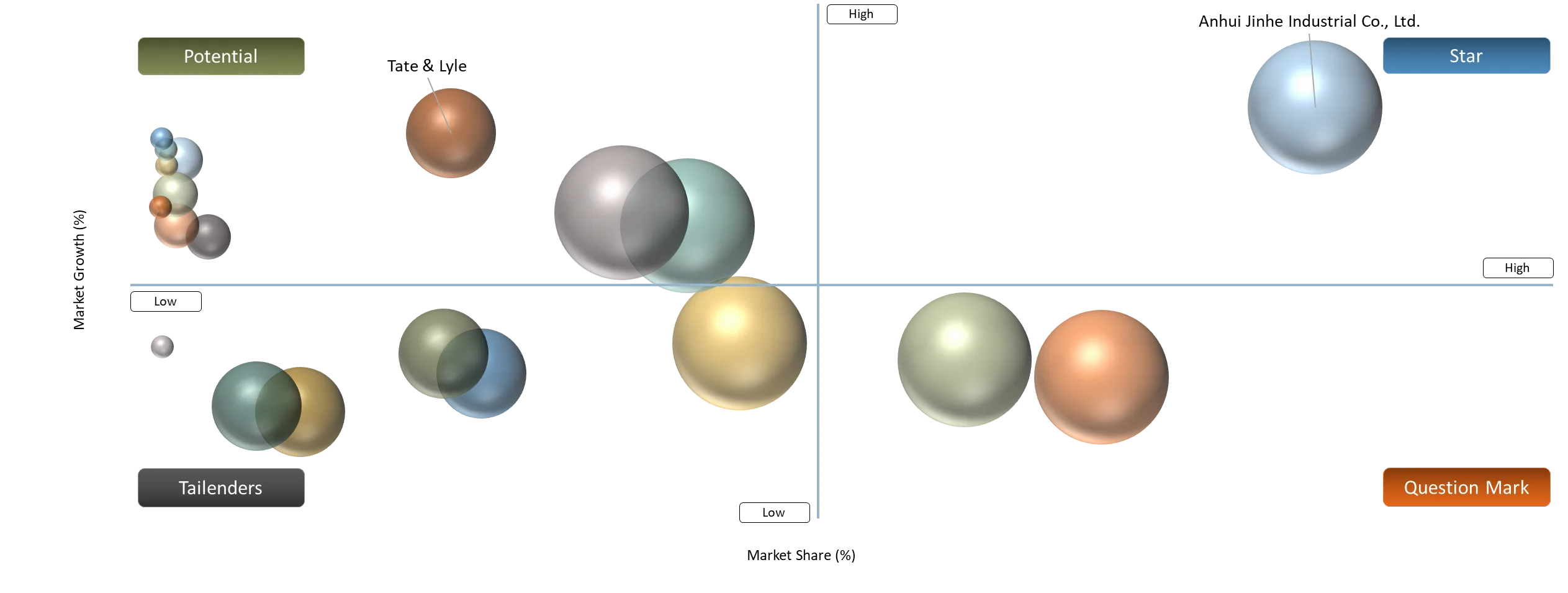
Stars include Anhui Jinhe Industrial Co., Ltd. and Celanese Corporation’s former sweetener business, Nutrinova, based on their established involvement in acesulfame potassium production and the strategic importance of maintaining reliable sweetener supplies. Question Marks include Nantong Acetic Acid Chemical Co., Ltd. and Advancein Organics LLP because they offer acesulfame potassium but have less publicly established evidence of market-leading positions.
Potential include Tate & Lyle, Ajinomoto Co., Inc., and Roquette Frères are classified as Potential companies in this qualitative assessment because of their broader sweetener, food-ingredient, and formulation capabilities. Tailenders include Merck KGaA because of specific market assessment because its broader chemicals and life-science portfolio does not, by itself, establish a leading position in food-grade acesulfame potassium production.
Acesulfame Potassium Market Dynamics
Driver Impact Analysis
| Driver | Market Growth Impact (%) | Demand Concentration | Impacted Use Case | Strategic Impact |
Increasing development of diet soft drinks, energy drinks, and reduced-sugar beverages is supporting the use of acesulfame potassium. | 35% | Carbonated soft drinks, diet beverages, and energy drinks | Sugar-free soft drinks, zero-sugar energy drinks, and reduced-sugar beverages | Strengthens demand for high-intensity sweeteners and encourages beverage manufacturers to expand reduced-sugar product portfolios. |
Food manufacturers are incorporating acesulfame potassium into processed foods, desserts, and confectionery to reduce sugar content. | 25% | Processed foods, confectionery, desserts, and bakery products | Sugar-reduced desserts, chewing gum, confectionery, and baked goods | Expands application opportunities beyond beverages and supports the reformulation of established food products. |
Manufacturers are combining acesulfame potassium with sucralose and aspartame to improve sweetness profiles and support sugar-reduction formulations. | 20% | Blended sweetener systems across food and beverage applications | Diet drinks, flavoured beverages, and sugar-free confectionery | Increases the importance of formulation expertise and enables suppliers to address taste, aftertaste, and product-stability requirements. |
The development of calorie-reduced and sugar-free food and beverage portfolios is increasing demand for high-intensity sweeteners. | 25% | Low-calorie packaged foods, beverages, and specialised nutrition products | Sugar-free beverages, reduced-calorie foods, and dietary products | Encourages manufacturers to broaden sweetener offerings and develop application-specific formulations to meet sugar-reduction targets. |
Increasing development of diet soft drinks, energy drinks, and reduced-sugar beverages is supporting the use of acesulfame potassium
The increasing development of diet soft drinks, energy drinks, and low-sugar drinks is creating more demand for acesulfame potassium since it allows for the reduction of sugar while still maintaining the level of sweetness. The high level of sweetening power possessed by acesulfame potassium makes it applicable in beverage products that can help the company change the sweetness profile without depending on regular sugar alone. It especially been the case with beverage companies, which have been increasingly introducing beverages that contain reduced sugar content.
In parallel, the U.S. Food and Drug Administration (FDA) reports that acesulfame potassium is about 200 times sweeter than table sugar, and it is often used together with other sweetening agents to reach the required level of sweetness in foods and beverages. In addition, the Food and Drug Administration of the USA analysed more than 90 studies on the toxic effects, reproductive effects, carcinogenic effects, and metabolic effects of the product. According to the safety assessment conducted by the Food and Drug Administration, the acceptable daily intake of the product is 15 mg/kg body weight per day, which requires consumption of 23 packs of the product per day for a person weighing 60 kilograms.
Restraint Impact Analysis
| Restraint | Drag on Market Growth (%) | Primary Impact Area | Impacted Use Case | Strategic Impact |
Growing demand for plant-derived alternatives such as stevia and monk fruit is encouraging food and beverage manufacturers to reconsider synthetic sweeteners. | 20% | Clean-label beverages, natural sweeteners, and sugar-reduction formulations | Reduced-sugar soft drinks, energy drinks, flavoured beverages, and natural-positioned food products | Encourages manufacturers to diversify sweetener portfolios and develop stevia-based or blended formulations to meet consumer preferences. |
Demand for products marketed with natural or minimally processed ingredients may limit the adoption of acesulfame potassium. | 15% | Consumer-packaged foods and beverages with clean-label positioning | Natural-positioned drinks, dairy products, confectionery, and reduced-sugar packaged foods | May reduce Ace-K adoption in products where ingredient perception influences purchasing decisions, increasing pressure to reformulate products. |
Advancements in fermentation-derived sweeteners and improved stevia formulations are creating alternatives for manufacturers. | 15% | Sweetener innovation and alternative ingredient development | Sugar-free beverages, functional drinks, and reduced-sugar confectionery | Increases competition from alternative sweeteners and encourages Ace-K suppliers to improve taste performance, formulation compatibility, and cost competitiveness. |
Compliance with purity specifications, manufacturing controls, and food-safety documentation can increase operational costs for acesulfame potassium producers. | 10% | Quality assurance, regulatory compliance, and manufacturing operations | Food-grade Ace-K production and supply to beverage, food, and pharmaceutical manufacturers | May increase production and compliance expenses, placing pressure on margins and requiring continued investment in quality control and traceability. |
Growing demand for plant-derived alternatives such as stevia and monk fruit is encouraging food and beverage manufacturers to reconsider synthetic sweeteners
The increasing consumer preference for natural-origin sweeteners like stevia and monk fruit is a competitive challenge faced by the acesulfame potassium (Ace-K) industry as producers seek alternatives that match their natural ingredient strategy. While Ace-K provides high levels of sweetness and product stability, producers can opt to use plant-origin sweeteners while formulating new products using recognisable ingredients. The change makes it necessary for sweetener providers to focus on the improvement of taste, cost-effectiveness, and formula compatibility to remain relevant in sugar reduction products.
The growing consumer demand for clean-label and nature-sourced sweeteners, and competition from artificial intense sweeteners like acesulfame potassium, is increasing. In April 2026, according to the Centre for the Promotion of Imports from developing countries (CBI), the imports of glycosides that included steviol glycosides in stevia sweeteners by Europe increased by 15% between 2020 and 2024. The contribution of developing countries in supplying glycoside imports to Europe was 57%, worth €186.5 million (USD 208.9 million). The rise in trend can be attributed to growing consumer demand for clean label and natural products as an alternative to synthetic components.
Acesulfame Potassium Market Segment Analysis
The global acesulfame potassium market is segmented based on form, grade, application, and region.
Granular Acesulfame Potassium Form Driving Demand Through Efficient Bulk Handling and Processing Stability
The granular segment dominates the acesulfame potassium (Ace-K) market, with a market share of 28.6% in 2025, due to the benefits associated with handling, storage, measuring and mixing this form of the product. Granular Ace-K may be used in large-scale production of food and drink products where ingredient dosing and efficient bulk handling are required. The ability to use granular Ace-K in dry mixes and powder preparations makes it appropriate for instant drinks, tabletop sweeteners, candies and other sugar-free products. The benefits of granules in comparison with fine powders may include better handling and reduction of dusting when transferring ingredients.
The granular form of acesulfame potassium allows for commercial manufacture of food and beverages by virtue of easy handling and stability under various processing conditions. According to Apura Ingredients, acesulfame potassium is about 200 times sweeter than sucrose in a 3% solution and is very stable at high temperatures and in moderately acidic or basic environments, making it suitable for formulations that are heat stable and require a long shelf life. The product comes in powdered and granular form packed in fibre drums of 25 kg net weight with inner liner and a stated shelf life of three years under recommended storage conditions. Its potential uses include soft drinks, fruit juices, chewing gums, hard candy, ice creams, yoghurt, and puddings.
Acesulfame Potassium Market Geographical Penetration
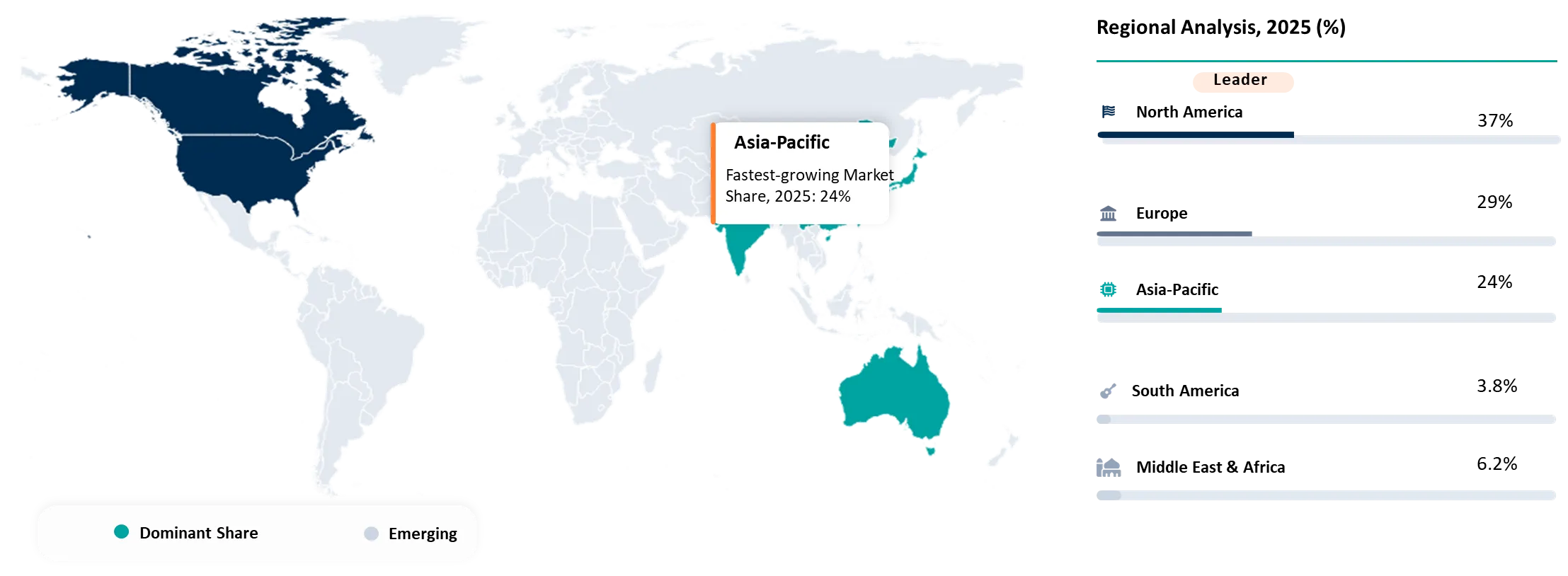
Strong Demand for Sugar-Reduced Beverages and Established Food Manufacturing in North America
North America dominates the acesulfame potassium (Ace-K) market, accounting for 37% of the market share in 2025, supported by its established food and beverage manufacturing industry and demand for sugar-reduced and sugar-free products. The region benefits from the widespread use of high-intensity sweeteners in carbonated soft drinks, energy drinks, powdered beverages, confectionery, baked goods, and other processed foods.
The growing demand for sugar-free snacks is encouraging manufacturers to incorporate high-intensity sweeteners such as acesulfame potassium into familiar confectionery and bakery products. In December 2025, Mondelēz International, Inc., a U.S.-based global snack food manufacturer and consumer packaged goods company that owns the Oreo brand, announced the launch of Oreo Zero Sugar and Oreo Double Stuf Zero Sugar in the U.S. market, with nationwide availability scheduled for January 2026. The products were developed over four years and use a combination of maltitol, polydextrose, sucralose, and acesulfame potassium to deliver sweetness without sugar.
U.S. Acesulfame Potassium Market Trends
The U.S. holds a dominant position in the North American acesulfame potassium (Ace-K) market, supported by its large packaged food and beverage industry, established sweetener suppliers, and continued demand for reduced-sugar and sugar-free products. Ace-K is used in beverages, confectionery, dairy products, and other processed foods because it provides high sweetness intensity and can be combined with other sweeteners to achieve desired taste profiles. The country's established product-development capabilities and broad distribution networks allow manufacturers to incorporate high-intensity sweeteners into new and reformulated products.
Increasing regulatory scrutiny of high-intensity sweeteners is prompting manufacturers to engage with policymakers on food-additive safety and labelling requirements. In November 2025, Nutrinova, a Netherlands-based speciality food-ingredient manufacturer producing high-intensity sweeteners and preservatives, including acesulfame potassium (Ace-K) under the Sunett brand, hired Holland & Knight LLP, a U.S.-based law and lobbying firm, to engage on food-additive regulatory issues affecting its business. The engagement involved four lobbyists and addressed potential U.S. legislative changes, including proposals for front-of-package labelling of nonnutritive sweeteners and periodic FDA safety reviews of existing food additives.
Canada Acesulfame Potassium Market Outlook
Canada is one of the major countries in the North America acesulfame potassium (Ace-K) market because of its established food and beverage processing industry, regulatory framework for approved sweeteners, and use of high-intensity sweeteners in reduced-sugar products. Ace-K is permitted in several food categories in Canada, including beverage mixes, dairy beverages, chewing gum, yoghurt, bakery products, and tabletop sweeteners, subject to specified conditions and maximum permitted levels.
Regulatory changes in Canada are simplifying labelling requirements for food products containing high-intensity sweeteners, including acesulfame potassium. In November 2025, Millar Kreklewetz LLP, a Canada-based law firm specialising in indirect tax, customs, and international trade, reported on amendments to Canada's food labelling regulations. The changes, scheduled to take effect on January 1, 2026, include the removal of additional labelling requirements for four high-intensity sweeteners: aspartame, sucralose, acesulfame potassium, and neotame. Under the revised rules, food products containing these sweeteners no longer require quantitative declarations of sweetener content or a statement on the principal display panel identifying the presence of a high-intensity sweetener.
Japan Acesulfame Potassium Market Trends
Japan is one of the major countries in the acesulfame potassium (Ace-K) market, supported by its established food and beverage manufacturing industry, demand for reduced-sugar products, and use of high-intensity sweeteners in beverage and confectionery formulations. Ace-K is suitable for applications such as sugar-free soft drinks, powdered beverages, chewing gum, candies, and other processed foods because of its high sweetness intensity and stability under various processing conditions.
Strategic ownership changes in the sweetener industry are strengthening investment and supply-chain integration in the acesulfame potassium market. In September 2026, Mitsui & Co., Ltd., a Japan-based is a diversified global trading and investment company, and Celanese Corporation, a U.S.-based global chemical and speciality materials manufacturer, agreed to sell an additional 19% stake in Nutrinova Netherlands B.V. to Mitsui for approximately USD 152 million, increasing Mitsui's ownership to 89% and reducing Celanese's stake to 11%.
Acesulfame Potassium Market Competitive Landscape
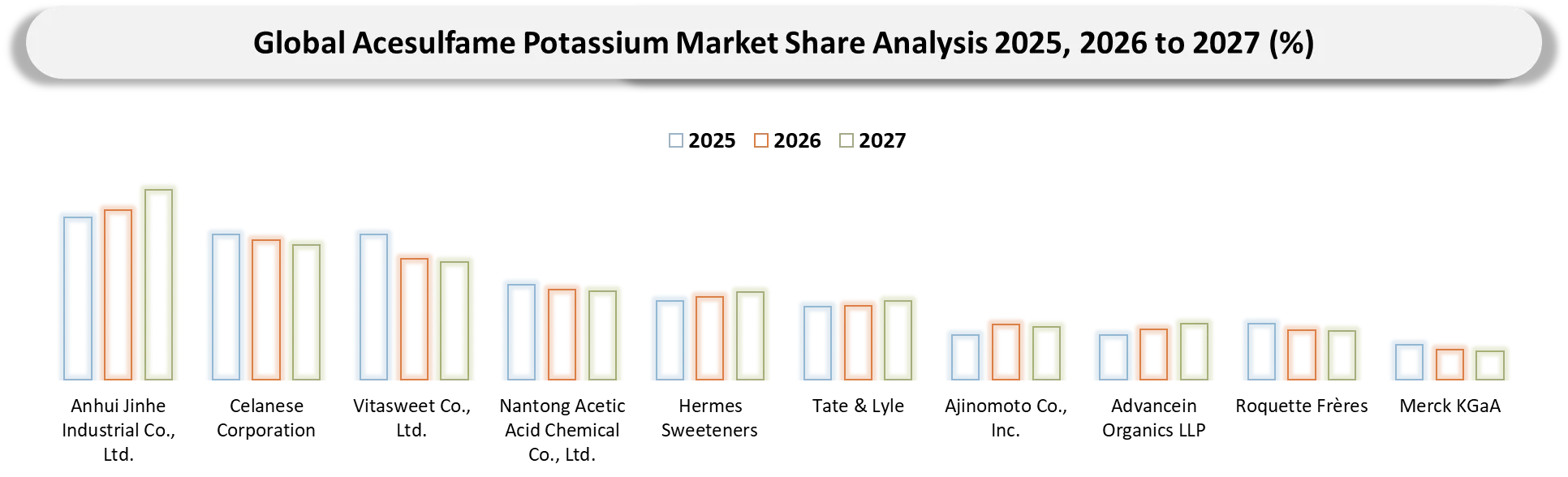
- The acesulfame potassium (Ace-K) market is characterised by three broad participant groups: large-scale Ace-K manufacturers, speciality sweetener suppliers, and global food-ingredient companies. Anhui Jinhe Industrial Co., Ltd., Vitasweet Co., Ltd., and Nantong Acetic Acid Chemical Co., Ltd. are associated with Ace-K manufacturing and supply, while Celanese Corporation and Hermes Sweeteners participate in the broader sweetener and ingredient supply landscape. Tate & Lyle, Ajinomoto Co., Inc., Roquette Frères, Merck KGaA, and Advancein Organics LLP contribute through sweetener-related ingredients, distribution, formulation expertise, or speciality chemical supply. Competitive positioning depends on manufacturing scale, product purity, cost efficiency, regulatory compliance, dependable supply, and the ability to serve food and beverage manufacturers across different applications.
- Key players: Anhui Jinhe Industrial Co., Ltd. (China), Celanese Corporation (United States), Vitasweet Co., Ltd. (China), Nantong Acetic Acid Chemical Co., Ltd. (China), Hermes Sweeteners (Germany), Tate & Lyle (United Kingdom), Ajinomoto Co., Inc. (Japan), Advancein Organics LLP (India), Roquette Frères (France), and Merck KGaA (Germany).
Key Developments
- September 2026: The European Food Safety Authority (EFSA), an Italy-based independent European Union agency responsible for scientific risk assessment of food and feed safety, concluded that the salt of aspartame-acesulfame (E 962), as well as acesulfame potassium (E 950) and aspartame (E 951), raises no safety concerns at currently reported uses and exposure levels.
- March 2026: The Coca-Cola Company, a U.S.-based global beverage manufacturer, announced the launch of Minute Maid Zero Sugar Peach Lemonade in Japan, with nationwide availability beginning March 30, 2026.
- September 2026: Café Amazon, a Thailand-based coffeehouse chain operated by PTT Oil and Retail Business Public Company Limited, introduced its Amazon Fizzpresso sparkling coffee range in Thailand.
Key Procurement Priorities and Buyer Evaluation Criteria
- Organizations procuring acesulfame potassium (Ace-K) prioritize suppliers that can provide consistent food-grade quality, high purity, reliable supply volumes, and competitive pricing for large-scale food and beverage manufacturing.
- Procurement decisions are increasingly influenced by demand for sugar-reduced and sugar-free products, clean-label positioning, and sweetener blends that maintain desirable taste profiles across beverages, confectionery, dairy products, and processed foods.
- Buyers evaluate suppliers based on product purity, compliance with food-safety regulations, impurity limits, batch-to-batch consistency, documentation, traceability, and the ability to meet applicable regional food-additive requirements.
Why Choose DataM?
- Technological Innovations: Explores advancements in acesulfame potassium (Ace-K) manufacturing, purification, quality control, and sweetener formulation, highlighting opportunities to improve product consistency, manufacturing efficiency, and suitability for diverse food and beverage applications.
- Product Performance & Market Positioning: Evaluates Ace-K across granular and powdered forms, comparing sweetness intensity, heat stability, formulation compatibility, and cost efficiency while assessing its competitive position against alternatives such as stevia, monk fruit, sucralose, and aspartame.
- Real-World Evidence: Examines the use of Ace-K in carbonated soft drinks, energy drinks, powdered beverages, confectionery, dairy products, and sugar-free foods, demonstrating its role in reducing sugar content while maintaining desired sweetness and product characteristics.
- Market Updates & Industry Changes: Tracks developments in sweetener manufacturing, regulatory assessments, product reformulation, and supply-chain integration across North America, Europe, and Asia-Pacific to identify changes influencing Ace-K demand and availability.
- Competitive Strategies: Analyses how leading manufacturers and suppliers, including Anhui Jinhe Industrial, Celanese, Vitasweet, and other industry participants, strengthen their market positions through production capabilities, product quality, cost competitiveness, distribution networks, and strategic partnerships.
- Pricing & Market Access: Evaluates factors influencing Ace-K procurement costs, including raw material availability, production efficiency, purity specifications, packaging, transportation, and regulatory compliance, while assessing supplier accessibility for food and beverage manufacturers across global markets.
- Market Entry & Expansion: Identifies opportunities arising from growing demand for reduced-sugar and sugar-free products, expanding beverage applications, and increasing interest in blended sweetener systems, while assessing strategies for regional expansion, customer partnerships, and differentiation against plant-derived alternatives.
Target Audience 2026
- Acesulfame Potassium Manufacturers
- Food and Beverage Manufacturers
- Sweetener and Food Ingredient Suppliers
- Research and Development Teams
- Procurement and Supply Chain Managers
- Regulatory Affairs and Quality Assurance Professionals
- Investors and Private Equity Firm


























































