


Can LNG Infrastructure Become the Fastest Route Around the Data Center Grid Bottleneck?
Venture Global’s October 2026 power agreements with GE Vernova and Baker Hughes mark a strategic shift that extends well beyond LNG. The company is creating a framework for up to 16 additional 720 MW power islands, equivalent to as much as 11.52 GW of new gas-fired nameplate generation, while targeting up to 10 GW of compute capacity at sites it owns or controls by the end of 2034. The new generation would operate in Island Mode, behind the meter and independently of the public grid.
The significance is the business model. Venture Global already has six power islands ordered, under construction or operating across its LNG facilities, representing about 4.5 GW of modular gas-fired generation. It also controls natural gas supply, industrial land, water infrastructure and large-scale project execution capability. By placing data centers next to this infrastructure, the company is attempting to convert an LNG platform into what management calls a vertically integrated AI utility.
If the model works, it changes the economics of data-center power procurement. Instead of waiting for transmission upgrades, utility interconnections and new public-grid generation, developers can contract directly with an energy infrastructure owner that controls the fuel, power plant, grid equipment, land and supporting utilities. That makes time-to-power rather than simply electricity price the core value proposition.
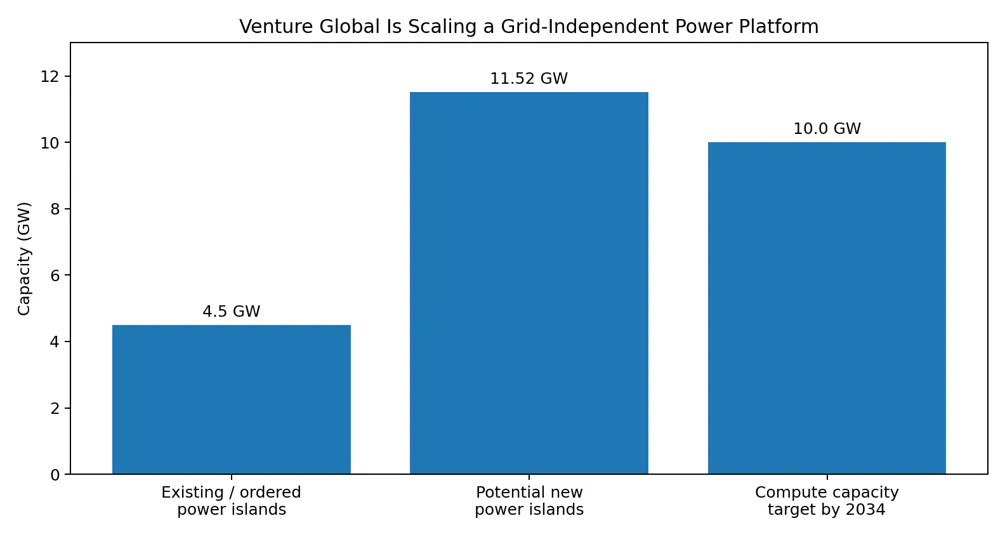
Source: Venture Global. Company agreements imply up to 16 × 720 MW = 11.52 GW of new power-island nameplate capacity
Request Free Demo Access: https://www.datamintelligence.com/electroiq
DMI Analyst View: The Venture Global announcement is an early example of energy infrastructure being redesigned around compute rather than compute being forced to wait for utility infrastructure. The strategic asset is not only cheap natural gas. It is control over the complete path from molecule to megawatt to data-center campus.
The Announcement Is Much Larger Than a Conventional Gas-Turbine Order
Venture Global has entered into power and grid frame agreements with GE Vernova and Baker Hughes Energy Services covering up to 16 new 720 MW power island units plus transformers and gas-insulated switchgear. The power islands use combined-cycle gas turbine configurations consistent with Venture Global’s existing LNG-site infrastructure. The company expects to place the first purchase order by the end of 2026, with equipment delivery capacity scheduled through 2034.
The SEC filing shows the scale of the optionality being secured. If Venture Global ultimately places all contemplated power-island and grid-equipment orders, the aggregate amount payable under the two agreements would be approximately US$17.2 billion, subject to contractual adjustments. Venture Global has already reserved manufacturing capacity for eight of the remaining 15 power islands after the first unit and has entered into initial long-lead reservations for five grid-equipment packages.
This is therefore not a single-project procurement. It is a manufacturing-capacity reservation strategy. In a market where large gas turbines, transformers and switchgear are developing long lead times, Venture Global is reserving equipment slots before all end customers are secured. The objective is to be able to offer power on a timeline that conventional utility development may struggle to match.
| Agreement element | 2026 position | Strategic implication |
| New power islands | Up to 16 units × 720 MW | Creates up to 11.52 GW of potential new nameplate generation |
| Compute target | Up to 10 GW by end-2034 | Positions Venture Global as a hyperscale power-and-site provider |
| Existing power platform | ~4.5 GW across six power islands | Provides operating template, staff and procurement experience |
| Potential equipment spend | ~US$17.2B if all contemplated orders proceed | Shows infrastructure scale required to bypass grid bottlenecks |
| First purchase order | Expected by end-2026 | Moves the platform from concept toward executable capacity |
| Delivery framework | Equipment schedules through 2034 | Aligns turbine and grid-equipment supply with staged AI demand |
Source: Venture Global October 15, 2026 announcement. SEC Form 8-K filed October 2026
Request Free Demo Access: https://www.datamintelligence.com/electroiq
The Real Product Is Time-to-Power
The AI infrastructure cycle is exposing a mismatch between data-center construction timelines and electric-grid expansion. Large data-center campuses can move from site selection to construction faster than new transmission lines, substations and utility-scale generation can be permitted and built. That creates a market for power solutions that can be developed in parallel with the data center rather than after a grid interconnection becomes available.
Lawrence Berkeley National Laboratory’s 2026 update estimates that data centers could consume 11.8% of total U.S. electricity by 2030 under its central estimate, with a scenario range of 9.5% to 15.3%. This compares with approximately 4.4% in 2023. The implication is that data centers are no longer a marginal commercial load. They are becoming a system-scale source of demand capable of changing generation, transmission and equipment investment priorities.
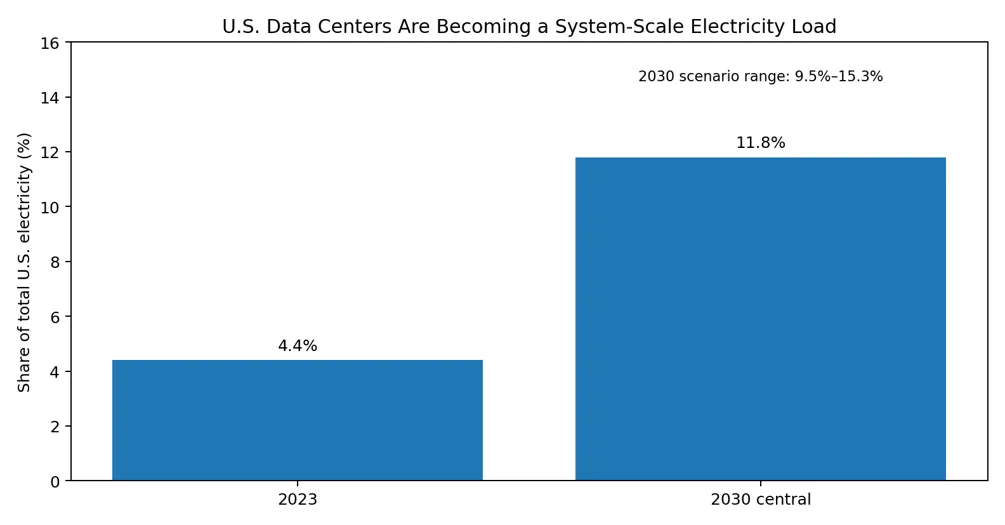
Source: Lawrence Berkeley National Laboratory, United States Data Center Energy Usage Report: 2025 Update, published June 2026
Request Free Demo Access: https://www.datamintelligence.com/electroiq
A grid-independent campus offers a different development equation. A data-center operator can potentially secure power generation, fuel access, land and electrical infrastructure under one commercial framework. For hyperscalers, this can reduce exposure to interconnection queues and utility construction schedules. For the energy provider, it creates a new long-term customer for gas and power without requiring the customer to become the plant developer.
Natural Gas Is Becoming the Bridge Fuel for the AI Power Buildout
The Venture Global strategy is supported by the current U.S. data-center generation mix. The International Energy Agency estimates that natural gas already supplies more than 40% of electricity consumed by U.S. data centers, ahead of renewables at about 24%, nuclear at around 20% and coal at roughly 15%. Through 2030, the IEA expects natural gas to provide the largest increment of U.S. data-center electricity supply, adding more than 130 TWh of annual generation, while renewables add around 110 TWh.
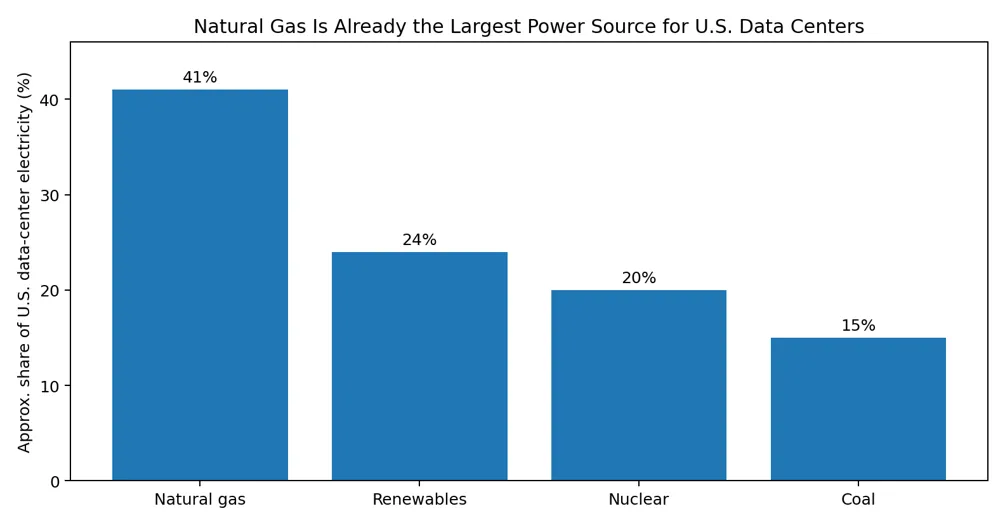
Source: International Energy Agency, Energy and AI, 2025
Request Free Demo Access: https://www.datamintelligence.com/electroiq
This does not mean gas becomes the only long-term AI power source. Nuclear, renewables, storage and grid power will all remain important. Gas has a specific near- to medium-term advantage: large combined-cycle plants can provide firm output, are commercially mature and can be developed around existing gas infrastructure faster than many greenfield transmission or nuclear projects.
For Venture Global, the advantage is even more direct because natural gas is already embedded in the company’s core business. The company’s LNG portfolio exceeds 100 MTPA of capacity in production, construction or development. Using the same gas-infrastructure ecosystem to supply dedicated power effectively adds another monetization pathway for the molecule before export.
The LNG Site Is Being Recast as an AI Infrastructure Campus
Traditional LNG terminals are designed around liquefaction trains, gas pipelines, marine infrastructure and industrial power. Venture Global’s strategy adds a second large demand center alongside that system: computing. Management has highlighted a potential combination of Island-Mode generation, gas supply, closed-loop water systems, thousands of acres of land, data centers and supporting infrastructure.
This creates a new type of industrial campus where LNG infrastructure and digital infrastructure share the same enabling assets. The value comes from co-location. Natural gas does not need to be moved through another distribution network before reaching the power plant. Power does not need to travel through a congested public transmission system before reaching the server load. Long-lead electrical equipment can be procured as part of an integrated program rather than assembled independently by the data-center developer.
The strategic model can be summarized as: upstream gas access → LNG and pipeline infrastructure → dedicated combined-cycle generation → private electrical network → adjacent hyperscale compute. Each step that Venture Global controls removes a third-party dependency from the development schedule.
Gas-Turbine Manufacturing Capacity Is Becoming an AI Supply-Chain Constraint
The agreements also show why power-equipment manufacturing capacity is becoming a strategic asset. GE Vernova said in July 2026 that it expected at least 125 GW of gas equipment to be under contract by the end of 2026. The company was targeting annual gas-turbine output of 20 GW in the third quarter of 2026, 24 GW in 2028 and 30 GW by 2030. Its data-center-related Electrification orders exceeded US$5 billion year-to-date in the first half of 2026, already more than double its 2025 total.
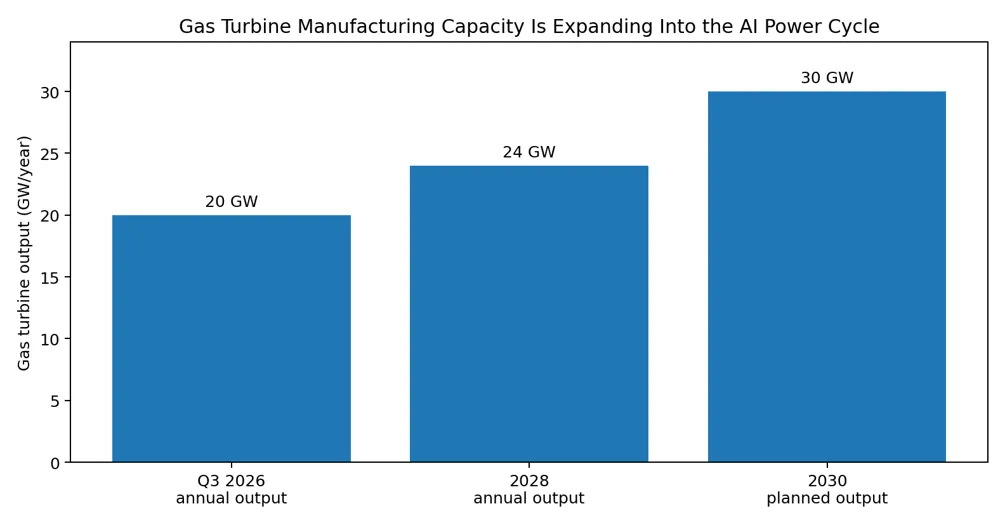
Source: GE Vernova Q2 2026 financial results
Request Free Demo Access: https://www.datamintelligence.com/electroiq
This explains the importance of Venture Global reserving manufacturing capability instead of waiting until a data-center customer signs a final contract. In an equipment-constrained market, the party controlling the turbine slot and transformer slot may control the achievable energization date. The same logic increasingly applies to switchgear, large transformers, gas turbines and other high-voltage equipment.
For GE Vernova and Baker Hughes, the AI buildout expands the addressable power market beyond utilities and independent power producers. Energy companies, hyperscalers and infrastructure developers can become direct buyers of gigawatt-scale generation packages. This changes customer concentration and makes long-term manufacturing capacity itself a competitive differentiator.
Venture Global Is Moving From LNG Exporter Toward Power-and-Compute Infrastructure Provider
The most important strategic shift is in Venture Global’s potential revenue model. LNG remains the company’s core business and management has emphasized that third-party power development would be separate from existing LNG sales commitments. Yet the same asset base can increasingly support three commercial layers: LNG sales, dedicated power sales and data-center infrastructure.
That creates a vertically integrated commercial stack. An LNG exporter traditionally sells molecules. A power producer sells megawatt-hours. A data-center developer sells powered capacity. Venture Global is positioning itself to participate in all three layers by owning or controlling the physical infrastructure connecting them.
| Commercial layer | Traditional model | Venture Global opportunity |
| Natural gas / LNG | Sell gas or LNG to external customers | Retain LNG exports while using gas as feedstock for dedicated power |
| Power generation | Utility or IPP develops generation | Venture Global develops Island-Mode CCGT behind the meter |
| Site infrastructure | Data-center developer secures land, water and interconnection | Offer large industrial sites with power and utilities already integrated |
| Compute capacity | Hyperscaler waits for grid energization | Potential adjacent data centers can contract around dedicated power availability |
Source: DataM Intelligence interpretation of Venture Global’s announced vertically integrated AI utility model
Request Free Demo Access: https://www.datamintelligence.com/electroiq
The Model Could Reshape Where U.S. Data Centers Are Built
Historically, data centers cluster around fiber routes, customer demand, tax incentives and large utility service territories. Grid constraints are making power availability a stronger site-selection variable. A model that places compute next to energy infrastructure could shift a portion of future development toward gas-producing regions, LNG corridors and other industrial sites with existing fuel and infrastructure access.
The Wall Street Journal reported in October 2026 that roughly one-third of data centers currently under development are considering or using on-site power solutions. The figure illustrates how rapidly the market is moving beyond the assumption that the public grid must be the sole source of electricity. Behind-the-meter gas, fuel cells, microgrids, storage and dedicated generation are increasingly being treated as development tools rather than emergency backup systems.
Louisiana is particularly relevant because Venture Global already operates or is developing major LNG facilities there. The same Gulf Coast industrial ecosystem offers gas pipeline access, large tracts of land, heavy industrial permitting experience and an established energy-services workforce. If data centers can be co-located without relying on constrained utility infrastructure, regions traditionally viewed primarily as energy-export hubs can also become compute-export hubs.
The Strategic Trade-Off Is Speed Versus Carbon Intensity
The main constraint on the model is emissions. Combined-cycle gas generation can deliver reliable power quickly, but hyperscalers also have long-term decarbonization commitments. A 10 GW gas-backed compute platform would therefore need a credible strategy around efficiency, carbon capture, renewable integration, low-carbon fuels or long-term transition to lower-carbon generation if it is to remain aligned with increasingly stringent corporate carbon targets.
Venture Global is already developing carbon capture and sequestration projects at its LNG facilities, creating a potential integration pathway. Even so, applying CCS economically and at high capture rates across large power fleets remains a material engineering and commercial challenge. The power solution may therefore be most attractive where time-to-power is valued highly enough to justify a transitional gas-heavy generation mix.
This creates an emerging segmentation in the data-center power market. Some campuses will prioritize carbon-free firm power through nuclear and renewables plus storage. Others will prioritize the fastest possible firm capacity through gas. The largest hyperscalers may combine both approaches across different regions and time horizons.
What This Means for the Global Gas Turbine and Grid Equipment Market
The Venture Global framework is a direct demand signal for gas turbines, steam turbines, transformers, switchgear and power-services capacity. Up to 16 new 720 MW power islands would require a multi-year equipment program at a scale comparable with a national generation buildout. The accompanying grid agreement extends to equipment supporting up to 21 power-island projects, demonstrating that the electrical balance of plant is being secured alongside generation.
If similar models are adopted by other gas producers, midstream companies or large industrial-site owners, the gas-turbine market could gain a new buyer class. This would add AI-related demand on top of utility replacement cycles, grid reliability investment and emerging-market generation growth. Manufacturers with available turbine slots, transformer capacity, service networks and proven modular plant designs should gain pricing power as buyers compete for delivery schedules.
The most valuable capability may therefore shift from simply producing efficient turbines toward delivering complete, repeatable power islands on a contracted timeline. Standardization allows developers to reuse engineering, procurement and construction templates across multiple sites, reducing execution risk and compressing the schedule from customer commitment to energization.
What Data Center Developers Should Watch Through 2030
The Venture Global announcement suggests that future data-center power procurement will increasingly begin before the data-center design is finalized. Developers should evaluate generation equipment availability, fuel access, transformer lead times and private-grid architecture during site selection rather than after a utility interconnection request has been submitted.
Four strategic questions become more important. First, can the site obtain firm power on the same timeline as the compute equipment? Second, is the power source scalable from hundreds of megawatts toward multi-gigawatt campuses? Third, can generation and electrical infrastructure be financed through long-term customer commitments rather than fully speculative development? Fourth, can the carbon profile evolve over the 15- to 25-year life of the data-center campus?
For hyperscalers, the implication is that electricity procurement is becoming infrastructure procurement. Securing power may increasingly require direct participation in generation economics, equipment reservations and site development rather than conventional utility tariffs and renewable PPAs alone.
The Bigger Shift: Energy Companies Are Becoming AI Infrastructure Companies
Venture Global’s planned AI utility represents a broader convergence between energy and digital infrastructure. The companies best positioned to supply the next wave of compute may not be traditional data-center developers alone. Gas producers, LNG companies, utilities, nuclear operators and renewable developers increasingly control the scarce asset AI needs most: large blocks of deliverable power.
The winners will be organizations that can package that power with land, water, grid equipment, permitting and development execution. Venture Global already possesses many of those capabilities because LNG terminals require comparable industrial infrastructure. The company is effectively attempting to reuse its LNG development platform to create a second infrastructure business around compute.
The announcement therefore should not be read only as a 10 GW gas-generation plan. It is a test of whether energy companies can vertically integrate into the AI infrastructure stack. If Venture Global can convert reserved turbine capacity and LNG-adjacent sites into contracted data-center megawatts by the end of the decade, the model is likely to attract competitors across the gas, power and midstream sectors.
The next AI power race may therefore be decided less by who owns the most data-center land and more by who can deliver the fastest bankable gigawatt.