


Automakers Want Optionality Without Walking Away From CATL
“De-CATL-ization” is increasingly being used to describe efforts by automakers to reduce dependence on Contemporary Amperex Technology Co. Ltd. (CATL). The phrase can overstate what is actually happening. CATL remains the world’s dominant EV battery supplier, accounting for approximately 333 GWh of installations and 39.4% of the global market during January-August 2026. BYD followed at 15.1%, while LG Energy Solution held 8.1%.
The structural change is not that automakers are abandoning CATL. They are building alternatives. Li Auto is investing directly in Sunwoda’s battery business. Xiaomi has expanded from a CATL-heavy sourcing structure toward CATL, FinDreams, CALB and Sunwoda. Huawei’s Aito has added CALB and Gotion after relying predominantly on CATL. At the same time, automakers are increasing control over battery packs, BMS, thermal management and cell specifications.
The emerging model is therefore CATL as a core supplier, plus qualified secondary suppliers, plus more internal battery intellectual property. The strategic objective is to remove single-supplier dependence without absorbing the full capital and execution risk of cell manufacturing.
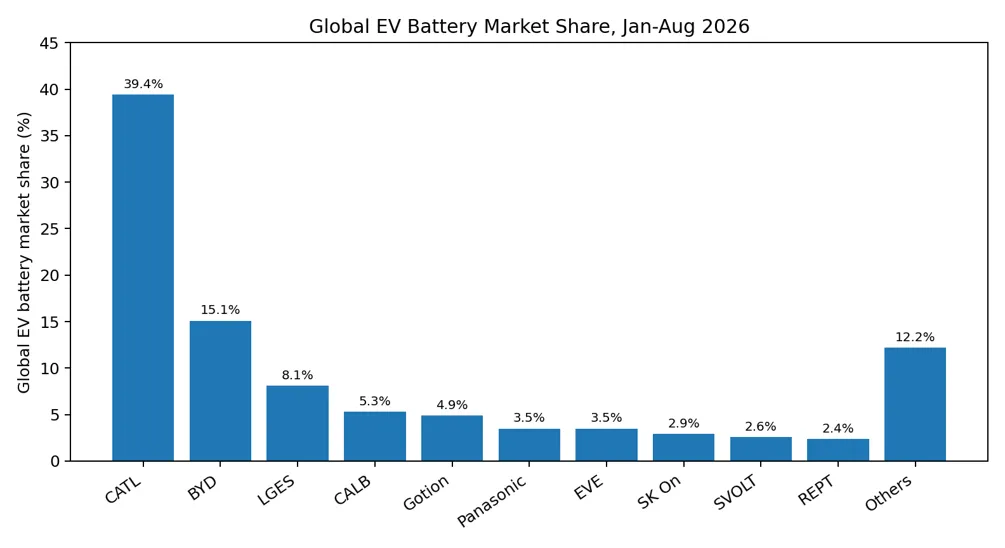
Source: SNE Research via CnEVPost, Jan-Aug 2026
Request Free Demo Access: https://www.datamintelligence.com/electroiq
CATL Still Controls Almost 40% of the Global EV Battery Market
Any discussion around de-CATL-ization needs to begin with the scale of CATL’s position. Global EV battery demand reached approximately 845 GWh during January-August 2026. CATL supplied about 333 GWh, roughly 2.6 times BYD’s 127.9 GWh. Seven Chinese suppliers in the global top ten collectively controlled more than 70% of installations.
CATL’s lead has also remained relatively stable through 2026. It held 45.2% of global installations in January, 40.1% during January-April, 40.2% during January-May and 39.9% during the first half. By January-August, its share stood at 39.4%. This shows that diversification has not yet translated into a sharp collapse in CATL’s aggregate market share.
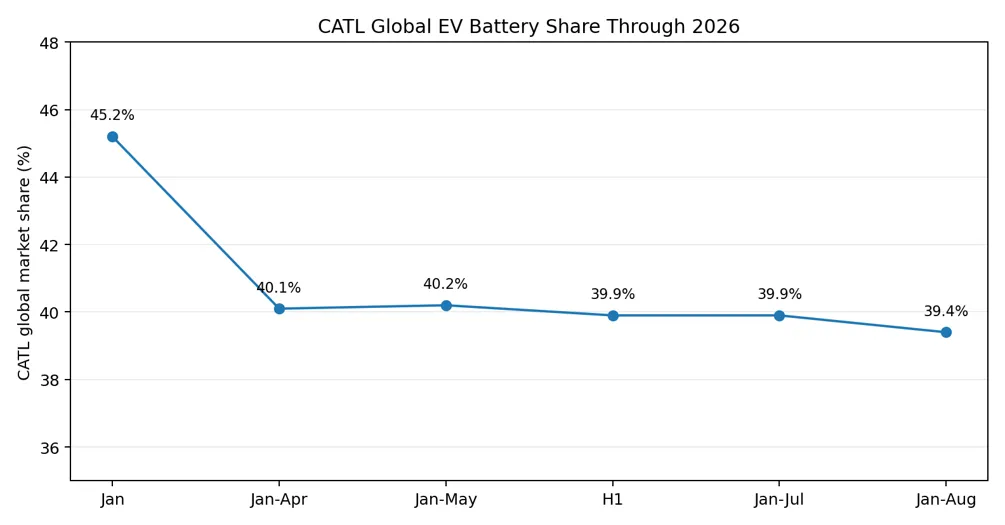
Source: SNE Research data compiled through CnEVPost
Request Free Demo Access: https://www.datamintelligence.com/electroiq
De-CATL-ization Is Really About Removing Single-Supplier Dependence
The most important strategic change is the move from exclusive sourcing toward parallel supplier architectures. Gasgoo describes the trend as a balancing act: automakers continue signing agreements with CATL while simultaneously cultivating backup suppliers, investing in battery companies and increasing internal development.
This creates a hybrid procurement model. CATL can remain the primary supplier while CALB, Gotion, Sunwoda, FinDreams or EVE serve as qualified alternatives. Automakers can then internalize the layers where differentiation matters most, including pack architecture, battery management, thermal control, charging strategy and vehicle integration.
Chinese state media linked to the Ministry of Industry and Information Technology pushed back against describing this as outright “de-CATL-ization,” arguing that adding suppliers and developing internal battery capabilities should be viewed as normal supply-chain diversification. That distinction is important because the market is moving toward post-exclusivity procurement rather than a post-CATL market.
Li Auto Has Made One of the Clearest Investments Into Supplier Diversification
In September 2026, Li Auto agreed to invest RMB 2.65 billion, approximately US$390 million, in Sunwoda Electric Vehicle Battery. Following the transaction, Li Auto would directly own about 8.79% of the battery company, while Li Auto-related entities would collectively hold roughly 11.17%.
The transaction is strategically significant because it combines equity ownership with technology cooperation and capacity support. Li Auto and Sunwoda already have battery manufacturing cooperation, while Li Auto has increased internal work on cell design, 5C fast charging, battery packs, BMS, thermal management and vehicle integration. The objective is not merely to buy cheaper cells. It is to create a bankable alternative battery ecosystem around Li Auto’s own technical specifications.
| Automaker / Ecosystem | 2026 De-CATL-ization Action | Strategic Effect |
| Li Auto | RMB 2.65B (~US$390M) investment in Sunwoda EVB; deeper battery co-development | Creates equity-backed second source and increases internal battery IP |
| Xiaomi EV | Expanded supplier pool from >80% CATL exposure toward CATL, FinDreams, CALB and Sunwoda | Reduces capacity concentration and strengthens pricing leverage |
| Huawei / Aito | Added CALB and Gotion to a portfolio previously centered on CATL | Breaks sole-supplier dependence on selected models |
| Broader Chinese OEMs | Increasing in-house pack, BMS and thermal-management development | Makes cells more interchangeable across qualified suppliers |
Source: Company announcements, CnEVPost and Gasgoo, 2026
Request Free Demo Access: https://www.datamintelligence.com/electroiq
Xiaomi Shows How Concentration Can Be Reduced Without Dropping CATL
As of April 2026, CATL reportedly supplied more than 80% of batteries used in Xiaomi EV deliveries. For a rapidly growing automaker, that level of concentration creates exposure to one supplier’s capacity allocation, pricing and product roadmap. Xiaomi subsequently broadened its qualified supplier base to include CATL, FinDreams Battery, CALB and Sunwoda.
This structure offers four advantages. It reduces dependence on a supplier that also serves competing automakers, improves price negotiation, allows different chemistries and fast-charging specifications to be matched to individual models and lowers the risk that battery availability becomes the bottleneck during product launches. The de-CATL-ization thesis therefore becomes strongest at the account level even when CATL’s global share remains high.
Huawei’s Aito Demonstrates the Pricing Logic Behind Second Sourcing
Huawei’s HIMA ecosystem provides another visible example. Aito historically relied heavily on CATL, but in 2026 it brought CALB and Gotion High-Tech into its battery supply system. Gotion was selected for an 81-kWh battery pack for the Aito M6, ending CATL’s previous sole-supplier position for parts of the portfolio.
Industry sources cited by CnEVPost indicated that smaller suppliers were quoting approximately 10% below CATL in some procurement discussions. Even a 10% difference becomes significant when battery packs represent several thousand dollars of vehicle cost. This gives OEMs a strong incentive to maintain qualified alternatives even when they continue assigning the majority of volume to CATL.
The Second Tier Is Becoming Strategically More Important
De-CATL-ization creates perhaps the largest opportunity for China’s second-tier battery manufacturers. During January-July 2026, CATL still controlled 42.4% of China’s passenger-EV battery market and FinDreams held 23.0%. CALB, Gotion, ZENERGY and Sunwoda each held mid-single-digit shares, giving automakers a deeper pool of technically credible alternatives than existed several years ago.
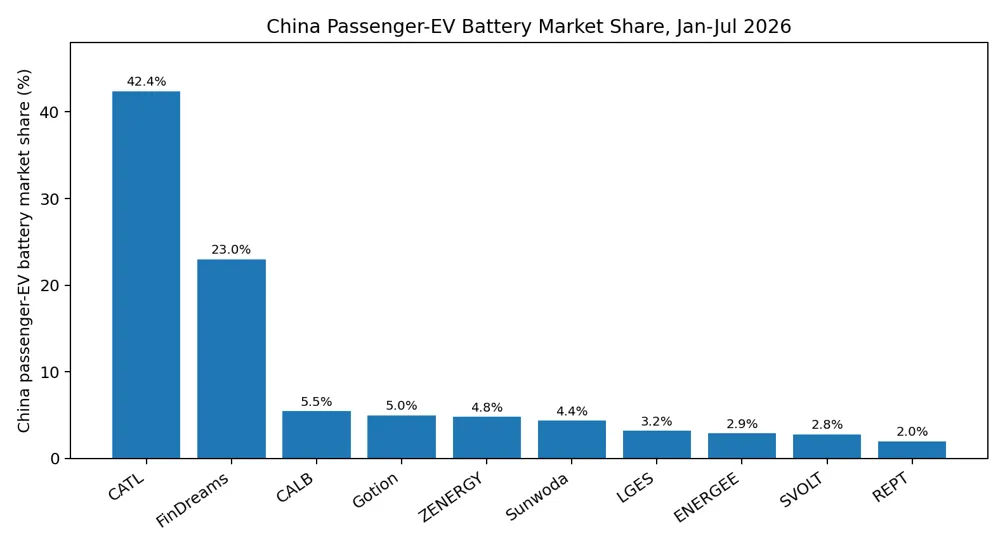
Source: Gasgoo Automotive Research Institute, Jan-Jul 2026
Request Free Demo Access: https://www.datamintelligence.com/electroiq
Sunwoda’s 4.4% share is a useful example. Its market position remains only a fraction of CATL’s, yet Li Auto is willing to provide capital, technology cooperation and demand visibility to help it scale. Second-tier suppliers are therefore moving from residual-order recipients toward strategic counterweights that can be deliberately strengthened by OEM customers.
De-CATL-ization Is Also a Pricing and Procurement-Leverage Strategy
The diversification trend also extends beyond cell procurement. Automakers are bringing more battery-system engineering in-house. This includes pack architecture, battery-management software, thermal systems and cell specifications. Owning these layers gives an OEM greater ability to switch cell suppliers without redesigning the complete battery system around one vendor.
This is strategically different from building a fully integrated cell manufacturing business. Cell production remains capital intensive, yield sensitive and technologically demanding. A more flexible model is for the automaker to own the specification and system architecture while specialist suppliers manufacture qualified cells against those requirements.
CATL’s scale provides major advantages in cost, technology depth and production reliability. The same scale also gives automakers a reason to keep supplier competition active. Battery procurement is therefore becoming a balance between cost, performance, capacity security, bargaining power and platform differentiation.
An automaker does not need to replace CATL across its fleet to materially improve leverage. A credible second source covering even a portion of a vehicle platform can create price discovery, capacity insurance and technical optionality. This is why the strategic impact of de-CATL-ization can be larger than the immediate change in CATL’s market share suggests.
There are strong reasons CATL remains difficult to replace. Battery qualification requires validation of cycle life, thermal behavior, fast charging, safety, software calibration, pack structure, crash performance, manufacturing consistency and warranty performance. CATL also combines scale with broad chemistry development, manufacturing expertise and the ability to support large vehicle programs.
For many OEMs, the rational strategy is therefore to retain CATL as a major supplier while ensuring that CATL no longer controls every critical platform. De-CATL-ization is best understood as a risk-management and negotiating strategy rather than a technological rejection of CATL.
CATL’s Share Is Declining More Slowly Than the Narrative Suggests
The strongest argument against an imminent CATL displacement is the company’s actual installation performance. Its global market share remained close to 40% through most of 2026, while its domestic share remained above 40% in August. Automotive qualification cycles also mean sourcing decisions can take several model years to affect installation volumes.
The more likely path is gradual: fewer exclusive supply arrangements, smaller shares of individual OEM programs, more competitive pricing, greater automaker ownership of battery IP and rising capital flows into second-tier suppliers. CATL can therefore continue growing absolute shipments while becoming less dominant inside individual customer accounts.
CATL Is Responding by Deepening OEM Relationships
The shift is not one-sided. CATL continues to deepen strategic agreements with automakers, including partnerships with SAIC-GM-Wuling and BAIC Group. Its response is increasingly likely to include longer-term supply agreements, joint battery development, faster customization, cell-to-chassis technology, licensing structures, regional manufacturing partnerships and more aggressive commercial terms.
Competition is therefore moving beyond battery-cell manufacturing. The suppliers that are hardest to displace will be those embedded deeply in vehicle architecture, software, thermal engineering and product development.
De-CATL-ization Could Reshape Battery Capital Allocation
The most important long-term consequence may be where new battery investment goes. If automakers provide second-tier suppliers with strategic equity, long-term offtake, joint ventures, dedicated lines and technology agreements, those suppliers can finance capacity that would otherwise be difficult to justify.
The Li Auto-Sunwoda transaction demonstrates the mechanism: an OEM wants an alternative to CATL, invests in that alternative, provides volume visibility, improves the supplier’s ability to scale and ultimately creates a more credible competitive benchmark for future sourcing. If repeated across multiple OEMs, this can gradually reduce market concentration without requiring CATL shipments to decline outright.
Outside China, supplier diversification has another dimension. Automakers and governments increasingly want battery supply chains aligned with regional manufacturing rules, localization targets and industrial-policy incentives. CATL remains globally competitive, but Western OEMs may balance CATL exposure with LG Energy Solution, Samsung SDI, SK On, Panasonic and regional ventures. In some cases, Chinese battery technology may still enter through licensing or technology-transfer structures rather than direct cell imports.
The outcome is likely to be a more regionalized battery market: China led by CATL, BYD and a growing group of second-tier suppliers; Europe supported by a mix of Chinese, Korean and regional producers; North America dominated by Korean and Japanese suppliers with selected licensed Chinese technology; and emerging Asia using a broader mix of Chinese, Korean and Japanese capacity.
Request Free Demo Access: https://www.datamintelligence.com/electroiq
What Battery Suppliers and Automakers Should Prepare for
Winning one OEM battery program will no longer guarantee control of that automaker’s next platform. Battery suppliers increasingly need to defend share vehicle by vehicle. Cost competitiveness, technology differentiation and integration depth will be the three most important capabilities. Second-tier suppliers should use the current diversification cycle to move from backup-supplier status toward strategic co-development status.
For automakers, de-CATL-ization should not be treated as an objective in itself. The real objective is supply-chain optionality. Major platforms should increasingly have at least two qualified battery suppliers, while OEMs internalize pack, BMS and system-integration capabilities that make cell switching easier. Strategic equity investments or joint ventures should be used selectively where an alternative supplier requires scale support.
The resulting industry is unlikely to become post-CATL. CATL’s approximately 39.4% global share remains too large and its technology position too strong for that framing. A more accurate description is a move toward post-exclusivity battery procurement. CATL is likely to remain the global benchmark supplier. What is disappearing is the assumption that being the benchmark supplier automatically means being the only supplier.