


The Global Animal Nutrition Market is segmented by animal type (Poultry, Ruminant, Aquaculture, Swine, and Others), ingredients (Amino Acids, Enzymes, Minerals, Lipids, Vitamins, and Others), end-user (Aquaculture, Pet Food Manufacturers, Animal Feed Manufacturers, and Others), and region (North America, Europe, South America, Asia-Pacific, Middle East, and Africa).
Rising Demand for High-Quality Animal Protein, Growing Focus on Animal Health and Feed Efficiency, and Increasing Adoption of Functional Feed Ingredients Accelerate Global Animal Nutrition Market Growth
FOR IMMEDIATE RELEASE
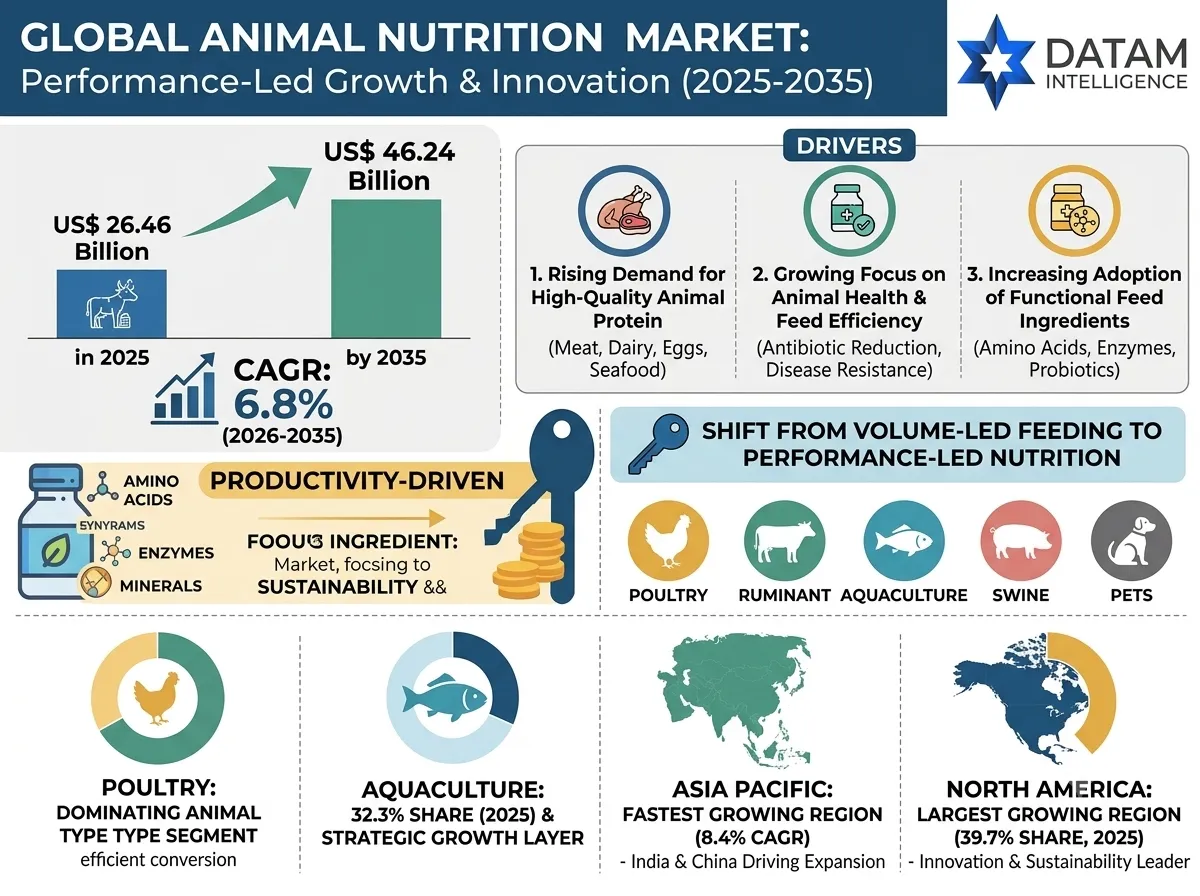
LEANDER, Texas: The animal nutrition market is becoming more important as livestock, aquaculture and pet food producers move from volume led feeding to performance led nutrition. Feed is no longer viewed only as a cost item. It is now a productivity tool that affects growth rate, feed conversion, animal health, disease resistance, reproductive performance and product quality.
According to DataM Intelligence, the global Animal Nutrition Market reached US$ 26.46 billion in 2025 and is expected to reach US$ 46.24 billion by 2035, growing at a CAGR of 6.8% during 2026 to 2035. The market is segmented by animal type into poultry, ruminant, aquaculture, swine and others. It is segmented by ingredients into amino acids, enzymes, minerals, lipids, vitamins and others. It is also segmented by end user into aquaculture, pet food manufacturers, animal feed manufacturers and others.
Request a Sample Report for the Global Animal Nutrition Market
Gain comprehensive insights into market trends, growth opportunities, competitive landscape, and key industry developments shaping the global animal nutrition market. This report provides detailed analysis of animal types, ingredients, end-user segments, regional dynamics, market drivers, challenges, and future growth prospects.
The market is being pulled by rising demand for meat, dairy, eggs and seafood, but the deeper shift is in how producers manage feed. DataM Intelligence notes that animal nutrition is becoming productivity driven rather than only volume driven, with producers focusing on feed conversion efficiency, growth optimization, disease resistance and profitability per animal. Precision feeding, amino acid balanced diets, enzymes, probiotics and micronutrient premixes are becoming more important because they help producers improve output without simply expanding herd or flock size.
North America Region Analysis: Innovation, Feed Additives and Sustainable Nutrition Support Growth
North America remains a major animal nutrition market because of its mature livestock industry, advanced feed formulation capability, large poultry and swine sectors, strong dairy production and established pet food manufacturing base. North America is the largest growing region at 39.7% share in 2025, supported by new product development, partnerships and emerging opportunities in personalized nutrition, alternative proteins and sustainable feed solutions.
The region’s advantage comes from technical depth. Feed producers, additive suppliers, nutritionists and livestock integrators work closely on formulations that improve digestibility, gut health and production economics. This matters because North American producers are under pressure to reduce antibiotic use, improve animal welfare, manage input costs and respond to changing consumer expectations around food safety and sustainability.
Recent product activity reflects this direction. North America’s next opportunity will come from nutrition systems that support measurable performance. Basic additives will still have demand, but higher value growth will be tied to enzyme blends, probiotics, precision premixes, methane reducing additives and digital feeding tools that can prove feed efficiency or health benefits at farm level.
Asia Pacific Region Analysis: Fastest Growth Comes From Poultry, Aquaculture and Dairy Expansion
Asia Pacific is the fastest growing region in the animal nutrition market at 8.4% Crough 2035AGR through 2035. China, India, Southeast Asia and other emerging economies are expanding poultry, aquaculture and dairy production capacity, which is increasing demand for advanced feed ingredients and nutritional additives.
The region’s growth is practical. More consumers are entering higher protein diets. Poultry consumption is rising because it is affordable and widely accepted. Aquaculture is expanding because seafood demand is increasing and wild catch growth is limited. Dairy production is becoming more organized in several markets, especially where cold chain and branded dairy distribution are improving.
Asia Pacific also has a strong need for feed efficiency. Feed costs can represent a large share of production costs, especially in poultry, swine and aquaculture. That makes enzymes, amino acids, minerals, vitamins and functional additives more attractive when they improve digestibility or reduce waste. Precision nutrition is gaining traction because it allows producers to tailor feed by species, age, growth stage and production target.
In Q1 and Q2 2026 increased investment in precision livestock feeding systems across Asia Pacific, particularly in India and China have driven market expansion. Companies are accelerating adoption of amino acid balanced feed formulations, enzyme based additives and sustainable protein sources to improve feed efficiency and reduce methane emissions, supported by government backed livestock productivity programs.
The challenge is market fragmentation. Large integrated producers can adopt advanced nutrition systems faster. Smaller farms may need education, distributor support and affordable premix formats before they shift away from conventional feeding patterns.
Animal Type Segment Analysis: Poultry Leads Because It Converts Feed Into Protein Efficiently
Poultry is the dominating animal type segment in the animal nutrition market. Its lead is supported by strong global demand for chicken meat and eggs, relatively short production cycles, high feed conversion efficiency and large-scale integrated production systems.
Poultry nutrition is highly formulation sensitive. Broilers need diets that support rapid growth, gut health and efficient nutrient absorption. Layers need mineral, vitamin and amino acid balance to support egg production, shell quality and flock health. This creates strong demand for amino acids, enzymes, vitamins, trace minerals, probiotics and specialty feed additives.
The poultry segment also sits at the center of antibiotic reduction trends. Producers are increasingly using probiotics, enzymes, immune enhancers and natural growth promoters to maintain performance while reducing antibiotic dependence. DataM Intelligence identifies gut health and antibiotic free production as important forces reshaping feed strategies across livestock systems.
Poultry’s advantage is that nutrition improvements can be measured quickly. Small gains in feed conversion, weight gain or mortality reduction can create meaningful economic value across large flocks. That makes poultry one of the most attractive segments for feed additive suppliers.
Ingredient Segment Analysis: Amino Acids, Enzymes and Functional Additives Are Moving Into the Core
Animal nutrition is becoming more ingredient specific as producers shift toward precision feeding. Amino acids, enzymes, minerals, lipids and vitamins all play different roles in improving animal performance, but the fastest strategic interest is around ingredients that improve feed efficiency, gut health and sustainability.
Amino acids help producers balance diets more precisely. They can reduce crude protein excess while still supporting growth, muscle development and productivity. This can lower feed waste and reduce nitrogen excretion, which matters for both cost and environmental compliance.
Enzymes are also becoming more important because they improve nutrient availability from feed ingredients. Phytase, carbohydrase and protease based solutions can help animals digest feed more effectively, reduce formulation costs and improve performance. DataM Intelligence notes that functional feed additives such as amino acids, enzymes, probiotics, micronutrients and specialty ingredients are becoming essential tools for improving animal health, feed efficiency and production consistency across poultry, swine and ruminants.
Probiotics and gut health products are gaining relevance as producers reduce antibiotic use. These products support intestinal balance, immune function and resilience during stress periods. The value is not only biological. It is commercial. Healthier animals convert feed better and create more predictable production outcomes.
Aquaculture Nutrition Is Becoming a Strategic Growth Layer
Aquaculture is one of the most important growth areas within animal nutrition. Aquaculture in the animal type segment accounted for 32.3% share, supported by rising production of salmon, trout, tilapia, carp, catfish, barramundi, shrimp and other farmed aquatic species.
Aquaculture feeds are technically demanding. Fish and shrimp require balanced proteins, lipids, vitamins, minerals and functional ingredients to support growth, survival, disease resistance and product quality. As aquaculture expands, the need for high quality nutritionally balanced feeds becomes more pronounced.
The segment is also linked to sustainability. Feed producers are exploring alternative proteins, algae based inputs, insect based meals and improved lipid sources to reduce dependence on fishmeal and fish oil. Nutreco’s September 2025 expansion of aquaculture feed production capacity in Asia, with a focus on sustainable feed sourcing and alternative protein integration is a major market development.
Aquaculture will remain a premium nutrition opportunity because feed quality directly affects survival rate, growth efficiency and seafood quality.
Analyst Insight
Animal nutrition is moving from a commodity feed input market into a performance and sustainability platform. The strongest growth will come from products that improve feed conversion, gut health, disease resistance and emissions performance. Poultry and aquaculture will remain highly attractive because nutrition outcomes can be measured quickly, while ruminant nutrition will gain more attention as methane reduction becomes a commercial and regulatory priority. Companies that combine formulation science, species specific programs and farm level technical support will be better positioned than suppliers selling ingredients alone.
About DataM Intelligence
DataM Intelligence is a market intelligence and strategic consulting firm specializing in high growth sectors including agriculture, animal health, food and beverage, veterinary health, biotechnology, chemicals and industrial markets. Through analyst led research, market assessment, competitive intelligence, value chain analysis, product launch assessment and custom consulting, DataM Intelligence helps organizations identify growth opportunities, evaluate adoption barriers, benchmark competitors and support stronger strategic decisions.
Media Contact
Company Name: DataM Intelligence 4Market Research
Contact Team: Media Relations and Analyst Inquiries
Email: [email protected]
Corporate Address: 2243 Rocoso TRL, Leander, TX 78641, USA
Official Website: https://www.datamintelligence.com/
Topic: Animal Nutrition Market
Download Sample Report: https://www.datamintelligence.com/download-sample/animal-nutrition-market