


Two FDA approvals in seven days position Roche at the forefront of next-generation endocrine therapy, intensifying competition with AstraZeneca, Eli Lilly and Menarini in the global breast cancer treatment landscape.
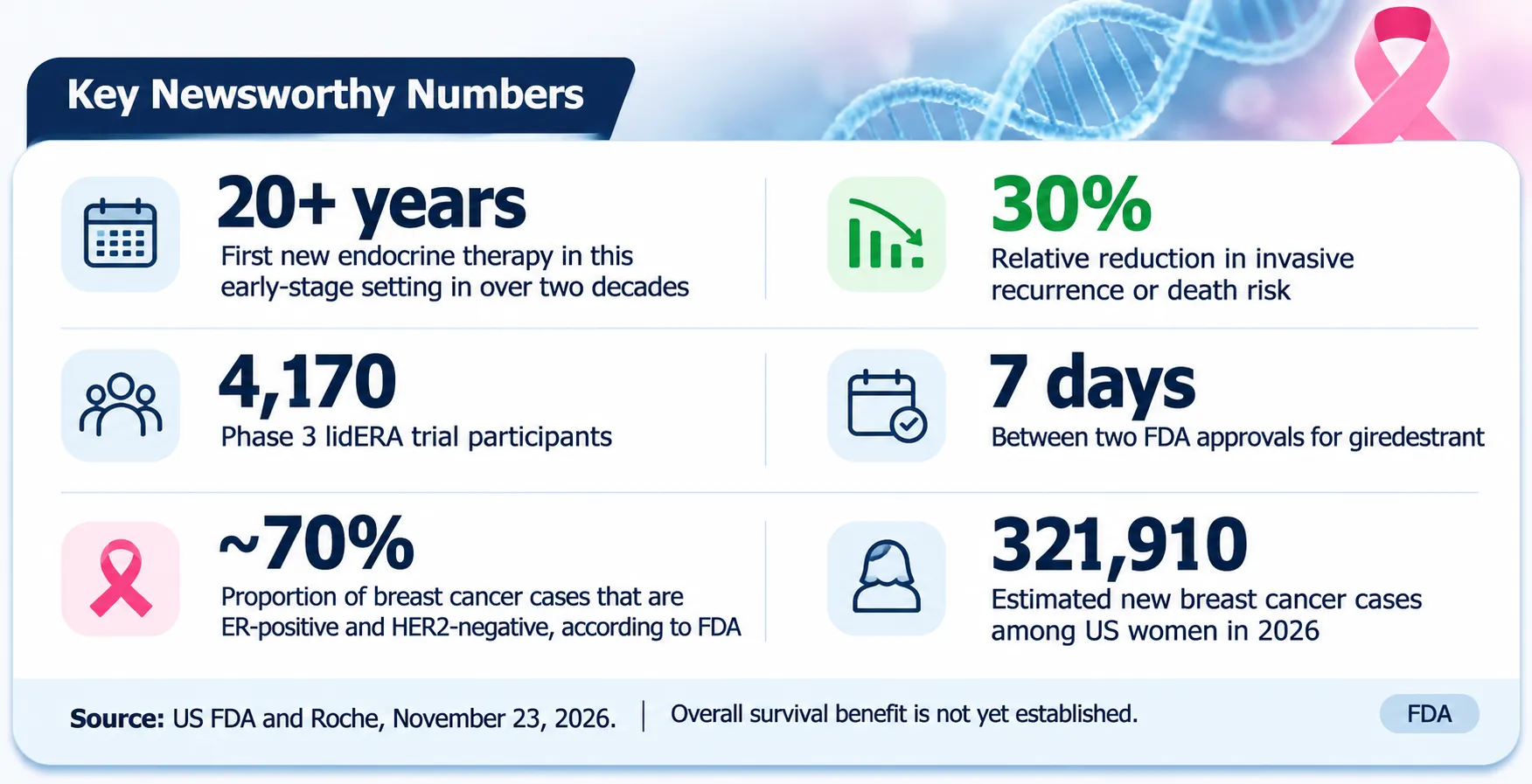
The US Food and Drug Administration (FDA) has approved Roche and Genentech’s Wilserdly (giredestrant), introducing the first new hormone therapy for early-stage breast cancer in more than two decades and marking a significant advancement in the treatment of hormone-driven tumors.
Announced on November 23, 2026, the approval follows pivotal Phase 3 clinical findings showing a 30% reduction in the relative risk of invasive disease recurrence or death compared with conventional endocrine therapies.
The regulatory milestone comes just seven days after giredestrant received FDA approval for a separate advanced breast cancer indication, making it the first selective estrogen receptor degrader (SERD) approved in both early-stage and advanced breast cancer.
For the global pharmaceutical industry, the development signals a potentially significant shift in oncology competition, clinical development priorities and commercial opportunities across the United States, Japan and South Korea.
Request Executive Sample: https://www.datamintelligence.com/download-sample/breast-cancer-treatment-market
Wilserdly FDA Approval: Why November 23 Marks a Turning Point in Breast Cancer Treatment
The FDA approved Wilserdly as a postoperative treatment for eligible adults with estrogen receptor-positive (ER-positive), HER2-negative stage I, II or III breast cancer who face an intermediate to high risk of recurrence.
For decades, tamoxifen and aromatase inhibitors have served as foundational endocrine treatment options. Although these therapies have substantially improved patient outcomes, disease recurrence and endocrine resistance remain significant challenges.
Wilserdly introduces a next-generation therapeutic approach designed to inhibit estrogen receptor signaling and promote receptor degradation, disrupting an important biological mechanism responsible for tumor growth.
| Approval Details | Information |
| Drug name | Wilserdly |
| Active ingredient | Giredestrant |
| Developer | Roche / Genentech |
| FDA approval date | 23-Nov-26 |
| Drug class | Oral selective estrogen receptor degrader (SERD) |
| Approved indication | ER-positive, HER2-negative early-stage breast cancer at intermediate to high recurrence risk |
| Administration | Once-daily oral tablet |
| Pivotal clinical trial | Phase 3 lidERA |
| Previous FDA approval | November 16, 2026, for a specified advanced breast cancer indication |
The approval introduces another treatment option for eligible patients while establishing a new competitive benchmark for pharmaceutical companies developing advanced endocrine therapies.
Phase 3 lidERA Trial: Wilserdly Reduces Invasive Recurrence or Death Risk by 30%
The FDA’s decision was supported by the multinational Phase 3 lidERA Breast Cancer study, involving 4,170 adults with ER-positive, HER2-negative early-stage breast cancer.
Participants received either giredestrant or standard endocrine therapy, including tamoxifen and aromatase inhibitors, for up to five years.
Wilserdly vs. Standard Endocrine Therapy: Clinical Trial Results
| Clinical Outcome | Wilserdly | Standard Endocrine Therapy |
| Patients enrolled | 2,084 | 2,086 |
| Invasive disease recurrence or death events | 140 | 196 |
| Three-year invasive disease-free survival | 92.40% | 89.60% |
| Absolute improvement at three years | 2.8% | Reference |
| Relative reduction in recurrence or death risk | 30% | Reference |
Source: US FDA, November 23, 2026; Phase 3 lidERA Breast Cancer Study.
The findings translate into approximately 28 additional patients per 1,000 remaining alive and free of invasive breast cancer at three years compared with conventional endocrine treatment.
The study reported a hazard ratio of 0.70, with a 95% confidence interval of 0.57–0.87 and a p-value of 0.0014.
Overall survival data remain immature, and continued follow-up will determine whether the observed reduction in recurrence translates into a long-term survival benefit.
Reported adverse effects include musculoskeletal pain, hot flashes, fatigue, nausea, headache and reduced heart rate. The treatment may also cause fetal harm during pregnancy.
Two FDA Approvals in Seven Days: Roche’s Expanding Breast Cancer Strategy
Roche’s latest approval represents more than an isolated regulatory achievement.
On November 16, 2026, the FDA approved giredestrant in combination with everolimus for eligible adults with ER-positive, HER2-negative, ESR1-mutated locally advanced or metastatic breast cancer following prior endocrine treatment.
The November 23 approval subsequently expanded giredestrant’s regulatory position into the early-stage setting, with a different indication and treatment approach.
Together, these approvals establish a commercial foundation across two distinct breast cancer treatment settings.
Roche is pursuing six company-sponsored Phase 3 studies across different stages and lines of breast cancer treatment, including investigations involving combination therapies.
The company’s broader ambition is to establish giredestrant as a foundational endocrine therapy across multiple treatment settings.
For competing pharmaceutical developers, this creates increasing pressure to accelerate clinical programs, demonstrate therapeutic differentiation and secure commercially attractive positions within the evolving oncology treatment landscape.
Roche vs. AstraZeneca, Eli Lilly and Menarini: The Next Major Race in Breast Cancer Therapeutics
The approval of Wilserdly is expected to intensify competition in the oral SERD segment, particularly as other major pharmaceutical companies advance their early-stage breast cancer clinical development programs.
Next-Generation Oral SERD Competitive Pipeline
| Pharmaceutical Company | Drug | Early-Stage Clinical Program | Development Status |
| Roche / Genentech | Giredestrant (Wilserdly) | lidERA | FDA approved |
| AstraZeneca | Camizestrant | CAMBRIA-1 and CAMBRIA-2 | Phase 3 |
| Eli Lilly | Imlunestrant (Inluriyo) | EMBER-4 | Phase 3 |
| Menarini / Stemline Therapeutics | Elacestrant (Orserdu) | ELEGANT | Phase 3 |
Development status refers to early-stage breast cancer programs as of November 25, 2026.
Purchase This Exclusive Report: https://www.datamintelligence.com/buy-now-page?report=breast-cancer-treatment-market
Additional Benefits:
✅ Get Interactive Dashboard Access (With No Additional Cost)
✅ Three months of analyst support to answer queries related to the report
AstraZeneca’s CAMBRIA programs are evaluating camizestrant in different adjuvant treatment settings, while Eli Lilly’s EMBER-4 and Menarini’s ELEGANT studies are investigating alternative endocrine treatment strategies following previous adjuvant therapy.
Roche’s first-mover advantage could influence clinical prescribing patterns, reimbursement expectations and future competitive positioning.
However, the competing programs have different patient populations, treatment sequences and study designs. Their relative effectiveness cannot be established without appropriate comparative clinical evidence.
Future competition is likely to focus on recurrence prevention, long-term safety, treatment persistence, overall survival and combination opportunities with CDK4/6 inhibitors and other targeted oncology medicines.
Why Early-Stage Breast Cancer Could Become the Next Major Commercial Battleground
Much of the recent innovation in advanced endocrine therapies has focused on metastatic breast cancer and treatment resistance.
Wilserdly’s approval creates a potential opportunity to introduce newer endocrine technologies earlier in the disease pathway, where treatment is focused on preventing recurrence following surgery.
According to Roche, approximately 225,000 women are diagnosed with hormone receptor-positive, HER2-negative breast cancer annually in the United States, with around 90% diagnosed at an early stage.
Not all these patients qualify for Wilserdly. Nevertheless, the figures illustrate why pharmaceutical companies are investing in adjuvant endocrine therapy development.
The emerging competitive landscape could influence several strategic areas:
- Pharmaceutical investment in early-stage oncology clinical trials.
- Development of next-generation endocrine and targeted therapy combinations.
- Long-term pharmaceutical revenue and treatment adherence strategies.
- Precision diagnostics and recurrence-risk assessment.
- Oncology licensing, partnerships and portfolio acquisitions.
- Reimbursement negotiations and comparative healthcare economics.
For pharmaceutical executives, the critical question is whether next-generation endocrine therapies can deliver sufficient long-term clinical and economic value to compete with widely available, lower-cost conventional medicines.
United States: First-Mover Advantage and Oncology Commercialization
The United States represents the immediate commercial opportunity following Wilserdly’s FDA approval.
The FDA estimates that approximately 321,910 women and 2,670 men will be diagnosed with breast cancer in the US during 2026. Around 70% of cases are expected to be ER-positive and HER2-negative.
Roche’s commercial performance will depend on physician adoption, patient eligibility, insurance coverage, treatment costs and the integration of giredestrant into established clinical pathways.
The approval also creates potential opportunities for precision oncology companies, diagnostic laboratories, specialty pharmaceutical distributors and clinical research organizations.
For US pharmaceutical developers, the next competitive priority will be demonstrating meaningful differentiation against both existing endocrine treatments and newly approved SERDs.
Japan: Emerging Opportunities in Next-Generation Endocrine Therapy
Japan represents a strategically important market for oncology innovation, supported by advanced clinical research capabilities, established pharmaceutical infrastructure and growing investment in precision medicine.
Roche’s relationship with Chugai Pharmaceutical provides an important industry context for monitoring the potential development and commercialization of next-generation oncology therapies in Japan.
Japanese pharmaceutical companies, including Chugai, Daiichi Sankyo, Eisai, Takeda and Astellas Pharma, have broader oncology or pharmaceutical development capabilities that make emerging endocrine therapy developments relevant to their portfolio strategies.
Potential opportunities include clinical development partnerships, novel oncology combination therapies, molecular diagnostics and regional commercialization.
Any introduction of Wilserdly in Japan will depend on domestic regulatory authorization, clinical requirements and reimbursement decisions. A specific Japanese approval or launch date was not established in the November 23 announcement.
South Korea: Precision Oncology and Pharmaceutical Partnership Opportunities
South Korea’s expanding biotechnology sector, advanced cancer research infrastructure and precision diagnostics capabilities provide a relevant environment for monitoring next-generation breast cancer therapies.
The emergence of oral SERDs could encourage greater interest in oncology clinical development, biomarker research, treatment-risk assessment and pharmaceutical licensing.
Companies such as Hanmi Pharmaceutical, Yuhan Corporation, Celltrion, Samsung Bioepis and Lunit represent organizations with broader capabilities across oncology development, biologics or precision diagnostics.
For South Korean industry leaders, emerging opportunities may extend beyond direct drug commercialization to include companion technologies, clinical research collaborations and combination treatment development.
Local adoption will remain dependent on Ministry of Food and Drug Safety approval, reimbursement assessment and clinical practice decisions. The US approval does not establish regulatory authorization in South Korea.
Global Breast Cancer Treatment Market Enters a New Phase of Innovation
According to DataM Intelligence’s Breast Cancer Treatment Market assessment, the global market was valued at USD 41.30 billion in 2025 and is projected to reach USD 101.97 billion by 2035, growing at a CAGR of 9.4% during 2026–2035. Advancements in targeted therapies, endocrine treatments, immunotherapies and precision oncology are reshaping pharmaceutical investment priorities. Wilserdly’s approval provides an additional catalyst for reassessing future treatment adoption, competitive positioning and oncology revenue opportunities across major healthcare markets.
What Comes Next for Global Breast Cancer Drug Developers?
The next phase of competition will extend beyond regulatory approvals.
Pharmaceutical companies will increasingly focus on demonstrating sustained clinical benefits, optimizing treatment combinations and establishing the long-term economic value of next-generation endocrine therapies.
Several developments warrant close industry attention:
- Long-term survival results from the Phase 3 lidERA trial.
- Commercial adoption and reimbursement of Wilserdly in the United States.
- Clinical progress across AstraZeneca’s CAMBRIA programs.
- Eli Lilly’s EMBER-4 clinical development milestones.
- Menarini’s ELEGANT early-stage breast cancer study.
- Emerging evidence for oral SERD combinations with targeted oncology medicines.
- Potential regulatory and commercialization developments in Japan and South Korea.
The upcoming San Antonio Breast Cancer Symposium (SABCS), scheduled for December 8–11, 2026, provides another important opportunity for the oncology community to assess emerging research and competitive clinical developments.
Roche’s back-to-back FDA approvals have opened a new competitive chapter in endocrine therapy. Whether the company can convert its regulatory lead into sustained clinical adoption and commercial leadership will depend on long-term evidence, pricing, treatment accessibility and the progress of competing pharmaceutical programs.
After more than two decades without a new endocrine treatment in this early-stage setting, the global pharmaceutical industry is entering a period in which preventing breast cancer recurrence could become an increasingly important frontier for oncology innovation.
Frequently Asked Questions
What new breast cancer drug did the FDA approve in November 2026?
The FDA approved Wilserdly (giredestrant), developed by Roche and Genentech, on November 23, 2026, for eligible adults with ER-positive, HER2-negative stage I, II or III breast cancer at intermediate to high risk of recurrence.
Why is Wilserdly’s FDA approval significant?
Wilserdly is the first new endocrine therapy approved by the FDA for early-stage breast cancer in more than 20 years. It is also the first oral SERD approved in both early-stage and advanced breast cancer treatment settings.
How effective is giredestrant compared with conventional hormone therapy?
The Phase 3 lidERA trial demonstrated a 30% relative reduction in invasive disease recurrence or death. Three-year invasive disease-free survival reached 92.4% with giredestrant, compared with 89.6% with standard endocrine therapy.
Which companies are developing competing breast cancer endocrine therapies?
AstraZeneca, Eli Lilly and Menarini are advancing early-stage breast cancer programs involving camizestrant, imlunestrant and elacestrant, respectively. These programs could contribute to future competition in the oral SERD treatment segment.
Is Wilserdly approved in Japan and South Korea?
The November 23, 2026, announcement concerns US FDA approval. Japanese and South Korean approval dates were not confirmed in the reviewed announcement. Commercial availability in these countries requires separate regulatory and market-access processes.
Can Wilserdly cure breast cancer?
The clinical evidence demonstrates a reduction in the risk of invasive recurrence or death compared with standard endocrine treatment. It does not establish that Wilserdly cures breast cancer, and long-term overall survival data remain under evaluation.