


U.S. Critical Minerals Investment: A US$3 Billion Supply-Chain Shift
The latest U.S. critical-minerals push goes beyond conventional mining support. Roughly US$3 billion in government-backed financing and investment commitments is being directed toward strategic minerals, battery materials and domestic processing capacity, spanning silicon-carbon battery anodes, scandium, permanent magnets, graphite and other critical-material supply chains.
The larger objective is clear: reduce U.S. dependence on foreign-controlled mineral supply chains and create domestic production capacity for materials required in defense systems, aerospace, batteries, semiconductors, robotics and advanced manufacturing. The economic impact therefore extends well beyond mining companies. It could influence suppliers across several layers of the industrial value chain.
Explore the Critical Minerals Market Report
Discover Critical Mineral Market size, growth trends, key segments, regional insights, competitive developments and emerging opportunities shaping the global critical minerals industry.
Explore the report for actionable insights and strategic market intelligence. Request a Sample Report Toady!
Battery Materials Could See One of the Largest Immediate Impacts
The most significant individual commitment is the approximately US$1.4 billion government-backed financing package associated with Sila Nanotechnologies, supporting the expansion of silicon-carbon anode material production and domestic lithium-ion battery manufacturing.
Silicon-carbon anodes are strategically important because they can increase battery energy density compared with conventional graphite-based anodes. This makes the technology attractive for applications where weight, size and energy density are critical, including drones, satellites, robotics, electric vehicles and portable electronic systems.
The investment could therefore create opportunities beyond Sila itself. Suppliers of silane, specialty chemicals, battery-processing equipment, coating systems, cell-manufacturing machinery, thermal-management technologies and battery-testing equipment could all benefit as capacity expands.
At the same time, the U.S. is continuing to support domestic graphite production. That suggests the government is not betting on a single battery-anode technology. Instead, it appears to be building parallel supply chains around both battery-grade graphite and next-generation silicon-carbon materials.
Permanent Magnets Are Becoming a Strategic Industrial Battleground
Approximately US$150 million in government-backed financing is associated with Niron Magnetics, which is developing rare-earth-free permanent magnets based on iron-nitride technology. If commercialized at scale, the technology could provide an alternative to conventional rare-earth permanent magnets in selected applications.
This matters because high-performance permanent magnets are critical components in electric motors, industrial automation, robotics, aircraft actuators, drones, vehicles and defense equipment.
The investment could therefore create two parallel U.S. magnet supply chains.
One will continue to revolve around conventional neodymium-iron-boron magnets, supported by domestic rare-earth mining and processing companies. The other will attempt to commercialize rare-earth-free permanent magnets.
That creates an interesting competitive dynamic. Traditional NdFeB producers may benefit from government efforts to localize rare-earth supply, while emerging technologies could eventually reduce rare-earth intensity in certain applications.
Companies involved in motors, actuators and motion-control systems may therefore need to evaluate both supply pathways. This could increase strategic importance for suppliers of magnets, motors, actuators and motion-control systems as alternative material technologies mature.
Scandium Investment Could Unlock a New Aerospace Materials Supply Chain
The approximately US$400 million government-backed financing commitment associated with Sunrise Energy Metals could have important implications for aerospace and defense materials.
Scandium is valuable because small additions to aluminum can significantly improve properties such as strength, weldability and heat resistance. Aluminum-scandium alloys have potential applications in fighter aircraft, spacecraft, missiles, lightweight structures and additive manufacturing.
Historically, however, scandium adoption has been constrained by limited and uncertain supply.
If new primary scandium production becomes commercially viable, aerospace manufacturers could have greater confidence in designing scandium-containing alloys into long-term platforms.
The resulting opportunity extends well beyond the mine. Potential beneficiaries could include aluminum-alloy producers, metal-powder manufacturers, additive-manufacturing suppliers, aerospace component manufacturers and specialist metallurgical companies.
Defense and Aerospace Could Become the Largest Downstream Beneficiaries
The strongest strategic rationale for these investments is defense supply-chain security.
Modern defense platforms depend heavily on specialty materials. Rare earths are needed in permanent magnets and actuators. Tungsten is used in high-density and high-temperature applications. Germanium is important for infrared optics and sensors. Scandium has potential applications in lightweight aerospace alloys. Tantalum is used in electronic components and high-performance alloys.
These materials ultimately flow into products such as missiles, military aircraft, drones, radar systems, satellites, electro-optical sensors, armored vehicles and communications equipment.
Major defense contractors may therefore benefit even though they are not necessarily direct recipients of the mining investments.
Companies such as Lockheed Martin, RTX, Northrop Grumman, Boeing and General Dynamics could gain from a broader pool of domestic material suppliers, particularly if qualification programs allow new U.S. sources to enter defense procurement chains.
The near-term impact, however, will probably be more operational than financial. Defense companies will need to qualify alternative material suppliers, redesign sourcing strategies and manage the transition from foreign-dependent supply chains to domestic or allied sources.
Semiconductor and Electronics Supply Chains Will Also Be Affected
The investment program also touches strategically important materials used in electronics.
Tantalum and niobium are important in specialty electronics, capacitors, alloys and semiconductor-related applications. Boron is used across semiconductor processing, specialty glass and permanent-magnet production.
Although the investment amounts in these materials are smaller than those for batteries or scandium, they are strategically important because semiconductor supply security depends on far more than chips and fabrication equipment.
A semiconductor fabrication ecosystem requires a large network of ultra-high-purity chemicals, specialty gases, metals, target materials and advanced electronic materials.
Strengthening domestic supply of these inputs could therefore indirectly benefit semiconductor manufacturers, electronic-component suppliers, capacitor producers, advanced-glass manufacturers and defense-electronics companies.
Refractory Materials Represent an Overlooked Opportunity
Investment in refractory-grade bauxite deserves greater attention than it is likely to receive.
Refractory materials are essential in industries operating at extreme temperatures, including steel, foundries, aerospace, defense manufacturing, furnaces and industrial processing.
New domestic refractory-grade bauxite capacity could strengthen the supply chain for high-temperature alumina-based materials and specialty refractories.
This is commercially different from the broader bauxite market, which is heavily associated with aluminum production.
A more targeted Refractory-Grade Bauxite Market or High-Temperature Materials for Defense and Aerospace Market could therefore capture the investment story more accurately than a generic Bauxite Market.
Mining Equipment, Processing Technology and EPC Companies Could Benefit First
Before new mineral production reaches defense contractors or battery manufacturers, billions of dollars must be spent constructing mines, processing plants and refining facilities.
That means some of the earliest commercial beneficiaries may be companies supplying:
mining equipment, crushing and grinding systems, flotation equipment, separation technologies, furnaces, filtration systems, pumps, water-treatment equipment, analytical instruments, process automation and engineering services.
EPC contractors, environmental consultants and metallurgical engineering companies could see increased project pipelines as new capacity moves from financing into construction.
This is an important distinction. Mining companies receive the capital, but industrial suppliers may receive a large portion of the subsequent project spending.
Critical-Mineral Recycling Should Gain Strategic Importance
The U.S. critical-material strategy is also increasingly incorporating recycled sources.
Rare-earth magnets, tungsten products, lithium-ion batteries and graphite-containing materials can potentially become secondary sources of strategic materials.
As domestic manufacturing expands, recycling becomes important for two reasons. First, it reduces dependence on imported raw materials. Second, it allows high-value strategic materials already circulating within the U.S. economy to be recovered and reused.
Consequently, markets such as Rare Earth Recycling, Tungsten-Based Materials Recycling and Graphite Recycling should increasingly be viewed as national supply-security markets rather than purely sustainability-driven industries.
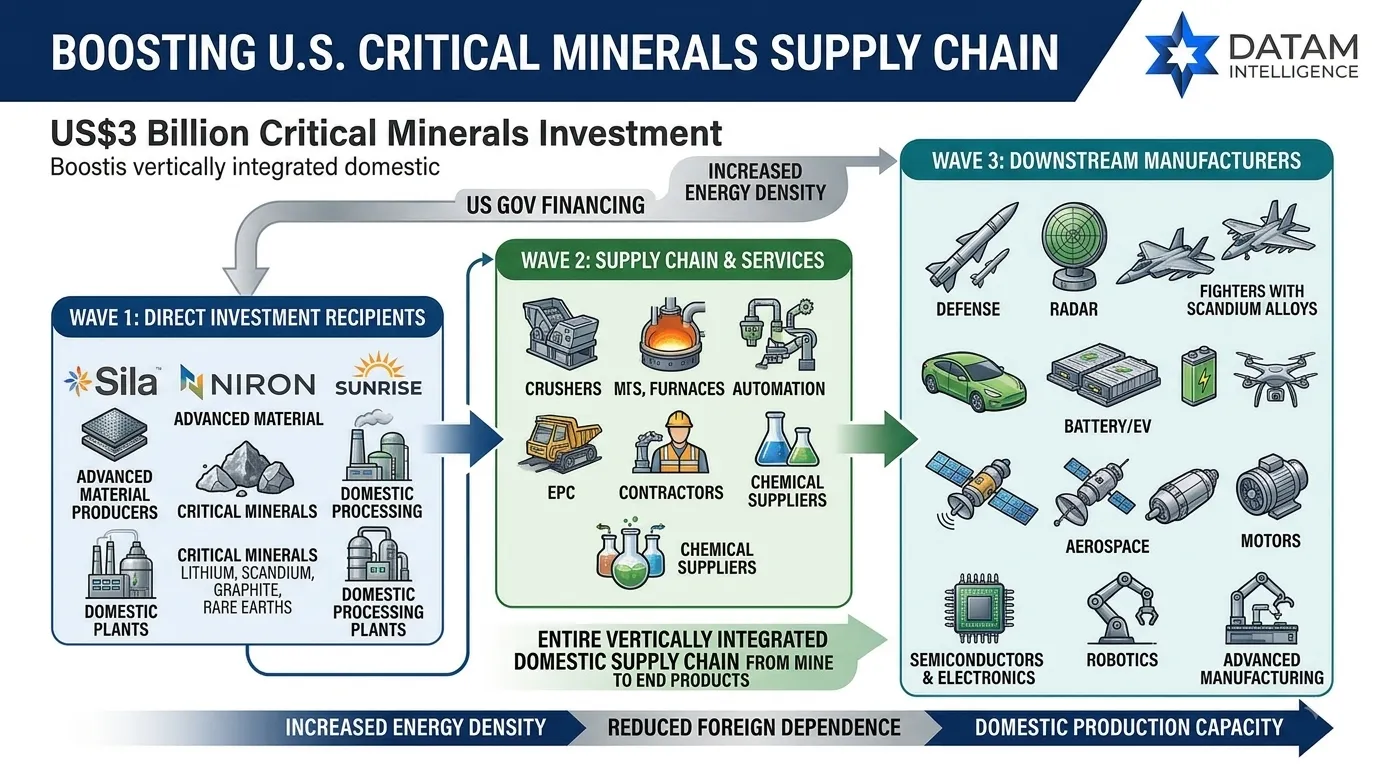
The Real Impact Will Occur in Three Waves
The approximately US$3 billion investment should create three distinct waves of economic impact.
The first wave will benefit the companies receiving direct government-supported capital, including advanced battery-material, scandium, magnet, graphite, bauxite and specialty-mineral producers.
The second wave will affect mining-equipment suppliers, processors, EPC contractors, chemical companies, testing laboratories, automation companies and materials-processing technology providers as projects move into development and construction.
The third and potentially largest wave will reach downstream manufacturers in defense, aerospace, batteries, electric motors, robotics, semiconductors and advanced electronics once new domestic material capacity becomes commercially available.
The strategic significance is therefore much larger than US$3 billion of mining investment. It represents an attempt to build vertically integrated U.S. advanced-material supply chains stretching from the mine all the way to missiles, aircraft, batteries, motors, satellites and semiconductor components.