


India’s Critical Minerals Push Signals a New Investment Era for Energy, EVs and Advanced Manufacturing
India’s push for energy security and critical mineral independence is emerging as a strategic investment theme, with implications for EVs, semiconductors, AI data centres, renewable energy, defence and advanced manufacturing.
Prime Minister Narendra Modi has placed energy security and critical minerals at the centre of India’s long-term economic and technology strategy, signalling that reliable access to energy and strategically important raw materials will become increasingly important to the country’s industrial competitiveness.
Explore the Critical Minerals Market Report & Identify High-Value Opportunities
Get comprehensive market intelligence on Critical Minerals Market demand, supply-chain risks, country opportunities, processing bottlenecks, recycling, technology trends, competitive dynamics, and investment white spaces. The report provides decision-ready insights for manufacturers, investors, procurement teams, and strategy leaders evaluating the rapidly evolving critical minerals ecosystem. Request a Sample Report Today!
Addressing the nation from the Red Fort on August 15, 2026, Modi highlighted energy security as a fundamental requirement for the modern economy and pointed to the growing importance of securing critical mineral supplies as India expands technology-intensive industries. Business Standard reported that rising demand from chips, artificial intelligence and data centres is making energy security increasingly important for India.
Why Energy Security Is Becoming an Investment Priority
India’s rapidly expanding digital and industrial economy is increasing demand for reliable power infrastructure. Semiconductor manufacturing, AI computing, data centres, electric mobility and renewable energy all require significant quantities of electricity as well as increasingly complex supply chains for minerals and advanced materials.
For investors and corporate decision-makers, this creates a broader opportunity extending beyond conventional energy markets.
The emerging investment landscape includes:
- Power generation and transmission infrastructure
- Renewable energy and energy storage
- Nuclear energy
- Data-centre power infrastructure
- Semiconductor manufacturing
- Battery materials and manufacturing
- Critical mineral exploration and mining
- Mineral processing and refining
- Rare-earth supply chains
- Recycling and recovery technologies
The strategic significance is particularly high because critical minerals are essential inputs for clean energy, electronics, defence and advanced manufacturing, while their global supply is concentrated across a limited number of countries.
India’s Critical Minerals Strategy Gains Momentum
India has already been building a policy framework aimed at reducing vulnerabilities in critical mineral supply chains.
The National Critical Mineral Mission (NCMM) was approved with a total expected outlay of ₹34,300 crore over seven years, including ₹16,300 crore in government expenditure and an expected ₹18,000 crore investment by public-sector entities and others. The mission covers the value chain from exploration and mining through processing, beneficiation and recovery from end-of-life products.
The government has also been expanding auctions of critical and strategic mineral blocks. In July 2026, the eighth tranche of auctions covered 20 critical and strategic mineral blocks, reinforcing efforts to reduce import dependence and develop resilient domestic supply chains.
This creates potential opportunities across the entire minerals ecosystem rather than simply at the mining stage.
Critical Minerals Could Reshape India’s EV and Semiconductor Supply Chains
The strategic importance of critical minerals is closely linked to India's ambitions in electric mobility, semiconductor manufacturing, renewable energy and advanced electronics.
Lithium, graphite, nickel, cobalt and rare earth elements are important to various battery, electronics, permanent-magnet and clean-energy applications. Semiconductor and electronics manufacturing also depend on specialised minerals and materials.
India's expanding EV and battery ecosystem therefore increases the strategic value of securing dependable mineral supplies.
At the same time, the country's semiconductor ambitions could create additional demand for specialised materials, energy infrastructure and technology-intensive industrial inputs.
Business Standard previously reported that India has identified 30 critical minerals and has been strengthening bilateral partnerships to secure supplies required for EVs, semiconductors, renewable energy and defence manufacturing.
Overseas Partnerships Become Increasingly Important
Domestic exploration alone may not be sufficient to secure all of India's future mineral requirements.
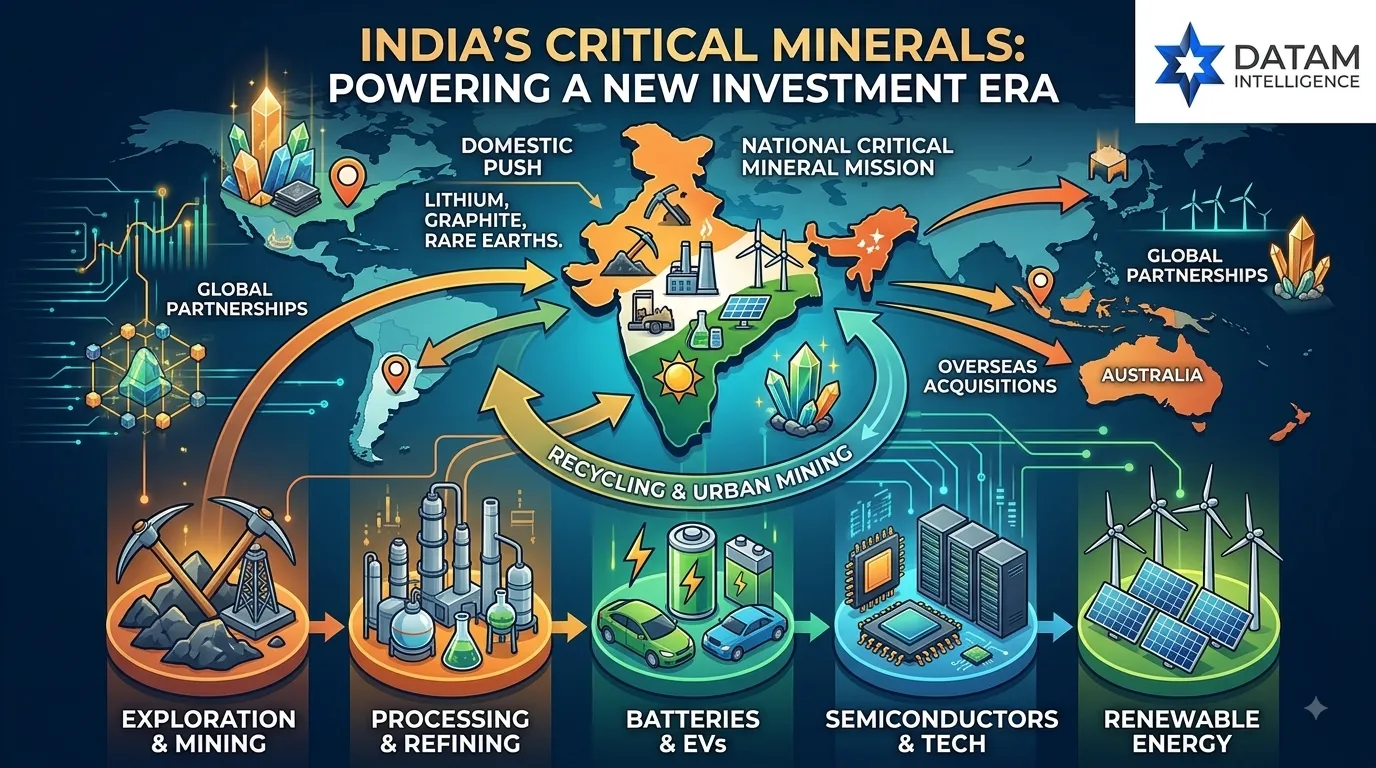
India has therefore been developing partnerships with resource-rich economies to diversify supply sources. Recent initiatives have involved countries including Australia, Indonesia, Argentina, Canada, France and the United States.
The strategy is increasingly shifting from simply importing minerals toward developing more resilient international supply chains involving exploration, mining, processing, manufacturing and technology partnerships.
Private-sector participation is also becoming more significant. In July 2026, Hyderabad-based Midwest became the first Indian private company reported to have secured overseas rare-earth assets through an agreement with Indonesia's state-run PERMINAS.
Coal India is also exploring a potential acquisition involving lithium assets in Chile, highlighting how Indian companies are increasingly looking overseas to secure strategically important resources.
What This Means for Investors
For investors, the critical-minerals story is evolving from a narrowly defined mining opportunity into a broader industrial and supply-chain investment theme.
The most relevant opportunities could emerge across five interconnected areas:
1. Mineral exploration and mining
Domestic and overseas exploration could become increasingly important as India seeks to diversify its mineral supply base.
2. Processing and refining
Securing ore is only one part of the supply chain. Processing and refining capacity can determine whether mineral resources translate into commercially useful inputs for Indian manufacturers.
3. Recycling and urban mining
Recovering lithium, cobalt, nickel, rare earth elements and other materials from batteries, electronic waste and industrial waste could become strategically important.
The government's critical-mineral framework already includes recovery from end-of-life products, strengthening the long-term case for recycling technologies.
4. Battery and advanced manufacturing ecosystems
As EVs and energy storage expand, demand for battery materials and associated manufacturing infrastructure is likely to remain strategically important.
5. Energy-intensive technology infrastructure
Semiconductor fabs, AI data centres and advanced manufacturing facilities require dependable electricity. Consequently, energy security and critical-mineral security are becoming increasingly interconnected investment themes.
Energy Security and Critical Minerals Are Becoming One Strategic Theme
The significance of the latest policy messaging is that energy security and mineral security are no longer isolated policy issues.
India's next phase of industrial growth will require simultaneous access to:
Energy → Minerals → Manufacturing → Technology → Strategic Supply Chains
A disruption in any one of these areas could affect the competitiveness of industries ranging from electric vehicles and batteries to semiconductor manufacturing and AI infrastructure.
That makes critical minerals increasingly relevant not only to mining companies but also to technology companies, industrial manufacturers, infrastructure developers, energy companies, investors and policymakers.
Analyst View: Where the Investment Opportunity Could Move Next
From an investment perspective, India's critical-minerals strategy could create opportunities across the upstream, midstream and downstream segments of the value chain.
The most important indicators to monitor will include domestic mineral discoveries, auction activity, overseas mining partnerships, refining capacity, recycling economics, battery manufacturing expansion, semiconductor investments and government incentives.
The investment opportunity is therefore likely to extend beyond individual mineral prices. Companies capable of building reliable supply chains, processing capabilities and technology partnerships could become increasingly important as India seeks greater resource security.
For businesses and investors, the key question is shifting from “Does India need critical minerals?” to “Which parts of the critical-mineral value chain will capture the greatest investment and demand growth?”
What to Watch in India’s Critical Minerals Market
Going forward, market participants should closely track:
- Critical mineral block auctions and exploration results
- Overseas acquisitions and strategic mineral partnerships
- Lithium and rare-earth supply agreements
- Domestic mineral processing and refining capacity
- Battery manufacturing investments
- EV penetration and battery demand
- Semiconductor and electronics manufacturing capacity
- Critical-mineral recycling infrastructure
- Government incentives and regulatory changes
- Strategic partnerships involving India and resource-rich countries
India's push for energy and mineral security could consequently become an important structural theme for the country's next stage of manufacturing, technology and clean-energy expansion.
For investors, executives and industry participants, the critical-minerals opportunity is increasingly about understanding the complete value chain from resources and processing to batteries, semiconductors, energy infrastructure and advanced manufacturing.
News source: https://www.business-standard.com/india-news/modi-energy-security-critical-minerals-independence-day-red-fort-speech-126081500217_1.html