


Australia Commits $2.5 Billion to Secure Hunter Region's Industrial Future
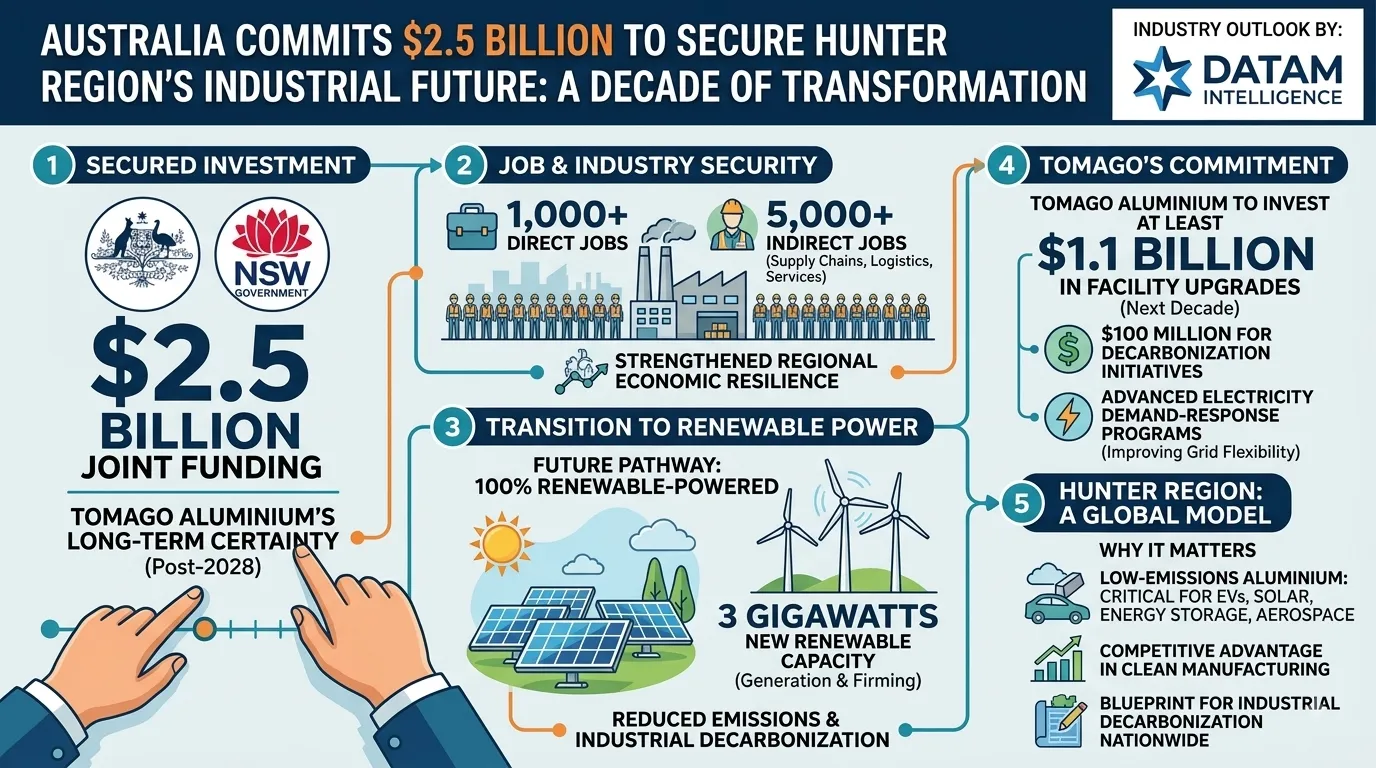
The Australian Government and the New South Wales Government have announced a landmark $2.5 billion joint investment package aimed at securing the future of Tomago Aluminium, one of Australia's most strategically important industrial assets. The investment is expected to protect more than 1,000 direct jobs and approximately 5,000 indirect jobs across the Hunter region while creating a pathway for long-term renewable-powered industrial operations.
The agreement provides certainty for Tomago Aluminium beyond the expiration of its current electricity supply contract in December 2028. The package will support the development of a long-term renewable energy solution, enabling the facility to remain globally competitive while reducing emissions and supporting Australia's broader industrial decarbonization goals.
Get Exclusive Demand Response Management System Market Insights
Download the free sample report to explore market trends, growth opportunities, competitive analysis, and future forecasts shaping the global Demand Response Management System market.
Strategic Investment Strengthens Australia's Industrial Future
Tomago Aluminium plays a critical role in Australia's manufacturing ecosystem and is among the nation's largest industrial energy consumers. The latest investment reinforces the government's commitment to maintaining domestic industrial capability while supporting the transition to a cleaner and more resilient energy system.
Under the agreement, Tomago Aluminium has also committed to investing at least $1.1 billion in facility upgrades and operational improvements through the next decade. This includes approximately $100 million dedicated to decarbonization initiatives and advanced electricity demand-response programs designed to improve grid flexibility and reliability.
The initiative is expected to underpin nearly 3 gigawatts of new renewable generation and firming capacity, helping strengthen New South Wales' electricity network while supporting long-term energy affordability and industrial competitiveness.
Why the Hunter Region Matters for Australia's Energy Transition
The Hunter region has long served as one of Australia's industrial and energy powerhouses. As global markets increasingly prioritize low-carbon materials and sustainable supply chains, securing the future of aluminium production is becoming strategically important for both economic growth and energy transition objectives.
Industry analysts note that aluminium remains a critical material for electric vehicles, renewable energy infrastructure, energy storage systems, aerospace manufacturing, and advanced construction applications. As demand for low-emissions aluminium rises worldwide, Australia's ability to maintain an integrated aluminium value chain could become a significant competitive advantage.
The investment demonstrates how governments and industry can collaborate to preserve industrial employment while accelerating clean energy adoption. It also positions the Hunter region as a leading example of industrial transformation driven by renewable energy investment.
Economic Impact Extends Beyond Manufacturing
Beyond protecting direct employment, the agreement provides certainty for thousands of workers across supply chains, logistics networks, engineering services, maintenance contractors, and regional businesses connected to Tomago Aluminium's operations. The investment is expected to strengthen regional economic resilience and encourage future industrial investment throughout New South Wales.
The announcement also aligns with Australia's broader industrial strategy focused on strengthening sovereign manufacturing capability, supporting regional development, and attracting investment into low-carbon industries. As global competition intensifies for clean manufacturing leadership, initiatives such as the Tomago agreement could serve as a blueprint for future industrial decarbonization projects nationwide.
Analyst View
The Hunter investment highlights a growing global trend where governments are actively supporting energy-intensive industries through the clean energy transition rather than allowing strategic manufacturing assets to decline. By linking industrial competitiveness with renewable energy infrastructure development, Australia is strengthening its position in the rapidly expanding market for low-carbon industrial products.
For investors, manufacturers, energy developers, and policymakers, the agreement signals increasing opportunities across renewable energy generation, energy storage, industrial electrification, grid modernization, and sustainable materials production. The successful execution of the Tomago roadmap could become a benchmark for industrial decarbonization projects worldwide.
Conclusion
The $2.5 billion commitment to Tomago Aluminium represents more than a regional jobs package. It is a strategic investment in Australia's manufacturing future, clean energy transition, and industrial competitiveness. By securing thousands of jobs, enabling large-scale renewable energy deployment, and reinforcing domestic aluminium production, the initiative positions the Hunter region at the center of Australia's next phase of sustainable industrial growth.
News source: https://www.nsw.gov.au/ministerial-releases/25-billion-investment-hunters-future