


Google DeepMind’s India-Built Agricultural AI Models Gain Global Adoption
Artificial intelligence developed in India is increasingly shaping the future of global agriculture. Google DeepMind has announced the expansion of its India-first agricultural AI models, originally created to solve complex farming challenges across the country, into international agricultural ecosystems supporting farmers, policymakers, financial institutions, and food security organizations.
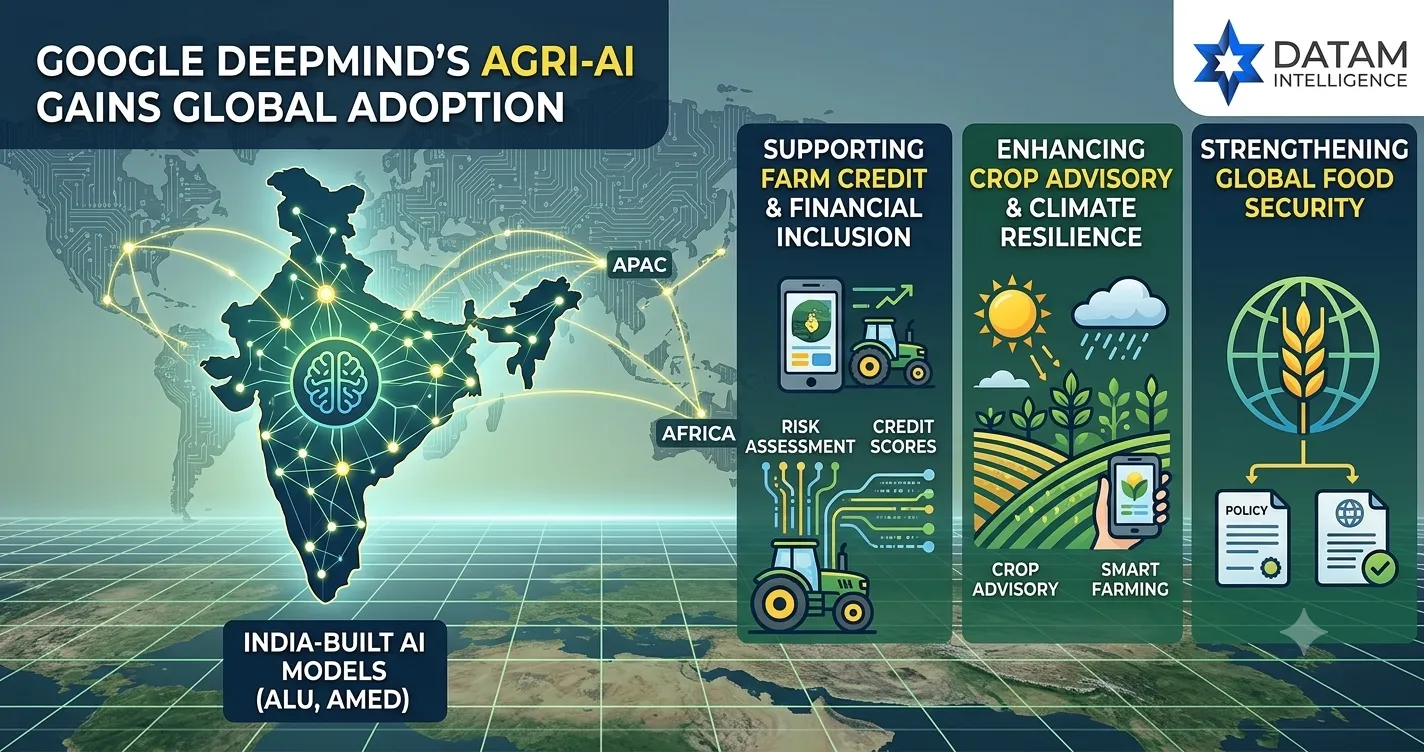
The two flagship models Agricultural Landscape Understanding (ALU) and Agricultural Monitoring & Event Detection (AMED) use satellite imagery and advanced machine learning algorithms to provide field-level agricultural intelligence. The systems can identify farm boundaries, monitor crop activity, detect agricultural events, and generate actionable insights for stakeholders across the agricultural value chain.
Unlock AI in Agriculture Market Opportunities
Get actionable market insights, competitive intelligence, forecasts, and segmentation analysis to identify growth opportunities and make informed business decisions.
Request the Sample Report and explore the key findings before investing in the full report.
AI Supporting Farm Credit and Financial Inclusion
One of the most significant applications of these AI models is improving access to agricultural credit. Financial institutions and agricultural lending platforms can leverage satellite-based farm intelligence to better assess agricultural risks and verify farming activity, enabling more accurate and inclusive credit decisions for farmers.
Access to timely agricultural credit remains a major challenge for millions of farmers globally. AI-powered farm monitoring can help bridge information gaps, reduce risk assessment costs, and create new opportunities for digital financial services in rural economies.
Enhancing Crop Advisory and Climate Resilience
Beyond financial services, the AI models are increasingly being used for crop advisory systems. By analyzing satellite data at scale, the technology helps generate insights related to crop conditions, agricultural activities, and resource utilization. These capabilities can support farmers in making more informed decisions regarding cultivation practices and resource management.
The importance of AI-driven agricultural intelligence is growing as climate variability continues to impact crop productivity worldwide. Advanced monitoring systems can improve resilience by providing earlier and more accurate insights into changing agricultural conditions.
Strengthening Global Food Security Initiatives
Google DeepMind's agricultural AI technology is also contributing to international food security efforts. The models have been integrated into agricultural data systems used by global organizations, including initiatives supporting food security monitoring and policy planning. This enables governments and development agencies to access more granular agricultural intelligence for decision-making.
The expansion demonstrates how AI solutions initially developed for India's diverse agricultural landscape can be adapted to address broader global challenges. Trusted testers across Asia-Pacific and Africa are currently evaluating the technology for applications ranging from agricultural planning to water resource management and sustainability programs.
India Emerging as a Global Agri-AI Innovation Hub
The international adoption of these AI models reinforces India's position as a growing center for agricultural technology innovation. India's large-scale farming ecosystem, diverse climatic conditions, and extensive agricultural datasets have created an ideal environment for developing AI systems capable of operating across varied agricultural landscapes.
As governments and organizations increasingly seek technology-driven solutions for food security, climate resilience, and sustainable farming, India's AI innovations are demonstrating how locally developed technologies can deliver global impact.
FAQs
1. What are Google DeepMind's agricultural AI models?
Google DeepMind's agricultural AI models include Agricultural Landscape Understanding (ALU) and Agricultural Monitoring & Event Detection (AMED), which use satellite imagery and machine learning to analyze agricultural landscapes, monitor crop activity, and generate farm-level insights.
2. How do these AI models help farmers?
The models support crop advisory services, agricultural monitoring, farm management decisions, and improved access to agricultural credit by providing accurate field-level agricultural intelligence.
3. Why were these AI models developed in India?
India's large agricultural sector, diverse cropping patterns, and complex farming challenges provided an ideal environment for developing scalable AI solutions capable of addressing real-world agricultural problems.
4. How do AI models improve farm credit access?
AI-generated agricultural insights help lenders verify farming activities, assess agricultural risks, and make more informed lending decisions, improving financial inclusion for farmers.
5. Which countries are using Google's agricultural AI models?
The technology is currently being evaluated and deployed across multiple countries in Asia-Pacific and Africa, with trusted testers operating in 11 countries.
6. How does AI contribute to food security?
AI enables better crop monitoring, agricultural forecasting, resource management, and policy planning, helping governments and organizations improve food security outcomes and agricultural resilience.
7. What role does satellite imagery play in agricultural AI?
Satellite imagery provides real-time and historical data about crop conditions, field boundaries, land use, and agricultural activities, enabling AI models to generate actionable agricultural insights.
8. Why is agricultural AI becoming important globally?
Growing food demand, climate change, resource constraints, and the need for sustainable farming practices are driving increased adoption of AI-powered agricultural technologies worldwide.