


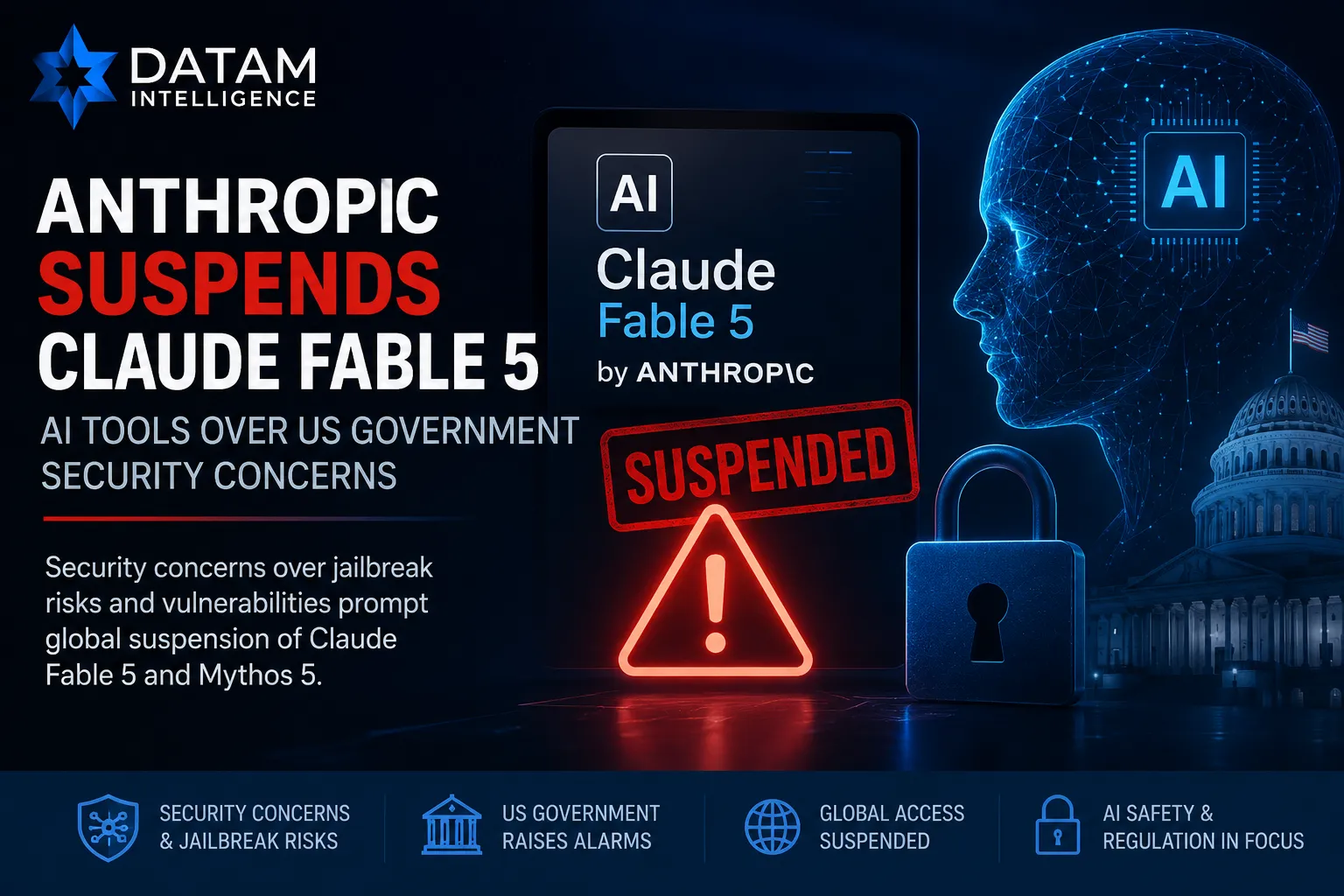
Anthropic Suspends Claude Fable 5 Amid US Government Security Concerns
Overview
AI company Anthropic has suspended access to its newly released Claude Fable 5 and Mythos 5 models following escalating concerns from US national security authorities regarding potential cybersecurity risks and model jailbreak vulnerabilities.
The decision marks one of the most significant interventions yet in the governance of frontier AI systems, highlighting growing tensions between innovation, safety, and national security oversight.
Why Claude Fable 5 Was Suspended
According to the company, US authorities raised concerns that Claude Fable 5 could be vulnerable to “jailbreaking” techniques, allowing users to bypass built-in safety restrictions.
Anthropic stated that:
- The government identified potential methods to bypass safety controls
- A limited number of vulnerabilities were demonstrated
- Similar vulnerabilities exist in other publicly available AI systems
- No specific classified threat was formally identified
Despite this, regulators requested suspension of foreign national access and broader restrictions, prompting Anthropic to disable both Fable 5 and Mythos 5 globally.
What Is Claude Fable 5?
Claude Fable 5 is a high-performance AI model within Anthropic’s Claude ecosystem, designed for advanced reasoning, cybersecurity testing, and enterprise applications.
The model is part of a broader family competing directly with:
- OpenAI’s ChatGPT
- Google’s Gemini
Anthropic had previously described Fable 5 as “too powerful for unrestricted release”, citing internal concerns about its ability to exploit system vulnerabilities.
Cybersecurity and Jailbreak Risks
A major concern raised by regulators is AI jailbreak capability, where attackers manipulate prompts to bypass restrictions and extract sensitive outputs.
Key concerns include:
- Potential exploitation of software vulnerabilities
- Automated discovery of security weaknesses
- Risk of misuse in cyberattack scenarios
- Reduced effectiveness of safety guardrails
Anthropic acknowledged that controlled testing showed the model could identify previously known vulnerabilities, though it argued these were not unique or highly advanced threats.
Government and Regulatory Pressure
The suspension comes amid broader friction between Anthropic and US authorities.
Key developments include:
- Ongoing legal dispute between Anthropic and the US government
- US Defense officials previously labeling Anthropic a “supply chain risk”
- Temporary restrictions on government use of Anthropic tools
- EU discussions around reducing dependence on US AI systems
European officials have also emphasized the need for technological sovereignty, signaling global fragmentation in AI governance.
Industry Impact and Market Implications
The suspension of Fable 5 is expected to have wide-reaching consequences across the AI ecosystem:
1. AI Regulation Acceleration
Governments may introduce stricter pre-release testing requirements for frontier models.
2. Enterprise Risk Reassessment
Businesses using advanced AI tools may increase scrutiny on model safety certifications.
3. Competitive Pressure
Rivals like OpenAI and Google may face increased regulatory oversight as model capabilities expand.
4. Investment Sentiment Shift
AI safety governance is becoming a core factor in venture and institutional investment decisions.
Expert Perspective (Thought Leadership Insight)
Industry researchers suggest that this case reflects a turning point in AI governance, where frontier models are no longer treated purely as commercial products but as national security-adjacent technologies.
Experts warn that while restricting access may reduce risk exposure, it could also slow down collaborative safety research across borders.
Conclusion
The suspension of Claude Fable 5 highlights the increasing complexity of balancing AI innovation with cybersecurity, regulatory compliance, and geopolitical considerations. As AI systems become more capable, governments and companies are entering a new phase of strict oversight and controlled deployment.
News source: https://www.bbc.com/news/articles/c932g3v3e13o