


AI Infrastructure Boom Reshapes Semiconductor Supply Chain
The global AI revolution is no longer limited to software innovation it is fundamentally restructuring the semiconductor supply chain. The rapid buildout of AI data centers by hyperscalers has triggered an aggressive demand cycle for memory chips, particularly DRAM and HBM, which are essential for training and running large-scale AI models.
Industry developments show that major technology firms are entering long-term supply agreements to secure memory capacity, reflecting a shift from traditional spot pricing to strategic procurement models. This structural change is helping stabilize revenues for chipmakers while tightening global supply availability.
Experts note that AI workloads especially inference-heavy and agentic AI systems are significantly increasing memory intensity per server, accelerating a multi-year super cycle in semiconductor demand.
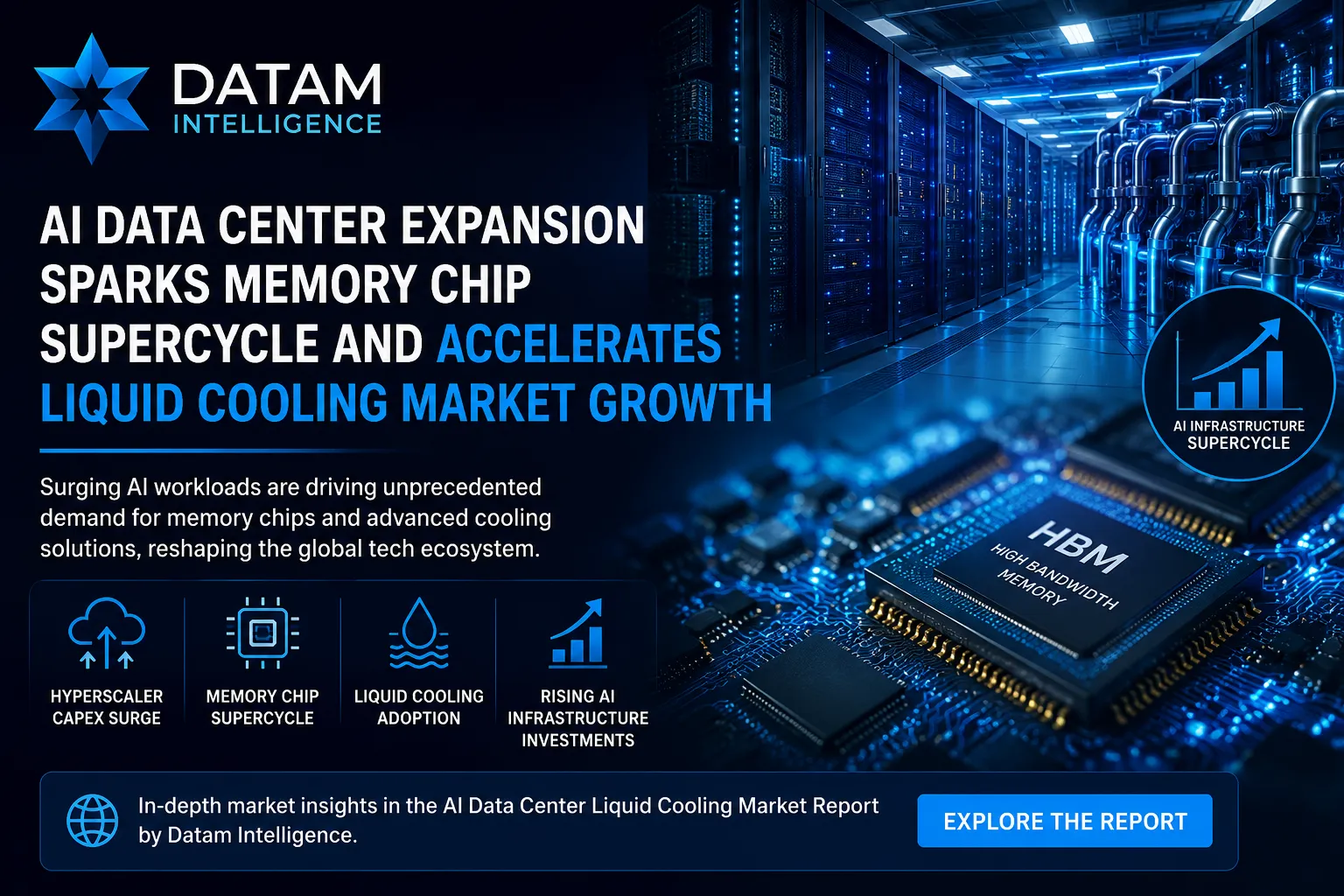
Memory Chip Prices Enter a Structural Supercycle
The memory semiconductor market is experiencing one of its strongest growth phases in decades. AI data centers are consuming an increasing share of global DRAM and NAND supply, leading to persistent shortages and rising prices across the value chain.
Key industry drivers include:
- Explosive demand for HBM chips used in AI accelerators
- Increased DRAM per server for AI inference workloads
- Manufacturing shift toward high-margin AI chips
- Persistent global capacity constraints in semiconductor fabs
As a result, memory pricing is no longer cyclical but structurally elevated, with analysts describing the trend as a long-term “AI memory supercycle.”
This has also triggered a ripple effect across consumer electronics, cloud infrastructure, and enterprise hardware markets, increasing costs for PCs, smartphones, and storage devices.
AI Data Centers Drive Liquid Cooling Market Acceleration
Alongside memory constraints, AI data centers are facing another critical bottleneck thermal management.
Next-generation AI workloads require massive GPU clusters that generate extreme heat densities. Traditional air cooling systems are becoming insufficient, pushing rapid adoption of liquid cooling technologies, including:
- Direct-to-chip liquid cooling
- Immersion cooling systems
- Hybrid thermal management architectures
The Datam Intelligence AI Data Center Liquid Cooling Market report highlights strong growth potential driven by hyperscale data center expansion, increasing rack power densities, and sustainability requirements.
Liquid cooling is now emerging as a core infrastructure layer for AI compute scalability, enabling higher performance per watt and reducing energy overhead in high-density AI clusters.
Strategic Impact on the Global Tech Ecosystem (Expanded Analysis)
The simultaneous surge in AI-driven memory demand and escalating data center cooling constraints is creating a structural shift across the global technology ecosystem. Rather than isolated supply-side pressures, these dynamics are now influencing capital allocation, pricing power, supply chain design, and end-user cost structures across the entire digital infrastructure stack.
1. Hyperscaler Capital Expenditure Surge
Global hyperscalers are entering an unprecedented phase of AI infrastructure expansion, driven by the need to support large-scale model training, inference workloads, and real-time AI applications.
To mitigate risks associated with memory shortages (DRAM, NAND, HBM) and GPU bottlenecks, cloud providers are:
- Locking in multi-year supply agreements with semiconductor manufacturers
- Expanding direct investments in advanced data center builds
- Accelerating deployment of high-density compute clusters optimized for AI workloads
- Increasing adoption of next-generation cooling architectures to sustain higher rack power densities
This shift is fundamentally transforming hyperscalers from traditional cloud service operators into vertically integrated AI infrastructure investors, where securing compute capacity has become as critical as software innovation.
As a result, capital expenditure is increasingly being redirected toward infrastructure resilience, supply security, and performance scalability, rather than purely demand-driven expansion.
2. Semiconductor Market Consolidation and Pricing Power Shift
The memory semiconductor segment is experiencing a structural realignment driven by constrained supply and sustained AI demand.
Leading DRAM and HBM manufacturers are benefiting from:
- Tight global supply conditions caused by fabrication capacity limitations
- Accelerated demand from AI data center operators
- Increasing reliance on high-performance memory stacks for GPU-based systems
This environment is strengthening the pricing power of tier-1 memory vendors, enabling a shift away from volatile spot pricing toward:
- Long-term enterprise procurement contracts
- Strategic supply allocation agreements with hyperscalers
- Premium pricing for advanced memory architectures (especially HBM)
Consequently, the memory chip industry is moving toward greater consolidation, where scale, advanced node capability, and AI-grade production capacity define competitive advantage. Smaller or less technologically advanced players face increasing pressure to specialize or exit high-performance segments.
3. Rising AI Infrastructure Cost Base
The expansion of AI data centers is leading to a sustained increase in the total cost of infrastructure deployment and operation.
Key cost drivers include:
- Elevated pricing for memory components (DRAM and HBM)
- Increased GPU procurement costs driven by AI compute demand
- Higher energy consumption from dense AI workloads
- Additional capital required for advanced thermal management systems
Liquid cooling and hybrid cooling architectures, while improving efficiency, also introduce higher upfront engineering and deployment costs compared to conventional air cooling systems.
As a result, the cost per compute unit (e.g., per AI training token or inference cycle) is rising in the short term, even as long-term efficiency gains are expected from architectural optimization.
This cost inflation is prompting enterprises to:
- Optimize model efficiency and parameter scaling
- Invest in workload scheduling and inference optimization
- Prioritize high-value AI applications over experimental deployments
4. Hardware Inflation and Downstream Pricing Pressure
The effects of AI-driven semiconductor demand are now extending beyond data centers into broader consumer and enterprise hardware markets.
As memory and component costs rise, manufacturers of:
- Smartphones
- Personal computers
- Gaming systems
- Enterprise storage devices
are increasingly exposed to input cost inflation.
To maintain margins, hardware OEMs are gradually:
- Passing incremental cost increases to end consumers
- Reducing component specifications in entry-level devices
- Shifting product portfolios toward higher-margin premium segments
This is creating a structural inflation layer in electronics pricing, where AI infrastructure demand indirectly influences everyday device affordability.
Over time, this could widen the gap between premium and budget hardware segments, reinforcing market stratification across the global consumer electronics industry.
Strategic Summary
Collectively, these four forces indicate that the global tech ecosystem is transitioning into a compute-constrained, infrastructure-intensive AI economy, where:
- Supply security is as critical as innovation
- Memory and cooling technologies define scalability
- Capital expenditure is increasingly strategic rather than cyclical
- Cost pressures propagate from data centers to consumer devices
This marks a foundational shift in how digital infrastructure is financed, built, and monetized in the AI era.
Market Outlook: 2026 - 2030
The AI infrastructure cycle is expected to remain strong through the decade, supported by:
- Expansion of generative and agentic AI systems
- Continued hyperscaler infrastructure investments
- Rising demand for memory-intensive workloads
- Growth of liquid-cooled high-density data centers
As AI computing scales globally, both semiconductor memory and data center cooling markets are expected to remain critical enablers of digital transformation.
News source: https://www.forbes.com/sites/rashishrivastava/2026/06/24/the-worlds-largest-tech-companies-memory-chips-skyrocket-amid-ai-data-center-buildout/