


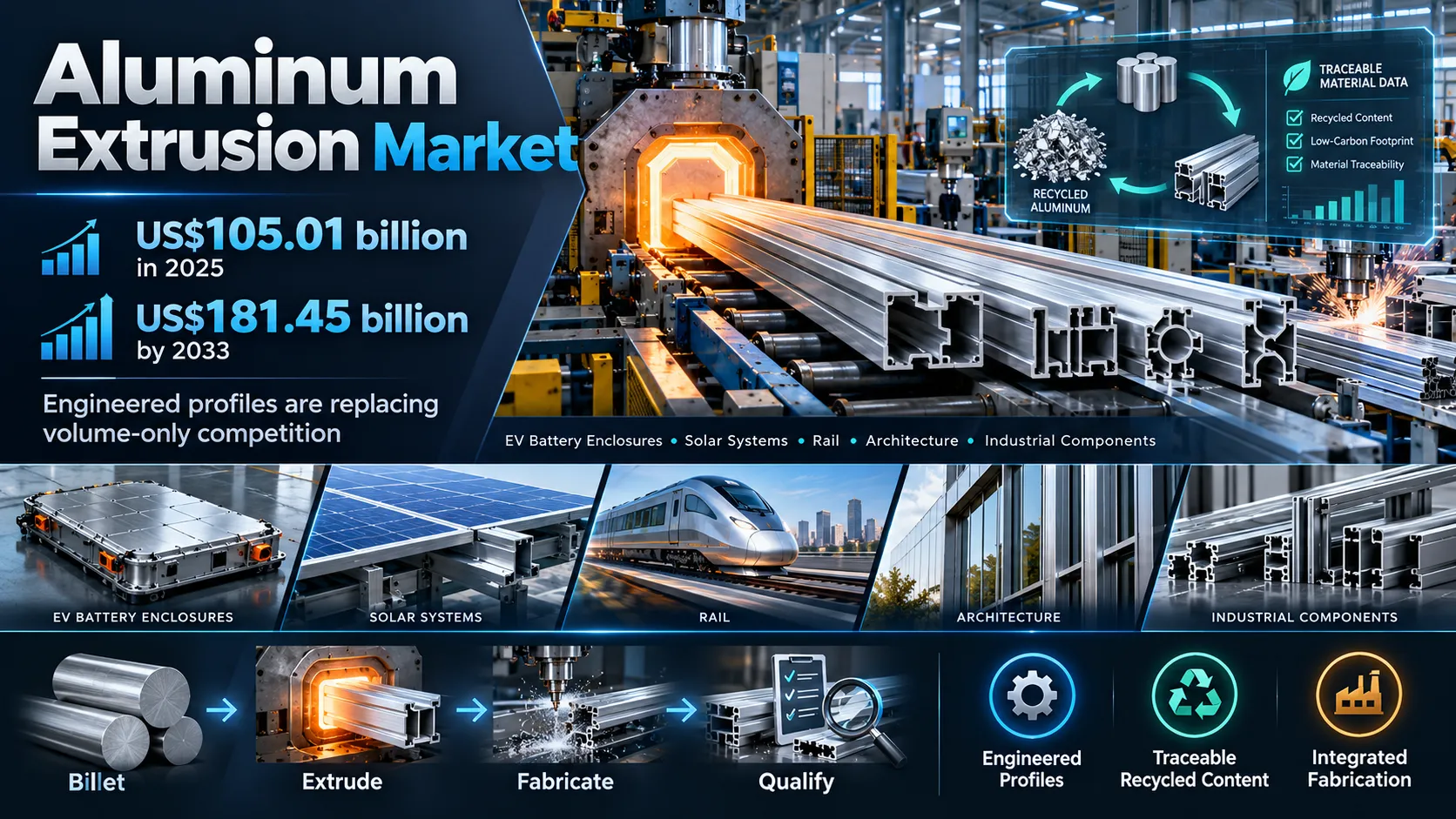
The global aluminum extrusion industry is moving from a price-and-tonnage model toward engineered profiles, traceable recycled content and integrated fabrication. Extruders are competing for higher-value work in vehicle crash structures, EV battery enclosures, solar systems, rail equipment, precision industrial assemblies and architectural façades. Die design, alloy consistency, tolerance control, coating and downstream machining increasingly determine supplier selection.
DataM Intelligence values the global aluminum extrusion market at US$105.01 billion in 2025 and forecasts US$181.45 billion by 2033. Asia-Pacific remains central to manufacturing volume, while suppliers in Europe and North America are emphasizing localized deliveries and low-carbon materials. Global demand does not move uniformly: construction orders can remain soft even as electric mobility, grid upgrades and high-specification industrial projects create new opportunities.
Hydro CEO Eivind Kallevik observed that “what we produce, where we produce it and how we produce it is more important than ever” in Hydro’s 2025 annual-report commentary. Constellium CEO Ingrid Joerg said that “demand for high value add products remained strong,” even while describing weaker aerospace and European automotive conditions. Their comments illustrate how product mix and manufacturing resilience can matter more than overall metal volume. (Hydro; Constellium, 2026)
Request Sample: https://www.datamintelligence.com/download-sample/aluminium-extrusion-market
Top 10 Companies Analysis
Norsk Hydro / Hydro Extrusions
Hydro is among the broadest global extrusion suppliers, operating 69 extrusion production sites across 20 countries, with about 1.0 million tonnes of extrusion sales in 2025. Its key advantage is coordinated recycling, billet sourcing, extrusion and downstream fabrication. The group reported 2025 revenue of approximately US$20.6 billion, converted from NOK207.97 billion using an indicative annual exchange rate; this is total Hydro revenue, not extrusions alone. Its focus is increasing recycled inputs and customer-specific engineered parts.
Constellium
Constellium supplies hard- and soft-alloy extrusions and assembled aluminum structures for automotive, aerospace, rail and industrial clients. It generated US$8.4 billion consolidated 2025 revenue, encompassing significant rolled-products operations. Its competitive advantage is application engineering, crash-management systems and integration of extruded profiles with joining and assembly. Automotive platform demand and customer qualification cycles remain core execution sensitivities.
Kaiser Aluminum
Kaiser offers engineered semi-fabricated products, including automotive extrusion and high-strength applications. Its 2025 consolidated net sales were US$3.37 billion, while conversion revenue was US$1.45 billion. These are not pure extrusion revenue figures. Precision production and qualification credentials strengthen its position in technically demanding customers, although aluminum input-price movements can distort headline sales comparisons.
Jindal Aluminium
Jindal Aluminium is a leading India-based extruder with architectural and industrial profiles plus an expanding engineered-products offering. Its differentiation centers on press capacity, broad profile availability and integrated finishing. A consistently comparable standalone 2025 USD revenue figure is not confirmed for this analysis. Competition increasingly rests on tight tolerances and export-grade finishing.
Hindalco Industries
Hindalco combines a large integrated aluminum platform with downstream extrusion capacity and strategic investments in high-value aluminum applications. Its company revenue includes Novelis and major non-extrusion activities, so a group figure would overstate its extrusion scale. Its advantage is upstream access and the ability to address automotive, electrical and industrial requirements.
Bonnell Aluminum (Tredegar)
Bonnell serves North American building products, transportation, machinery and industrial buyers with custom profiles and fabrication. Its regional manufacturing footprint and application-specific engineering help customers reduce component count. A separately verified 2025 Bonnell revenue figure is not included. Its main opportunity is improving value-added mix against import competition.
Xingfa Aluminium
Xingfa is a significant Chinese producer of architectural and industrial extrusions. Its strengths include complex profile design, building-system integration and export capability. Revenue denominators differ across group activities, so no unverified 2025 USD figure is assigned. Building demand softness and international trade barriers are major pressures.
Guangdong Fenglu Aluminium
Fenglu manufactures extrusion profiles for architecture, transportation and industrial use. Scale, die engineering and finishing capability support its customer proposition. Publicly comparable standalone 2025 revenue could not be established. Its strategic challenge is moving into certified precision products while managing pricing competition.
Gulf Extrusions
Gulf Extrusions serves Middle Eastern and international projects in architectural, transportation and industrial sectors. Regional proximity, anodizing and fabrication are important differentiators. A verified standalone 2025 revenue figure is unavailable; procurement opportunities are closely tied to large-scale construction and infrastructure programs.
Press Metal Aluminium Holdings
Press Metal is a major Southeast Asian aluminum producer with downstream extrusion exposure. Integrated metal sourcing provides potential cost and supply-security advantages, but reported consolidated revenue includes much more than extrusion. Further downstream integration and differentiated industrial profiles represent the strategic opportunity.
Competitor Analysis: Leading Aluminum Extrusion Market Players
| Company | Core position | 2025 Revenue (USD) | Competitive focus |
| Hydro | Global extrusion and recycling | ~$20.6bn group | Recycled profiles, fabrication |
| Constellium | Engineered extrusions and structures | $8.4bn group | Automotive assemblies |
| Kaiser Aluminum | High-specification aluminum products | $3.37bn group | Precision and qualifications |
| Jindal Aluminium | Architectural and industrial extrusions | $750 mn | Capacity and finishing |
| Hindalco | Integrated metal and downstream products | $32.8 bn | Industrial integration |
| Bonnell Aluminum | North American custom profiles | $471.8 mn | Fabrication |
| Xingfa Aluminium | China-based extrusion systems | $2.9 bn | Building and industrial profiles |
| Guangdong Fenglu | Profile manufacturing | $1.4 bn | Industrial specifications |
| Gulf Extrusions | Regional custom extrusions | $139.8 mn | Project proximity |
| Press Metal | Integrated aluminum and downstream | $3.65 bn | Supply-chain integration |
Request Sample: https://www.datamintelligence.com/download-sample/aluminium-extrusion-market
Who Are the Rising Companies Influencing the Market?
- Maan Aluminium - Strategic focus: expand engineered extrusion capacity and integrated value-added processing in India.
- Century Extrusions - Strategic focus: increase industrial alloy and custom-profile penetration in domestic infrastructure supply chains.
- Taber Extrusions - Strategic focus: serve high-tolerance aerospace, defense and transport applications with specialized extrusions.
- Regional precision extruders in Southeast Asia - Strategic focus: combine machining, coatings and shorter delivery lead times to attract diversified OEM sourcing.
Major Mergers, Acquisitions and Portfolio Restructuring - 2026
- 2026 - Hydro continued integrating recycling and extrusion operations into a more traceable circular supply chain, emphasizing group-wide operational resilience. This is a strategic integration program, not a newly announced acquisition.
- 2026 - Constellium introduced its Vision 2028 operational-excellence program with efficiency and cost-reduction priorities. It represents portfolio and operating-model optimization rather than a merger.
- 2026 - No additional material extrusion-specific acquisition is included without a confirmed announcement and effective date. Sector consolidation remains a strategic possibility, especially in regional fabrication and recycling.
Recent Innovations and Their Potential Impact - June 2026 Onward
- 11 September 2026 - Hydro announced its participation in Siemens Mobility’s Train2Train pilot, turning aluminum recovered from retired trains into new extrusion billets and rail components. Potential impact: traceable closed-loop procurement and reduced dependence on primary billet.
- 2026, publicly highlighted in Hydro’s October ALUMINIUM 2026 update - Hydro advanced closed-loop façade recycling and high-recycled-content automotive applications. Potential impact: verified recycled-content supply becomes an important tender criterion for buildings and vehicles.
- July 2026 - Constellium outlined progress in its group-wide operational efficiency strategy during second-quarter reporting. Potential impact: process yield, cost reduction and manufacturing consistency become more important differentiators; this is a process strategy rather than a newly launched alloy.
What Is Driving Competition in the Market?
Automotive lightweighting is shifting value toward precise extrusions for battery enclosures, crash absorbers, sills and thermal management. Solar installations, electrical enclosures and modular industrial equipment require reliable profile supply at scale. However, pricing remains sensitive to metal-index adjustments, energy costs, import duties and conversion premiums. The most profitable producers increasingly combine extrusion with machining, welding, heat treatment and finishing.
Low-carbon aluminum and post-consumer scrap are becoming material purchasing criteria. Buyers need credible traceability, mechanical consistency and assured supply, especially when recycled feedstocks are involved. Integrated players can secure billet inputs and closed-loop return streams, while regional specialists can compete through engineering responsiveness and customized order economics.
By 2035, the likely competitive dividing line is between high-volume standard profiles and qualified, fabricated components with demonstrable customer value. Companies that can document product carbon footprint, deliver stable tolerances and shorten downstream assembly time are positioned to capture a greater portion of the value created by extrusion.