


Critical Minerals Market Research insights
The critical minerals market now sits inside battery strategy, defense planning, renewable energy buildout, grid modernization, electronics production and industrial policy. That makes the market more interesting, but also harder to read.
Lithium, cobalt, nickel, graphite, copper, manganese, tungsten and rare earth elements have moved into the center of procurement conversations. A few years ago, many buyers looked at these materials mainly through price cycles. That feels outdated now. The real concern is whether enough material can be mined, processed, refined and delivered in the right form, at the right quality, from a supply chain that does not become a political or tariff problem overnight.
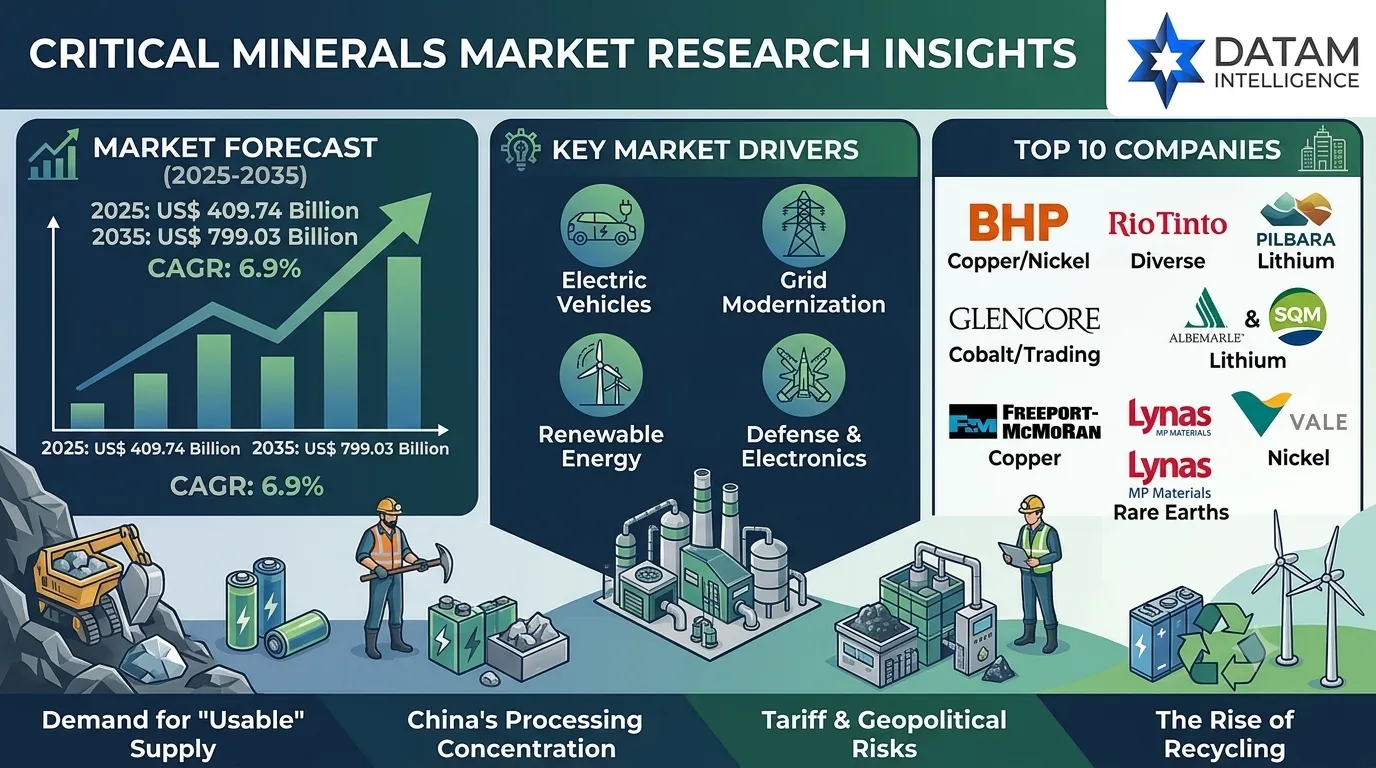
According to DataM Intelligence, the Critical Minerals Market was valued at US$ 409.74 billion in 2025 and is expected to reach US$ 799.03 billion by 2035, growing at a CAGR of 6.9% during the forecast period. Growth is being supported by electric vehicles, battery energy storage, grid expansion, renewable energy deployment, defense electronics, semiconductors, industrial machinery and consumer electronics.
Identify Growth Opportunities in the Global Critical Minerals Industry
Access expert market intelligence covering critical mineral demand, supply chain risks, regional trends, competitive analysis, and strategic opportunities for businesses, investors, and industry stakeholders. Request the Critical Minerals Market Sample Report and make informed decisions in this rapidly evolving industry.
What makes this market different from older mining cycles is the nature of downstream demand. Battery companies need lithium and graphite that can be qualified for cell production. Automakers need supply that can support long term model launches. Defense customers care about rare earths, tungsten and specialty minerals because supply disruption is a security issue. Grid operators and renewable energy developers need copper because electrification does not happen without it.
Processing is where the market becomes more complicated. China remains the leading refiner for 19 of the 20 strategic minerals tracked by the International Energy Agency. That statistic is hard to ignore. It explains why governments are funding domestic processing, why automakers are signing offtake agreements earlier and why graphite, rare earths and lithium conversion are getting more attention than their historical market size might suggest.
There is also the tariff question. In 2025, the United States announced preliminary anti dumping duties of 93.5% on Chinese battery graphite. With existing duties included, total effective tariffs were reported at around 160%. For battery makers, that is not a footnote. It changes sourcing math.
Top 10 Critical Minerals Market Companies Analysis
BHP Group
BHP is one of the most important companies in the critical minerals market because of copper and nickel. Simple as that.
Copper is becoming one of the most strategic industrial metals because it touches nearly every part of electrification. Power grids need it. EV charging infrastructure needs it. Data centers need it. Renewable energy projects need it. Nickel gives BHP a link to battery materials and high performance industrial uses.
BHP’s advantage is scale, but scale alone would be too easy an explanation. The company also has asset quality, operational depth and the ability to invest through cycles. That matters in a market where project delays can stretch for years and customers increasingly want dependable long term supply rather than opportunistic spot purchases.
Rio Tinto
Rio Tinto has a broader critical minerals position than it sometimes gets credit for. Copper, lithium, aluminum, titanium minerals and industrial materials all give the company exposure to different parts of the energy transition and advanced manufacturing chain.
Its copper position connects it to electrification and grid infrastructure. Its lithium exposure brings it closer to battery manufacturing. The combination is useful because the market is not moving in one straight line. Lithium has sharper battery exposure. Copper has wider infrastructure exposure. Rio Tinto has both, which gives it some balance.
The challenge is execution. Large mining projects do not move quickly, and critical minerals customers are increasingly impatient. Rio Tinto’s long term strength will depend on how well it converts project pipelines into reliable supply.
Glencore
Glencore has a different feel from many miners because it is not only a producer. It is also a major trader. That changes its role in critical minerals.
The company has exposure to cobalt, copper, nickel and zinc. Cobalt and nickel keep it tied to battery materials. Copper connects it to electrification. Its trading arm gives it reach into supply flows, customer relationships and market volatility. In a market where price swings and regional concentration can unsettle buyers quickly, that commercial reach is a real advantage.
There are risks. Cobalt sourcing has always carried ESG and jurisdictional sensitivity. Battery chemistry shifts could also affect long term cobalt demand. Still, Glencore remains one of the few companies that can influence both physical supply and market movement.
Albemarle Corporation
Albemarle is one of the clearest lithium plays in the global critical minerals market. Its position is closely tied to electric vehicle batteries and energy storage systems.
Lithium is an attractive market, but it is not a comfortable one. Prices can move sharply. Supply can overbuild. Demand forecasts can change with EV adoption rates, battery chemistry shifts and policy support. Albemarle’s strength is that it is not just sitting on lithium resources. It has processing capability and customer links across the battery and automotive supply chain.
That processing piece matters more than many casual observers realize. Battery makers do not buy a story about lithium. They need qualified lithium chemicals that work inside commercial battery production.
Sociedad Química y Minera de Chile
SQM is one of the most important lithium producers globally, supported by Chilean brine resources and long experience in lithium production. Its role in the market is straightforward, but not simple.
The company benefits from strong resource access and deep operating knowledge. It also sits in a country where lithium policy, environmental expectations and community concerns can shape future production. That creates both strength and uncertainty.
SQM remains highly relevant because battery supply chains need large, proven lithium producers. The company’s position will depend on how well it balances production growth with environmental management and long term customer requirements.
Freeport McMoRan
Freeport McMoRan is a copper company first in this context, and that is enough to make it one of the most important critical minerals players.
Copper does not always attract the same attention as lithium or rare earths, but it may be one of the hardest minerals to substitute at scale. It is used in power grids, EV charging, data centers, renewable energy connections and industrial equipment. The demand base is broad, which makes Freeport McMoRan’s copper exposure especially valuable.
The company’s advantage comes from large reserves and global operations. The market will still be cyclical, as copper always is, but the structural demand case looks stronger than in many past cycles.
Vale
Vale brings nickel and copper exposure to the critical minerals market, alongside its much larger iron ore business. Nickel is the key point here. It remains important for battery applications where energy density and performance matter.
Vale has the scale and mining capability to serve both industrial customers and battery material supply chains. That said, nickel is not an easy market to call. Battery chemistry changes, Indonesian supply growth and pricing pressure can all affect the outlook. Vale’s strength is that it has the asset base to remain relevant even as the market shifts.
Its position is meaningful, but not risk free.
Lynas Rare Earths
Lynas Rare Earths is important because rare earth supply is one of the most politically sensitive parts of the critical minerals market. Rare earth elements are used in permanent magnets for EV motors, wind turbines, robotics, defense systems and advanced electronics.
The company’s value is tied to supply diversification. Buyers want rare earth sources outside highly concentrated processing networks, and Lynas is one of the few credible names in that space. That gives it strategic importance beyond its production scale.
Rare earths are technically difficult, capital intensive and exposed to policy risk. Still, Lynas has a position that many governments and manufacturers care about.
MP Materials
MP Materials has become a key US rare earth company because it operates the Mountain Pass mine. Its importance comes from timing as much as assets. The United States is trying to rebuild rare earth supply chains for defense, electric vehicles, electronics and advanced manufacturing.
Mining is only one part of the story. MP Materials is trying to move into separation and magnet related activities, which is where the strategic value increases. The hard part is execution. Building a rare earth supply chain outside the established processing base is difficult, expensive and slow.
Even so, MP Materials is one of the few companies that can credibly sit inside a US rare earth security discussion.
Pilbara Minerals
Pilbara Minerals is one of Australia’s leading hard rock lithium producers. It supplies spodumene concentrate into the battery materials supply chain, which makes it closely tied to lithium conversion and EV battery demand.
Australia remains central to lithium supply, and Pilbara Minerals benefits from that position. The company’s exposure is attractive when lithium demand is strong, but it also means the business can feel the full force of lithium price swings.
Its strategic value comes from resource strength, production experience and a direct link to battery supply chains. In a market where battery manufacturers are looking for secure feedstock, that matters.
Competitor Analysis: Top Critical Minerals Market Players
| Company | Core Position | Strategic Focus | Main Demand Exposure | Competitive Strength |
| BHP Group | Copper and nickel with diversified mining base | Energy transition metals | Grids, batteries, renewable energy, industrial infrastructure | Scale, asset quality, copper exposure |
| Rio Tinto | Copper, lithium, aluminum, industrial minerals | Battery materials and electrification | EVs, grids, renewable energy, manufacturing | Broad portfolio and project execution |
| Glencore | Cobalt, copper, nickel, zinc, trading | Battery minerals and supply chain management | Battery makers, automakers, industrial buyers | Mining scale and trading reach |
| Albemarle | Lithium production and chemicals | Battery grade lithium supply | EV batteries and energy storage | Processing capability and customer links |
| SQM | Lithium brine and specialty minerals | Lithium supply growth | Cathode producers, batteries, storage | Chilean brine access and lithium experience |
| Freeport McMoRan | Copper mining and processing | Electrification and grid metals | Grids, EV charging, data centers, renewables | Large copper reserves and global operations |
| Vale | Nickel, copper, iron ore | Battery minerals and industrial supply | Batteries, steel, industrial users | Nickel exposure and mining scale |
| Lynas Rare Earths | Rare earth mining and processing | Non China rare earth supply | EV motors, wind turbines, defense, electronics | Strategic rare earth diversification |
| MP Materials | Rare earth mining, separation, magnet materials | US rare earth supply chain development | Defense, EVs, electronics, manufacturing | Key US rare earth asset |
| Pilbara Minerals | Hard rock lithium mining | Spodumene supply | Battery chemicals and EV supply chains | Australian lithium resource strength |
Who Are Other Companies Influencing the Market?
The market is much wider than the top ten. Anglo American and Teck Resources remain important because copper, nickel and diversified mining exposure still matter. Lithium Americas, Arcadium Lithium, Mineral Resources Limited and IGO Limited are relevant because lithium supply is still central to battery manufacturing, even if pricing cycles make the story uneven.
Rare earths bring in another group of companies. Iluka Resources, Arafura Rare Earths and China Northern Rare Earth Group are important because rare earth supply chains remain sensitive and concentrated. CMOC Group and Sumitomo Metal Mining influence cobalt, nickel and battery material supply. Eramet and Sibanye Stillwater also remain relevant through their exposure to strategic minerals and industrial metals.
Graphite deserves its own attention. Syrah Resources and Graphite One are being watched more closely because battery anode supply has become a sourcing risk. The 2025 tariff pressure on Chinese battery graphite has made alternative graphite supply more commercially relevant.
Recycling companies are also becoming harder to ignore. Redwood Materials, Li Cycle Holdings and Umicore are influencing the market because secondary recovery can support lithium, cobalt, nickel, copper and graphite supply resilience. Recycling will not replace mining. It can, however, reduce some pressure on primary supply and help buyers create more resilient sourcing models.
What Is Driving Competition in the Market?
Competition is being driven by the uncomfortable gap between mineral demand and usable supply. That word matters. Usable. A mineral deposit is not enough if it cannot be processed, qualified and delivered into a battery, magnet, grid component or defense system.
- Battery manufacturing is one of the strongest demand signals. More than 300 gigafactories are being tracked globally across active, planned and under construction sites. Each factory increases demand for lithium, graphite, nickel, cobalt, manganese and copper. It also raises expectations for quality, reliability and long term supply agreements.
- Processing concentration is the larger strategic issue. Lithium needs conversion capacity. Rare earths need separation. Graphite needs anode processing. Nickel and cobalt need refining routes that meet battery standards. Companies with access to these middle stages often have a stronger position than companies selling raw material into uncertain downstream channels.
- Trade policy is changing buyer behavior as well. Tariffs, export controls, country of origin rules and local content incentives are pushing companies to evaluate suppliers differently. Material quality still matters, but so does processing location, compliance risk, tariff exposure and traceability.
- Recycling is adding a new layer of competition. Battery recycling, electronics recycling, rare earth magnet recovery and copper scrap recovery can create secondary supply streams. It will not solve every supply problem. Still, it gives buyers another lever at a time when concentrated supply chains are becoming harder to defend.
The next phase of competition will probably favor companies that can connect upstream assets with processing capacity and real customer demand. Not every project will qualify. Not every supply story will survive price volatility. The stronger players will be those that can offer reliable supply, clearer traceability, lower tariff exposure and stronger customer qualification as critical minerals become part of long-term industrial planning.