


Introduction: Why Graphene Is Called a Wonder Material
Graphene is one of the most talked-about materials in modern science. It is extremely thin, strong, lightweight, flexible, and highly conductive. Because of this unusual combination, researchers and industries are exploring graphene for electronics, batteries, coatings, composites, sensors, medical devices, water filtration, construction materials, textiles, and many other applications.
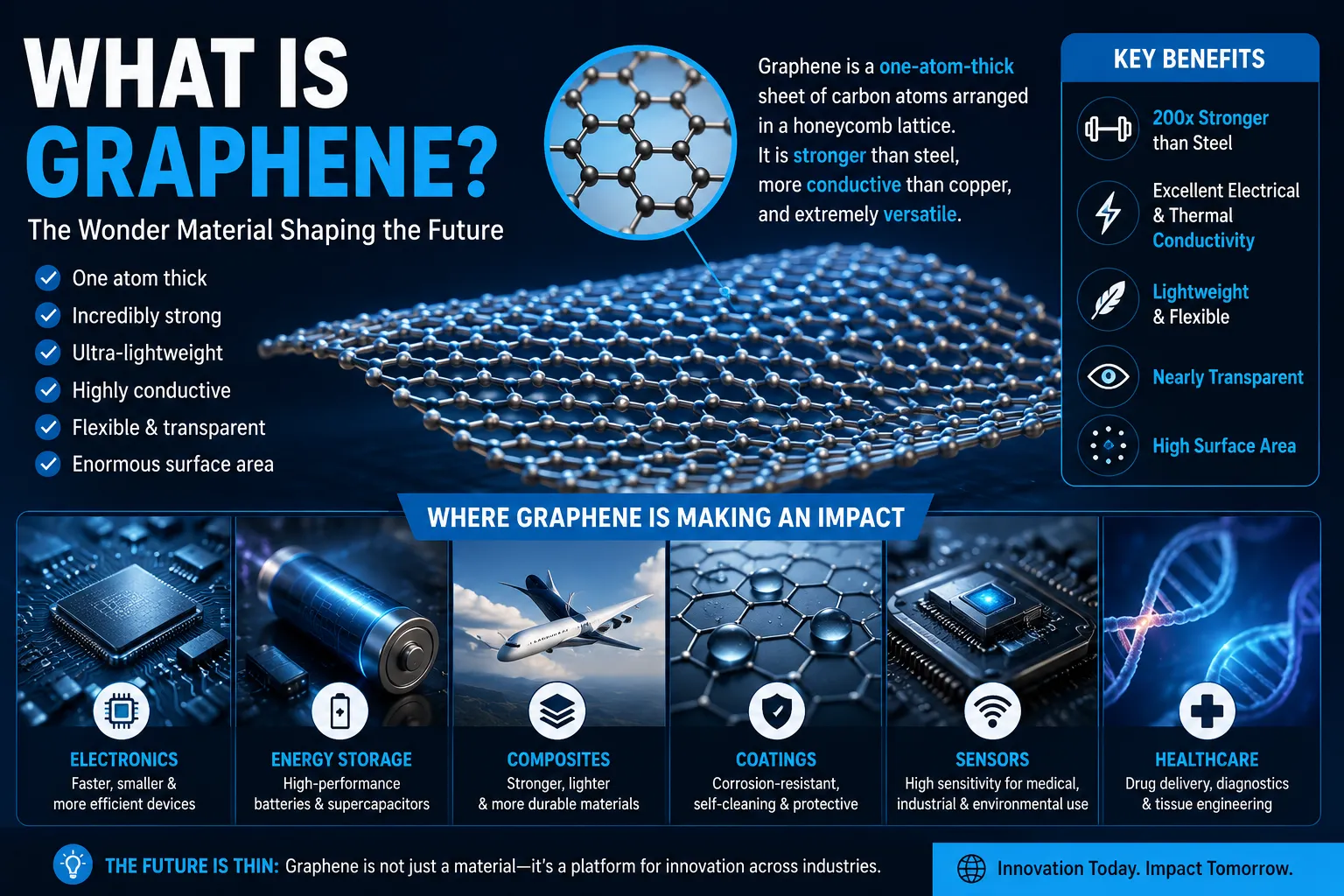
In simple words, graphene is a one-atom-thick sheet of carbon atoms arranged in a flat honeycomb-like pattern. The Nobel Prize describes graphene as carbon atoms joined in a flat lattice similar to a honeycomb, but only one atom thick. It also notes that graphite contains millions of graphene layers stacked on top of one another.
That is what makes graphene so interesting. Carbon is already familiar to us in forms such as graphite and diamond. But when carbon atoms are arranged as a single, flat layer, they behave in extraordinary ways. Graphene can conduct electricity and heat, bend without easily breaking, remain almost transparent in thin layers, and add strength to other materials.
This blog explains graphene in a simple, practical way. You will learn what graphene is, how it is different from graphite, how it was discovered, what properties make it special, how it is produced, where it is used, what benefits it offers, and what limitations still prevent it from becoming an everyday material in every product.
Request for Exclusive Sample: Global Graphene Market
What Is Graphene?
Graphene is a two-dimensional material made of carbon atoms arranged in a hexagonal pattern. It is often described as a single layer of graphite. Graphite, the material commonly associated with pencil “lead,” is made of many layers of carbon sheets stacked together. Graphene is what you get when one of those layers is separated into a single atomic sheet.
A simple way to imagine it is this: if graphite is like a thick notebook, graphene is like one page from that notebook. The difference is that this “page” is only one atom thick.
Graphene has six important features:
- It is made of carbon.
- It is one atom thick.
- It has a honeycomb-like structure.
- It is closely related to graphite.
- It is considered a two-dimensional material.
- It has unusual strength, conductivity, flexibility, and surface area.
Because graphene is so thin, almost every atom sits on the surface. This gives it a very large surface area compared with its mass. That surface-rich structure helps explain why graphene is so useful in sensors, coatings, membranes, energy-storage materials, and composites.
Although graphene sounds futuristic, its base material is very ordinary: carbon. What makes it special is not the element itself, but the arrangement of the atoms.
According the DataM Intelligence Research Report, “Globla Graphene Market size is expected to reach up to US$ 8,847.65 Million in 2033, growing at a CAGR of 34.2% by 2026-2033”.
Graphene vs Graphite: What Is the Difference?
The easiest way to understand graphene is to compare it with graphite. Graphite is made of many thin carbon layers stacked together. Graphene is one of those layers separated into a single sheet. This structural difference gives graphene many unusual properties.
| Feature | Graphene | Graphite |
| Structure | Single layer of carbon atoms | Many graphene layers stacked together |
| Thickness | One atom thick | Thick, layered material |
| Form | Two-dimensional sheet | Three-dimensional bulk material |
| Conductivity | Very high electrical conductivity | Good conductivity, but different due to layered structure |
| Strength | Extremely strong at the atomic level | Softer and easily leaves marks, such as pencil marks |
| Use cases | Electronics, sensors, batteries, coatings, composites | Pencils, lubricants, electrodes, refractories, industrial materials |
Graphite is useful because its layers can slide over one another. That is why it works well in pencils and lubricants. Graphene, on the other hand, is useful because a single layer of carbon atoms can show exceptional electrical, thermal, mechanical, and optical behavior.
The two materials are related, but they are not the same. Graphite is a bulk material. Graphene is a single atomic layer.
Discovery of Graphene
Scientists had studied carbon materials for many years before graphene became famous. The big breakthrough came when researchers successfully isolated a stable single layer of graphene from graphite.
Graphene was isolated in 2004 at the University of Manchester by Professor Andre Geim and Professor Kostya Novoselov. Their work later earned them the 2010 Nobel Prize in Physics. The University of Manchester describes graphene as being discovered there in 2004 by Geim and Novoselov.
The method was surprisingly simple. Britannica explains that Novoselov, Geim, and colleagues isolated single-layer graphene using exfoliation from graphite, often described as the “scotch-tape method.”
This discovery opened the door to modern two-dimensional materials research. After graphene, scientists began paying much more attention to other atomically thin materials and how they could be used in future technologies.
Why Is Graphene Special?
Graphene is special because it combines several impressive properties in one material. Many materials are strong but heavy. Some are conductive but not flexible. Others are transparent but not strong. Graphene stands out because it can be strong, light, flexible, conductive, and nearly transparent at the same time.
The University of Manchester highlights graphene’s combination of strength, light weight, flexibility, electrical conductivity, thermal conductivity, and transparency.
1. Strength
Graphene is known for its remarkable strength despite being extremely thin. Its strength comes from the tight bonds between carbon atoms in the honeycomb structure. At the atomic level, these bonds create a highly stable sheet.
This does not mean everyday products can simply be made from pure graphene sheets like plastic or steel panels. In most real-world applications, graphene is added to other materials to improve strength, stiffness, durability, or wear resistance.
2. Electrical Conductivity
Graphene can conduct electricity very efficiently. This makes it interesting for electronics, sensors, conductive inks, flexible circuits, transparent conductors, batteries, and supercapacitors.
Because graphene is thin and flexible, it may be useful in electronic systems where traditional rigid materials are less suitable, such as wearable devices, foldable electronics, and printed electronics.
3. Thermal Conductivity
Graphene can also transfer heat very well. This makes it attractive for electronics cooling, battery heat management, thermal coatings, and high-performance composites.
Heat control is a major issue in modern technology. Phones, laptops, electric vehicles, batteries, LED systems, and industrial electronics all need better thermal management. Graphene-based materials may help spread heat more efficiently in some of these applications.
4. Lightweight Structure
Graphene is extremely thin and light. This is valuable in industries where weight reduction matters, such as aerospace, automotive manufacturing, sports equipment, wearable technology, and advanced composites.
The goal is not always to make a product entirely from graphene. More often, manufacturers study how small amounts of graphene can improve a larger material without adding much weight.
5. Flexibility
Graphene can bend without easily breaking. This makes it useful for flexible electronics, wearable sensors, smart textiles, foldable displays, and flexible electronic patches.
Flexibility is especially important as technology moves beyond flat, rigid screens and circuit boards. Wearable devices, medical patches, flexible displays, and smart clothing need materials that can bend, stretch, or move with the body.
6. Transparency
Graphene can be highly transparent in thin layers while still conducting electricity. This combination makes it interesting for touchscreens, displays, transparent conductive films, solar cells, and advanced optical devices.
Traditional transparent conductive materials have limitations, including brittleness or supply concerns. Graphene is being studied as a possible alternative or performance enhancer in this area.
How Is Graphene Made?
There is no single best way to make graphene. Different production methods are used depending on the desired quality, cost, quantity, and final application. Some methods create very high-quality graphene for scientific research or electronics, while others produce graphene flakes, graphene oxide, or nanoplatelets for coatings, composites, inks, and industrial materials.
The University of Manchester notes that the original sticky-tape method is still used, but it is not suitable for industrial-scale production; other methods, such as chemical deposition, are used for larger-scale manufacturing.
| Method | Simple Explanation | Common Use |
| Mechanical exfoliation | Peeling thin layers from graphite | Research and high-quality graphene samples |
| Chemical vapor deposition | Growing graphene on a surface using carbon-containing gases | Electronics, sensors, advanced films |
| Liquid-phase exfoliation | Breaking graphite into graphene flakes in liquid | Coatings, inks, composites |
| Graphene oxide method | Chemically modifying graphite to create graphene oxide | Membranes, coatings, biomedical research, composites |
| Electrochemical exfoliation | Using electricity to separate graphene layers | Scalable graphene production |
A review of graphene synthesis techniques describes graphene production through both top-down and bottom-up approaches, including mechanical exfoliation, liquid-phase exfoliation, oxidation-reduction, and chemical vapor deposition.
The important point is that “graphene” is not one identical material in every product. A perfect single-layer graphene sheet used in a laboratory is very different from graphene nanoplatelets used in rubber or a graphene oxide dispersion used in a membrane.
Types of Graphene Materials
Graphene is often discussed as one material, but in practice there are several graphene-related materials. Each type has different properties and uses.
1. Single-Layer Graphene
Single-layer graphene is one sheet of carbon atoms. It is important in advanced electronics, sensors, physics research, and high-performance films. It is often the form people imagine when they hear the word graphene, but it can be difficult and expensive to produce at large scale with consistent quality.
2. Few-Layer Graphene
Few-layer graphene contains a small number of graphene layers. It may not have every ideal property of perfect single-layer graphene, but it is often more practical for industrial uses. It can be used in composites, coatings, conductive materials, and energy-related applications.
3. Graphene Oxide
Graphene oxide is a graphene-related material that contains oxygen-containing groups. These groups make it easier to disperse in water and mix with polymers, coatings, membranes, and other materials.
Graphene oxide is widely studied for filtration membranes, biomedical research, coatings, composites, and chemical functionalization.
4. Reduced Graphene Oxide
Reduced graphene oxide is produced by removing some oxygen from graphene oxide. This can improve electrical conductivity compared with graphene oxide, although it may not fully match pristine graphene.
It is used in applications where a balance of processability and conductivity is needed, such as sensors, energy-storage materials, conductive coatings, and research devices.
5. Graphene Nanoplatelets
Graphene nanoplatelets are small flakes or stacks of graphene-like sheets. They are commonly used as additives in plastics, rubber, coatings, lubricants, construction materials, composites, and thermal-management materials.
They are often more commercially practical than perfect single-layer graphene because they can be produced and mixed into other materials more easily.
6. Graphene Films
Graphene films are thin layers used in sensors, electronics, transparent conductors, advanced coatings, and research devices. Films may be produced through methods such as chemical vapor deposition and transferred onto suitable surfaces.
What Is Graphene Used For?
Graphene is being explored across many industries because its properties can support different functions: conductivity, heat transfer, strength, flexibility, barrier performance, sensitivity, and surface interaction. Fraunhofer ISI notes that graphene is expected to contribute to areas such as sensors, photonics, optoelectronics, energy, electronics, composites, coatings, and biomedical technologies.
1. Graphene in Electronics
Graphene is useful in electronics because it can conduct electricity, bend, and remain extremely thin. It is studied for flexible electronics, wearable devices, sensors, touchscreens, conductive films, transistors, photodetectors, printed electronics, and transparent conductive layers.
In the future, graphene may help create devices that are thinner, lighter, more flexible, and better at managing heat. It may also support new kinds of sensors that respond quickly to changes in pressure, gas, chemicals, or biological signals.
2. Graphene in Batteries and Energy Storage
Graphene is widely studied in batteries, supercapacitors, conductive additives, and electrode materials. In energy storage, graphene is mainly valued for its conductivity, surface area, and heat-transfer properties.
Potential benefits include faster charging, better conductivity, improved heat management, longer battery life, lighter energy-storage systems, and improved electrode performance.
Graphene is not a magic ingredient that automatically makes every battery better. Its performance depends on the battery chemistry, electrode design, graphene quality, dispersion method, and manufacturing process. Still, it remains one of the most discussed materials in next-generation energy storage.
3. Graphene in Coatings and Paints
Graphene-based coatings are interesting because very small amounts of graphene can improve barrier performance, conductivity, mechanical strength, or corrosion resistance.
Possible coating applications include anti-corrosion coatings, marine coatings, industrial paints, protective coatings, thermal coatings, and conductive coatings.
For example, a graphene-enhanced coating may help protect metal surfaces from moisture, chemicals, or salt exposure. In electronics, graphene coatings may support conductivity or heat spreading. In industrial settings, they may help reduce wear and extend product life.
4. Graphene in Composites
Graphene can act like a performance-enhancing additive. When mixed properly into plastics, rubber, metals, ceramics, or carbon-fiber composites, it can help improve strength, stiffness, durability, conductivity, heat resistance, or wear performance.
Common areas of interest include automotive parts, aerospace components, sports equipment, protective gear, industrial materials, lightweight structures, and high-performance polymers.
The key challenge is dispersion. Graphene must be distributed evenly throughout the material. If it clumps together, the final product may not achieve the desired improvement.
5. Graphene in Healthcare and Biomedical Applications
In healthcare, graphene is still largely being studied and developed. Its high surface area, conductivity, and ability to interact with biological molecules make it interesting for biosensors, diagnostic tools, medical imaging research, drug delivery research, tissue engineering research, and antibacterial surfaces.
Graphene-based biosensors could help detect biomarkers, pathogens, or chemical signals. Graphene oxide and related materials are also studied in drug delivery and tissue engineering because their surfaces can be modified for specific biological interactions.
However, biomedical use requires careful safety testing. A material that works well in a lab experiment must still pass strict requirements for biocompatibility, toxicity, stability, dosage, clearance, and long-term safety.
6. Graphene in Water Filtration
Graphene oxide and graphene-based membranes are studied for water purification, desalination research, contaminant removal, industrial wastewater treatment, and selective separation membranes.
The idea is that graphene-based membranes may help separate salts, molecules, or pollutants from water while allowing water molecules to pass through. This makes graphene especially interesting for future filtration technologies.
Real-world use depends on membrane cost, durability, fouling resistance, manufacturing scalability, and performance under actual water-treatment conditions.
7. Graphene in Construction Materials
In construction, graphene is mainly explored as an additive. The goal is not to build bridges or buildings from pure graphene, but to use small amounts of graphene to improve ordinary materials such as cement, concrete, coatings, asphalt, paints, and protective layers.
Possible benefits include stronger concrete, reduced cracking, improved durability, better water resistance, longer-lasting structures, and lower material usage in some designs.
This area is promising because even small improvements in construction materials can have large effects. Stronger and longer-lasting materials may reduce repair needs, waste, and maintenance costs.
8. Graphene in Textiles and Wearables
Graphene’s flexibility and conductivity make it useful for wearable technologies. It can be explored in smart clothing, conductive fabrics, heat-spreading textiles, lightweight protective clothing, wearable health sensors, and flexible electronic patches.
A graphene-enhanced textile may help sense movement, conduct electricity, spread heat, or connect with electronic devices. This could support future sportswear, health-monitoring clothing, military textiles, and medical wearables.
9. Graphene in Sensors
Graphene is extremely thin and has a large surface area, so changes on its surface can strongly affect its electrical behavior. This makes it valuable for sensitive detection technologies.
Possible sensor uses include gas sensors, biosensors, pressure sensors, strain sensors, chemical sensors, environmental sensors, and wearable health sensors.
Because graphene responds strongly to surface interactions, it may help create sensors that are small, fast, sensitive, and flexible.
10. Graphene in Automotive and Aerospace
Automotive and aerospace industries are interested in graphene because even small improvements in weight, durability, heat management, and strength can make a major difference in performance.
Possible applications include lightweight panels, anti-corrosion coatings, battery materials, thermal management systems, conductive composites, stronger tires, rubber parts, aircraft materials, drone parts, and protective coatings.
In electric vehicles, graphene may support batteries, sensors, lightweight composites, and heat management. In aerospace, it may contribute to lighter materials and protective coatings.
Benefits of Graphene
The biggest advantage of graphene is not just one property. Its value comes from the combination of many properties in one material.
Key graphene benefits include:
- Extremely thin structure
- High strength at the atomic level
- Very low weight
- Flexibility
- Electrical conductivity
- Thermal conductivity
- Transparency in thin layers
- Large surface area
- Ability to improve other materials
Compatibility with polymers, coatings, metals, rubber, textiles, and membranes
This combination makes graphene a platform material. It may not always be the main material in a product, but it can improve the performance of other materials when used correctly.
Limitations and Challenges of Graphene
Graphene has exciting potential, but it is not a magic material. Its success depends on the type of graphene, how it is produced, how it is mixed with other materials, and whether it can deliver reliable results in real-world products.
Important limitations include:
- High production cost for some graphene types
- Difficulty producing high-quality graphene at large scale
- Quality differences between suppliers
- Difficulty mixing graphene evenly into other materials
- Safety and environmental testing requirements
- Gap between laboratory performance and real-world performance
- Application-specific manufacturing challenges
- Need for standards and quality control
- Not every product needs graphene
Many applications still remain in research or early development
One major challenge is consistency. Two materials sold as “graphene” may have different layer counts, oxygen content, particle sizes, purity levels, surface chemistry, and performance. This can make product development difficult.
Another challenge is cost-performance balance. Graphene must do more than sound impressive. It must deliver enough performance improvement to justify its cost, processing requirements, and regulatory evaluation.
Graphene Myths vs Facts
| Myth | Fact |
| Graphene will replace all materials. | Graphene is more likely to improve existing materials than replace everything. |
| All graphene is the same. | There are many forms, including single-layer graphene, few-layer graphene, graphene oxide, reduced graphene oxide, and graphene nanoplatelets. |
| Graphene products are already everywhere. | Some commercial uses exist, but many applications are still developing. |
| Graphene is only useful in electronics. | It is also useful in coatings, composites, batteries, sensors, textiles, water filtration, construction, and biomedical research. |
| Graphene is always too expensive. | Cost depends on production method, quality, purity, scale, and application. |
| Adding graphene always improves a product. | Graphene only helps when the right type is used in the right amount and properly dispersed. |
These myths matter because graphene has often been surrounded by hype. The real story is more practical. Graphene is powerful, but it must be engineered carefully.
Graphene vs Other Carbon Materials
Graphene belongs to the carbon-material family, but its flat, one-atom-thick structure makes it different from graphite, diamond, carbon nanotubes, carbon black, and fullerenes.
| Material | Description | Difference from Graphene |
| Graphite | Many layers of carbon sheets | Graphene is a single layer from graphite |
| Carbon nanotubes | Tube-shaped carbon structures | Graphene is flat; nanotubes are cylindrical |
| Carbon black | Fine carbon particles | Used widely as a filler; less structurally ordered than graphene |
| Diamond | Carbon atoms arranged in a 3D crystal | Very hard but not a 2D conductive sheet |
| Fullerenes | Ball-shaped carbon molecules | Different shape and properties from graphene |
This comparison shows why structure matters. The same element, carbon, can create very different materials depending on how atoms are arranged.
Is Graphene Safe?
Graphene safety depends on the type of graphene, particle size, concentration, exposure route, surface chemistry, and application. Graphene used inside a sealed battery, coating, or composite may have a different safety profile from loose graphene powder handled in a laboratory or factory.
The Graphene Flagship states that, as graphene and layered materials move into new applications, it is important to study their effects on health and the environment and understand how to mitigate possible risks.
Safety considerations include:
- Worker exposure during production
- Inhalation of powders
- Skin contact
- Environmental release
- Biomedical compatibility
- Disposal and recycling
- Product-specific testing
- Workplace ventilation and protective controls
This does not mean graphene is automatically unsafe. It means graphene should be evaluated like other advanced materials. The risk depends on how the material is produced, handled, used, and disposed of.
For consumer products, the most important question is not simply “Is graphene safe?” A better question is: “What type of graphene is used, in what amount, in what product, and how can people or the environment be exposed to it?”
Future of Graphene
The future of graphene will depend on practical applications. Instead of replacing every material, graphene is more likely to improve existing products by making them stronger, lighter, more conductive, more durable, or better at managing heat.
Future graphene application areas include:
- Faster-charging batteries
- Flexible electronics
- Smart textiles
- Better sensors
- Anti-corrosion coatings
- Lightweight vehicles
- Stronger construction materials
- Improved water filters
- Advanced medical diagnostics
- Heat-management materials for electronics
- Conductive inks and printed electronics
- Durable rubber and tire materials
- High-performance composites
The future will also depend on manufacturing progress. Researchers and companies must produce graphene at the right quality, scale, and price. They must also show that graphene-based products perform reliably outside the laboratory.
Graphene is not just a futuristic material. It is a platform material. Its greatest value may come from helping ordinary materials do extraordinary things.
Conclusion
Graphene is a remarkable carbon material with a unique combination of strength, flexibility, conductivity, transparency, light weight, and large surface area. It is one atom thick, arranged in a honeycomb-like pattern, and closely related to graphite.
From electronics and batteries to coatings, composites, healthcare, construction, textiles, sensors, and water filtration, graphene has many possible uses. However, its success depends on producing the right type of graphene at the right quality and cost for each application.
Graphene is not a miracle solution for every product. It is a powerful material that must be used carefully and intelligently. When matched with the right application, it can improve existing materials and support the next generation of advanced technologies.
To understand how graphene is being adopted across industries, explore a detailed Graphene Market research report.
FAQs
What is graphene in simple words?
Graphene is a one-atom-thick sheet of carbon atoms arranged in a honeycomb-like pattern. It is often described as a single layer of graphite.
What is graphene made of?
Graphene is made only of carbon atoms. These atoms are arranged in a flat, two-dimensional hexagonal structure.
Is graphene stronger than steel?
Graphene is extremely strong at the atomic level. The University of Manchester describes it as many times stronger than steel while still being lightweight and flexible.
How is graphene different from graphite?
Graphite is made of many layers of carbon sheets stacked together. Graphene is a single layer from graphite. This one-layer structure gives graphene unusual properties.
What are the main properties of graphene?
The main properties of graphene include high strength, electrical conductivity, thermal conductivity, flexibility, light weight, transparency in thin layers, and large surface area.
What is graphene used for?
Graphene is used or studied in electronics, batteries, sensors, coatings, composites, water filtration, construction materials, textiles, biomedical research, and energy-storage systems.
Is graphene used in batteries?
Yes. Graphene is studied for batteries and supercapacitors because it can improve conductivity, support heat management, and enhance electrode performance in some designs.
Can graphene be used in electronics?
Yes. Graphene is studied for flexible electronics, wearable sensors, touchscreens, conductive films, transistors, photodetectors, and printed electronics.
What is graphene oxide?
Graphene oxide is a graphene-related material that contains oxygen groups. It is easier to disperse in water and other materials, making it useful in coatings, membranes, composites, and biomedical research.
Is graphene safe?
Graphene safety depends on the type of graphene, particle size, concentration, exposure route, and application. Safety testing and workplace controls are important, especially when handling powders or using graphene in biomedical applications.
Why is graphene called a wonder material?
Graphene is called a wonder material because it combines several valuable properties: it is extremely thin, strong, lightweight, flexible, conductive, thermally efficient, and nearly transparent in thin layers.
What are the disadvantages of graphene?
Graphene’s disadvantages include high production cost for some types, difficulty scaling high-quality production, quality inconsistency, dispersion challenges, safety testing needs, and the gap between laboratory performance and commercial products.
Is graphene natural or man-made?
Graphene exists as individual layers inside graphite, which is natural. However, isolated graphene used in research or products is usually produced through human-controlled methods such as exfoliation, chemical vapor deposition, or chemical processing.
Can graphene be used in medicine?
Graphene and graphene oxide are being studied for biosensors, diagnostics, drug delivery research, tissue engineering, antibacterial surfaces, and medical imaging research. Many medical uses are still under development and require careful safety testing.
What is the future of graphene?
The future of graphene is likely to involve practical improvements to existing products, including faster-charging batteries, flexible electronics, smart textiles, better sensors, anti-corrosion coatings, lightweight vehicles, stronger construction materials, and advanced water filters.
Read Complete Research Report: https://www.datamintelligence.com/research-report/graphene-market