


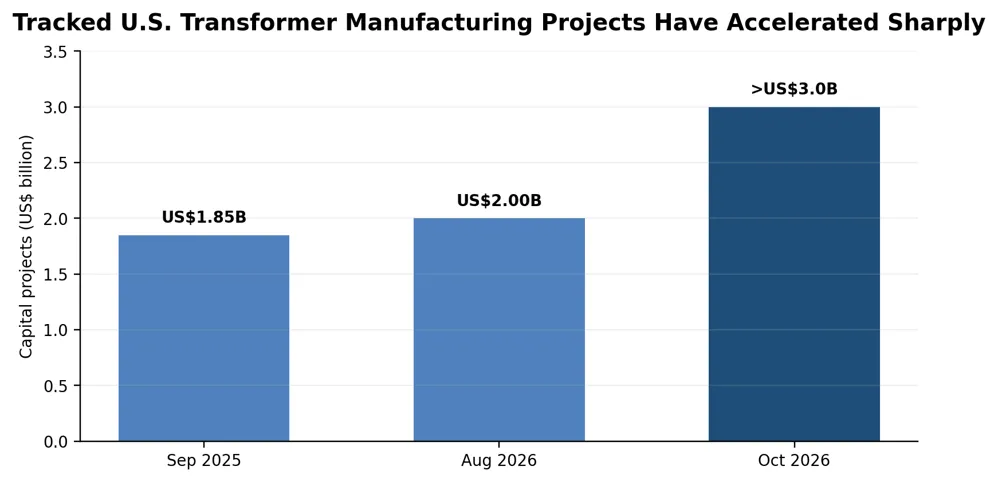
| KEY TREND | U.S. transformer-manufacturing investment has accelerated from about US$1.85 billion in tracked projects in September 2025 to more than US$3 billion by October 2026. |
| MARKET OUTLOOK | Domestic capacity is expanding rapidly, but most major projects ramp between 2027 and 2029, leaving power-transformer lead times and import exposure elevated in the near term. |
| RECOMMENDED FOR | Transformer OEMs, electrical equipment suppliers, utilities, data-center developers, EPCs, transmission developers and grid-infrastructure investors |
DMI Analyst View
The U.S. transformer shortage is now converting directly into a manufacturing-investment cycle. Industrial Info Resources reported on October 28, 2026 that more than US$3 billion of current and planned construction activity is being tracked at U.S. transformer-manufacturing facilities, up from about US$2 billion in August 2026 and US$1.85 billion in September 2025. Most of the investment is concentrated in power-transformer capacity, where import dependence and multi-year lead times remain most acute.
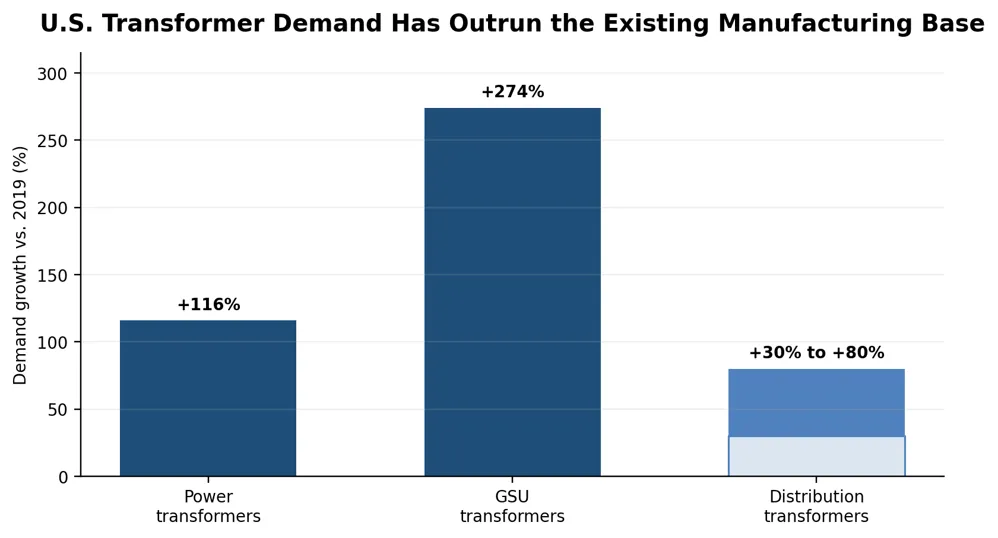
The demand base is structurally different from the one that existing factories were designed to serve. Power-transformer demand increased 116% from 2019 to 2025 and generator step-up transformer demand increased 274%, while distribution-transformer demand rose between 30% and 80% depending on specification. Data centers, new generation, transmission expansion, reshored manufacturing and aging-grid replacement are now competing for overlapping transformer categories and factory slots.
Source: Industrial Info Resources, ElectroIQ Project Tracker
Explore ElectroIQ Intelligence
Discover how ElectroIQ helps you track electrical equipment demand, monitor lead times and identify emerging market opportunities: https://www.datamintelligence.com/electroiq
Demand Growth Is Outrunning the Existing Manufacturing Footprint
The market imbalance is visible in both demand growth and import reliance. A Wood Mackenzie estimate cited by Industrial Info puts U.S. power-transformer demand 116% above 2019 levels by 2025 and GSU demand 274% higher. Distribution transformers also moved materially higher, although the exact increase varies by design and rating.
Source: Wood Mackenzie, ElectroIQ Project Tracker
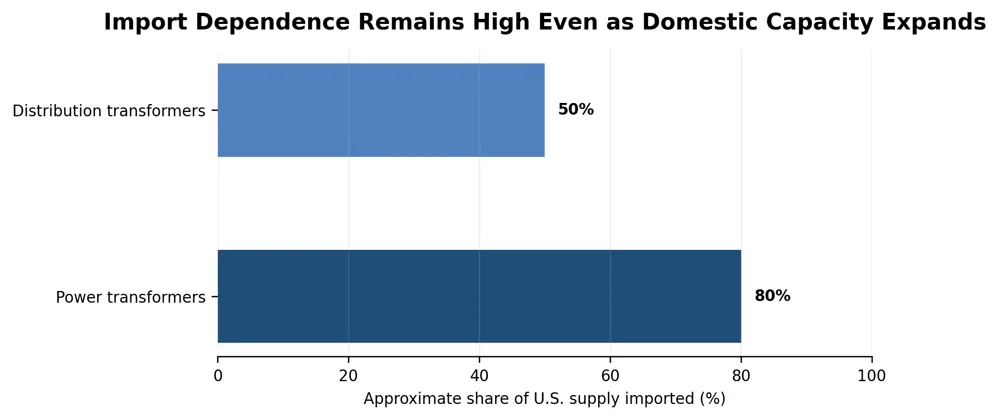
Domestic manufacturing has not scaled at the same rate. Imports account for roughly 80% of U.S. power-transformer supply and about 50% of distribution-transformer supply. That creates a strategic exposure that is larger for transmission-scale equipment because large units are custom-engineered, logistics-intensive and difficult to substitute once a project is deep into design and qualification.
Source: Industrial Info Resources, ElectroIQ Project Tracker
Request Demo: https://www.datamintelligence.com/electroiq
The Manufacturing Response Is Broadening Across Transformer Classes
The 2026 investment cycle is no longer centered on one manufacturer or one transformer category. Capacity additions now span large power, medium power, small power, substation transformers and critical components such as bushings. The mix matters because the U.S. shortage is not uniform. Large and generator step-up transformers remain the most constrained, while distribution equipment has improved in some specifications but still faces project-specific bottlenecks.
| Company / Site | Investment | Capacity / Jobs | Focus | Timing |
| Hitachi Energy South Boston, VA | US$457M | 825 jobs | Large power transformers | Production ramp 2028 |
| Hitachi Energy Gallman, MS | US$528M | 700+ jobs; >2x local capacity | Small / medium power transformers up to 230 kV | Production 2029 |
| HD Hyundai Montgomery, AL | US$200M | 200 jobs | Larger / EHV power transformers | New facility mid-2027 |
| Prolec GE Goldsboro, NC | US$140M | 220 → 420 units/yr | Medium power transformers | ~2.5-year buildout |
| Niagara Power Buffalo, NY | >US$71M | ~50% capacity increase | Liquid-filled power / substation transformers | ~2-year expansion |
| Hitachi Energy Alamo, TN | US$106M | 60,000 sq ft; 100+ jobs | Transformer bushings / components | Expansion underway |
Source: Company announcements, Industrial Info Resources, state/local development agencies
The capacity mix is strategically important. Prolec GE is doubling annual output at Goldsboro from 220 to 420 medium power transformers, while Niagara is targeting a 50% production increase. HD Hyundai is moving further into larger transformer classes, and Hitachi Energy is simultaneously expanding large-power, medium-power and component capacity across multiple states.
Lead Times Show Why New Factories Will Not Relieve the Near-Term Bottleneck
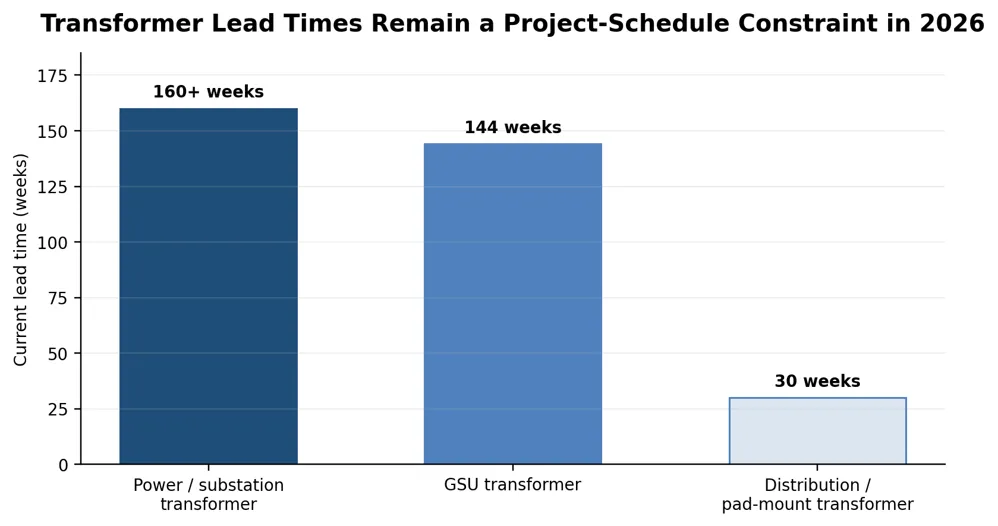
Factory investment is accelerating, but the commissioning schedule does not align with immediate utility and data-center demand. The U.S. market still shows 160+ week lead times for power and substation transformers and 144 weeks for generator step-up transformers. Distribution and pad-mount transformers are materially shorter at around 30 weeks, highlighting how the shortage is concentrated in the most complex equipment classes.
Source: ElectroIQ Lead Time Tracker
Request Demo: https://www.datamintelligence.com/electroiq
Industrial Info notes that transformer-factory expansions require highly specialized production infrastructure. Large power transformers need high-bay assembly space, heavy cranes, winding and drying equipment, oil processing, high-voltage test capability and logistics systems capable of handling units weighing hundreds of tons. Hitachi Energy’s South Boston expansion includes 130-foot-high assembly bays and a 375-ton overhead crane, illustrating why manufacturing capacity cannot be added like conventional light industrial floor space.
The Bottleneck Is Expanding From Factory Floor to the Full Production System. This means the effective output of a factory depends on the slowest element in the production chain. A building expansion does not automatically translate into proportional transformer output if skilled technicians, core steel, bushings, on-load tap changers or high-voltage test capacity remain constrained.
The Capacity Ramp Extends Through 2029
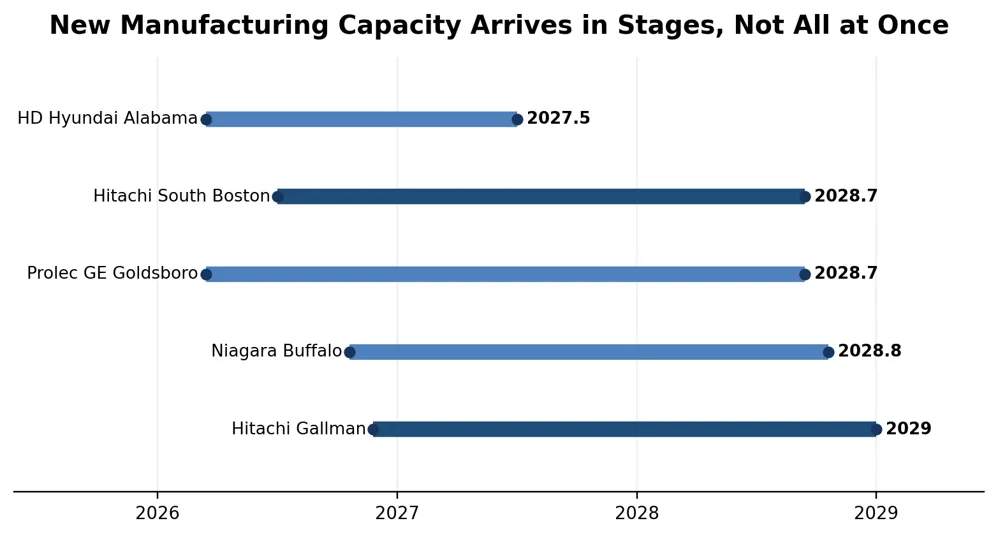
The construction timeline is the clearest reason buyers should not assume the shortage disappears in 2027. HD Hyundai’s Alabama expansion is scheduled to open around mid-2027. Hitachi’s South Boston large-power plant and Prolec GE’s Goldsboro expansion ramp later. Niagara’s capacity addition is expected over roughly two years, while Hitachi’s new Gallman factory is scheduled to begin production in 2029.
Source: ElectroIQ Project Tracker
Request Demo: https://www.datamintelligence.com/electroiq
The result is a transition period in which utilities and developers face two realities at once: manufacturing capacity is clearly improving, but much of the incremental output will arrive only after projects currently in engineering or interconnection queues have already placed equipment orders. Suppliers with available near-term slots therefore retain unusually strong commercial leverage even as long-term capacity expands.
What This Means for Utilities, Data Centers and EPCs
| Buyer | 2026 Risk | Procurement Response |
| Utilities | Replacement and expansion projects can be delayed by EHV/LPT slots. | Lock framework capacity earlier, standardize specifications and maintain alternate qualified suppliers. |
| Data centers | Transformer availability can become the pacing item for time-to-power. | Order electrical infrastructure earlier than the building shell and evaluate sites against equipment availability. |
| Generation developers | GSU lead times can delay energization even when generation equipment is ready. | Reserve GSU capacity during late-stage development rather than after final EPC award. |
| EPCs | Late design changes can reset qualification and factory schedules. | Freeze electrical specifications earlier and minimize custom changes after slot reservation. |
Domestic Manufacturing Will Reduce Import Risk, But Not Eliminate It
The investment wave should materially improve U.S. transformer availability over the next several years. Hitachi Energy alone is taking its broader U.S. manufacturing commitment to around US$1.5 billion, HD Hyundai is deepening ultra-high-voltage capability, Prolec GE is expanding medium-power output and Niagara is increasing substation and power-transformer capacity. This is a much broader response than the market had in 2021-2023.
However, domestic assembly does not automatically mean a fully domestic supply chain. Transformer cores, electrical steel, bushings, tap changers, insulation systems and other specialized components can remain exposed to global suppliers. The U.S. therefore needs both more final assembly and more depth across the component ecosystem if it wants to reduce the strategic vulnerability created by roughly 80% import dependence in power transformers.
Where Suppliers Can Win
The most attractive commercial opportunities are likely to sit where project timing and equipment scarcity intersect. Manufacturers able to offer earlier factory slots, standard platforms, domestic testing, component availability and credible delivery schedules can win share even when they are not the incumbent supplier. The shortage also increases the value of refurbishment, spare transformer programs, mobile substations and standardized fleet designs that reduce engineering time.
For component suppliers, the manufacturing expansion itself creates a second opportunity. New transformer factories need bushings, tap changers, insulation, cooling systems, electrical steel, conductors, monitoring devices, drying equipment, test systems and heavy material-handling infrastructure. The current investment cycle therefore expands the addressable opportunity beyond transformer OEMs themselves.
ElectroIQ: Converting Transformer Capacity Signals Into Commercial Opportunities
DataM Intelligence’s ElectroIQ platform can connect transformer-factory expansions, lead-time shifts and utility/data-center project schedules in one workflow. The Lead Time Tracker shows where transformer availability is tightening or improving, while the Project Tracker identifies transmission, generation, data-center and industrial projects moving toward equipment procurement. For suppliers, the highest-value signal is often a project whose required energization date no longer matches the incumbent transformer delivery window.
The U.S. Transformer Market Is Moving From Shortage Management to Capacity Competition
The October 2026 manufacturing pipeline confirms that the transformer shortage is finally attracting a large capital response. More than US$3 billion of tracked factory projects is a significant step up from the investment base visible only a year earlier. Yet the timing matters: major new capacity arrives progressively through 2027, 2028 and 2029, while utilities, generation developers and hyperscalers need equipment now.
That gap will keep lead-time intelligence commercially important. The companies that gain share during the next phase will not simply be those building the most factory space. They will be the suppliers that can convert new capacity into qualified, tested and deliverable transformer slots fastest, while giving buyers enough visibility to align equipment delivery with project energization.