


Request FREE Demo Access: https://www.datamintelligence.com/electroiq
DMI Analyst View
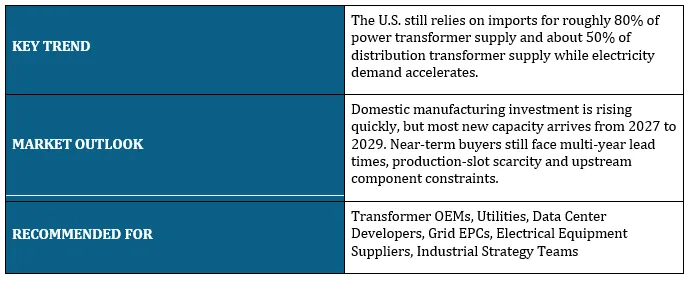
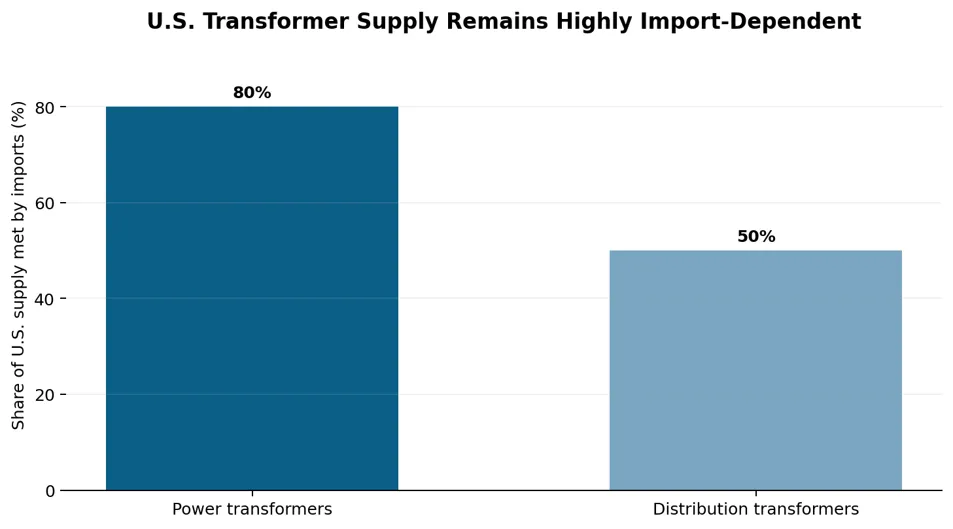
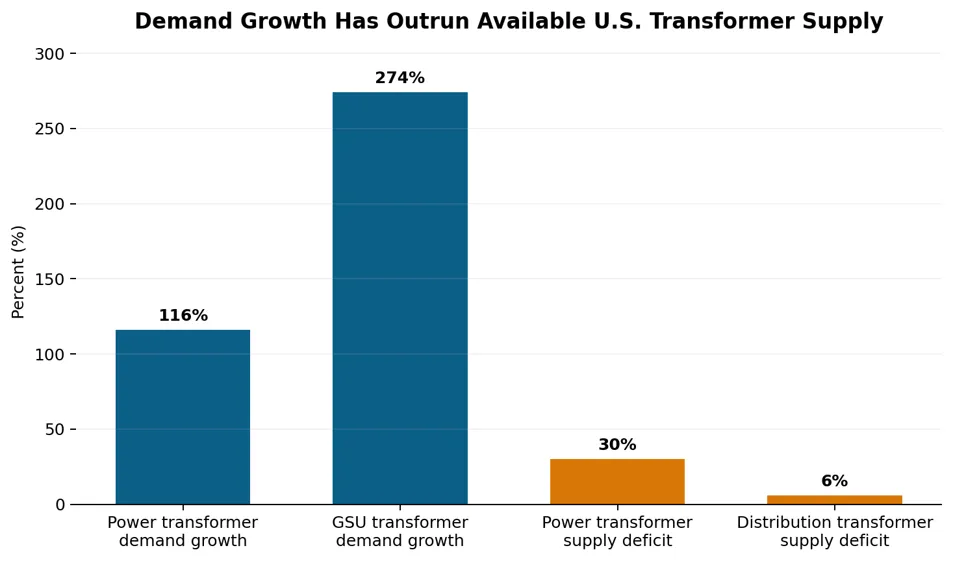
The U.S. transformer shortage has moved beyond a cyclical equipment problem. It is now a grid expansion, AI infrastructure, and industrial policy issue. Wood Mackenzie estimates that imports account for roughly 80% of U.S. power transformer supply and 50% of distribution transformer supply. At the same time, power-transformer demand has increased 116% since 2019 while demand for generation step-up transformers has increased 274%.
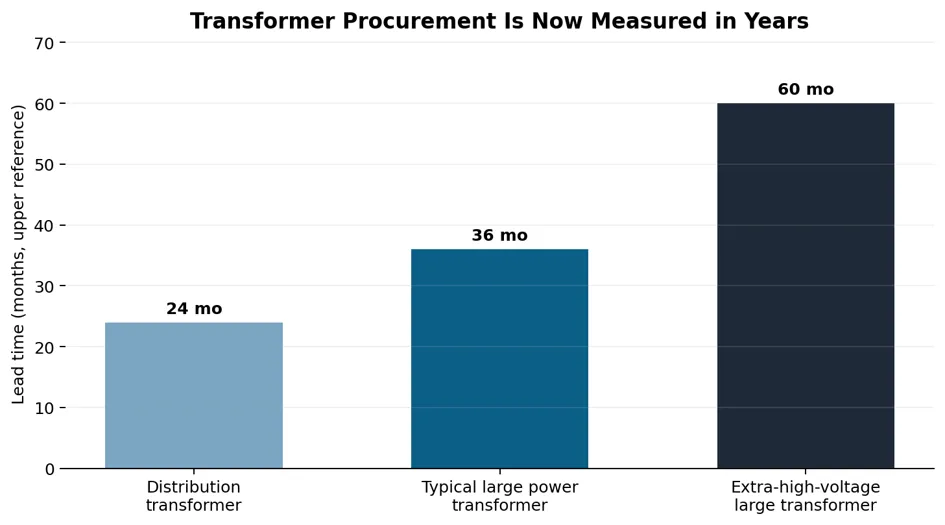
The timing is difficult because domestic manufacturing cannot expand at the same speed as load growth. Wood Mackenzie estimates a 30% supply deficit for power transformers and a 6% deficit for distribution transformers. The National Laboratory of the Rockies reported in 2026 that a typical large power transformer can require about 2.5 to 3 years to procure, with extra-high-voltage units stretching to five years. A project can therefore secure land, interconnection progress and financing while still waiting years for the equipment required to energize the site.
The U.S. response is becoming more aggressive. Industrial Info Resources is tracking about US$2 billion of transformer-manufacturing capital projects. Hitachi Energy, HD Hyundai Electric and Prolec GE are adding domestic capacity. Policy is also shifting from resilience studies toward industrial support through the proposed CIRCUIT Act, Defense Production Act authorities and a Department of Energy supply-chain program worth up to US$375 million. The strategic question is whether capacity can arrive fast enough to prevent transformers from becoming the pacing item for U.S. grid growth through the end of the decade.
Source: DataM Intelligence, Trademap
Request FREE Demo Access: https://www.datamintelligence.com/electroiq
The U.S. Is Still Importing the Equipment at the Center of Grid Expansion
Large power transformers are difficult to substitute because they are engineered around voltage class, MVA rating, impedance, transport constraints and the precise requirements of an individual substation. The U.S. Department of Energy reported that more than 80% of new large power transformers were imported as far back as 2019. Wood Mackenzie still estimates import dependence at about 80% in 2025-2026, showing how little the structural exposure has changed despite years of concern over grid security.
Distribution transformers have a broader domestic manufacturing base, yet roughly half of U.S. supply is still imported. This matters because distribution equipment represents the highest-volume part of the transformer market. Utilities must replace aging units while also serving new housing, EV charging, manufacturing plants and data centers. The result is simultaneous pressure at both ends of the grid: high-voltage projects need large custom units while distribution networks need much greater volumes of smaller transformers.
Import dependence would be less problematic if global capacity were abundant. It is not. The same suppliers are serving grid investment in Europe, the Middle East, Asia and North America. U.S. buyers therefore compete internationally for factory slots. Tariffs, shipping risk, electrical steel availability and long qualification cycles add further uncertainty to procurement that is already measured in years.
Demand Has Risen Faster Than Transformer Manufacturing Capacity
The transformer shortage is being driven by several demand waves arriving together. Utilities are replacing aging assets. New transmission is required for generation additions and regional load growth. AI data centers need large blocks of firm power. Advanced manufacturing is returning to the U.S. Renewable generation and storage require additional substations plus generation step-up transformers.
Wood Mackenzie estimates U.S. power-transformer demand is 116% above 2019 levels. Generation step-up transformer demand has increased 274%. Distribution-transformer demand has also increased materially, with growth varying by specification. Supply has not kept pace, leaving the power-transformer market with an estimated 30% annual deficit. This is why manufacturers can carry multi-year order books even before the full wave of announced data-center and grid projects reaches procurement.
Source: DataM Intelligence
Request FREE Demo Access: https://www.datamintelligence.com/electroiq
The Replacement Cycle Is Colliding With New Load Growth
The shortage is not only about new demand. A large share of the installed transformer fleet is already old. Maddox reports that 55% of U.S. distribution transformers are more than 33 years old. That creates a replacement requirement even if electricity demand were flat. Instead, electricity demand is rising, so utilities must simultaneously replace old equipment and install additional capacity.
Maddox also cites industry projections showing transformer capacity requirements could increase by as much as 260% by 2050 as electrification, data centers and renewable integration reshape the grid. The exact timing will vary by utility territory, but the direction is clear: the installed base cannot simply be maintained. It must expand substantially while a large portion of legacy equipment moves closer to retirement.
This dynamic makes transformer demand less sensitive to short-term economic cycles than many other capital goods. A utility can postpone some discretionary upgrades, but it cannot indefinitely defer replacement of critical transformers or interconnection equipment for committed load. That gives transformer manufacturers unusually strong visibility into future demand.
The Real Cost of the Shortage Is Time
Transformer prices have increased sharply, but time is becoming the more important commercial constraint. DOE stated in August 2026 that some transformer categories have experienced four- to nine-fold price increases over the previous five years. Yet a developer may still accept a higher price if it secures a production slot that protects a project schedule.
Industrial Info reports lead times of up to two years for distribution transformers and up to four years for power transformers. The National Laboratory of the Rockies places a typical large power transformer at about 2.5 to 3 years, with extra-high-voltage units extending to five years. These delays can push transmission upgrades, data centers, power plants and industrial facilities beyond planned energization dates.
Source: Industrial Info Resources; National Laboratory of the Rockies
Request FREE Demo Access: https://www.datamintelligence.com/electroiq
Long lead times also change procurement behavior. Buyers place orders earlier, hold backup reservations, standardize specifications where possible and consider refurbishment or redeployment. This can make order books look even tighter because future capacity is committed well before equipment is needed on site.
Why Domestic Capacity Cannot Be Added Quickly
Transformer manufacturing looks like a heavy-equipment capacity problem, but the bottleneck extends through the entire production chain. Large power transformers require specialized engineering, winding, core assembly, drying, tank fabrication, insulation, bushings, tap changers and high-voltage testing. New floor space helps only if the manufacturer also adds skilled labor, qualified suppliers and testing capability.
| Bottleneck | Why it extends lead times |
| Grain-oriented electrical steel | Large transformer cores depend on specialized electrical steel. U.S. manufacturers remain exposed to imported material, laminations and cores. |
| Copper and conductors | Large transformers consume substantial copper. Material availability and price volatility affect both cost and production planning. |
| Bushings and tap changers | Specialized components have their own qualification requirements and can become the pacing item inside a transformer build. |
| Testing capacity | Every large unit requires extensive factory testing. Adding assembly lines without expanding test bays can simply move the bottleneck downstream. |
| Skilled labor | Winding, insulation, engineering and high-voltage testing rely on specialized workers that cannot be trained instantly. |
| Customization | DOE has identified more than 80,000 distribution-transformer varieties nationwide. Excessive specification diversity reduces repeatability and slows throughput. |
| Transport and installation | Large transformers require specialized rail, trailers, route studies and site logistics. Delivery remains part of the lead-time problem. |
Source: U.S. Department of Energy; National Laboratory of the Rockies
Request FREE Demo Access: https://www.datamintelligence.com/electroiq
A Domestic Manufacturing Buildout Is Finally Underway
Manufacturers are responding with the largest U.S. transformer capacity investments in years. Industrial Info Resources is tracking about US$2 billion of capital projects across power, specialty, and distribution transformer manufacturing. Most spending is tied to power-transformer capacity, where the shortage is deepest, and import dependence is highest.
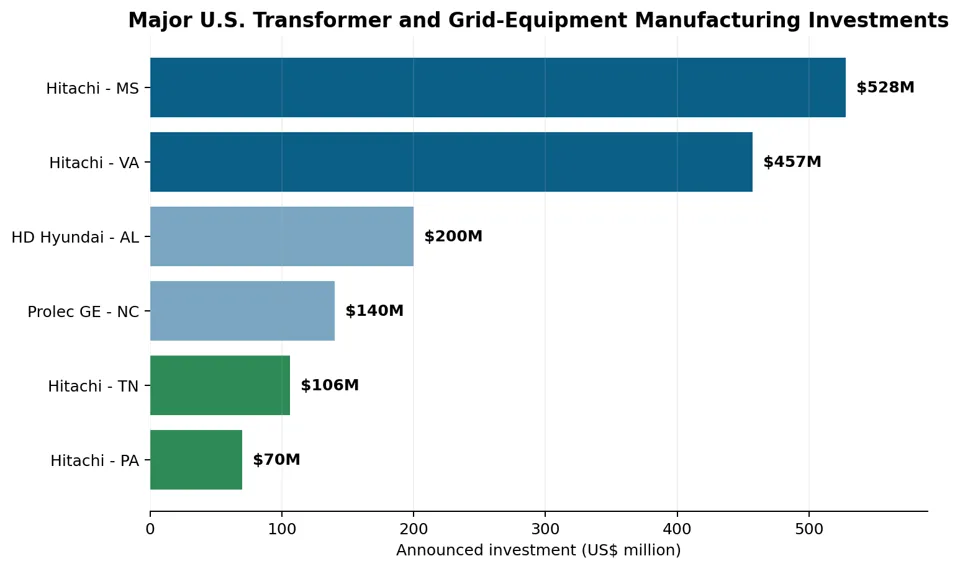
Source: Hitachi Energy; HD Hyundai Electric; Prolec GE; Industrial Info Resources
| Company / location | Investment | What changes | Timing | Strategic impact |
Hitachi Energy - Gallman, Mississippi | US$528M | New transformer factory more than twice the size of Crystal Springs; capacity more than doubles | Production from 2029 | Major increase in domestic transformer output |
Hitachi Energy - South Boston, Virginia | US$457M | Nation's largest large-power-transformer manufacturing site; about 825 jobs | Operational target 2028 | Adds critical LPT capacity for transmission, generation and data centers |
HD Hyundai Electric - Montgomery, Alabama | US$200M | EHV transformer capacity +50%; adds 765 kV manufacturing and testing | Target 2027 | Expands domestic ultra-high-voltage capability |
Prolec GE - Goldsboro, North Carolina | US$140M | Medium-power transformer output rises from 220 to 420 units/year | ~2.5-year buildout from Mar 2026 | Adds 200 units/year of domestic capacity |
Hitachi Energy - Alamo, Tennessee | US$106M | Expands transformer bushing production including HVDC/AC up to 800 kV | Mid-2027 | Strengthens upstream component supply |
Hitachi Energy - Pennsylvania | US$70M | High-voltage grid equipment expansion | 2025-2026 program | Broadens U.S. grid-equipment manufacturing base |
Request FREE Demo Access: https://www.datamintelligence.com/electroiq
The investment wave is meaningful, but its timing matters. Much of the new capacity arrives from 2027 through 2029. Projects requiring transformers before then remain exposed to the existing manufacturing base. Even after new factories open, utilization must ramp, workers must be trained and supplier capacity must scale with final assembly. The shortage can therefore improve without disappearing.
Industrial Policy Is Moving From Concern to Direct Support
Transformer dependence is increasingly being treated as an economic-security issue. In April 2026, a Presidential Determination under the Defense Production Act identified transformers, substations, high-voltage circuit breakers, electrical core steel and related equipment as industrial resources essential to national defense. The determination specifically cited limited U.S. production capacity, long lead times and overreliance on imported equipment.
The proposed CIRCUIT Act would add distribution transformers to the Section 45X advanced manufacturing production credit. H.R. 4128, introduced in June 2025, proposes a credit equal to 10% of production costs for qualifying distribution transformers produced in the United States. As of October 2026, the bill remains a proposal rather than enacted law. Its significance is that transformer manufacturing is being discussed using the same industrial-policy tools previously applied to batteries, solar components and semiconductors.
DOE is also planning a supply-chain program worth up to US$375 million to strengthen domestic manufacturing of distribution transformers, power transformers, materials and grid components. DOE's work on specification standardization is equally important. Reducing the roughly 80,000 distribution-transformer variants identified by the Department could improve throughput without waiting for entirely new factories.
| Policy / program | 2026 status | Mechanism | Market implication |
CIRCUIT Act - H.R. 4128 | Introduced / referred | Proposed 10% Section 45X production-cost credit for U.S.-made distribution transformers | Would improve economics of domestic production if enacted |
Defense Production Act determination | Active policy authority | Treats transformers and upstream grid materials as essential industrial resources | Creates a basis for federal support of domestic capacity and supply resilience |
DOE Supply Chain Program | Planned, up to US$375M | Manufacturing, refurbishment, reuse and alternative-material support | Can strengthen both new production and near-term supply resilience |
DOE specification standardization | Industry working-group implementation | Reduces unnecessary SKU and design variation | Potentially increases throughput without equivalent capex |
Request FREE Demo Access: https://www.datamintelligence.com/electroiq
Domestic Capacity Will Change Competition, But Imports Will Remain Essential
The reshoring cycle does not imply the U.S. will quickly become self-sufficient. New factories are being built by global manufacturers including Hitachi Energy, HD Hyundai Electric and Prolec GE. The practical model is localization of global supply chains rather than replacement of international suppliers. Imported components and raw materials will continue to matter even when final assembly moves onshore.
For utilities and developers, the biggest benefit of domestic capacity is not necessarily a lower transformer price. It is greater control over production slots, shipping risk, qualification, service access, and emergency replacement. A domestic plant can also support closer engineering collaboration where project specifications change during design.
For manufacturers, the market opportunity is unusually attractive because buyers are competing for time rather than simply price. Suppliers able to offer shorter confirmed delivery, standardized designs, flexible testing capacity, or North American component sourcing can win projects even when they are not the lowest-cost bidder. The commercial value of schedule certainty is rising as transformer delays begin to threaten revenue dates for data centers, industrial projects and new generation.
What Transformer Companies Should Prepare for Through 2030
The first priority is to sell available manufacturing capacity as a strategic asset. Customers with 2027-2029 energization targets increasingly need visibility into factory slots before final equipment specifications are complete. Early engineering engagement can therefore convert into stronger order capture.
Second, manufacturers should expand upstream capability alongside assembly. Bushings, electrical steel, conductors, cores and test bays can become bottlenecks even when transformer floor space increases. Vertically integrated or dual-sourced component strategies will be more valuable than headline factory capacity alone.
Third, suppliers should develop standardized product families where utility requirements permit. The U.S. market's extreme specification diversity creates complexity that consumes engineering hours, inventory and production time. Standardization can become a competitive advantage if utilities accept common interfaces and accessories.
Fourth, aftermarket capability should be treated as part of the capacity solution. Refurbishment, rewinding, condition assessment, spare sharing and life extension can reduce the number of projects that need entirely new units during the tightest years of the supply cycle.
Request FREE Demo Access: https://www.datamintelligence.com/electroiq
ElectroIQ Can Help Identify Projects Exposed to Transformer Constraints
DataM Intelligence's ElectroIQ platform can help transformer and electrical-equipment suppliers connect capacity intelligence with project opportunities. Its Lead-Time Tracker monitors equipment availability while the Project Tracker identifies data center, power, industrial and grid projects where transformer procurement can become a schedule risk. Used together, the tools can help commercial teams prioritize buyers that may be seeking alternate suppliers, earlier factory slots or localized equipment options.
The U.S. Transformer Market Is Becoming a Capacity Market
The central market shift is that transformer procurement is moving away from normal equipment purchasing toward capacity reservation. With roughly 80% of power-transformer supply still imported, a 30% power-transformer deficit and lead times that can extend to five years for extra-high-voltage equipment, access to manufacturing capacity has become part of project strategy.
Domestic investment is now large enough to change the market. Hitachi Energy, HD Hyundai Electric, Prolec GE and other suppliers are building the next layer of U.S. capacity while federal policy increasingly treats transformers as strategic infrastructure. The near-term challenge is timing. Most new production arrives after many projects already need equipment. That gap creates both the shortage and the opportunity: manufacturers that can deliver earlier, standardize faster or unlock alternate capacity can capture projects that cannot afford to wait for the broader market to rebalance.