


U.S. Transformer Core & AI Infrastructure Intelligence | 2026
| DOMESTIC CHOKE POINT | Cleveland-Cliffs remains the sole U.S. producer of grain-oriented electrical steel (GOES), the specialized silicon steel used in transformer cores. Domestic transformer makers can import GOES and cores, but U.S. primary production is concentrated in one supplier. |
| MATERIAL EXPOSURE | Commerce estimated GOES at about 25% of transformer manufacturing cost. DOE-linked analysis puts core steel at roughly 40% of a large power transformer's weight. |
| AI SCALING RISK | DOE says more than 80% of U.S. power transformers are imported and critical grid equipment can carry lead times of two years or more. Factory expansion can add assembly capacity, but it does not automatically create more core steel. |
The Transformer Bottleneck Starts Before the Transformer Factory
AI infrastructure is often framed as a power-generation and substation problem. Upstream of both sits a narrower constraint: transformer-grade electrical steel. Grain-oriented electrical steel is rolled and annealed so its crystal structure carries alternating magnetic flux with low core loss. That makes it fundamental to power and distribution transformer cores, but it also makes the manufacturing route difficult to replicate quickly.
The U.S. problem is concentration. Cleveland-Cliffs is the only domestic GOES producer. That does not mean every U.S. transformer uses U.S.-melted steel - imported GOES, laminations and cores remain part of the market - but it means domestic raw-material resilience rests on one producer while transformer demand is being pulled higher by data centers, grid replacement, renewables and industrial electrification.
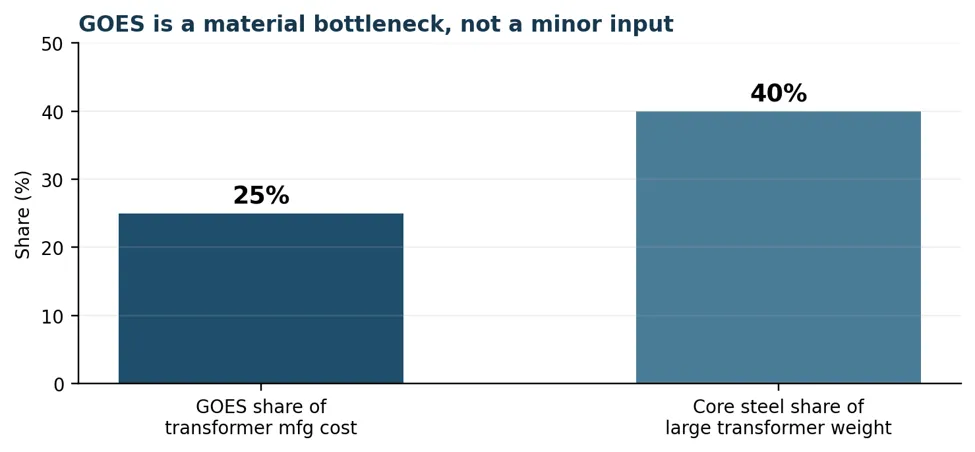
Source: U.S. Department of Commerce Section 232 transformer investigation; DOE/National Laboratory analysis.
Request Free Demo: https://www.datamintelligence.com/electroiq#demo
This is why the upstream material constraint matters commercially. Adding winding lines, test bays and transformer assembly buildings raises final-equipment capacity only if high-grade core material, copper, bushings and other critical components scale with them.
The U.S. Is Scaling Transformer Plants Faster Than It Is Diversifying GOES
Transformer OEM investment is accelerating. Hitachi Energy announced a $528 million Mississippi transformer facility in September 2026 after committing $457 million to a new Virginia large-power-transformer factory in 2025. Eaton is investing $340 million in South Carolina. Prolec GE is investing $140 million in North Carolina, WEG $77 million in Missouri and GE Vernova announced another $34.5 million in Louisiana in November 2026.
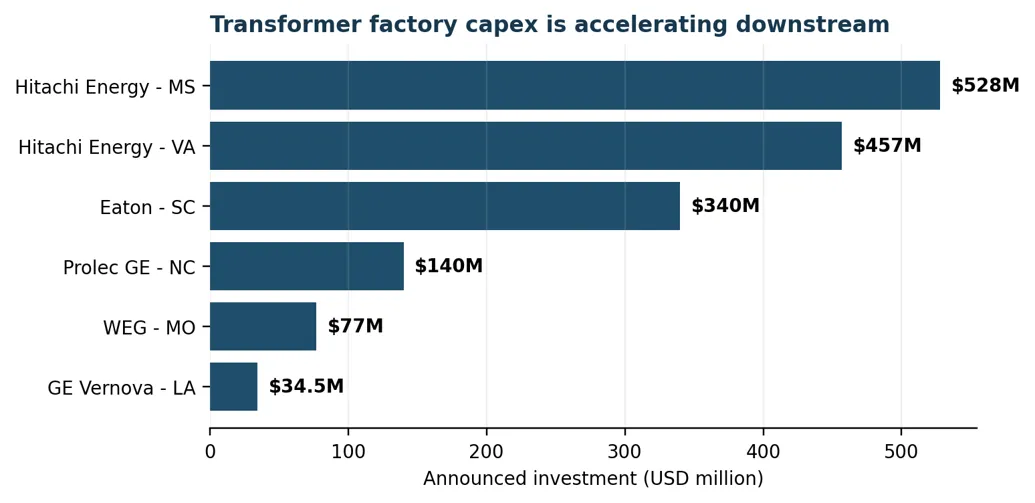
Sources: Hitachi Energy, Eaton, Prolec GE, WEG and GE Vernova company announcements. Values shown are announced project-level investments with a direct transformer manufacturing component.
Explore ElectroIQ Intelligence
Discover how ElectroIQ helps you track electrical equipment demand, monitor lead times and identify emerging market opportunities: https://www.datamintelligence.com/electroiq#demo
Downstream Capacity Can Expand Faster Than Upstream Metallurgy
SILICON / ALLOY INPUTS mineral exposure | GOES MELTING + ROLLING Highly specialized steelmaking route | LAMINATION / CORE Slitting, stacking, wound or stacked cores | TRANSFORMER FACTORY Windings, tanking, drying, assembly, test | DATA CENTER SUBSTATION Energization and commissioning |
The investment wave is asymmetric. New transformer plants can be financed and built on a multi-year schedule, but a new GOES supply base requires specialized melt chemistry, rolling, annealing, coatings and process know-how. Commerce has previously warned that U.S. production is insufficient or absent for certain grades and qualities, which is why imported material and imported cores remain structurally important.
For data-center developers, the risk is that a factory expansion headline gets interpreted as equivalent new transformer availability. It is not. A factory can have floor space, labor and test capacity while still competing for the same constrained core steel and components as utilities, renewable projects and industrial customers.
Imports Are Still the Release Valve for the U.S. Transformer System
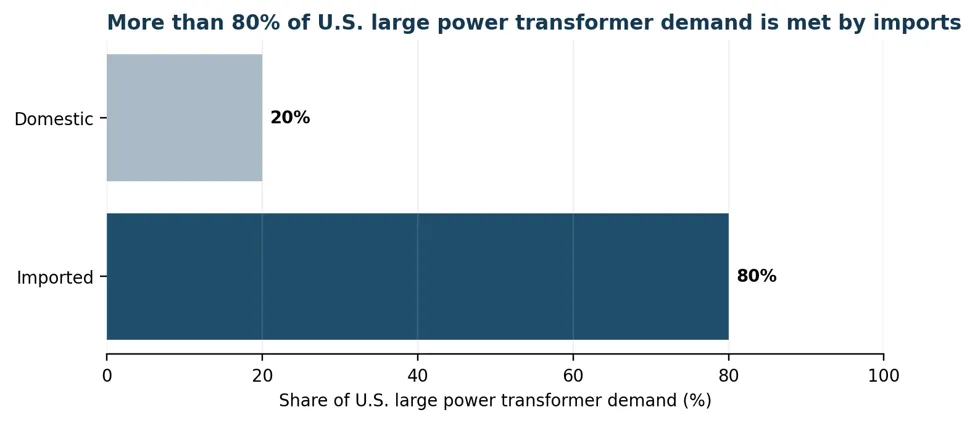
Source: 2026 National Laboratory large-power-transformer supply-chain analysis and DOE grid supply-chain materials.
The U.S. currently meets more than 80% of large power transformer demand through imports, with major supply coming from Mexico, South Korea, Brazil, Austria and Canada. That import dependence is not merely a finished-equipment issue. The steel inside imported laminations and cores also matters when measuring effective GOES exposure.
Trade Policy Can Protect Domestic Steel and Still Leave Transformer Buyers Exposed
The policy tension is unusually sharp. Section 232 measures can support domestic steel production, but transformer makers also need access to grades, laminations and cores that domestic supply cannot always provide in sufficient quantity, specification or price. Commerce found that imports of transformer cores rose from about $22 million in 2015 to $167 million in 2019, with Canada and Mexico accounting for more than 95% of those core and lamination imports at the time.
That creates a three-way balancing problem: preserve the economics of the sole domestic GOES producer, keep enough imported material available to prevent transformer output from being throttled and avoid shifting dependence toward finished transformer imports. For AI infrastructure, the outcome shows up as procurement risk rather than as a steel-market debate.
Lead Times Show Why Material Availability Has Become a Schedule Variable
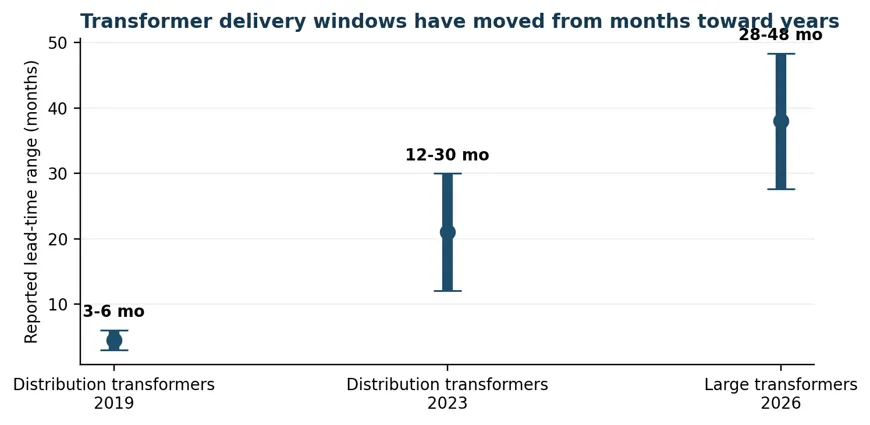
Distribution-transformer ranges are from DOE supply-chain data. 2026 large-transformer range converts reported 120-210 weeks to approximately 28-48 months.
DOE says distribution-transformer lead times moved from roughly 3-6 months in 2019 to about 12-30 months by 2023. In 2026 congressional testimony, customers reported 120-210 week lead times for certain large transformers. Those delays cannot be assigned to GOES alone, but electrical steel is one of the upstream constraints consistently identified alongside copper, bushings, tap changers, labor and test capacity.
What the GOES Choke Point Means for AI Data Center Projects
A hyperscale campus can require multiple large power transformers across utility interconnection, campus substations and redundancy architecture. As AI loads increase, the consequence of a delayed core-steel allocation becomes larger because transformer procurement is pulled earlier and equipment packages become harder to substitute after design freeze.
| 1 DOMESTIC PRODUCER | 25% OF COST |
Cleveland-Cliffs is the sole U.S. GOES producer. Supplier concentration remains extreme even though imported GOES and cores supplement the market. | Commerce estimated GOES at roughly one-quarter of transformer manufacturing cost, making steel pricing and availability commercially material. |
| 40% OF WEIGHT | >80% IMPORTED |
Core steel is roughly 40% of a large power transformer's weight, so metallurgy is physically central to every unit. | More than 80% of U.S. large power transformer demand is met through imports, leaving domestic expansion tied to global capacity and trade flows. |
| 120-210 WEEKS | $1.58B+ |
Reported 2026 lead times for certain large transformers remain measured in years, not quarters. | The six transformer-focused U.S. projects charted above total more than $1.58 billion in announced investment - without creating a second domestic GOES producer. |
Turn Market Signals into Business Opportunities
Explore equipment-level intelligence to support procurement planning, supplier evaluation and strategic market expansion: https://www.datamintelligence.com/electroiq#demo
Five Commercial Signals Electrical Suppliers Should Track
| Signal | Why it matters | Commercial action |
Transformer factory expansion | Assembly capacity is rising, but upstream material demand rises with it | Track GOES, core and component sourcing alongside factory startup dates |
New AI campus / substation award | Large transformers move from forecast demand into a real procurement window | Engage before core steel and manufacturing slots are allocated |
GOES tariff / trade-rule change | Imported coil, laminations or cores can change price or availability quickly | Re-price sourcing scenarios and qualify alternate supply routes |
Transformer lead-time extension | Upstream material or factory congestion is worsening | Prioritize projects where alternate OEM or imported unit qualification is still possible |
Core / lamination capacity investment | A genuine upstream constraint may be easing | Map which transformer OEMs gain access and which end markets receive the new output |
ElectroIQ Turns Raw-Material Risk Into Transformer Opportunity Intelligence
The commercial problem is that GOES risk is not visible in a data-center project database alone. A hyperscaler may announce a campus before the utility finalizes its substation design. A transformer OEM may announce a new factory before the plant reaches full throughput. A trade change may alter the economics of imported cores months before a project RFQ. The actionable signal comes from connecting all of them.
| AI LOAD / PROJECT Campus MW and energization date | TRANSFORMER PACKAGE Rating, redundancy and OEM | CORE MATERIAL EXPOSURE GOES grade, core source and import route | CAPACITY / LEAD TIME Factory slot and upstream constraint | COMMERCIAL ACTION Qualify, source, displace or partner |
ElectroIQ connects Project & Tender Tracking, Lead-Time Intelligence, Market Intelligence, Company Capacity Intelligence and Customer & Partner Identification so suppliers can see where a transformer shortage is being driven by downstream factory congestion versus upstream material exposure - and which buyer still has time to act.
The Commercial Takeaway
The U.S. transformer shortage is often described as a factory-capacity problem. That is only part of it. The industry is now adding billions of dollars of winding, assembly and test capability, yet the domestic GOES base remains concentrated in one producer and imported large power transformers still dominate U.S. supply.
For AI infrastructure, that changes how capacity additions should be interpreted. A new transformer plant is meaningful, but it is not equivalent to an unconstrained new transformer supply. Full output depends on core steel, copper, bushings, tap changers, skilled labor and test capacity arriving together.
The winners in the electrical supply chain will be the companies that can identify where new transformer manufacturing capacity is genuinely backed by upstream material availability, where imported cores or finished units remain necessary and where a project still has time to qualify an alternate supplier before the data-center energization date slips.
See which U.S. AI and grid projects are colliding with transformer lead times, GOES exposure and new factory capacity. We can then map the suppliers, sourcing routes and procurement windows that matter: Request a Demo