


A commercial playbook for winning projects before the transformer package and factory slot is locked.
| KEY TREND | Power is becoming the binding constraint for AI infrastructure. Transformer availability can now determine whether a data center reaches energization on time. |
| COMMERCIAL OPENING | Suppliers that identify projects before RFQ, map the buying committee and prove an earlier qualified factory slot can displace incumbents even when they are not the lowest-price bidder. |
| RECOMMENDED FOR | Transformer OEMs, component manufacturers, EPCs, distributors and commercial strategy teams selling into data centers, utilities and power infrastructure. |
The transformer shortage is changing who wins the data-center race
A data center can secure land, financing and a grid connection and still miss its power-on date because the transformer is not available. ElectroIQ currently tracks average lead times of 160 weeks for large power transformers and 144 weeks for GSUs. That is long enough for equipment availability to become a commercial strategy issue, not just a procurement issue.
The wider infrastructure system is under the same pressure. The Data Center Power Playbook describes power as the primary bottleneck to scaling compute and targets 500 MW+ deployments with a 12-18 month time-to-power ambition. FERC has ordered all six regional grid operators under its jurisdiction to justify or reform large-load connection rules, while DOE says the grid has moved from decades of stagnant demand into an era of rapid load growth driven partly by hyperscale AI data centers.
The commercial question is therefore simple: Can your sales team see the project, buyer, specification and delivery gap early enough to act before the transformer package is closed?
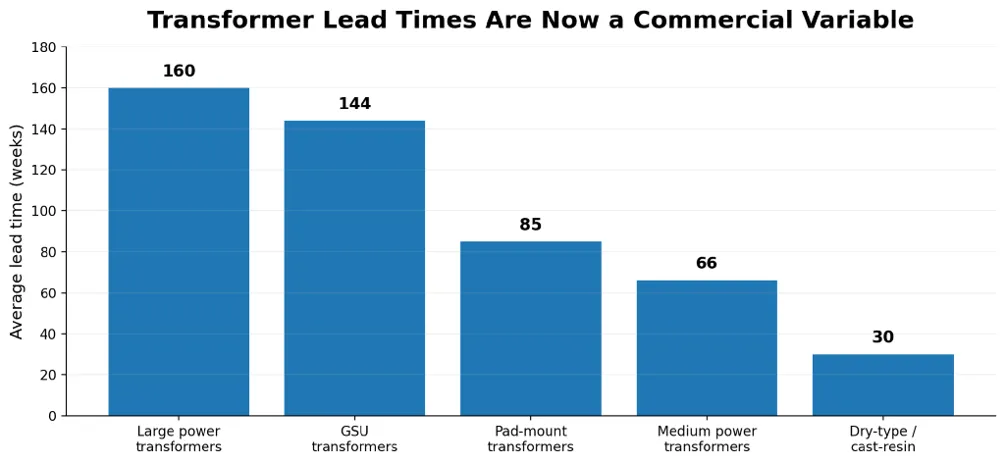
Source: ElectroIQ Lead Time Tracker.
Request Demo Access: https://www.datamintelligence.com/electroiq#demo
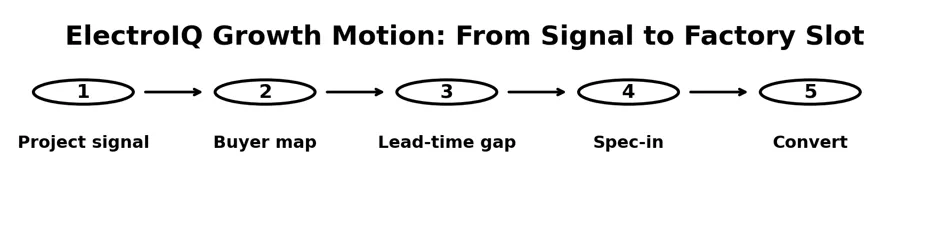
Play 1 - Find the project before the RFQ exists
The highest-value transformer opportunity often appears before the transformer itself is publicly tendered. A new AI campus can trigger utility studies, transmission upgrades, dedicated substations, backup generation and phased energization long before the final equipment list is frozen.
ElectroIQ’s Project & Tender Tracker can convert those early signals into an account list: new campuses, utility substations, transmission reinforcements, power-plant connections and industrial loads. Its public platform specifically highlights new data-center campuses, transformer factory expansions and lead-time shifts as commercial signals. ElectroIQ’s objective is to enter the opportunity while the specification can still move.
Play 2 - Map the real buying committee, not just the developer
A transformer sale into a data-center program can involve the hyperscaler or colocation operator, the utility, the EPC, the substation engineer, the consultant, the equipment procurement lead and the finance team carrying the schedule risk. The wrong contact can keep a technically strong offer outside the decision process.
Use ElectroIQ Customer & Partner Identification to map the organization behind each project, then separate the roles: who owns the transformer, who writes the specification, who approves alternates, who controls the factory-slot decision and who carries the cost of a delayed energization date.
Play 3 - Sell delivery certainty as a product
When lead times reach 160 weeks, the factory slot becomes part of the value proposition. A lower equipment price can be economically irrelevant if it pushes commissioning into another quarter or delays revenue from an AI campus.
ElectroIQ Lead-Time & Order Book intelligence should be used inside the sales motion, not only by procurement teams. Compare the project COD with the incumbent delivery window. If the gap is negative, the account becomes a displacement opportunity. The sales message changes from “our transformer is better” to “we can protect your energization date.”
Play 4 - Use capacity expansion intelligence to know where relief will - and will not - arrive
New factories matter, but timing matters more. Hitachi Energy broke ground in June 2026 on a $457 million large-power-transformer facility in South Boston, Virginia, and announced a $528 million Mississippi transformer factory in September with production scheduled for 2029. South Boston expansion Mississippi factory These investments improve medium-term supply, but many projects ordering in 2026 still compete for today’s winding, bushing, drying and high-voltage test capacity.
ElectroIQ Capacity Expansion and Competitor Intelligence can therefore answer a practical question for every target account: which suppliers are genuinely adding qualified capacity before this project needs delivery?
Play 5 - Score opportunities by commercial urgency
The best transformer opportunities are not simply the largest projects. They are the projects where timing pressure, buyer access and specification flexibility overlap.
| Signal | High-priority condition | ElectroIQ engine | Commercial action |
| Project stage | Power design / EPC / early procurement | Project & Tender Tracker | Enter before final equipment lock |
| Lead-time gap | Required-on-site date is earlier than incumbent slot | Lead-Time & Order Books | Lead with delivery certainty |
| Buyer visibility | Utility, EPC and specification owner identified | Customer & Partner ID | Multi-thread the account |
| Spec flexibility | Alternate OEM / regional source still possible | Opportunity Tracker | Propose qualified substitute |
| Capacity change | Competitor plant or line is ramping too late | Capacity Expansion | Target exposed projects first |
Play 6 - Turn the intelligence into a repeatable growth engine
The final advantage is operational. Intelligence only creates revenue when the commercial team knows what to do next. ElectroIQ can connect market demand, projects, buyers, lead times, competitors and capacity expansions into one opportunity workflow rather than separate spreadsheets and public announcements.
Request Demo Access: https://www.datamintelligence.com/electroiq#demo
A practical weekly cadence is straightforward: review newly announced data-center and grid projects, flag accounts with transformer timing risk, map the decision chain, qualify whether the specification can move, then assign the opportunity to the relevant regional sales team. The same workflow can also surface partner and EPC relationships where direct access to the end user is limited.
What this changes for transformer growth strategy
The Chamber of Progress data-center development framework argues that large-load developers should bring, build or buy the power their facilities require rather than shift the cost to households. That principle increases the importance of early power planning and makes transformer availability more central to site development. Data Center Development Playbook
For transformer suppliers, this creates a shift in go-to-market strategy. Waiting for the formal RFQ means entering after the highest-value intelligence has already been used by someone else. The growth opportunity is earlier: identify the campus, understand the utility architecture, map the buying committee, quantify the delivery gap and show a credible path to power.
The question for every transformer commercial team is: How many projects in your target market already have a power date that their current transformer supply plan cannot meet?