


Top AI Server Companies Driving U.S. Market Growth
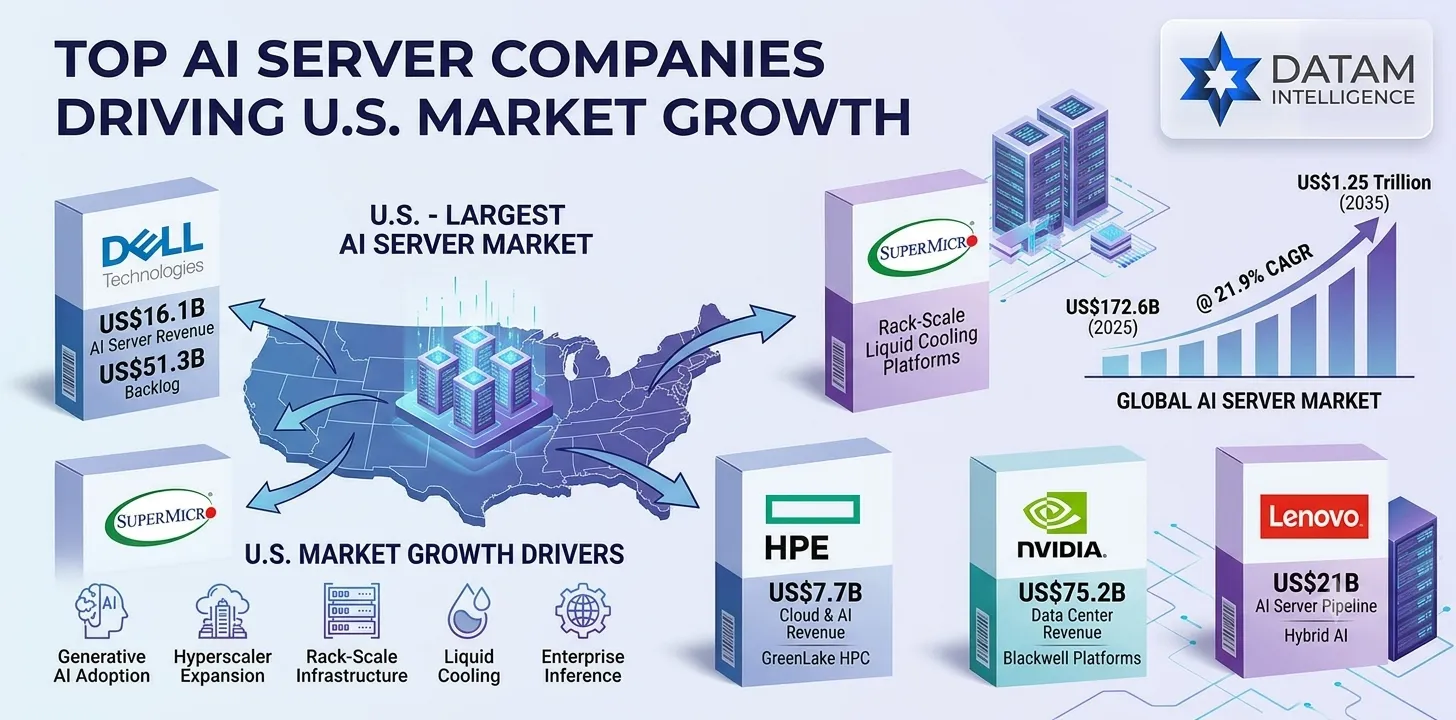
The global AI Server Market is entering a major expansion phase as hyperscalers, cloud providers, enterprises and governments accelerate investments in AI factories, accelerated computing clusters, sovereign AI programs and enterprise inference infrastructure. According to DataM Intelligence, the global AI Server Market was valued at US$172.6 billion in 2025 and is projected to reach approximately US$1.25 trillion by 2035, expanding at a 21.9% CAGR during 2026 - 2035. North America held the largest regional market position in 2025, reinforcing the strategic importance of the U.S. in the global AI infrastructure ecosystem.
Get an AI Server Market Report Built Around Your Priorities
Need insights beyond the standard report? Customize the AI Server Market study with the specific regions, segments, companies, forecasts and data points that matter to your business. Our analysts can tailor the research to support your market entry, investment, competitive intelligence and growth strategies.
Make the research more relevant to your business. Request your customized AI Server Market report today.
The market is increasingly shifting from individual server procurement toward rack-scale AI infrastructure, where accelerator density, networking, memory bandwidth, power delivery and thermal management determine system performance and value. GPU-based systems currently represent the commercial core of AI server spending, while direct-to-chip liquid cooling and rack-scale architectures are becoming increasingly important for high-density deployments.
Against this backdrop, companies such as NVIDIA, Dell Technologies, Hewlett Packard Enterprise (HPE), Super Micro Computer, Lenovo, Quanta Computer, Wiwynn, GIGABYTE, Foxconn and Cisco are playing important roles across the AI server ecosystem. DataM Intelligence identifies NVIDIA, Dell, HPE, Supermicro and Lenovo among the key companies shaping the competitive landscape, while ODMs such as Quanta and Wiwynn remain critical to hyperscale AI infrastructure supply.
Why the U.S. Is a Critical AI Server Market
The U.S. is the largest AI server market globally, supported by hyperscaler capital expenditure, leading AI model developers, concentration of the accelerator ecosystem and rapid development of AI factories. However, the next phase of U.S. market growth is increasingly influenced by power availability, data-center construction timelines, cooling infrastructure and access to advanced accelerators and high-bandwidth memory.
This environment is creating opportunities for AI server manufacturers that can provide more than computing hardware. Buyers are increasingly evaluating rack-level performance, time-to-deployment, power efficiency, software compatibility, networking, cooling architecture, serviceability and total cost of ownership.
Leading AI Server Companies Shaping U.S. Market Growth
The competitive landscape includes traditional server OEMs, accelerator companies, hyperscale ODMs and integrated AI infrastructure providers. NVIDIA-linked ecosystems, Dell Technologies, Supermicro, HPE and Lenovo are positioned strongly because of their exposure to AI infrastructure growth, platform breadth and ability to support rack-scale deployments.
DataM Intelligence's latest company performance analysis further highlights the scale of this opportunity. Dell reported US$16.1 billion in AI-optimized server revenue, Lenovo reported a US$21 billion AI server pipeline, HPE recorded US$7.7 billion in Cloud & AI revenue, and NVIDIA generated US$75.2 billion in Data Center revenue during the cited 2026 reporting periods.
These developments demonstrate that AI servers are no longer a niche segment of the traditional server industry. They are becoming a central component of the broader AI infrastructure economy, with growth increasingly tied to generative AI, AI inference, rack-scale computing, liquid cooling, high-speed networking and enterprise AI deployment.
Which Companies Are Leading the U.S. AI Server Market?
The leading AI server companies in the U.S. include:
- Dell Technologies
- Super Micro Computer
- Hewlett Packard Enterprise (HPE)
- NVIDIA
- Lenovo
- IBM
- Cisco Systems
- Advanced Micro Devices (AMD)
- Intel
- ADLINK Technology
These companies compete through GPU-accelerated servers, rack-scale systems, liquid cooling, AI networking, high-performance computing, enterprise deployment services, and integrated AI infrastructure.
1. Dell Technologies
Dell Technologies has emerged as one of the strongest beneficiaries of the U.S. AI infrastructure buildout. Its AI-optimized server business is benefiting from demand for GPU-intensive computing, rack-scale infrastructure and enterprise AI deployments.
Dell reported USD 16.1 billion in AI server revenue for the three months ended May 1, 2026, while its AI server backlog and orders demonstrate strong forward demand. Deloitte reported that Dell had a USD 51.3 billion AI server backlog entering fiscal 2027.
Dell's competitive advantage increasingly comes from combining servers with networking, storage, cooling, deployment capabilities and enterprise support.
2. Super Micro Computer
Super Micro Computer, commonly known as Supermicro, has built a strong position in AI servers through rapid product development, modular architectures and liquid-cooling capabilities.
The company focuses heavily on GPU-based platforms designed for generative AI, machine learning and high-performance computing. Its ability to rapidly integrate new accelerator platforms has helped it compete for large AI infrastructure deployments.
Supermicro's strategy also emphasizes direct liquid cooling, which is becoming increasingly important as AI racks move toward higher power densities.
3. Hewlett Packard Enterprise
HPE is another major AI server supplier benefiting from enterprise and hyperscale AI investment.
The company's portfolio combines AI servers, high-performance computing, networking and its GreenLake consumption model. HPE reported USD 7.7 billion in Cloud & AI revenue in its fiscal second quarter of 2026, with server revenue increasing more than 30% year over year.
HPE's long-standing presence in HPC gives it an advantage as organizations deploy AI workloads that require large-scale compute, networking and storage.
4. NVIDIA
NVIDIA occupies a unique position in the AI server ecosystem because it supplies the GPUs and increasingly complete computing platforms that power many AI servers.
Its Blackwell platform, networking technologies, software ecosystem and rack-scale architectures have become critical components of modern AI infrastructure.
NVIDIA reported USD 75.2 billion in Data Center revenue in Q1 fiscal 2027, representing 92% year-over-year growth.
While NVIDIA is primarily known as an accelerator and platform company rather than a traditional server OEM, its integrated AI infrastructure strategy makes it one of the most influential companies shaping the U.S. AI server market.
5. Lenovo
Lenovo is expanding its position in AI infrastructure through GPU servers, liquid cooling and hybrid AI solutions.
The company reported a USD 21 billion AI server pipeline and strong growth in its Infrastructure Solutions Group during fiscal 2025/26.
Its global manufacturing footprint and relationships with cloud service providers give Lenovo an opportunity to capture increasing AI infrastructure demand in the U.S. and internationally.
6. IBM
IBM remains relevant in enterprise AI infrastructure through servers, hybrid cloud, high-performance computing and AI-focused enterprise solutions.
Its strength is particularly relevant among organizations seeking integrated infrastructure, security and enterprise AI deployment rather than standalone GPU capacity.
7. Cisco Systems
Cisco is becoming increasingly important to the AI server ecosystem through AI networking and infrastructure connectivity.
AI workloads require extremely high-speed communication between GPUs, servers and storage systems. As a result, networking has become an increasingly important component of AI infrastructure spending.
Deloitte reported that Cisco had secured USD 5.3 billion in AI infrastructure orders year-to-date in 2026 and raised its expected fiscal 2026 AI infrastructure orders to USD 9 billion.
8. AMD
AMD is challenging NVIDIA's dominance in AI accelerators with its Instinct GPU portfolio and broader data-center strategy.
For AI server manufacturers and hyperscalers, AMD provides an alternative accelerator ecosystem that can help diversify compute supply and manage infrastructure costs.
9. Intel
Intel continues to participate in the AI infrastructure market through data-center processors, accelerators and server technologies.
Its installed base in enterprise data centers provides a potential channel for AI infrastructure upgrades as organizations move from conventional workloads toward AI-enabled computing.
Why Are AI Server Companies Growing Rapidly in the U.S.?
Several structural factors are accelerating U.S. AI server demand.
Generative AI and Agentic AI Adoption
The expansion of large language models, generative AI applications and emerging agentic AI workloads is increasing demand for high-performance compute.
Organizations need more GPU capacity for model training, fine-tuning and inference, creating a sustained requirement for AI-optimized servers.
Hyperscale Data Center Expansion
Hyperscalers and cloud providers continue to invest heavily in AI data centers.
The broader AI infrastructure market is expected to remain heavily hardware-driven, with S&P Global forecasting AI infrastructure hardware revenue to rise from USD 298 billion in 2025 to USD 946 billion in 2030.
Rising AI Inference Workloads
AI infrastructure demand is gradually shifting beyond model training toward inference.
As enterprises deploy AI assistants, recommendation engines, computer vision and real-time analytics, inference workloads are expected to require distributed server infrastructure closer to users and business operations.
Liquid Cooling Adoption
Higher-performance AI accelerators generate substantially more heat than traditional server processors.
This is accelerating adoption of direct liquid cooling and other advanced thermal-management technologies. Server companies that can integrate compute, cooling and rack-level infrastructure are therefore gaining a competitive advantage.
Enterprise AI Infrastructure Investment
AI adoption is expanding beyond hyperscalers.
Banks, healthcare organizations, manufacturers, retailers and other enterprises increasingly need dedicated AI infrastructure capable of supporting proprietary models, inference workloads and data-intensive applications.
Competitive Landscape of the U.S. AI Server Market
The competitive environment is shifting from a simple hardware race toward full-stack AI infrastructure.
Traditional server manufacturers are increasingly competing on:
- GPU and accelerator integration
- Rack-scale AI systems
- Direct liquid cooling
- High-speed networking
- AI storage
- Software optimization
- Data-center deployment services
- Supply-chain reliability
- Enterprise support
- Total cost of ownership
The market is also becoming more competitive as customers seek alternatives to single-vendor accelerator ecosystems.
Deloitte's analysis of Cisco, Dell, HPE, Lenovo and Supermicro found aggregate revenue growth of 53% year over year across comparable quarters, highlighting how strongly AI infrastructure is contributing to OEM growth.
Customize the AI Server Market Report to Fit Your Business Needs
Get a tailored AI Server Market report aligned with your specific business objectives. Customize the scope, market segments, geographic coverage, data metrics and forecasts you need backed by analyst consultation and secure, confidential delivery.
Request Customization Report Today or Request a Sample Report
Key Trends Shaping the U.S. AI Server Industry
Rack-Scale AI Infrastructure
AI deployments are increasingly moving from individual GPU servers toward complete rack-scale systems. This creates opportunities for vendors capable of integrating compute, networking, power and cooling into turnkey platforms.
Direct Liquid Cooling
Liquid cooling is becoming a critical technology for high-density AI clusters as accelerator power consumption increases.
AI Inference at the Edge
Not every AI workload will run in centralized hyperscale data centers. Edge AI is creating demand for smaller, power-efficient AI servers and accelerated computing systems.
Custom AI Accelerators
Hyperscalers and large technology companies are increasingly exploring custom accelerators to reduce dependence on general-purpose GPUs and optimize specific workloads.
Supply Chain Diversification
The availability of GPUs, HBM, networking components and advanced packaging remains a critical consideration for AI server manufacturers.
AI Infrastructure as a Service
Cloud and infrastructure providers are increasingly offering AI compute through consumption-based models, allowing enterprises to access accelerated infrastructure without making the entire upfront capital investment.
What Is the Outlook for U.S. AI Server Companies?
The outlook remains strongly positive as AI moves from experimentation into production.
The U.S. AI server market is expected to benefit from continued data-center investment, increasing enterprise AI adoption, rising inference workloads and the development of increasingly sophisticated AI models.
However, companies will also face challenges involving GPU availability, high-bandwidth memory supply, power availability, cooling requirements, data-center construction timelines and capital expenditure cycles.
The next phase of competition will therefore depend not only on who can provide the fastest AI accelerator, but also on who can deliver complete, scalable and energy-efficient AI infrastructure at the lowest practical total cost of ownership.
Key Takeaway
Dell Technologies, Super Micro Computer, HPE, NVIDIA, Lenovo, IBM, Cisco and AMD are among the companies shaping the U.S. AI server market. Their growth is being supported by accelerating generative AI adoption, hyperscale data-center expansion, enterprise AI deployment and the increasing need for GPU-accelerated computing.
For technology companies, investors and infrastructure buyers, tracking AI server manufacturers, accelerator roadmaps, cooling technologies, data-center investments and supply-chain developments will be critical to understanding where the next wave of AI infrastructure growth is occurring.
Related FAQs
Which are the top AI server companies in the U.S.?
The leading AI server companies serving the U.S. market include Dell Technologies, Super Micro Computer, Hewlett Packard Enterprise, NVIDIA, Lenovo, IBM, Cisco, AMD and Intel.
Which company is the largest AI server manufacturer?
The competitive landscape varies by definition and market segment. Dell, Supermicro and HPE are among the leading traditional AI server OEMs, while NVIDIA is a dominant supplier of AI accelerators and integrated computing platforms.
Why is the U.S. AI server market growing?
Growth is being driven by generative AI, enterprise AI adoption, hyperscale data-center expansion, increasing inference workloads, GPU demand and investments in AI infrastructure.
Which companies manufacture GPU servers?
Dell Technologies, Super Micro Computer, HPE, Lenovo and other server manufacturers offer GPU-accelerated systems. NVIDIA and AMD supply major AI accelerator platforms used in these systems.
What is driving demand for AI servers?
Major demand drivers include generative AI, machine learning, large language models, AI inference, high-performance computing, enterprise AI and hyperscale data-center expansion.
Why is liquid cooling important for AI servers?
AI accelerators generate significant heat at high compute densities. Liquid cooling can help data centers manage thermal loads and enable higher-density AI deployments.
What is the future of AI server infrastructure?
The market is moving toward rack-scale systems, liquid cooling, high-speed networking, specialized accelerators, AI inference infrastructure and integrated AI data-center platforms.