


Top 15 AI Data Center Liquid Cooling Companies in 2026
The global AI boom is reshaping data center infrastructure faster than any previous computing cycle. As hyper scalers, cloud providers, AI startups, and enterprises deploy increasingly powerful GPU clusters for generative AI and large language models, cooling infrastructure has become one of the most critical components of modern data centers.
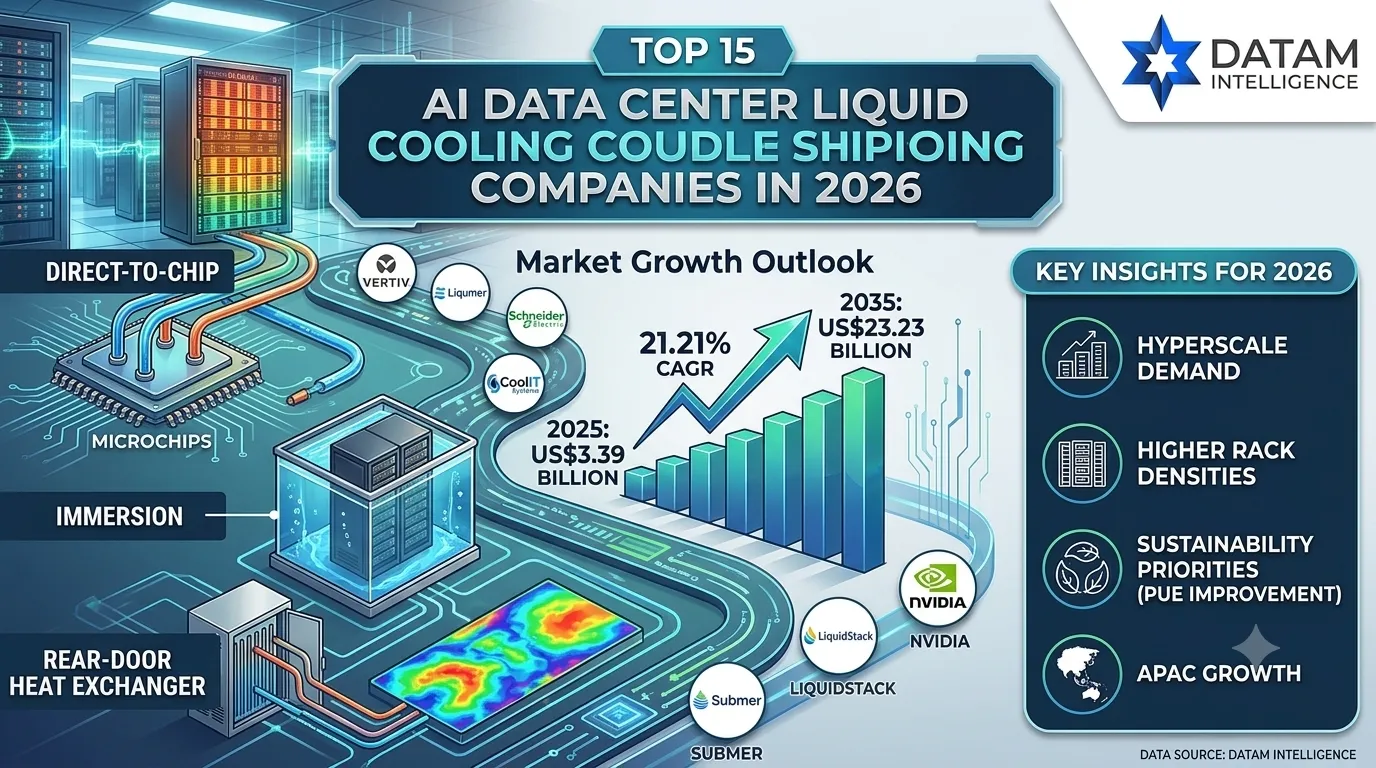
According to DataM Intelligence, the global AI Data Center Liquid Cooling Market was valued at US$3.39 billion in 2025 and is projected to reach US$23.23 billion by 2035, growing at a CAGR of 21.21%. The market expansion is driven by growing AI workloads, higher rack densities, accelerated computing, and the need for energy-efficient thermal management solutions.
Explore the Future of AI Data Center Liquid Cooling
Discover market forecasts, technology trends, competitive analysis, and growth opportunities driving the next generation of AI-ready data center infrastructure.
Download the sample report to access expert insights on liquid cooling technologies, market dynamics, leading companies, and investment opportunities through 2035.
Traditional air-cooling systems are increasingly unable to support next-generation AI infrastructure. As a result, liquid cooling technologies such as direct-to-chip cooling, immersion cooling, rear-door heat exchangers, and hybrid cooling architectures are becoming standard requirements for AI-ready data centers.
Why Liquid Cooling Is Becoming Essential for AI Data Centers
AI workloads powered by GPUs can generate heat densities far beyond traditional enterprise servers. Advanced liquid cooling technologies offer several advantages:
- Higher rack power density support
- Improved energy efficiency
- Lower cooling power consumption
- Better GPU performance and reliability
- Reduced operational costs
- Enhanced sustainability and water management
- Improved Power Usage Effectiveness (PUE)
Research comparing liquid-cooled and air-cooled NVIDIA H100 GPU systems found liquid cooling can improve performance by approximately 17% while maintaining significantly lower operating temperatures.
Top 15 AI Data Center Liquid Cooling Companies in 2026
1. Vertiv
Vertiv has established itself as one of the leading providers of critical digital infrastructure supporting hyperscale, colocation, enterprise, and AI-driven data centers worldwide. As artificial intelligence workloads continue to push rack power densities beyond traditional limits, Vertiv has significantly expanded its liquid cooling portfolio to address the thermal challenges associated with next-generation GPU clusters and accelerated computing environments.
The company's AI-focused cooling solutions include advanced Coolant Distribution Units (CDUs), direct-to-chip liquid cooling systems, rear-door heat exchangers, and integrated thermal management platforms designed to optimize energy efficiency and system reliability. Vertiv works closely with leading chip manufacturers, cloud providers, and hyperscale operators to develop scalable cooling architectures capable of supporting high-density AI workloads.
With growing demand for AI factories, large language model training infrastructure, and GPU-intensive computing, Vertiv's ability to integrate power, cooling, monitoring, and infrastructure management into a unified ecosystem has positioned the company as a preferred partner for many of the world's largest data center operators.
Key Strengths
- Comprehensive AI-ready cooling infrastructure portfolio
- Strong relationships with hyperscale cloud providers
- Advanced direct-to-chip liquid cooling technologies
- Integrated power, thermal, and monitoring solutions
- Global deployment and service capabilities
2. Schneider Electric
Schneider Electric has become a major force in the AI data center ecosystem through its comprehensive approach to energy management, digital infrastructure, and sustainable cooling technologies. As AI workloads drive unprecedented increases in data center power consumption and heat generation, Schneider Electric is helping operators design efficient, resilient, and future-ready facilities capable of supporting next-generation computing demands.
The company's solutions span liquid cooling systems, power distribution, data center management software, and advanced energy optimization technologies. Through its EcoStruxure platform, Schneider Electric enables real-time monitoring and management of critical infrastructure, allowing operators to improve cooling efficiency, reduce operational costs, and enhance overall data center performance.
Schneider Electric's emphasis on sustainability has become increasingly important as organizations seek to balance AI expansion with environmental objectives. The company actively supports customers in reducing carbon emissions, improving power usage effectiveness (PUE), and implementing efficient thermal management strategies for AI facilities.
As hyperscale operators continue investing billions of dollars in AI infrastructure globally, Schneider Electric's expertise in both power and cooling systems makes it a strategic partner for large-scale AI data center development projects.
Key Strengths
- EcoStruxure intelligent infrastructure platform
- End-to-end AI data center solutions
- Leadership in energy efficiency and sustainability
- Expertise in high-density facility design
- Global presence across enterprise and hyperscale markets
3. CoolIT Systems
CoolIT Systems is widely recognized as a pioneer in direct liquid cooling (DLC) technology and has emerged as a critical enabler of modern AI computing infrastructure. The company specializes in advanced cooling solutions that directly remove heat from processors, GPUs, and accelerators, enabling significantly higher performance while reducing overall energy consumption.
As AI models become increasingly complex and computationally intensive, traditional air-cooling approaches struggle to manage the heat generated by high-performance computing environments. CoolIT's direct-to-chip liquid cooling technology addresses this challenge by delivering coolant directly to heat-generating components, improving thermal efficiency and enabling greater rack densities.
The company collaborates with leading server manufacturers, semiconductor companies, and cloud infrastructure providers to integrate liquid cooling into AI-optimized systems. Its solutions are widely deployed in high-performance computing (HPC), machine learning, generative AI, and enterprise data center environments.
CoolIT's strong position within the GPU ecosystem and its extensive experience in thermal engineering have made it one of the most influential players in the rapidly growing AI data center liquid cooling market.
Key Strengths
- Industry-leading direct-to-chip liquid cooling technology
- Strong partnerships with OEMs and GPU vendors
- Proven deployments in AI and HPC environments
- High thermal efficiency for dense computing workloads
- Scalable cooling architectures for future AI growth
4. LiquidStack
LiquidStack is a global leader in immersion cooling technology and has become one of the most innovative companies addressing the thermal demands of AI infrastructure. The company's solutions are designed to support increasingly dense computing environments where conventional cooling methods may struggle to maintain performance and energy efficiency.
LiquidStack's immersion cooling platforms submerge servers in specially engineered dielectric fluids, enabling highly effective heat transfer while significantly reducing cooling-related energy consumption. The company's technology is particularly well suited for AI training clusters, hyperscale data centers, and high-performance computing facilities operating at extreme power densities.
As organizations seek ways to improve sustainability while expanding AI capabilities, LiquidStack's cooling solutions offer substantial benefits, including reduced facility footprint requirements, lower operational costs, and improved system performance. These advantages have positioned the company as a preferred technology partner for next-generation AI infrastructure projects.
With increasing demand for large-scale AI deployments globally, LiquidStack continues to play a key role in advancing the adoption of immersion cooling technologies across enterprise and hyperscale markets.
Key Strengths
- Advanced immersion cooling technologies
- High-performance thermal management capabilities
- Strong suitability for AI and HPC workloads
- Reduced energy and water consumption
- Support for ultra-high-density computing environments
5. Submer
Submer has emerged as one of the most innovative companies focused on sustainable cooling technologies for AI, cloud, and high-performance computing environments. The company specializes in immersion cooling solutions designed to address the growing energy, thermal, and environmental challenges associated with modern digital infrastructure.
As AI workloads continue to increase power density requirements, Submer's immersion cooling systems provide a highly efficient alternative to traditional air-cooling architectures. By immersing IT equipment in dielectric cooling fluids, the company enables superior heat dissipation, reduced energy consumption, and improved hardware reliability.
A key differentiator for Submer is its strong emphasis on sustainability. The company promotes technologies that minimize water usage, reduce cooling-related energy demands, and support environmentally responsible data center operations. These capabilities align closely with the sustainability goals of hyperscale cloud providers, enterprises, and colocation operators investing heavily in AI infrastructure.
Submer's modular and scalable designs make its solutions suitable for a wide range of deployment scenarios, from edge computing facilities to large-scale AI training environments. As the AI data center market continues expanding, Submer is well positioned to benefit from increasing demand for efficient and sustainable thermal management technologies.
Key Strengths
- Sustainable immersion cooling innovation
- Significant reduction in water consumption
- High-density AI and HPC workload support
- Modular and scalable deployment architecture
- Strong focus on environmental efficiency and operational savings
6. Johnson Controls
Johnson Controls has emerged as a significant player in the rapidly evolving AI data center ecosystem, leveraging decades of expertise in HVAC, building automation, and energy management technologies. As artificial intelligence workloads continue to increase cooling demands across hyperscale and enterprise facilities, the company is expanding its portfolio of advanced thermal management solutions designed to support high-density computing environments.
The company provides a broad range of cooling technologies, including chillers, air handling systems, intelligent controls, and energy-efficient HVAC infrastructure tailored for mission-critical data center operations. These solutions help operators maintain optimal operating conditions while reducing energy consumption and improving overall facility performance.
One of Johnson Controls' key advantages lies in its ability to integrate cooling infrastructure with smart building technologies and digital monitoring platforms. Through advanced analytics and automation, data center operators can gain greater visibility into energy usage, cooling efficiency, and infrastructure performance, enabling more proactive management of AI facilities.
As global investments in AI infrastructure continue to accelerate, Johnson Controls is well positioned to support the development of sustainable, resilient, and scalable data centers capable of handling increasingly demanding AI workloads.
Key Strengths
- Extensive expertise in HVAC and thermal management systems
- Proven experience in large-scale infrastructure deployments
- Smart building automation and digital monitoring capabilities
- Energy-efficient cooling solutions for mission-critical facilities
- Strong global presence across enterprise and hyperscale markets
7. Delta Electronics
Delta Electronics has become an increasingly influential contributor to AI infrastructure development through its advanced power management, thermal solutions, and energy-efficient technologies. As data centers evolve to support next-generation AI applications, the company is helping operators address the dual challenge of increasing computational power while maintaining sustainable energy consumption.
The company's portfolio includes liquid cooling technologies, thermal management systems, power distribution solutions, and energy optimization platforms designed specifically for high-density computing environments. Delta's expertise in integrating power and cooling infrastructure enables data center operators to improve efficiency, reduce operating costs, and support the deployment of large-scale AI clusters.
Delta Electronics has also invested heavily in innovation focused on sustainability and carbon reduction. Its energy-efficient cooling architectures help organizations lower Power Usage Effectiveness (PUE) while supporting increasingly power-hungry AI processors and GPU systems.
With growing adoption of direct liquid cooling and advanced thermal management technologies, Delta Electronics is well positioned to capitalize on the global expansion of AI-ready data centers and next-generation digital infrastructure projects.
Key Strengths
- Advanced thermal management and cooling technologies
- Comprehensive data center power infrastructure solutions
- Strong focus on energy efficiency and sustainability
- Expertise in integrated power and cooling ecosystems
- Global manufacturing and technology leadership
8. Boyd Corporation
Boyd Corporation is recognized as a leading provider of advanced thermal management technologies that support some of the world's most demanding computing and electronics applications. As AI infrastructure continues to evolve toward higher rack densities and more powerful processing architectures, Boyd's cooling technologies have become increasingly important in maintaining system reliability and performance.
The company specializes in engineered thermal solutions, including liquid cooling components, cold plates, heat exchangers, thermal interface materials, and customized cooling assemblies. These technologies play a critical role in dissipating heat generated by GPUs, CPUs, accelerators, and other high-performance computing components used in AI data centers.
Boyd's deep expertise in thermal engineering enables the company to develop highly customized solutions tailored to the unique requirements of hyperscale operators, semiconductor manufacturers, and enterprise data center providers. Its products are widely used across artificial intelligence, high-performance computing, cloud infrastructure, and advanced electronics applications.
As thermal management becomes a strategic priority for AI infrastructure operators, Boyd's ability to deliver innovative and scalable cooling technologies positions it as an important supplier within the global liquid cooling ecosystem.
Key Strengths
- Industry-leading thermal engineering expertise
- Advanced cold plate and liquid cooling technologies
- Strong capabilities in semiconductor thermal management
- Customized solutions for AI and HPC environments
- Broad experience across data center and electronics industries
9. Asetek
Asetek has built a strong reputation as an innovator in liquid cooling technologies, with extensive experience serving high-performance computing, enterprise IT, and data center markets. As AI workloads continue to drive unprecedented heat generation within modern computing systems, the company is leveraging its expertise to support the growing adoption of liquid cooling infrastructure.
The company's direct liquid cooling solutions are designed to efficiently remove heat from processors and accelerators, enabling improved performance, greater energy efficiency, and enhanced system reliability. These capabilities are becoming increasingly important as AI training and inference environments deploy larger GPU clusters and higher-density server configurations.
Asetek's modular cooling platforms provide flexibility for organizations seeking to integrate liquid cooling technologies into both new and existing data center environments. The company's solutions are designed to simplify deployment while delivering the thermal performance necessary to support demanding AI workloads.
With a strong foundation in thermal innovation and liquid cooling engineering, Asetek is positioned to play an important role in helping organizations transition toward more efficient and scalable AI infrastructure architectures.
Key Strengths
- Proven expertise in direct liquid cooling technologies
- Extensive enterprise and HPC deployment experience
- Flexible and modular cooling platform designs
- Enhanced thermal efficiency for AI workloads
- Strong heritage in performance-focused cooling solutions
10. Lenovo
Lenovo has established itself as a global leader in high-performance computing and AI infrastructure through its innovative Neptune liquid cooling technology. The company's approach combines advanced server engineering with integrated liquid cooling capabilities, enabling organizations to achieve higher computing performance while improving energy efficiency and sustainability.
Lenovo's Neptune architecture is designed to address the growing thermal demands of AI training, machine learning, and high-performance computing applications. By incorporating liquid cooling directly into server designs, the company helps customers maximize processing power, reduce energy consumption, and optimize data center utilization.
The Neptune platform supports a wide range of AI and HPC deployments, from enterprise research environments to some of the world's most powerful supercomputers. Its ability to efficiently cool processors, memory, storage, and accelerators has made it a preferred solution for organizations seeking to deploy large-scale AI infrastructure.
As AI adoption accelerates across industries, Lenovo continues to invest in innovations that improve infrastructure performance, sustainability, and operational efficiency. The company's integrated approach to server and cooling design positions it among the leading technology providers shaping the future of AI-ready data centers.
Key Strengths
- Industry-recognized Neptune liquid cooling architecture
- Integrated server and cooling system design
- Strong capabilities in AI and high-performance computing
- Enhanced energy efficiency and sustainability performance
- Proven leadership in enterprise, research, and supercomputing environments
11. Supermicro
Supermicro has emerged as one of the most influential hardware providers in the AI infrastructure ecosystem, driven by the rapid adoption of its GPU-optimized server platforms and liquid-cooled computing solutions. As enterprises, cloud providers, and hyperscalers race to deploy large-scale AI training and inference environments, Supermicro has positioned itself at the forefront of delivering high-performance, energy-efficient infrastructure designed specifically for AI workloads.
The company offers an extensive portfolio of AI servers, storage systems, and rack-scale solutions that support the latest GPU architectures from leading semiconductor vendors. To address the growing thermal demands of AI clusters, Super micro has significantly expanded its liquid cooling capabilities, incorporating direct-to-chip cooling, liquid-cooled racks, and integrated cooling technologies that enable higher power densities while reducing operational costs.
A key differentiator for Super micro is its ability to deliver complete rack-scale AI infrastructure solutions, often referred to as "AI factories." These solutions integrate computing, networking, storage, power, and cooling into a unified architecture optimized for large-scale AI model training and deployment. By simplifying infrastructure deployment and improving energy efficiency, Super micro is helping organizations accelerate their AI initiatives while managing increasing power and cooling requirements.
As AI infrastructure investments continue to grow globally, Super micro's comprehensive approach to liquid-cooled computing makes it a key player in the future of AI-ready data centers.
Key Strengths
- Advanced GPU-optimized server platforms
- Rack-scale liquid cooling solutions
- Comprehensive AI factory infrastructure offerings
- High-density computing support
- Rapid deployment and scalability capabilities
12. NVIDIA
NVIDIA is widely recognized as the driving force behind the modern AI revolution, providing the GPUs, accelerated computing platforms, and software ecosystems powering today's most advanced artificial intelligence applications. However, as AI models become increasingly complex and computationally intensive, NVIDIA is also playing a pivotal role in shaping the future of data center cooling technologies.
The company's next-generation AI infrastructure designs increasingly emphasize liquid-cooled architectures capable of supporting ultra-high-density GPU deployments. As AI factories scale to thousands of GPUs, traditional air-cooling systems face significant limitations in managing heat generation, power efficiency, and operational sustainability. NVIDIA's liquid-cooling initiatives aim to address these challenges by enabling higher computing performance, improved energy utilization, and greater infrastructure scalability.
Through collaborations with server manufacturers, cooling technology providers, and hyperscale cloud operators, NVIDIA is accelerating the adoption of direct liquid cooling and advanced thermal management solutions across the AI ecosystem. Its infrastructure platforms are designed to maximize GPU performance while supporting the demanding thermal requirements of generative AI, machine learning, and large language model workloads.
As the AI industry continues to evolve, NVIDIA's influence extends beyond processors and software into the broader infrastructure stack, making the company one of the most important contributors to the development of next-generation liquid-cooled data centers.
Key Strengths
- Global leadership in AI computing infrastructure
- GPU-centric cooling optimization strategies
- Advanced AI factory architecture development
- Strong ecosystem partnerships across the data center industry
- Focus on high-performance and energy-efficient AI deployments
13. Asperitas
Asperitas is an innovative technology company focused on delivering sustainable immersion cooling solutions for data centers, edge computing facilities, and high-performance AI environments. The company has gained recognition for its unique approach to thermal management, which utilizes natural convection principles to provide efficient and environmentally responsible cooling for high-density computing infrastructure.
Unlike conventional cooling systems that rely heavily on mechanical components and complex airflow management, Asperitas' immersion cooling technology submerges IT equipment in specially engineered dielectric fluids. This approach enables highly effective heat dissipation while reducing energy consumption, infrastructure complexity, and maintenance requirements.
As AI workloads continue to increase data center power densities, organizations are seeking cooling technologies that can support long-term scalability while meeting sustainability objectives. Asperitas addresses these requirements by offering solutions that minimize water usage, improve thermal efficiency, and reduce the overall environmental impact of computing operations.
The company's focus on innovation and sustainability has positioned it as an important player in the growing immersion cooling market, particularly among organizations seeking efficient cooling alternatives for AI and high-performance computing deployments.
Key Strengths
- Natural convection immersion cooling technology
- Reduced infrastructure and maintenance complexity
- Environmentally sustainable cooling operations
- Support for high-density AI and HPC workloads
- Improved energy efficiency and thermal performance
14. GRC (Green Revolution Cooling)
Green Revolution Cooling (GRC) is widely regarded as one of the pioneers of immersion cooling technology and has played a significant role in advancing the adoption of liquid cooling within enterprise, hyperscale, and high-performance computing environments. The company has spent years developing and refining immersion cooling systems capable of addressing the thermal challenges associated with increasingly powerful computing infrastructure.
GRC's cooling solutions are designed to fully immerse servers and IT equipment in dielectric fluids, enabling efficient heat transfer while significantly reducing dependence on traditional air-cooling systems. This approach allows data center operators to achieve higher rack densities, lower energy consumption, and improved infrastructure reliability.
As AI applications drive unprecedented demand for processing power, immersion cooling technologies are becoming increasingly attractive for organizations seeking to maximize computing performance while maintaining operational efficiency. GRC's proven deployment experience across a variety of industries has established the company as a trusted provider of advanced cooling solutions for next-generation AI data centers.
The company's continued focus on innovation, energy efficiency, and operational simplicity makes it a key participant in the expanding liquid cooling ecosystem supporting the global AI infrastructure boom.
Key Strengths
- Proven immersion cooling technology deployments
- Support for ultra-high-density computing environments
- Reduced cooling-related energy consumption
- Enhanced infrastructure reliability and performance
- Strong track record across enterprise and hyperscale markets
15. Iceotope
Iceotope is a leading innovator in precision liquid cooling technologies designed to support mission-critical computing environments, including artificial intelligence, edge computing, telecommunications, and high-performance data centers. The company's approach focuses on delivering targeted thermal management solutions that maximize performance while minimizing energy consumption and infrastructure complexity.
Iceotope's precision cooling architecture is engineered to remove heat directly from critical system components, ensuring stable operating conditions even under demanding workloads. This capability is particularly important for AI deployments, where GPU-intensive applications can generate substantial heat and place significant strain on traditional cooling systems.
In addition to supporting large-scale data centers, Iceotope's solutions are well suited for edge AI environments where space, power availability, and environmental conditions present unique operational challenges. By enabling highly efficient cooling in compact and distributed deployments, the company helps organizations extend AI capabilities beyond centralized facilities.
With increasing demand for reliable, energy-efficient, and scalable cooling technologies, Iceotope continues to strengthen its position as a provider of advanced thermal management solutions for the next generation of AI infrastructure.
Key Strengths
- Precision liquid cooling technology expertise
- Strong support for mission-critical AI applications
- Optimized solutions for edge AI and distributed computing
- High reliability and operational resilience
- Energy-efficient thermal management architecture
Key AI Data Center Liquid Cooling Market Insights
Market Growth Outlook
The AI Data Center Liquid Cooling Market is forecast to grow from US$3.39 billion in 2025 to US$23.23 billion by 2035, representing one of the fastest-growing segments of the digital infrastructure industry.
Direct-to-Chip Cooling Dominates
Direct-to-chip cooling is emerging as the preferred solution for hyperscale AI facilities because it removes heat directly from GPUs and CPUs while enabling gradual infrastructure upgrades.
APAC Emerges as Fastest Growing Region
Rapid AI infrastructure expansion across India, China, Southeast Asia, Japan, and South Korea is positioning Asia-Pacific as the fastest-growing market for liquid cooling technologies.
Sustainability Becomes a Strategic Priority
As AI data center energy consumption rises, operators are increasingly focused on reducing cooling energy, improving water efficiency, and supporting corporate sustainability goals. Advanced liquid cooling systems are becoming central to these efforts.
Analyst Viewpoint
The AI infrastructure race is transforming cooling from a facility-level consideration into a strategic technology investment. Organizations deploying next-generation GPU clusters are increasingly evaluating liquid cooling at the design stage rather than as a retrofit option.
Over the next decade, companies that combine thermal innovation, energy efficiency, sustainability, and AI infrastructure expertise will be best positioned to capitalize on the growing demand for AI-ready data centers. As rack densities continue to rise and hyperscalers expand globally, liquid cooling is expected to become a foundational element of future digital infrastructure.