


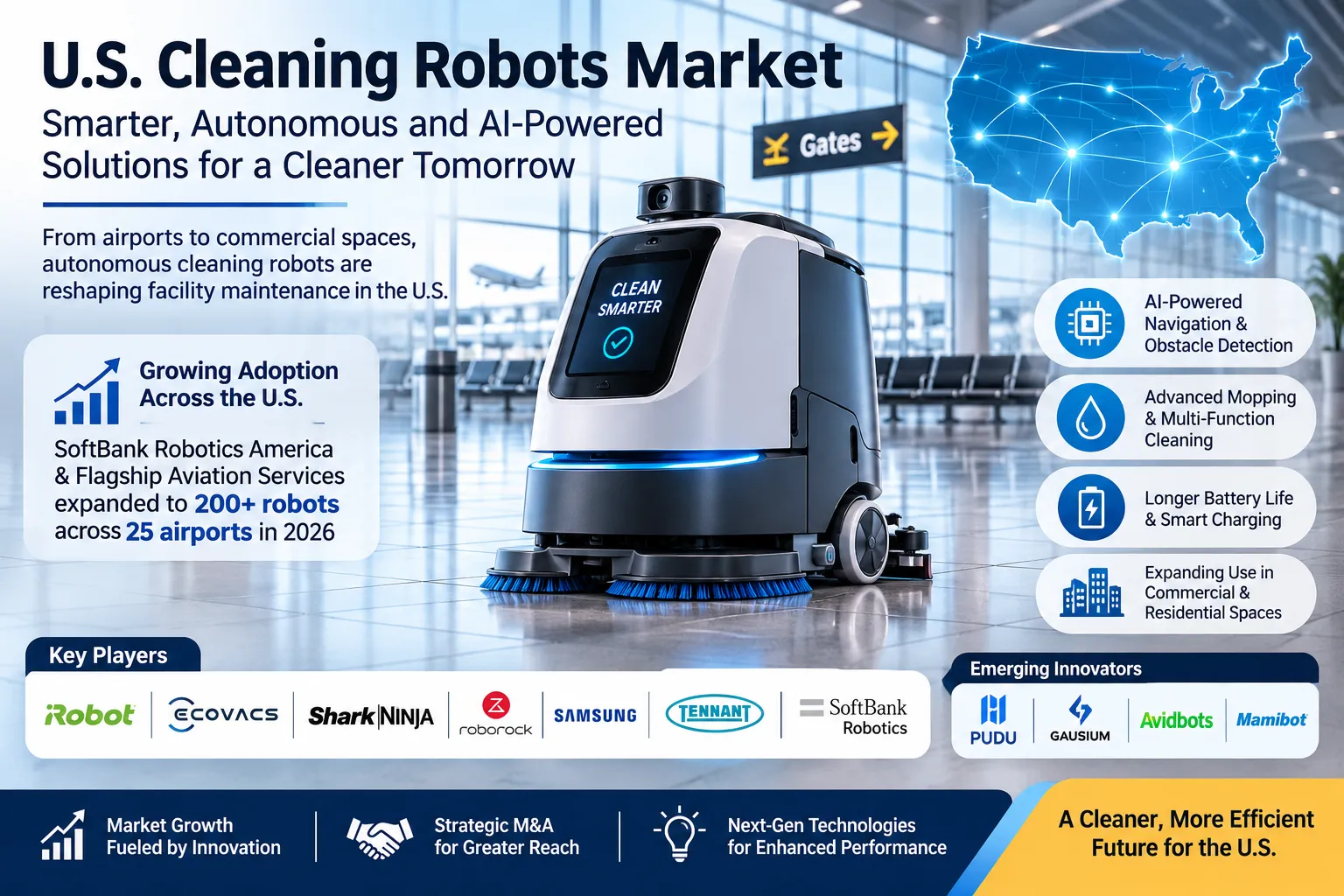
Large-scale commercial deployments are strengthening the role of autonomous cleaning robots in managing extensive floor-care requirements across US infrastructure facilities. For instance, in August 2026, SoftBank Robotics America and Flagship Aviation Services expanded their airport cleaning partnership to more than 200 robots across 25 locations, up from 100 robots across 15 locations in 2024. This expansion reflects growing commercial acceptance of autonomous cleaning systems and supports demand for robotic solutions capable of operating across large, high-traffic facilities.
Manufacturers are integrating AI-powered features, advanced mopping systems, obstacle detection, and enhanced charging technologies to expand robotic cleaning capabilities and improve user convenience. For instance, in April 2026, ECOVACS Robotics introduced its DEEBOT X12 OmniCyclone robot vacuum and mop. The product incorporates FocusJet technology, advanced roller mopping, and PowerBoost charging to address everyday cleaning requirements, including dried spills and pet-related messes.
Furthermore, manufacturing diversification supports the US cleaning robot market by reducing dependence on China-based production, expanding supplier networks across Southeast Asia and enabling manufacturers to manage import tariffs and production costs. In May 2025, SharkNinja announced plans to shift nearly all US-bound household appliance manufacturing outside China by the end of 2025, targeting approximately 90% of US product volume outside China by the end of Q2 2025. The company expanded manufacturing across Cambodia, Indonesia, Malaysia, Thailand and Vietnam, including products within its Shark robotic vacuum portfolio.
Request Sample: https://www.datamintelligence.com/download-sample/us-cleaning-robot-market
Key Companies and Competitive Positioning
The US cleaning robots market comprises manufacturers of residential robot vacuums and mops, as well as commercial cleaning robotics companies supplying autonomous floor scrubbers and vacuuming systems. Competitive positioning is shaped by navigation and obstacle-detection technologies, cleaning performance, automation features, product reliability, software integration and distribution reach. Residential manufacturers differentiate through suction performance, mapping, self-emptying and automated mopping, while commercial suppliers focus on autonomous operation, cleaning productivity, fleet management and integration into facility-maintenance workflows.
- iRobot Corporation - Roomba Max 715 Vac Robot and Roomba Max 875 Combo Robot.
- ECOVACS Robotics - DEEBOT X12S OmniCyclone and DEEBOT X12S Pro Omni robot vacuum and mop.
- SharkNinja, Inc. - Shark PowerDetect UV Reveal 2-in-1 Vacuum and Mop and Shark Matrix Plus 2-in-1 Robot Vacuum and Mop.
- Roborock Technology Co., Ltd. - Saros Z70 and Saros 20 robot vacuums.
- Dreame International Limited - Dreame L60 Pro Ultra and X60 Max Ultra Complete robot vacuums.
- Samsung Electronics Co., Ltd. - Bespoke AI Jetbot Combo Robot Vacuum and Mop.
- BISSELL Inc. - SpinWave Wet and Dry Robotic Vacuum.
- Anker Innovations (eufy) - eufy Robot Vacuum Omni S2 Pro and Omni E35.
- Tennant Company - X6 ROVR Autonomous Floor Scrubber and X2 ROVR SCRUB Autonomous Floor Scrubber.
- SoftBank Robotics America - Omnie, Vacuum 40, Phantas and Whiz.
Emerging Innovators Advancing Cleaning Robot Technologies
Emerging and specialized manufacturers are expanding the market through AI-enabled floor-cleaning robots, autonomous scrubbing systems and multifunctional residential cleaning devices. Their product development focuses on improving navigation in dynamic environments, reducing manual intervention, enabling targeted cleaning and supporting deployment across commercial facilities and households.
- Pudu Robotics - PUDU CC1 and PUDU CC1 Pro commercial cleaning robots, integrating sweeping, scrubbing, vacuuming and mopping functions.
- Gausium - Scrubber 50 AI-powered robotic floor scrubber, designed for retail centres, offices, healthcare facilities and transportation hubs.
- Avidbots Corp. - Neo, Neo 2W and Kas autonomous floor-scrubbing robots for commercial facilities.
- Mamibot Manufacturing USA Inc. - Ultra T20 OmniBase and Ultra M10/M20 wet-and-dry robotic cleaning systems.
Major Mergers, Acquisitions and Portfolio Restructuring
- January 2026: iRobot completed its court-supervised transaction with Shenzhen Picea Robotics and Santrum Hong Kong, through which Picea acquired 100% of the company's equity. The transaction enabled iRobot to emerge from Chapter 11 bankruptcy with a restructured financial position and renewed capacity to invest in consumer robotics and smart home technologies.
- March 2026: SoftBank Robotics America acquired Green Clean Commercial (GCC) to expand the use of physical AI, robotics and predictive intelligence across commercial facility services. The acquisition supports the development of Smart Building X (SBX), an intelligent platform that integrates traditional cleaning operations with automation, data analytics and AI-driven resource allocation.
Recent Innovations and Their Potential Impact
- April 2026: ECOVACS Robotics introduced its DEEBOT X12 OmniCyclone robot vacuum and mop. The product incorporates FocusJet technology, advanced roller mopping, and PowerBoost charging to address everyday cleaning requirements, including dried spills and pet-related messes.
- April 2025: Tennant Company launched the X6 ROVR, a mid-sized autonomous floor scrubber designed for commercial and light-industrial environments. The robot can clean up to 75,000 square feet per cycle, offers up to six hours of continuous operation and features 3D LiDAR, real-time obstacle detection and adaptive routing.
- August 2025: Narwal launched its Flow Series robot vacuum and mop in the US, featuring the FlowWash self-cleaning track-mopping system, Twin-AI obstacle avoidance and CarpetFocus technology. Equipped with dual RGB cameras and an AI chip, the robot recognizes more than 200 types of objects and navigates around obstacles with 5 mm precision. It delivers suction power of up to 22,000 Pa and automatically adjusts cleaning functions for carpets and hard floors.
- March 2026: Dyson launched the Spot+Scrub AI, its first robotic vacuum cleaner designed for both wet and dry floor cleaning, in the US. The robot integrates AI-powered vision and green illumination to identify nearly 200 types of household substances and objects, enabling targeted stain detection, obstacle avoidance and adaptive cleaning. It features a self-cleaning wet roller, an extending mop for edge cleaning and a cyclonic bagless dust collection system.
Competitive Outlook
The competitive landscape of the US cleaning robot market is evolving through advancements in autonomous navigation, AI-enabled obstacle recognition, multi-functional cleaning systems and commercial robotics deployment. Established participants such as iRobot, SharkNinja, Roborock, ECOVACS, Dreame Technology and Anker Innovations (eufy) are strengthening their positions in residential cleaning robots through product upgrades, expanded robot vacuum and mop portfolios and established retail distribution networks. In the commercial segment, companies such as Tennant Company, Gausium, Pudu Robotics, Avidbots and SoftBank Robotics America are expanding their offerings across autonomous vacuuming, floor scrubbing and multi-functional cleaning systems for large facilities.
Request Sample: https://www.datamintelligence.com/download-sample/us-cleaning-robot-market
In the short term, competitive advantage will depend on cleaning performance, navigation accuracy, obstacle detection, battery life, product reliability, pricing and distribution reach. Commercial market positioning will also depend on autonomous fleet management, service support and the ability to demonstrate measurable improvements in cleaning productivity. In the long term, differentiation is likely to depend on investments in AI-based perception, advanced mapping, autonomous decision-making, multi-surface cleaning technologies and integration with smart building management platforms.