


Data Center Infrastructure Management (DCIM) has evolved from equipment inventory and alarm reporting into a decision platform for data center operations. High-density AI computing, hybrid cooling, energy constraints and multi-site capacity commitments require operators to understand how rack assets, power chains, cooling loops and work orders affect each other in real time. The commercial opportunity is shifting from standalone monitoring licences toward integrated, continuously updated operational intelligence.
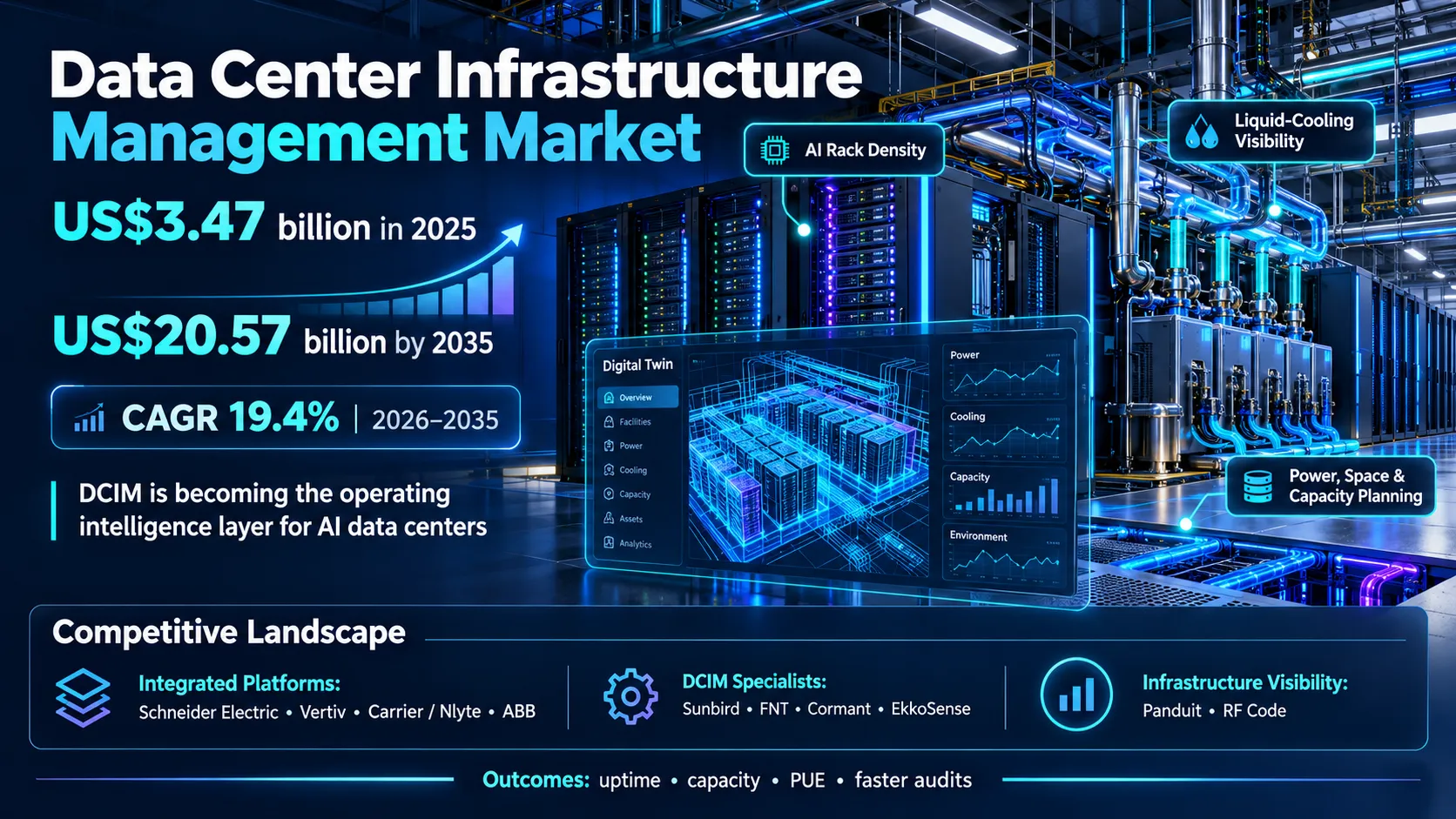
DataM Intelligence values the global DCIM market at US$3.47 billion in 2025 and forecasts US$20.57 billion by 2035, equivalent to a stated 19.4% CAGR for 2026-2035. North America remains the largest market while Asia-Pacific represents the fastest-growing region. Software solutions, cloud subscriptions, implementation services and long-term integration support all contribute to addressable spending.
The competitive field has three layers: broad infrastructure vendors such as Schneider Electric and Vertiv; integrated controls and operational platforms such as Carrier/Nlyte and ABB; and dedicated DCIM specialists including Sunbird, FNT, Cormant and EkkoSense. In a June 23, 2026 discussion, Schneider Electric executive Himamshu Prasad emphasized DCIM’s shift toward a unified lifecycle view spanning power, cooling, space and compute. Carrier CEO David Gitlin described the July 2026 75F transaction as a step toward “increasingly autonomous and self-optimizing buildings.” Those executive perspectives illustrate why software intelligence is becoming a source of differentiation, not merely an accessory to hardware.
Request Exclusive Sample: https://www.datamintelligence.com/download-sample/data-center-infrastructure-management-dcim-market
Top 10 Companies Analysis
Schneider Electric
EcoStruxure IT Expert, IT Advisor and Data Center Expert support distributed monitoring, planning and digital-twin operations. Its global installed base in power and cooling improves its channel reach; a July 2026 publication brought predictive DCIM positioning into sharper focus. 2025 group revenue: approximately US$45.4 billion (EUR40.2 billion translated at an indicative 2025 average EUR/USD rate of 1.13). Strength: broad integrated ecosystem. Challenge: proving interoperability and implementation value in mixed-vendor sites.
Vertiv
Environet connects facility equipment, alarms and operating analytics, while the company’s systems-level offerings link power, thermal management and software. September 2026 brought Environet Alert v1.5.3. 2025 group revenue: US$10.23 billion. Strength: deep physical infrastructure telemetry. Challenge: translating monitoring into asset and change-management workflows.
Carrier / Nlyte Software
Nlyte provides asset lifecycle, capacity and device management. Carrier combines it with Automated Logic, WebCTRL and Abound to connect plant controls with DCIM workflows; its July 2026 acquisition of 75F strengthens this story. 2025 Nlyte-only revenue: not separately disclosed. Strength: facility-to-IT bridge. Challenge: harmonizing acquired data models and commercial offerings.
Sunbird Software
dcTrack and Power IQ form a specialist combination for asset topology, connectivity, power and capacity. Its July 2026 release added liquid-cooling infrastructure modeling. 2025 revenue: not publicly disclosed. Strength: purpose-built workflows for colocation and enterprise operators. Challenge: scale against diversified global suppliers.
ABB
ABB Ability and electrical monitoring technologies address power-system visibility and infrastructure condition across critical environments. ABB competes most effectively where DCIM overlaps electrical automation rather than comprehensive IT asset lifecycle management. 2025 DCIM-specific revenue: not separately disclosed. Strength: switchgear and power telemetry. Challenge: dependence on integration with broader DCIM stacks.
FNT Software
FNT Command models assets, cabling, connectivity and infrastructure dependencies across facilities and networks, providing a strong configuration data backbone. 2025 revenue: not publicly disclosed on a comparable basis. Strength: detailed network and asset relationships. Challenge: integrating live power and thermal data.
Cormant
Cormant-CS supports asset tracking, connectivity, space, power and change operations using a flexible data model. This specialist orientation helps with retrofit and heterogeneous environments. 2025 revenue: not publicly disclosed. Strength: implementation flexibility. Challenge: visibility in large global procurement cycles.
EkkoSense
EkkoSoft Critical integrates thermal sensing, analytics and cooling optimization. It is an adjacent specialist with particular relevance to high-density compute rooms. 2025 revenue: not publicly disclosed. Strength: actionable thermal analytics. Challenge: limited breadth versus full-lifecycle DCIM platforms.
Panduit
Panduit combines connectivity and physical-infrastructure knowledge with asset-management and monitoring capabilities. It influences DCIM buying decisions through structured cabling and rack infrastructure specification. 2025 revenue: privately held; no verified comparable disclosure. Strength: physical-network expertise. Challenge: smaller standalone software footprint.
RF Code
RF Code emphasizes real-time location and environmental sensing for physical IT assets. Its technology can improve the accuracy of the asset record that DCIM platforms use. 2025 revenue: not publicly disclosed. Strength: automated physical visibility. Challenge: narrower application coverage than comprehensive DCIM suites.
Competitor Analysis: Leading DCIM Market Players
| Company | Core position | 2025 Revenue (USD) | Strategic technology |
| Schneider Electric | Integrated DCIM | ~US$45.4bn group | Planning, monitoring, digital twin |
| Vertiv | Facility monitoring | US$10.23bn group | Environet, power/cooling telemetry |
| Carrier / Nlyte | IT-facility operations | Not separately disclosed | Asset/device management, controls |
| Sunbird | Specialist DCIM | Not disclosed | dcTrack and Power IQ |
| ABB | Electrical monitoring | DCIM not separately disclosed | Electrical data and condition monitoring |
| FNT Software | Asset/connectivity model | Not disclosed | Dependencies, cabling |
| Cormant | Asset and change workflows | Not disclosed | Flexible DCIM modeling |
| EkkoSense | Thermal optimization | Not disclosed | Cooling analytics |
| Panduit | Physical infrastructure | Not disclosed | Connectivity visibility |
| RF Code | Asset sensing | Not disclosed | Location and environmental data |
Request Exclusive Sample: https://www.datamintelligence.com/download-sample/data-center-infrastructure-management-dcim-market
Revenue represents consolidated company turnover where noted, not DCIM market revenue. Private pure-play vendors rarely publish audited standalone annual sales; undisclosed amounts are not estimated.
Who Are the Rising Companies Influencing the Market?
- EkkoSense - Strategic focus: thermal analytics and cooling efficiency for high-density computing.
- FNT Software - Strategic focus: trusted asset and connectivity data underpinning multi-site digital twins.
- Cormant - Strategic focus: flexible asset lifecycle and change management in mixed-vendor estates.
- RF Code - Strategic focus: sensor-driven asset accuracy and environmental monitoring.
- Sunbird Software - Strategic focus: liquid-cooling-aware DCIM and automated infrastructure workflows.
Major Mergers, Acquisitions and Portfolio Restructuring (2026)
- 23 July 2026 - Carrier acquired 75F, adding cloud-native building automation, wireless sensing and AI-enabled controls. Carrier explicitly linked the addition to Nlyte and its wider building-management software ecosystem, potentially expanding predictive cooling and asset-intelligence workflows.
- 1 July 2026 - Carrier completed the sale of Riello to Ariston Group. This was a portfolio simplification rather than a DCIM software acquisition; it illustrates Carrier’s broader reshaping of climate and digital infrastructure exposure.
- 3 August 2026 - Carrier completed the sale of NORESCO to OPTERRA Energy Services. This was another portfolio action, with an indirect DCIM implication through sharpened emphasis on core climate, controls and digital platforms.
Recent Innovations and Their Potential Impact: June-October 2026
- 23 June 2026 - Schneider Electric discussed next-generation DCIM integrating energy, cooling, compute and planning through predictive analytics and digital twins. Impact: a move toward lifecycle and cross-domain operating decisions rather than isolated alarm dashboards.
- 6 July 2026 - Sunbird released dcTrack 9.3.5 with tracking and modeling for coolant distribution units and liquid-cooling manifolds. Impact: better capacity planning and change impact analysis for AI GPU racks.
- 6 July 2026 - Sunbird released Power IQ 9.3.5 with usability and bulk PDU configuration enhancements. Impact: simpler deployment and more consistent power telemetry workflows.
- 15 July 2026 - Schneider Electric published its EcoStruxure IT AI-oriented DCIM capabilities. Impact: increased emphasis on predictive operations and prioritization of corrective action.
- September 2026 - Vertiv issued Environet Alert v1.5.3. Impact: ongoing software maintenance improves the reliability and supportability of installed monitoring environments; no unverified feature claims are assumed.
What Is Driving Competition in the Market?
First, power availability and AI rack density have become capacity-planning problems that software must solve. A facility can have spare floor area yet insufficient electrical or cooling headroom for another high-density rack. DCIM vendors capable of tracking both physical dependencies and operational constraints can influence expansion decisions.
Second, liquid cooling changes asset models. Operators must map coolant distribution units, manifolds, sensors and maintenance procedures alongside racks and power chains. Third, enterprise buyers increasingly require open APIs, access control and integration with IT service-management platforms. A useful DCIM platform must preserve a trusted inventory while translating alerts into service tickets, approved changes and capacity forecasts.
Finally, measurable outcomes determine contract renewals: reduced unplanned downtime, improved power usage effectiveness, less stranded capacity, faster audits and fewer manual site visits. Specialist software vendors can win on depth and usability, while industrial groups compete on procurement reach and integration with physical systems. The strongest competitive advantage through 2035 will come from proving operational improvements across complex, multi-vendor facilities.