


Why AI Data Centers, Semiconductor Fabs and Grid Resilience Are Pushing Transformer and Switchgear Order Books Into 2030
| KEY TREND | Taiwan has raised its electricity-demand growth outlook as AI data centers and semiconductor expansion accelerate, while major electrical-equipment suppliers report order visibility extending through 2029 and into 2030. |
| MARKET OUTLOOK | The opportunity is shifting from a normal replacement cycle toward a multi-year capacity buildout across transformers, GIS, switchboards, HVDC equipment, cable and grid reinforcement. |
| RECOMMENDED FOR | Electrical Equipment OEMs, Transformer Manufacturers, Switchgear Suppliers, Cable Companies, EPCs, Data Center Power Teams and Grid Infrastructure Investors |
Request FREE Demo: https://www.datamintelligence.com/electroiq
DMI Analyst View
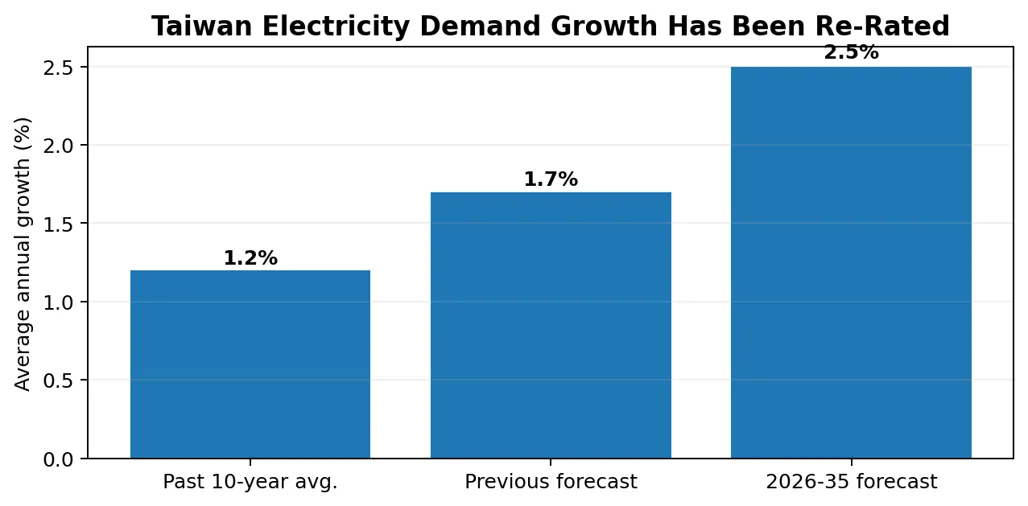
Taiwan is entering a power-infrastructure cycle in which electricity availability is becoming as important to technology expansion as semiconductor capacity itself. The Ministry of Economic Affairs now expects electricity demand to grow 2.5% annually between 2026 and 2035, up from an earlier 1.7% forecast and more than double the 1.2% average growth recorded over the previous decade. The upward revision is being driven primarily by semiconductor capacity additions, AI computing centers and electrification-related demand.
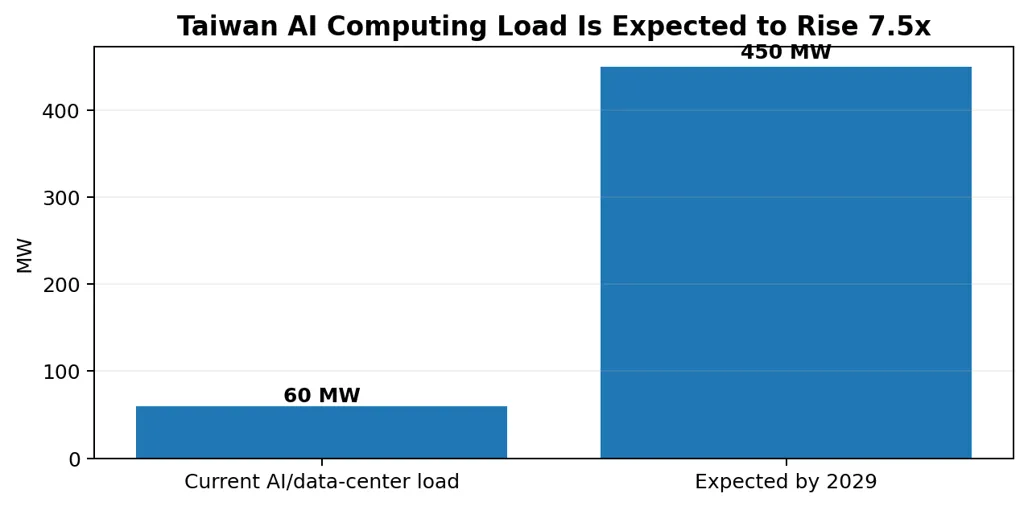
The demand shock is already visible in electrical-equipment order books. Fortune Electric, Shihlin Electric, Chung-Hsin Electric and Machinery and Allis Electric are reported to have order visibility extending beyond 2029, with some 2029-2030 delivery slots already being booked. Taiwan’s government and private AI computing centers are expected to rise from roughly 60 MW of load today to about 450 MW by 2029, a 7.5x increase. This means transformer, GIS, switchboard and cable demand is arriving before much of the new generation and substation capacity can be completed.
The strategic issue is therefore not simply higher power demand. It is a timing mismatch between AI/semiconductor construction cycles and the much longer cycle required to build substations, high-voltage equipment, transmission connections and generating capacity. Suppliers with qualified capacity, shorter lead times or the ability to redesign around constrained equipment can gain share even in a market where incumbent order books already look full.
Source: Taiwan Ministry of Economic Affairs
Taiwan Has Re-Rated Its Electricity Demand Outlook
Taiwan’s updated power plan represents a material change in the baseline. Average electricity demand growth is now expected at 2.5% per year through 2035. That compares with 1.7% in the previous forecast and 1.2% average growth over the last decade. The increase is large enough to change the required pace of generation, transmission and substation investment.
The 2025 base year also shows why the shift matters. Taiwan’s economy expanded 8.76% in 2025 while electricity consumption declined 0.3%. Growth was concentrated in high-value semiconductor and electronic-component activity while energy-intensive traditional sectors were softer. From 2026 onward, however, delayed fab projects and AI data-center buildouts are expected to move from planning into construction, reversing that temporary disconnect between economic growth and electricity use.
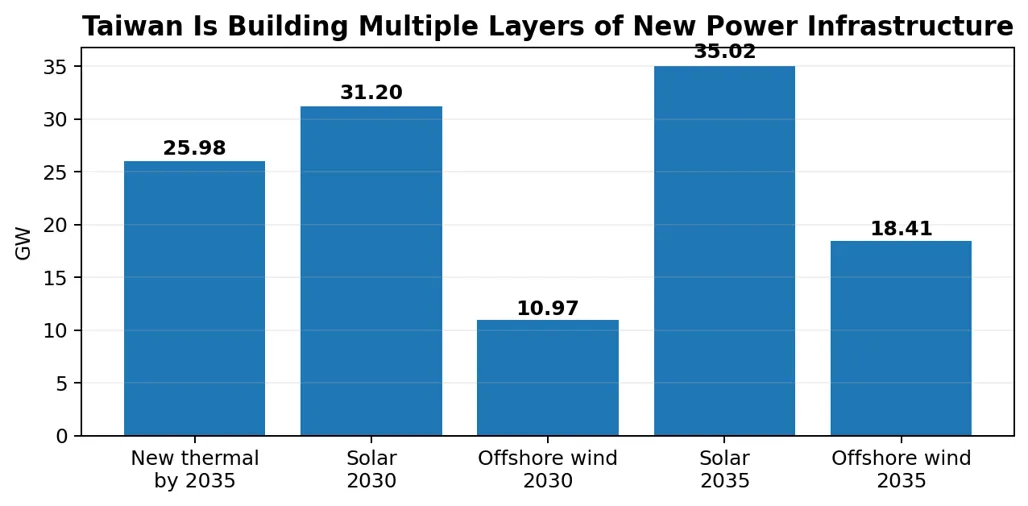
To meet this load, Taiwan plans 25.98 GW of additional thermal generation by 2035, largely gas-fired. The plan also targets 31.2 GW of solar and 10.97 GW of offshore wind by 2030, rising to 35.02 GW and 18.41 GW respectively by 2035. Each layer of capacity expansion creates demand for transformers, GIS, protection, switchboards, cables, power electronics and grid-control systems.
Source: Taiwan Ministry of Economic Affairs
AI Computing Is Compressing the Infrastructure Timeline
The most immediate pressure comes from AI computing. Taiwan’s government and private-sector AI computing centers are expected to reach a combined 450 MW by 2029, compared with about 60 MW across 36 data centers today. The implied 390 MW increase is roughly equivalent to adding several large industrial facilities to the grid within three years.
Unlike traditional industrial load, AI demand is concentrated, power-dense and sensitive to reliability. A single campus can require multiple high-voltage feeds, transformers, medium-voltage switchgear, backup generation, UPS systems and increasingly high-voltage DC distribution. This concentrates orders into product categories that already have long engineering, factory-test and delivery cycles.
The result is an infrastructure race in which the electrical package can become the critical path. A data-center shell can be built faster than a new substation can be permitted, designed, constructed and energized. Taipower’s revised Beitou-Shilin plan illustrates the problem: even after redesign, the proposed substation timeline is approximately six to seven years. A fully underground option had been estimated at nine years.
Source: National Science and Technology Council data
Electrical Equipment Order Books Are Already Extending Into 2030
The strongest signal is not the demand forecast but the order backlog. Taiwan News reported that the major domestic electrical-equipment manufacturers are already carrying orders through at least 2029, with some deliveries being booked for 2030. Shihlin Electric’s 2027 and 2028 capacity is reported to be nearly full.
Fortune Electric provides a second quantitative marker. By June 2026, the company said AI data-center transformer orders had exceeded NT$20 billion, with order visibility through 2029. It expected AI data-center transformer shipments of roughly NT$4-5 billion in 2026 and AI-related revenue above 15% of annual revenue. The United States remained its largest market, showing that Taiwan’s equipment cycle is being pulled by both domestic grid investment and overseas data-center demand.
| Signal | 2026 Position | Strategic Implication |
Top four heavy- electrical suppliers | Order visibility beyond 2029 | New projects are competing for factory slots several years ahead |
| Shihlin Electric | 2027-28 orders nearly full; accepting 2029-30 deliveries | Capacity allocation becomes a sales and procurement variable |
| Fortune Electric | >NT$20B AI transformer orders; visibility through 2029 | AI is already a material transformer demand pool |
| AI computing load | ~60 MW today to ~450 MW by 2029 | Electrical demand is scaling much faster than substation construction |
Request FREE Demo: https://www.datamintelligence.com/electroiq
Taipower’s NT$564.5 Billion Grid Program Creates a Second Demand Layer
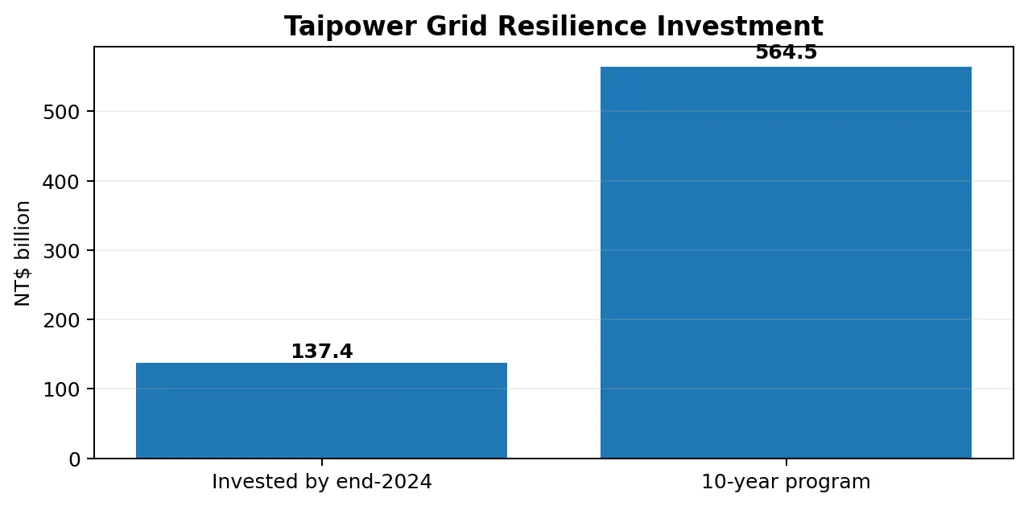
AI and semiconductor projects are arriving on top of an existing grid-reinforcement cycle. Taipower’s Power Grid Resilience Enhancement Program calls for NT$564.5 billion of investment over ten years. The program is built around decentralizing power flows, reinforcing equipment and strengthening system protection. By the end of 2024, NT$137.4 billion had been invested and 98 projects had been completed, representing 29.61% execution progress.
This means private data-center demand is not competing against an idle supply chain. It is competing with utility procurement for many of the same categories: high-voltage transformers, switchgear, breakers, relays, substation structures, conductors, cable and engineering labor. When utility orders have fixed regulatory or reliability deadlines, private buyers may face even greater difficulty securing attractive factory slots.
Source: Taiwan Power Company Sustainability Report / Grid Resilience Enhancement Program
Taiwanese Suppliers Are Being Pulled by Two Markets at Once
The current order cycle is unusual because Taiwan-based manufacturers are not relying only on domestic utility spending. North American grid replacement and AI data-center construction are pulling on the same transformer and switchgear factories. Fortune Electric said exports represented 66% of revenue in the first four months of 2026 and were expected to remain above 60% for the full year. This export exposure means domestic project owners cannot assume local manufacturers will reserve capacity for Taiwan-based work.
The same dynamic can strengthen pricing and reduce the willingness of manufacturers to hold speculative production slots. When a supplier can allocate capacity to a U.S. hyperscale project, Taipower reinforcement work or a Taiwanese semiconductor fab, buyers with incomplete specifications or uncertain award dates lose negotiating power. The commercial advantage shifts toward customers that can lock technical requirements, deposits and delivery windows earlier in the project cycle.
The Bottleneck Is Moving From Components to Entire Project Delivery Windows
The market constraint is broader than transformer manufacturing. Taiwan’s equipment makers are benefiting from strong demand, yet the same articles highlight shortages in experienced construction workers, power engineers, wiring specialists and high-voltage installation personnel. Equipment can therefore arrive on time while commissioning is still delayed by site readiness, civil works, cable installation, testing or utility interconnection.
This changes how lead time should be measured. Buyers increasingly need to track five clocks at once: factory slot, engineering approval, material availability, site construction and utility energization. The longest of those clocks determines commercial operation. In a market with multi-year equipment backlogs, the value of an available transformer can be lost if the substation site or transmission connection is several years behind.
| Bottleneck | Why It Is Tight | Commercial Effect |
| Power transformers | Long engineering cycles, specialized cores/windings, factory test capacity | Projects may lock supplier selection years before commissioning |
| GIS / HV switchgear | High specification burden, insulation/testing requirements, project-specific engineering | Limited qualified alternatives once design is frozen |
| Switchboards / MV gear | AI and fab projects are expanding simultaneously | Standard lead times can extend rapidly during award waves |
| Cable and conductors | Grid reinforcement plus data-center/fab buildout | Large projects can absorb substantial production runs |
| Skilled installation labor | High-voltage work requires experienced crews | Equipment delivery does not guarantee energization |
Request FREE Demo: https://www.datamintelligence.com/electroiq
800V HVDC Adds a New Product Cycle on Top of Grid Expansion
The next demand layer is architectural. Nvidia has previewed a transition toward 800V HVDC distribution for next-generation AI racks from 2027. Taiwanese suppliers are positioning around this change, with Shihlin Electric developing transformer and HVDC relay capacity while Lite-On has moved an 800V DC power shelf into sampling ahead of targeted production in 2027.
The move toward higher-voltage DC distribution can reduce current, conductor size and conversion losses at extreme rack densities, but it also creates new qualification requirements around DC protection, busway, connectors, relays, insulation and power conversion. Suppliers that enter these design cycles early can capture a higher-value position than companies competing only for conventional AC equipment after the project specification has been fixed.
The Best Opportunity Is Often a Project Whose Original Supply Plan Is No Longer Viable
Long backlogs create a commercial opening for alternative suppliers. When a transformer, GIS lineup or switchboard cannot meet a required energization date, the owner may reopen sourcing, split an award, redesign around another voltage class or accept a technically equivalent supplier that was not part of the original plan. These are unusually high-intent opportunities because the project already has budget, a defined specification and a schedule problem.
The most valuable targets are therefore not only newly announced projects. They include projects already under construction where the electrical package is slipping, projects with temporary substations, facilities waiting on grid upgrades and owners whose nominated supplier has moved delivery beyond the commissioning window. Suppliers with spare slots, regional capacity, retrofit capability or pre-qualified alternatives can use schedule certainty as the commercial differentiator.
| Project Signal | What It Usually Means | Supplier Opportunity |
| Required energization date moves out | Critical-path equipment is late | Offer shorter factory slot or alternate specification |
| Temporary substation announced | Permanent grid connection cannot meet project schedule | Supply interim transformers, switchgear or modular power systems |
| Multiple supplier approvals | Buyer is reducing dependency on incumbent | Enter as second source before next award |
| Civil works ahead of equipment | Site is ready but electrical package is delayed | Prioritize fast-track equipment and commissioning support |
| 2029-30 delivery quoted | Current OEM book is saturated | Use regional or underutilized manufacturing capacity |
Request FREE Demo: https://www.datamintelligence.com/electroiq
What Electrical Equipment Companies Should Do Now
The companies best positioned for Taiwan’s AI-power cycle will be those that sell availability rather than only equipment. Suppliers should map factory-slot availability by product and voltage, identify projects with schedule risk before specifications are fully locked and build engineering capability around technically acceptable alternatives. A three-month delivery advantage can have greater value than a modest price discount when the equipment sits on the critical path of a billion-dollar fab or AI campus.
Capacity strategy also matters. The order books extending into 2029-2030 suggest that incremental production added in 2027 or 2028 can still be commercialized against visible demand. Investment should prioritize the categories where qualification barriers are highest and where customers face the greatest cost from delay: power transformers, GIS, MV switchgear, DC protection and engineered busway.
How ElectroIQ Can Help Capture the Opportunity
DataM Intelligence’s new ElectroIQ platform is designed to connect project activity with electrical-equipment supply conditions. Its Project Tracker follows data centers, power projects, oil and gas facilities and other major electrical-infrastructure developments, while the Lead Time Tracker monitors delivery conditions across critical equipment categories. Used together, the tools can help commercial teams identify projects where the required commissioning date is beginning to conflict with quoted equipment availability.
The value is in prioritization. Rather than approaching every announced project, suppliers can focus on projects with a visible schedule gap, an incumbent supplier facing long delivery, a new substation requirement or an active second-source search. ElectroIQ combines these signals with company, project and market intelligence so sales teams can engage while the specification or supplier decision is still movable, turning industry-wide lead-time pressure into targeted pipeline opportunities.
Taiwan Is Becoming a Test Case for the Global AI Power Constraint
Taiwan combines three demand forces that are appearing across other markets: AI computing, semiconductor manufacturing and grid reinforcement. Its 2.5% annual electricity-demand forecast, 450 MW AI-computing target and multi-year electrical-equipment order books show what happens when those forces arrive at the same time.
The companies that will gain share will be those companies that can see where project schedules are breaking, allocate scarce capacity to the highest-value opportunities and provide an alternative before the delay becomes irreversible. In the emerging AI power cycle, lead time is becoming a market-share variable.