


A client came to us with a problem. They were intent on finding the right switchgear partners, customers and buying influencers before the opportunity is lost.
| THE PROBLEM | Too many company names. Too few accounts with the product fit, project access and buying influence to convert. |
| THE SHIFT | Move from directory building to project-triggered customer and partner qualification. |
| THE OUTCOME | A commercial shortlist with a reason to engage each account and a clear next step for sales. |
Request Demo: https://www.datamintelligence.com/electroiq#demo
The Client Had a List. What It Did Not Have Was a Route to Market
A key electrical equipment supplier came to us with a problem that looked deceptively simple: identify more potential customers and partners for its switchgear portfolio.
The team already had company names. Utilities. EPC contractors. Panel builders. Distributors. Industrial groups. The spreadsheet was not empty. The pipeline was.
The issue was qualification. A company can look relevant because it operates in power distribution and still be commercially useless for a specific switchgear portfolio. It may work at the wrong voltage class. It may never influence equipment specifications. It may buy only through an incumbent framework. It may be geographically attractive but have no active projects. Or it may be a capable installer with no authority to select the switchgear brand.
For customer and partner identification, the commercial equivalent is simple: do not qualify a company by what it says it does. Qualify it by where it sits in the buying process, what projects it touches and whether your product actually fits.
Why Generic Partner Lists Fail in Switchgear
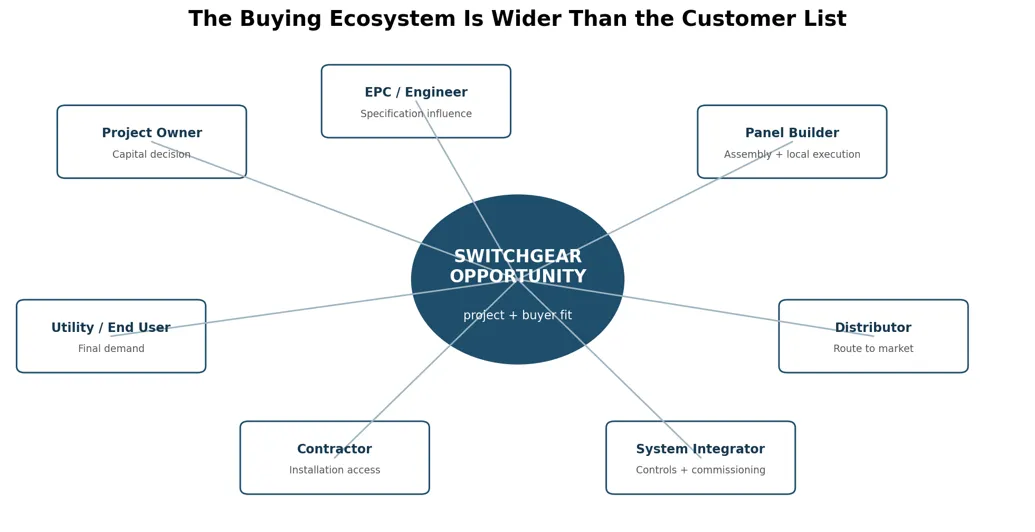
Switchgear is sold through an ecosystem, not a single buyer. A utility may own the project, an engineering consultant may write the specification, an EPC may run the tender, a panel builder may integrate the equipment, a distributor may carry the stock and an electrical contractor may control local execution. The account that signs the purchase order is not always the account that decides what gets purchased.
That is why a generic Top 100 electrical companies list creates activity without necessarily creating conversion. The commercial question is not “Is this company in the electrical industry?” It is “Does this company have a reason to influence or buy this switchgear package now?”
What a Qualified Switchgear Customer or Partner Actually Looks Like
| Qualification test | What to verify | Why it matters | Commercial signal |
| Product fit | Voltage class, AIS/GIS/RMU/VCB requirement, IEC specification | Stops irrelevant outreach | Active package matches your portfolio |
| Project access | Live utility, data-center, renewable, industrial or infrastructure projects | Creates a timing reason to engage | Tender, award or design-stage signal |
| Buying influence | Owner, EPC, consultant, panel builder, distributor or contractor role | Separates buyer from influencer | Named role in procurement path |
| Route-to-market fit | Local service, stock, assembly, approvals and coverage | Determines whether partnership is executable | Can close a geographic or service gap |
| Timing fit | Project energization versus current equipment lead time | Turns availability into leverage | Incumbent delivery date creates risk |
The Moment the Client Strategy Changed
Instead of asking, “Who are the switchgear companies in this market?”, we changed the question to: “Which organizations can help us reach a live switchgear requirement, and why?”
That changed the research sequence. We stopped treating company identification as a database exercise and started treating it as a commercial path-mapping exercise.
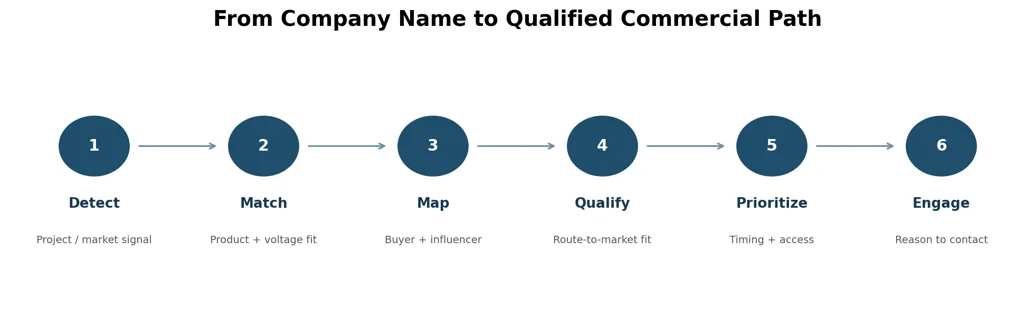
Step 1 - Start With the Project Signal, Not the Company Directory
A new substation, data-center campus, renewable interconnection, industrial expansion or grid-modernization program creates a more useful starting point than an industry directory. The project tells you where electrical demand is becoming real.
ElectroIQ tracks end-user projects across utilities, data centers, renewables, industrial facilities and infrastructure, then connects those projects to likely electrical-equipment packages and procurement milestones. That makes it possible to ask which switchgear class is relevant before deciding which accounts matter.
Check out how our ElectroIQ Project Tracker fits into your Sales Pipeline: https://www.datamintelligence.com/electroiq
Step 2 - Map the Buying Ecosystem Around the Project
For each opportunity, the client needed more than the project owner. The relevant map included EPC contractors, engineering consultants, panel builders, system integrators, distributors, electrical contractors and end users. Each plays a different role, and the outreach message must change with the role.
ElectroIQ Customer & Partner Identification is built around this distinction. It screens manufacturers, OEMs, EPCs, specifiers, distributors and end users against product compatibility, geography and project activity rather than presenting them as one undifferentiated list.
Step 3 - Use Lead Time as a Commercial Qualification Filter
Timing matters because a technically suitable account is not necessarily an urgent account. Your previously shared ElectroIQ benchmarks put average MV switchgear lead time at about 130 weeks, HV GIS at 72 weeks, HV AIS at 52 weeks, Siemens-apparatus LV switchgear at 54 weeks and general LV switchgear at 24 weeks.
That turns lead time into a prospecting signal. If a project needs energization before the incumbent supplier can deliver, alternate suppliers, approved panel builders and regional partners suddenly become strategically important. The lead-time gap is not only a supply-chain problem. It is a customer-acquisition trigger.
Understand how Lead Times are influencing Product sales with our ElectroIQ Lead-Time Intelligence: https://www.datamintelligence.com/blogs/electroiq-lead-time-intelligence-product-launch
Step 4 - Qualify Partners by What They Can Unlock
A distributor is useful if it opens local access, stock, service or approvals. A panel builder is useful if it can assemble, integrate or support a voltage class the client cannot efficiently serve alone. An EPC is valuable when it repeatedly influences specifications in the target vertical. A system integrator matters when protection, automation or commissioning is part of the package.
This is the switchgear equivalent of checking a type-test certificate against the exact configuration. The label is not enough. The evidence has to match the commercial need.
The Five Questions We Would Ask Before Putting Any Account Into Sales
- Is there an active reason to engage? Project, tender, expansion, retrofit, regulation or supply constraint.
- Does the company influence the right switchgear package? Voltage class, application and specification responsibility must match.
- Where does it sit in the buying chain? Owner, EPC, consultant, panel builder, distributor, contractor or integrator.
- Can it improve the route to market? Local approvals, customer access, service, stock, assembly or technical capability.
- What should sales do next? Contact, partner, qualify, monitor a milestone or wait until the project reaches a better stage.
What ElectroIQ Changes
The difference is not access to more names. It is the ability to connect four pieces of evidence in one workflow: where demand is emerging, which switchgear package is relevant, who can influence or buy it and whether the timing creates a reason to act now.
| ElectroIQ module | Question answered | Commercial use |
| Project & Tender Tracker | Where is switchgear demand becoming real? | Find projects before the RFQ is fully locked |
| Customer & Partner Identification | Who can buy, influence, assemble or distribute? | Build a qualified route-to-market map |
| Lead-Time Intelligence | Where is supply pressure creating urgency? | Prioritize accounts with a timing problem |
| Company Intelligence | Which competitors and partners are expanding? | Understand local capacity and channel gaps |
| Execution & Implementation | What should the team do next? | Turn the shortlist into outreach and partner actions |
A Better Demo Question
Most companies ask for a demo by saying, “Show me the platform.” A better way to evaluate ElectroIQ is to bring one real commercial problem into the session.
For example: “We sell 11-33 kV switchgear in two regions. Show us the projects where that product fits, the EPCs and panel builders around those projects, the likely customer path and where current lead times create an opening.”
That is the point of the platform. The demo should not end with more data. It should end with a shortlist of opportunities your commercial team can actually pursue.
Want to test the approach on your own switchgear portfolio? Bring your target geography, voltage class and ideal customer type. Request a personalized ElectroIQ demo and use the session to identify the customers, partners and live projects that fit your business.