


The Recycled Plastics Challenge: Why Food Grade Material Supply Is Becoming a Strategic Risk for Packaging Companies
Where is the Recycled Plastic Market Headed?
| Market question | 2026 Answers |
| Main constraint | Food grade recycled material is constrained by approved feedstock, food contact compliance, collection quality, bottle to bottle competition and price volatility. |
| Most exposed packaging type | Beverage PET bottles, food trays, rigid food containers and high barrier flexible food packaging face the greatest recycled content pressure. |
| Best positioned suppliers | Companies with access to clean bales, approved food contact recycling capacity, chemical recycling validation and long term brand offtake are best positioned. |
| Near term opportunity | rPET, PCR plastic, recycled polypropylene and sustainable flexible packaging suppliers can benefit if they solve quality, traceability and scale. |
Recycled Content Has Moved From Sustainability Target to Procurement Risk
Packaging companies are entering a more difficult phase of the circular packaging transition. Brand owners still want lower virgin plastic exposure, regulators are raising recycled content expectations and consumers increasingly expect packaging to show visible sustainability progress. The challenge is that food grade recycled material is harder to secure than ordinary recycled plastic because it must meet stricter safety, quality and traceability requirements.
Explore the Plastic Recycling Market to gain insights into recycling capacity, investment trends, regional infrastructure development, and emerging technology pathways shaping the future of the circular plastics economy.
This creates a new procurement reality. Packaging companies can no longer treat recycled resin as a tactical spot purchase. Food grade rPET, certified PCR plastic, recycled polypropylene and recycled flexible packaging inputs are becoming strategic materials that require early access, supply agreements and design alignment. The question for 2026 is whether packaging companies can secure enough compliant material before mandates tighten and buyers start competing more aggressively for the same clean waste streams.
DataM Intelligence's Sustainable Flexible Packaging Market report will help you assess flexible packaging redesign, recyclable structures, PCR integration and food packaging transition risks.
Food Grade Recycled Material Is a Different Market From General Recycled Plastic
The supply challenge is most visible in food and beverage packaging because recycled plastic cannot simply be collected, washed and used in direct food contact applications. Recycled content used in food packaging must pass approval pathways, contamination controls and process validation. EFSA notes that recycled plastic food contact materials can create health risks if contamination from previous use is not adequately controlled, which is why recycling technologies and material sources face greater scrutiny.
Explore the Recycled Plastic Market to assess growth opportunities across recycled PET, HDPE, PP, and flexible plastics, while gaining insights into packaging demand, circular economy trends, market dynamics, and future investment potential.
This means food grade recycled material is a narrower and more valuable market than broad post consumer recycled plastic. A packaging company may find recycled resin available for non food applications, while still facing shortages for beverage bottles, food trays, dairy containers or high barrier formats. The scarcity is therefore shaped by compliance and feedstock quality as much as by tonnage.Explore DataM Inteligence’s Post Consumer Recycled Plastic Market Report to understand PCR demand trends, certification requirements, adoption strategies, and regulatory developments shaping the future of recycled content in packaging.
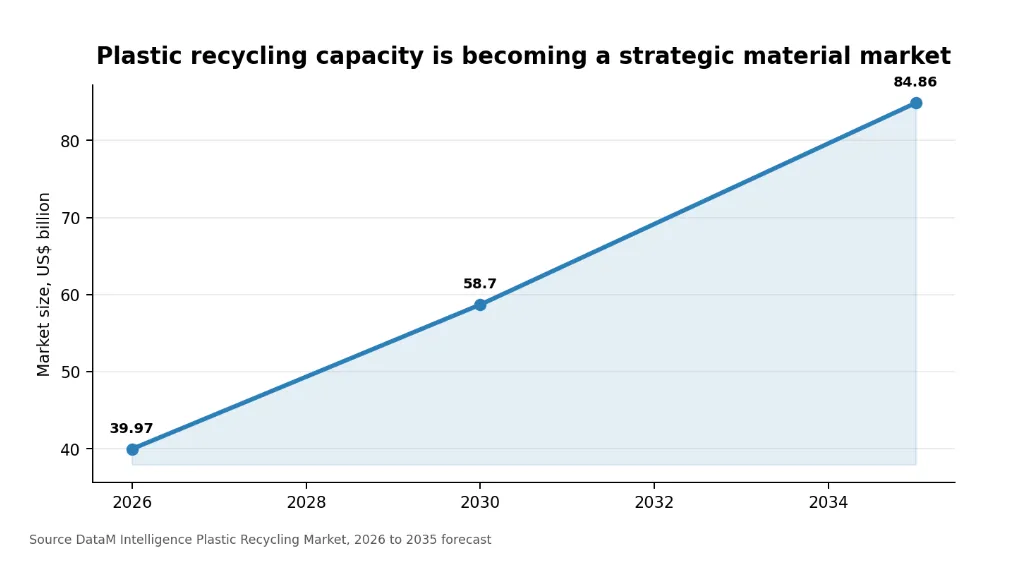
Plastic recycling is growing quickly, but food grade capacity remains a smaller and more technically constrained part of the market.
Regulation Is Pulling Demand Ahead of Available Supply
The recycled content challenge is becoming more urgent because regulations are pulling demand forward. The EU Packaging and Packaging Waste Regulation aims to make packaging recyclable in an economically viable way by 2030 and safely increase recycled plastics use in packaging. California already requires recycled content in plastic beverage containers, with 25% from 2025 and 50% from 2030 under AB 793. India has also moved toward mandatory food grade recycled PET use, with industry coverage pointing to a 40% recycled content requirement effective from April 2026.
Explore DataM Intelligence’s Recyclate PET Market Report to analyze market growth, recycling capacity, application trends, regional opportunities, and emerging developments shaping the future of recycled PET across packaging and circular economy industries.
These policies are important because they convert sustainability ambition into material demand. Once recycled content becomes a compliance requirement, beverage brands, food companies and packaging converters must secure approved feedstock regardless of short term price movements. That creates a stronger market for reliable recyclers, but it also raises the risk that smaller buyers are pushed out by large global brands with deeper procurement budgets.
India Shows How Quickly Supply Gaps Can Emerge
India is becoming a useful case study for the global recycled content challenge. Industry reporting indicates that food grade PET recycled content rules have unlocked investment in advanced recycling capacity, yet available approved capacity remains below the level needed to satisfy future demand. One industry estimate points to roughly 3 lakh tonnes of authorized food grade PET recycling capacity against a potential mandate need of 6.84 lakh tonnes.
The implication is clear for global packaging companies. Markets can move from under demand to shortage quickly when regulation, beverage growth and brand targets converge. Clean PET feedstock is also contested by textile, apparel, sheet, strapping and export buyers. Packaging companies that want bottle to bottle or tray to tray recycled content may need to secure feedstock access before those streams move into lower compliance applications.
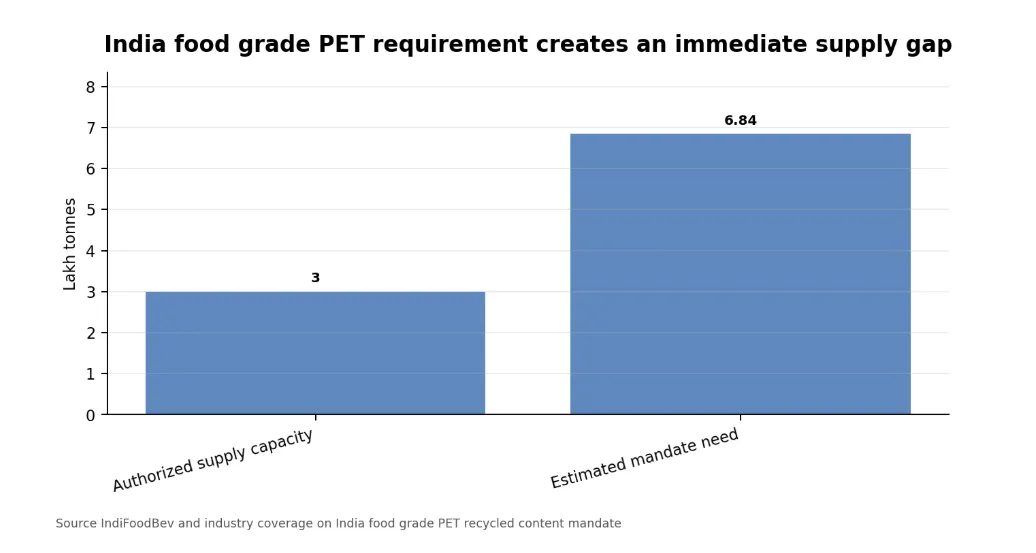
India illustrates how policy deadlines can expose gaps between approved food grade capacity and likely market requirement.
The Real Bottleneck Is Clean Feedstock and Approval Ready Processing
The biggest constraint extends beyond the number of recycling plants. The deeper issue is whether the input stream is clean enough, sorted enough and documented enough to support food contact material. Mixed plastics, colored PET, labels, adhesives, multilayer structures and contamination can reduce the share of collected material that becomes food grade output.
This is why bottle deposit systems, closed loop collection and high quality material recovery facilities matter. They improve bale consistency and raise the probability that recycled PET can return to food packaging. Packaging companies that rely only on open market feedstock may face higher price volatility, while companies that work with collection systems and recyclers can secure more predictable access.
Why rPET Is the First Battleground
rPET is the first major battleground because PET has strong food contact recycling pathways, high use in beverages and strong visibility in consumer packaging. Beverage companies need rPET to meet recycled content goals, while food tray and thermoform producers also want higher recycled content. This creates strong demand for clear PET bottles, which are the most valuable stream for closed loop recycling.
The risk is that bottle to fiber demand still competes with bottle to bottle recycling in several markets. If polyester fiber buyers pay aggressively for PET flakes, packaging companies may struggle to secure enough high quality material unless policy or commercial contracts reserve more feedstock for packaging circularity.
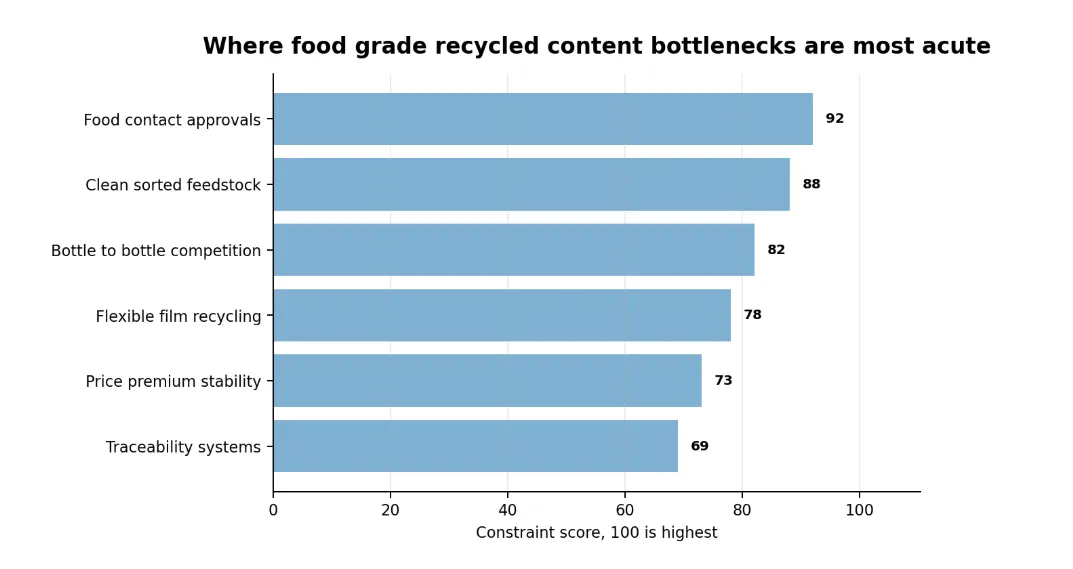
Food grade approvals and clean sorted feedstock create the highest friction points for recycled content adoption.
Flexible Food Packaging Faces a Harder Recycled Content Pathway
Flexible food packaging has a different challenge. It often uses multilayer structures, barrier materials and sealant layers that are difficult to recycle back into food grade applications. Even when recycled flexible plastic is available, it is often more suitable for non food applications because odor, migration, mechanical performance and contamination concerns are harder to control.
Flexible packaging still has a path into circularity. The economics will favor mono material design, improved sorting, compatibilizers, mechanical recycling for non food loops and selected chemical recycling pathways for food contact applications. Packaging companies that redesign flexible formats before regulation tightens can create a stronger advantage than those that wait for recycled resin supply to appear.
Recycled Polypropylene Will Be a High Value but Difficult Opportunity
Recycled polypropylene could become one of the most attractive packaging opportunities because PP is widely used in caps, closures, tubs, trays and foodservice packaging. However, food grade rPP is still more complex than rPET because the feedstock stream is more mixed and odor control can be difficult. DataM Intelligence projects the recycled polypropylene market to grow from US$ 5.26 billion in 2025 to US$ 24.1 billion by 2035, showing how strongly demand is expected to rise.
The companies that benefit will be those that can deliver consistent rPP grades with food contact suitability, odor control, color stability and traceable inputs. This could create premium opportunities for recyclers, resin compounders, packaging converters and technology providers that can improve PP sorting and purification.
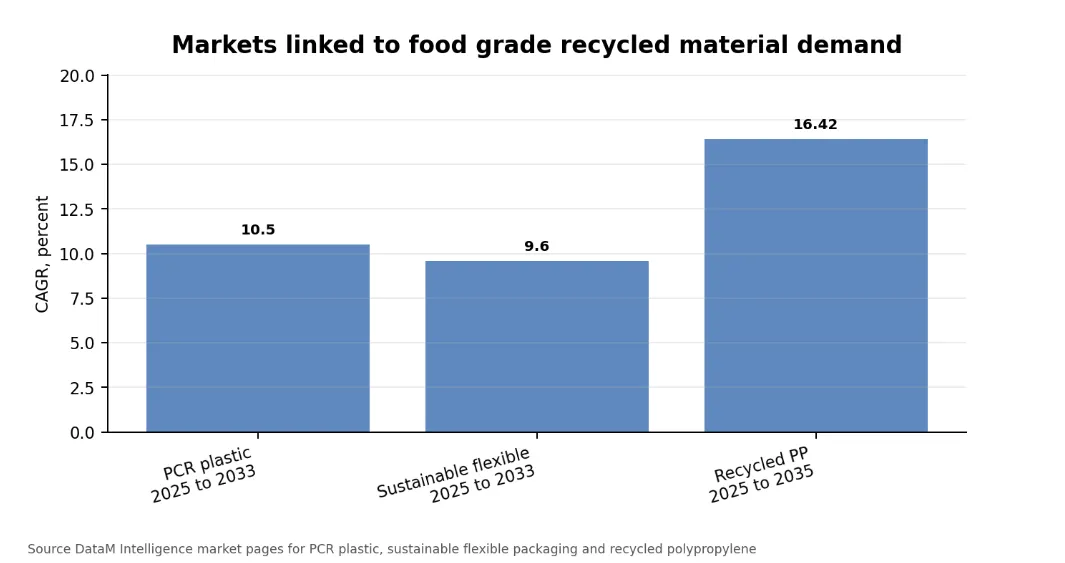
PCR plastic, sustainable flexible packaging and recycled polypropylene markets show where demand can expand as packaging mandates strengthen.
Chemical Recycling Can Help, but It Will Not Remove Procurement Pressure Quickly
Chemical recycling is often positioned as a solution for food grade recycled content because it can process harder to recycle streams and produce feedstock that may be suitable for new plastic production. It can support circular packaging where mechanical recycling faces quality limits, especially in flexible packaging and mixed plastic streams.
However, chemical recycling will not remove near term procurement pressure by itself. Projects require capital, permitting, reliable feedstock, energy inputs, offtake agreements and regulatory acceptance. For packaging companies, chemical recycling should be part of a broader portfolio that also includes mechanical recycling, packaging redesign, deposit access and supplier partnerships.
Who Benefits Most From the Recycled Content Challenge
The biggest beneficiaries are likely to be companies that control quality and access. Approved food grade PET recyclers can capture premium demand from beverage and food packaging buyers. Material recovery operators with advanced sorting can improve yield and capture higher bale values. Packaging converters with design for recycling expertise can help brands use recycled content without sacrificing performance.
Resin compounders and additive companies also benefit because recycled content often needs stabilization, deodorization, color management and performance improvement. Equipment suppliers that support washing, sorting, extrusion, decontamination and digital traceability can gain from capacity expansion. Brands with long term supplier agreements can protect compliance and reduce exposure to spot market volatility.
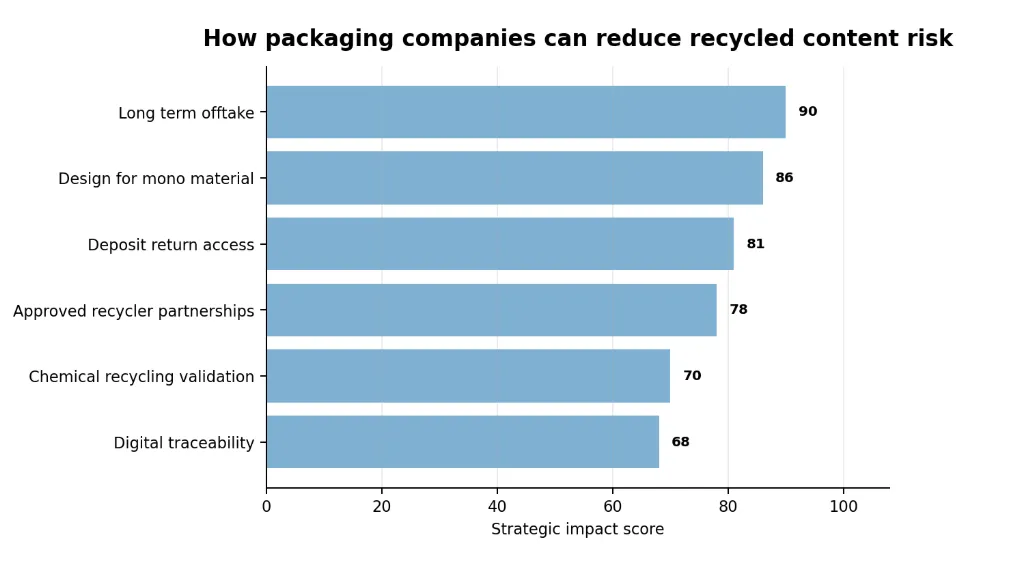
Long term offtake, mono material redesign and approved recycler partnerships are the strongest risk reduction moves for packaging companies.
What Packaging Companies Should Do Now
Packaging companies need a more disciplined recycled content strategy. The first step is to separate food grade requirement by resin, format and application. A beverage bottle, dairy tub, ready meal tray and flexible snack pack will not have the same recycled content pathway. Procurement teams should then map approved suppliers, technology status, compliance documentation and regional feedstock availability.
The second step is to redesign packaging around recyclability and recycled content compatibility. Clear PET, mono material structures, removable labels, compatible adhesives and simpler color choices can improve circularity economics. The third step is to secure long term offtake with recyclers or resin partners, especially in markets where policy deadlines are approaching.
The final step is to build traceability. Recycled content claims are becoming more regulated and more commercially sensitive. Companies that can document source, process, compliance and chain of custody will be better positioned with retailers, regulators and brand customers.
Market Outlook for 2026 and Beyond
The recycled content challenge will become a structural packaging market issue through 2030. Demand will rise because regulations, EPR schemes, brand commitments and retailer scorecards are moving in the same direction. Supply will expand, but food grade material will remain constrained because approval ready recycling requires cleaner inputs, better sorting, validated processes and stronger traceability.
Packaging companies that move early will secure better access to high quality recycled material. Companies that wait may face higher costs, reduced material choice and greater compliance risk. The strongest market opportunities will sit at the intersection of approved food grade recycling, high quality feedstock control, design for recycling and reliable conversion into packaging formats that can meet safety and performance requirements.