


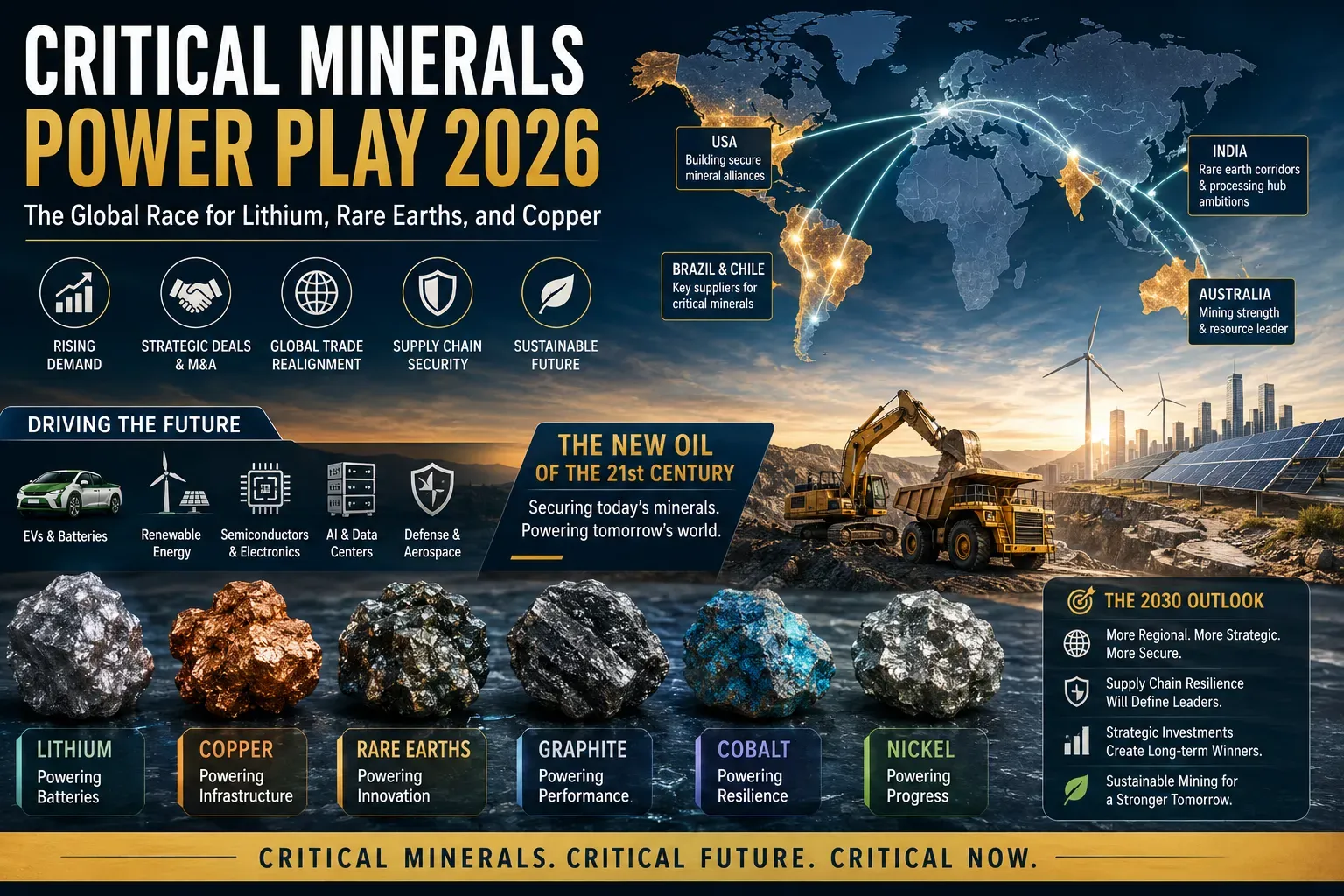
Critical minerals have moved beyond the narrow remit of mining and commodity markets. They are now a board-level issue for automakers, battery manufacturers, renewable-energy developers, data-center operators, defence contractors and industrial investors. This week's developments across rare earths, lithium, copper, cobalt and recycling show why: supply security increasingly depends on where minerals are processed, how materials are recovered and which countries control the strategic links in the value chain.
The most important signal is that the critical-minerals race is expanding. Governments are no longer focused only on discovering deposits. They are pursuing domestic processing, refinery capacity, battery recycling, offtake partnerships and new trade arrangements. Companies, meanwhile, are looking for qualified suppliers, more predictable prices and alternatives to concentrated supply chains. The following developments explain where the commercial priorities are shifting.
Request Sample: https://www.datamintelligence.com/download-sample/critical-minerals-market
India moves from mineral access to domestic processing
India is preparing measures to strengthen domestic processing of lithium and nickel, two materials central to EV batteries, energy storage and advanced manufacturing. The direction is commercially significant because mineral value is not captured at the mine alone. Lithium chemicals, nickel intermediates, cathode materials and high-purity products command far more strategic value than raw ore exports.
For international suppliers, the opportunity is not limited to selling material into India. It includes partnerships in mineral beneficiation, chemical conversion, recycling equipment, battery-grade testing, plant engineering and specialist logistics. For buyers, the policy reinforces a wider trend: countries with growing battery demand want a larger share of refining and component manufacturing within their own borders. Procurement strategies built entirely around exporting raw material to established processing hubs may therefore become less resilient.
Rare-earth diversification becomes an urgent European business issue
Rare earths remain one of the most concentrated parts of the critical-minerals chain. Neodymium and praseodymium are essential to permanent magnets used in EV traction motors, wind turbines, industrial automation and defence systems. Heavy rare earths are even more difficult to replace in high-performance applications.
European companies are intensifying their search for supply options outside China, with Brazil receiving renewed attention as a potential source of rare-earth concentrate and downstream material. This is not simply a question of finding another mine. Buyers need assurance that material can be separated, refined and converted into magnet-ready products at commercially viable cost and to the required technical specification.
The business consequence is clear: rare-earth supply agreements will increasingly be judged on traceability, processing route, qualification status and geopolitical durability. Companies that can offer an integrated mine-to-magnet proposition will have an advantage over those offering unprocessed concentrate alone.
Greenland raises the strategic value of Arctic mineral projects
Greenland is becoming a more visible part of the global rare-earth conversation. Its mineral potential, location and strategic importance have made it a focal point for U.S. and European interest. The renewed attention is driving investor interest in projects that could contribute to a more diversified supply base for rare earths and associated strategic metals.
However, businesses should treat Greenland as a long-cycle opportunity rather than an immediate supply solution. Mining projects need infrastructure, environmental approvals, community engagement, financing and credible downstream partners. The potential commercial value is substantial, but project schedules may be shaped as much by logistics and permitting as by resource quality.
For investors and buyers, the key question is whether a project has a realistic path through the entire value chain. Deposits alone are not enough. The strongest projects will secure processing capability, offtake commitments and clearly defined routes to end markets in Europe and North America.
AI could change the economics of rare-earth separation
Rare-earth processing is technically challenging and can be costly, energy intensive and environmentally demanding. New work involving quantum AI and automated chemistry is attracting attention because it may help identify better separation methods and reagents. If successful, these technologies could reduce processing-plant size, improve recovery efficiency and shorten the route from mineral concentrate to separated rare-earth oxides.
This is a significant development for the sector because processing is a major supply-chain bottleneck. A mining company can own a promising resource but still struggle to create strategic value without access to separation technology. Technology-led processing partnerships may therefore become as important as resource ownership.
Business leaders should track whether AI-enabled chemistry moves from research collaboration to commercial deployment. Early adopters could improve project economics, while technology companies may find new demand from rare-earth refiners seeking lower-cost, lower-impact processes.
Battery recycling shifts from sustainability story to supply strategy
Battery recycling is becoming a material component of critical-mineral security. Porsche's use of recycled lithium, nickel, cobalt and manganese in prototype battery cells illustrates the direction of travel: automakers want to recover high-value materials from end-of-life batteries and feed them back into new production.
The strategic importance is growing because recycled materials can reduce exposure to mining disruptions, shorten supply chains and support circularity requirements. But the challenge is scale. Effective recycling requires battery collection, safe transport, dismantling, black-mass processing, hydrometallurgical recovery and battery-grade quality control. Each stage needs investment and close coordination.
For battery manufacturers and OEMs, the near-term priority is to build partnerships with recyclers early, before end-of-life volumes become large enough to create intense competition for feedstock. For recycling companies, the opportunity lies in proving consistent recovery rates, traceability and quality specifications that allow recovered materials to qualify for high-value battery applications.
Copper demand gains support from grids and AI infrastructure
Copper continues to attract attention as power-grid investment, electrification and AI infrastructure expand. The metal is indispensable for transmission networks, transformers, electric vehicles, charging infrastructure, renewable-energy equipment and data centers. A sustained price rally reflects the market's focus on future supply adequacy as these demand channels overlap.
AI data centers add a new layer to the copper outlook. Their high power needs require investment in electrical equipment and grid connections, while the broader clean-energy transition increases demand for network expansion and grid modernization. The result is a demand profile that extends beyond conventional construction and manufacturing cycles.
Businesses should distinguish between headline demand expectations and deliverable supply. New copper mines face lengthy development timelines, capital intensity and permitting risk. Manufacturers dependent on copper should review hedging, supplier concentration and long-term contracting rather than relying solely on spot-market purchasing.
Battery-material pricing is moving in different directions
The latest market moves demonstrate why a single view of battery materials can be misleading. Lithium has rebounded after previous weakness, cobalt remains pressured and rare-earth prices continue to show volatility. Copper is gaining support from infrastructure demand, while other minerals can respond sharply to export controls, inventory shifts or changes in technology demand.
This divergence requires a more sophisticated procurement approach. Companies should not assume that an improvement in lithium availability means lower risk across all inputs. Nickel, cobalt, graphite, manganese, rare earths and copper each have different supply concentrations, processing dependencies and price drivers.
The practical response is mineral-specific risk management: identify critical grades, map tier-two and tier-three suppliers, assess substitution options, maintain appropriate inventory buffers and use long-term agreements where qualification periods are long. This approach is especially important in products where material change requires regulatory, safety or performance validation.
Brazil, Saudi Arabia and other emerging supply regions gain importance
Brazil is advancing its position as a future rare-earth and strategic-minerals supplier through new policy measures designed to support exploration, processing and investment. The country has large resource potential and is attracting attention from companies seeking diversified supply outside existing dominant regions. The value proposition will depend on whether policy support translates into projects that can meet international environmental, technical and delivery expectations.
Saudi Arabia is also expanding its minerals ambitions, including interest in uranium and heavy rare earths. Its broader industrial strategy could create demand for mining services, resource assessment, processing technologies and strategic partnerships. As with other emerging regions, investors will assess regulatory clarity, infrastructure, water availability, offtake arrangements and the timetable for commercial production.
These markets matter because diversification is becoming a commercial necessity. Yet businesses should avoid treating every new discovery as immediately investable. Resource announcements must be followed by verified grades, metallurgy, feasibility work, environmental approvals, financing and credible customer commitments.
Request for Customized Sample: https://www.datamintelligence.com/customize/critical-minerals-market
What businesses should do next
The current critical-minerals landscape rewards companies that act before a supply disruption occurs. The first step is to identify where critical materials enter the product portfolio and which minerals create the greatest operational or revenue risk. The next is to map the full supply chain-from mine and processor to component supplier and final assembly site.
Businesses should then test their exposure against several scenarios: export restrictions, processing outages, price spikes, delayed mine development, quality failures and changing local-content rules. In many cases, the most effective solution will combine long-term offtake, alternative supplier qualification, recycling partnerships and strategic inventory planning.
The winners in the next phase of the market will not necessarily be the companies with the largest mineral reserves. They will be the companies that can convert access into reliable, qualified and responsibly produced material. Rare earths, lithium and copper are no longer just inputs. They are strategic enablers of the energy transition, digital growth and industrial competitiveness.
Build a stronger critical-minerals strategy
Decision-makers need a view that connects supply availability with processing capacity, technology shifts, regional policy and end-market demand. A robust critical-minerals strategy should identify attractive supply partners, assess commercial and qualification risks, and clarify where investment or long-term contracting can create an advantage.
DataM Intelligence helps organizations evaluate critical-minerals markets, supplier ecosystems, regional opportunities and competitive developments to support more informed sourcing, investment and market-entry decisions