


Impact on Gabon production, offshore drilling schedules, jack-up risk and global oil & gas pricing
| KEY TREND | The Prospector 5 sinking is a material project and drilling-schedule shock for BW Energy and Gabon, but not a global oil-supply shock. |
| MARKET OUTLOOK | The immediate global crude-price effect should remain limited. The bigger consequences are delayed 2027 barrels, tighter jack-up availability, higher offshore risk costs and renewed scrutiny of geotechnical preload procedures. |
| RECOMMENDED FOR | Oil & Gas Operators, Offshore Drilling Contractors, EPCs, Investors, Energy Traders, Oilfield Services and Marine Insurers |
Request Sample: https://www.datamintelligence.com/download-sample/oilfield-services-market
DMI Analyst View
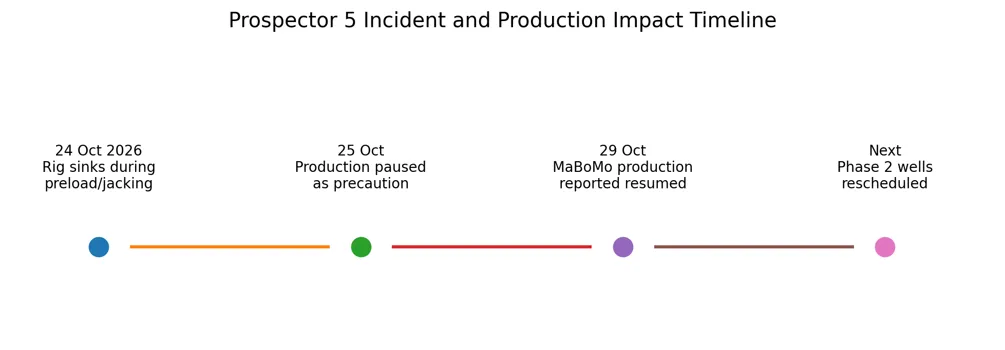
The sinking of Borr Drilling’s Prospector 5 on 24 October 2026 is a serious offshore operational incident, but its commodity-market significance needs to be separated from its project-level significance. The jack-up sank while conducting jacking and preload operations offshore Gabon ahead of BW Energy’s MaBoMo Phase 2 drilling campaign. Preliminary information from Borr Drilling points to a punch-through event that caused the rig to lose stability. The rig had not yet started the planned drilling campaign.
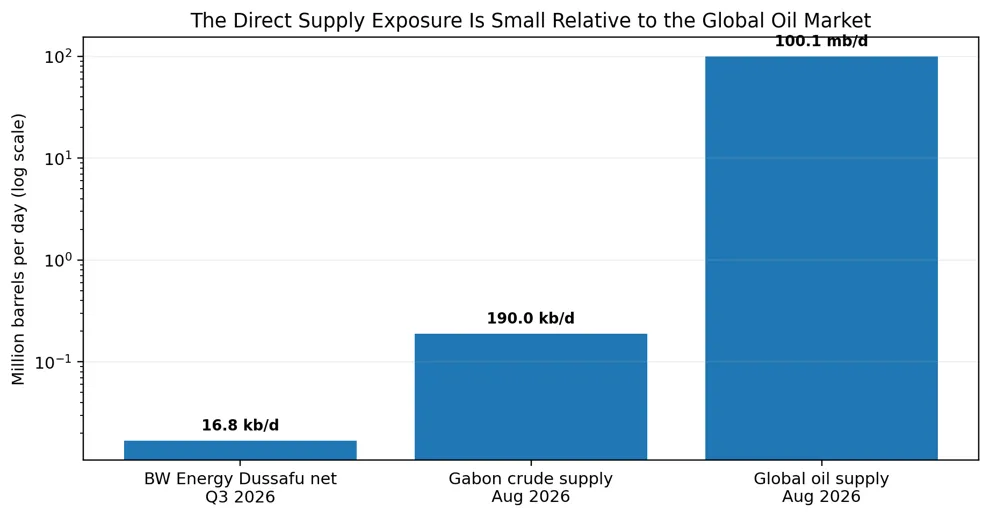
For global oil prices, the direct supply exposure is small. Gabon was producing about 190,000 barrels per day of crude in August 2026, compared with roughly 100.1 million barrels per day of global oil supply. BW Energy’s net Dussafu production averaged 16.8 kbopd in Q3 2026. MaBoMo production was temporarily shut down as a precaution after the incident, but BW Energy reported on 29 October that production had resumed. The incident therefore changes the timing of future barrels far more than it changes current global supply.
The more important impact sits in offshore development economics. MaBoMo Phase 2 is now delayed while BW Energy reassesses the remaining well program and replacement drilling arrangements. That creates additional rig-mobilization, scheduling, insurance, geotechnical and potentially service-cost exposure. It also matters for Gabon because the country’s production base is comparatively small, making individual offshore projects more important to national output growth than they are to the global balance.
Source: IEA Oil Market Report, September 2026; BW Energy Q3 2026 report
Request a Customized Report According to Your Business Strategy: https://www.datamintelligence.com/customize/oilfield-services-market
What Happened to Prospector 5?
Prospector 5 is a Friede & Goldman JU-2000E high-specification jack-up built in 2014. The unit is rated for water depths of up to 400 feet and drilling depths of up to 35,000 feet. It began operating for BW Energy in Gabon in July 2026 under a contract running to July 2027, with an extension option.
During preload activities on 24 October, the rig experienced a loss of stability and sank off the coast of Mayumba. Borr Drilling’s preliminary description identified a punch-through event during preload. At the time of the incident, 115 people were onboard. Search-and-rescue operations followed, with fatalities and missing personnel subsequently reported by Gabonese authorities and Reuters.
BW Energy initially shut production at the nearby MaBoMo facility under standard procedure. The company said there was no reported damage to the production facility or related equipment and no harmful discharge from the facility. By 29 October, BW Energy said MaBoMo production had resumed, while the drilling schedule and 2027 production impact remained under assessment.
Source: Borr Drilling; BW Energy; Reuters
Why the Incident Is Unlikely to Move Global Oil Prices on Its Own
The key reason is scale. Even if the full Dussafu production stream were unavailable for a period, the volume would still be small relative to the global market. Gabon’s entire August crude production represented about 0.2% of global oil supply. BW Energy’s Dussafu net production represented only a fraction of that.
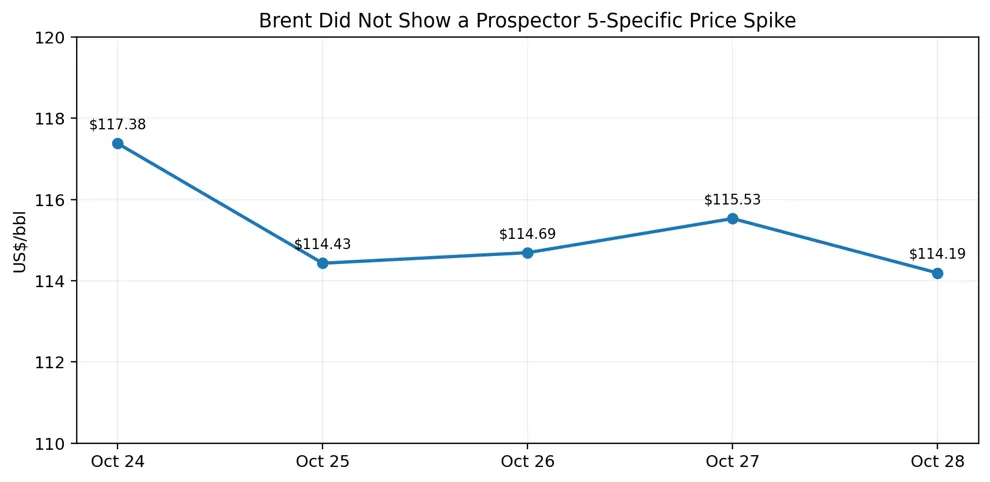
The market reaction around the incident supports this interpretation. Brent prices did not show a sustained Prospector 5-specific spike after 24 October. Available daily data show Brent around $117.38/bbl on October 24, $114.43 on October 25, $114.69 on October 26, $115.53 on October 27 and $114.19 on October 28. In other words, prices moved within an already volatile market shaped by much larger geopolitical and supply factors.
That is especially important in 2026, when the global oil balance is already being driven by Middle East disruptions, lower Gulf output, refinery outages, inventory draws and broader geopolitical risk. Against that background, a Gabon drilling-rig loss is not large enough to become a primary global price driver.
Source: Thinking on Energy / OilPriceAPI daily Brent data; event date from Borr Drilling
Request Sample: https://www.datamintelligence.com/download-sample/oilfield-services-market
The Global Gas-Price Impact Is Even Smaller
Prospector 5 was supporting an offshore oil development program rather than a material LNG-export system or globally important gas-production hub. No major gas-export infrastructure was taken offline by the incident. As a result, the event does not remove enough gas from Atlantic Basin or global LNG supply to create a direct Henry Hub, TTF or JKM price shock.
Any gas-price effect would therefore be indirect. If the incident contributes to tougher offshore engineering standards, higher insurance costs or slower jack-up deployment across West Africa, it could raise marginal development costs for future offshore projects. That is a multi-year capital-cost effect, not an immediate global gas-price shock.
The Bigger Risk Is BW Energy’s 2027 Production Timing
BW Energy’s Q3 2026 update makes the project-level impact much clearer. The company said the Prospector 5 incident affects the timing of MaBoMo Phase 2 barrels and that it is assessing the drilling schedule and 2027 production outlook. The company suspended its prior 2026 capex guidance of $600-650 million while the well program is being rescheduled.
The MaBoMo appraisal campaign had also added an estimated 8-9 million barrels of recoverable volumes supporting two planned production wells. Those barrels have not disappeared, but their delivery timeline is now less certain. BW Energy says it intends to incorporate the remaining wells into the wider Dussafu drilling program and still maintains its target of more than 100 kbopd of company production in 2028.
This is the central distinction for investors: the incident is primarily a deferral event rather than a reserve-destruction event. That is why the equity impact can be much larger than the commodity-price impact. BW Energy shares fell sharply after the accident even though global crude supply was barely affected.
For Gabon, the Incident Matters More Than It Does for the World Market
Gabon’s crude production is only around 0.19-0.23 mb/d, depending on month and source. That means new offshore wells can have a visible effect on national production growth, fiscal receipts and upstream investment. A delay to a multi-well campaign therefore matters more to Libreville than it does to global balances.
The Dussafu licence covers an 850 sq km offshore area and BW Energy holds a 73.5% operated interest, alongside Panoro Energy at 17.5% and Gabon Oil Company at 9%. BW Energy’s phased-development model has made Dussafu one of the more important sources of incremental output for Gabon. A replacement-rig delay therefore shifts the timing of national production growth even if current field production resumes quickly.
The Jack-Up Market and Offshore Cost Base Could Feel a Larger Secondary Effect
Prospector 5 was a modern high-spec jack-up with a contract extending to July 2027. Replacing a unit of that capability requires more than simply finding another idle rig. The replacement must be technically compatible with the field, available in the right region, mobilized to Gabon and accepted through operator and regulatory processes.
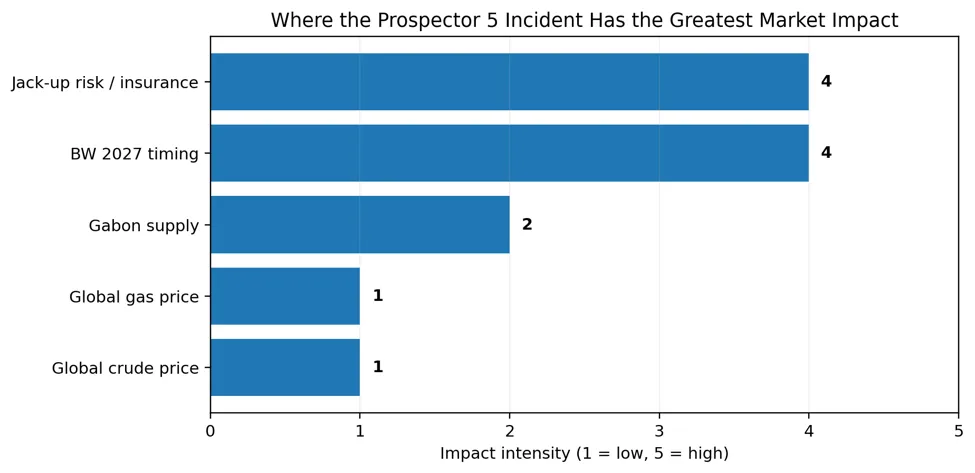
That creates several secondary effects. Replacement demand can tighten West African jack-up availability, increase mobilization costs and raise dayrate leverage for suitable units. Operators may also add more extensive geotechnical, preload and site-assessment requirements after the incident. Insurers and lenders could reassess exposure to jack-up installation risk, particularly in locations with challenging seabed conditions.
These costs will not immediately reprice global oil. However, if replicated across multiple projects, they can increase the marginal cost of bringing offshore barrels online. The result is a small but real upward pressure on future offshore development economics.
Source: DataM Intelligence assessment based on BW Energy, Borr Drilling and IEA data
Request a Customized Report According to Your Business Strategy: https://www.datamintelligence.com/customize/oilfield-services-market
What Would Be Required for Prospector 5 to Become a Global Price Event?
The incident would need to trigger a broader chain reaction rather than remain an isolated rig loss. Three scenarios would materially change the global-market interpretation.
| Scenario | What Would Change | Potential Price Relevance |
Extended Dussafu shutdown | Current production, not only future drilling, remains offline for a prolonged period | Regional/Gabon impact, still limited globally |
Broader jack-up safety stand-down | Multiple offshore campaigns are paused for inspection or regulatory review | Could tighten future offshore supply and service costs |
Environmental or infrastructure damage | A spill or damage forces wider field shutdowns or regulatory restrictions | Could raise regional risk premium and delay additional barrels |
What Oil & Gas Companies Should Watch Next
The most important next datapoints are not daily Brent moves. They are BW Energy’s replacement-rig plan, the revised MaBoMo Phase 2 drilling schedule, any change to 2027 production guidance, the outcome of the technical investigation and whether regulators impose additional jack-up site-assessment or preload requirements.
For drilling contractors, the event is going to increase the commercial value of available high-spec jack-ups in West Africa. For operators, it reinforces the need to map rig availability, backup drilling capacity and critical-path offshore equipment before sanctioning production schedules. For investors, the incident is a reminder that project execution risk can materially affect company-level value even when global commodity markets barely move.